Showing posts with label Fort Benton. Show all posts

Saturday, November 14, 2015

FRONTIER RELIGION

Fort Benton, Montana

I suppose I won’t closely review every chapter in “Whoop-Up Country” but it has enough thoughtful detail that a person of more current theories can find it useful to reflect on this Fifties material.  The chapter called “Chicago of the Plains” is a good example.  If you’ve ever been to Fort Benton, you’ll realize that it’s an hour’s drive (in a modern car) out onto the grain flats of Montana until you unexpectedly come to a valley created by the farthest reaches of the Missouri-Mississippi headwaters.  It was this system, reaching all the way down to New Orleans, that made the citizens have fantasies of becoming Chicago.

In fact, it was a landing platform made of gumbo whose front street along a “fort” not intended for war (much of it was adobe) had been stripped of trees by the need for firewood.  It was the Blackfeet agency (constantly contentious until it was moved north), a center for Fenian plotting, and a boomtown made of wood that easily burned.  It was racist against Indians, Chinese and African-Americans.   When the “fort” aspect was abandoned and the land, which was adjacent, offered for homesteading, people were so avid for land that they forgot to survey streets and so alert to defend their boundaries that they built fences everywhere, so that it was a puzzle to get around from one building to another.  But the townspeople remember those days with nostalgia and include many historians.

Commodities out, coal or grain back to town.

Sharp is interesting on the subject of religion.  Most people think of it as missionary work, which is fair enough, and split into two camps: protestant and Catholic, united by their belief that Indians would appreciate missionary work because it was the key to civilization.  They forgot that the Indians already considered themselves civilized on their own terms and that religious notions from European villages weren’t helpful on the open prairie.  But Sharp does realize -- as many do not -- that life on the trail is so different from small-town life that once adjusted to one (small town churches with music and steeples) or the other (nights sleeping under a wagon, days struggling with the land and animals) a person was restless in the alternative.  The trade-off was security and social relationships versus freedom and an emotional connection with existence.  

Demographics of “kind,” status and identification, probably had less importance that the simple population numbers.  Living someplace with few people is quite different from clustering, whether it is Fort Benton or Chicago.  In fact, big cities usually form internal neighborhoods about the size of a small town.  The government back east had no consciousness of this kind of thing, so their idea about religion is to “make the Indians be like us.”  Therefore, they wanted churches.  And denominations.  The Catholics, controlled from Rome, evaded these ideas, but the government thought the Methodists, among others, might be the solution to “primitive savages” and corrupt agency employees.  They turned out to be just as corrupt as anyone else.

Charlie Russell's version of Brother Van.
I don't know how much fantasy or teasing was involved.

Brother Van (1848-1919), a robust Methodist clergyman with a wonderful singing voice (I wish there were recordings!) arrived in Fort Benton on a steamboat, crossed the gumbo front street  that added fifty pounds to each foot, walked into the closest drinking establishment (a close relationship between spirits and The Spirit), and began to organize a church service.  It was very welcome.  Encouraged, Brother Van extended his message and methods to the indigenous people.  That didn’t work out and he soon declared that the whites needed religion, especially moral guidance, more than the tribes did.  From then on he worked the small towns and the trails between them.  He hitched rides, slept with the families, ate at their tables, and preached in their churches.  

My favorite Brother Van story is an episode where he walked into a town and found it seemingly deserted.  He’d been singing as he went and continued to do so.  As he entered the dusty streets, the townspeople -- hiding on roofs and behind barrels -- gradually realized who he was.  They had been notified by telegraph that a murderer was headed their way and they should prepare.  The sound of familiar hymns was a huge relief and Brother Van ate well that night.


Dendermonde city hall

Father DeSmet (1801-1873) was an earlier Jesuit missionary.  He was born in Dendermonde, now in Belgium.   In 1821 he came as a novice to establish a school in Maryland.  Between 1833 and 1837 he was back in Belgium recovering his health.  When he returned to the US, he helped to map the whole Upper Midwest, which noted the locations of the Native Americans villages.  Those tribes had true towns because they were based on agriculture and trade rather than hunting buffalo, so his ideas about gathering all indigenous peoples in villages were not unreasonable against that background.  He just didn’t understand life on the trail could be religious, even though he was actually a “man of the trail,” shaped by the experience.  In the end he died in St. Louis.  It would not be too far wrong to characterize Fort Benton as the “St. Louis of the Plains,” a trading post town, a point of debouchement in a wide unknown world, an intermodal hub between water and land travel.

No matter, the Catholic love of material symbols and complex mythic systems fit much better with the Blackfeet love of necessarily portable religious objects, though they understood them in a near medieval way, a form of magic efficacious in hunting and war.  It was a complication that first contact with Jesuits came from the Flathead Valley rival tribes in a fertile place where crops could thrive.  The other similarity to medieval religion was the importance of seasonal festivals that brought everyone together to reinforce ceremonies of unity.  

Dendermonde, DeSmet’s hometown, also began as a fort, eventually chartered as a town in 1233.  The economic foundation was making cloth, probably because of water wheels on the river that would power factories.  The fortunes of the town included many invasions and treaties, the worst being the destruction from WWI.  DeSmet was particularly helpful in persuading Sitting Bull to consider a treaty.  [Totally irrelevant is the 2009 event of an insane 20-year-old man who stabbed to death little children in a nursery in a wild attack, except that when one googles Dendermonde, the story is retold and retold.  I am writing this the day after the Paris atrocity.]

Father DeSmet

DeSmet was not of the religious kind to oppress and punish anyone.  He tells in his diary about befriending two feral dogs, one of them half-coyote, and taking them food.  He says that if he took his gun out to walk on the prairie, presumably hunting, the dogs would go with him.  Then one day a wolfer left poisoned meat where DeSmet had left food and the dogs died in agony.  I suspect the thought occurred to him that wolfers were the Devil’s disguise.  But what tortured him was the idea that if he hadn’t accustomed the dogs to him leaving food in a certain place, it wouldn’t have been so easy for the wolfer to do his evil work.

These two men were very different, one (Brother) the hearty American Methodist guest in the white towns, and the other (Father) the international mapper and generous observer on the trail, but that’s the main thing about the settling of the West -- it took many kinds of people.  If they weren’t dedicated and tough, they didn’t last long.  At least this is the story they tell now.
.  
Father DeSmet died in St. Louis.  Brother Van is buried in Helena.  Neither married.  Ellen Baumler tells the story of Brother Van's broken heart.   Whether it is a cover for something else has never been considered.   http://ellenbaumler.blogspot.com/2012/02/brother-vans-love-story.html


Monday, May 05, 2014

"THE FAR-OFF WILD LAND: The Upper Missouri Letters of Andrew Dawson"


This is Tom Dawson, Andrew's son.  
The coonskin cap was out of the artist's trunk of special effects.  
He never wore such a cap.

Andrew Dawson (1820-1872) is not on Wikipedia.  Lucky him!  Known as the last “King of the High Missouri,” he was a key fur trader and an excellent example of Jim Webb’s tall, red-headed Scots who built this nation.  What I knew about him until this excellent biography was mostly about his son, Tom, who married Isabel Clarke and settled in East Glacier on the Blackfeet Reservation.  Someone needs to follow up on the idea that the east slope of the Rockies since Lewis and Clark has been settled in large part by “Celtic” whites with their love of a challenge and determination to make things work.  Their style, which was resistant to top-down governance and appreciative of wilderness, meshed well with the pre-existing Blackfeet world, even as it helped to destroy it.  Tom and Isabel's adopted daughter, Helen, was known to the granddaughter of John Clarke the woodcarver as "Aunt Helen."  Helen Edkins is still well-remembered by living people.  (She is not the same as Helen Clarke who also lived there and is buried there.)  This is a "local" story.

Here is the live webcam going into East Glacier from the East.  The bridge is a new rebuild.

First, I want to make a bit of a time-line as I find that this high east slope area is so much later in development than either the East or the Pacific Coast that I lose the relationships among them.  The dates are mostly based on “This Far-Off Wild Land: The Upper Missouri Letters of Andrew Dawson,” by Lesley Wischmann and Andrew Erskine Dawson.  Wischman is also the author of “Frontier Diplomats”, the story of Alexander Culbertson and his Blackfeet wife, Natawista.  Culbertson was the immediate predecessor and guide of Dawson.  Andrew Erskine Dawson, the collateral great-nephew, had his ancestor’s letters, which make up half of this book.  These Scots had been educated and because Dawson valued his family so much, he wrote many letters.  And because the family valued Dawson, they saved them.

Grace Scott Dawson 1794-1859
Dawson's beloved mother

1804-1806  The Lewis and Clark expedition.  Several Blackfeet boys killed by the expedition.
1808   John Jacob Astor founds the American Fur Company.
1820  Dawson is born in Dalkeith, Scotland, seven miles from Edinburgh.
1822  Ramsay Crooks establishes the St. Louis office of the AFC.  Ownership shifts from man to man and from good fortune to setbacks -- then good luck again.
1835  Crow siege of Fort McKenzie under Culbertson, which the latter ended with conciliation in spite of his own blood-thirsty crew.
1839  Culbertson sends Malcolm Clarke to be in charge of Fort Benton when he's not there.
1840  Back in Scotland, the young Dawson qualifies as a professional accountant but doesn’t “stick” and becomes unemployed.  What he really wanted to be was an ornithologist and he was an admirer of Audubon.  His embarrassed family pressed him to find a place in the world that would yield an income. 
1842  Andrew Potts, owner of the Edinburgh bookstore where Dawson often hung out, had gone to the American frontier, so his brother, still in Scotland, vouched for Dawson by writing to Kenneth McKenzie, a fur trader. Just then Andrew Potts was killed at Fort McKenzie, commanded by Alexander Culbertson.  It was a mistaken murder, but led to a deliberate and murderous retaliation that prevented safe dealing with the Blackfeet.
1844  Dawson arrives from Scotland.  At about the same time Chardon and Harvey arranged a revenge at Fort McKenzie that made trade with Blackfeet impossible for years.
1847  Dawson reaches the upper Missouri.  Part of his preparation was learning to ride a horse.
1847 - 1854  Dawson is at Fort Berthold and Fort Clark, located near the Mandan, Hidatsa, Arikara complex that had been a major trading hub but had been nearly wiped out by a smallpox epidemic in 1837.  The settlement was vulnerable to the steamboat passengers and crew who were vectors for deadly diseases.
1851  Marriage to the widow of a friend, Josette Garreau Desautel, because of the deathbed wishes of the friend.  He was also looking out for Jerry Potts because of friendship with his father.
1852  Birth of an outside-marriage child, Andrew, as well as his son James with "Kuta", as Josette was called (As well as "Mary.")  Their daughter was named Grace.
1854  Dawson moves to Fort Benton as the new factor.   This is the same year as another incident when hungry tribes were gathered to wait for their late commodities near Fort Laramie.  They killed and ate a lame cow belonging to a wagon train, which kicked up another dangerous fracas.
Clarke is very angry at being passed over and soon quits the company.    Dawson is popular and as a surrogate agent becomes involved in Indian allotments and gold strikes.  He helps to develop the Mullan Road that breached the Rockies before Isaac Stevens showed the railroad how to cross through Marias Pass.  In this period the steamboats were finally able to get as far as Fort Benton.  In short, he's a success.
1855  The Blackfeet treaty (Lame Bull)
1858  Rising in the night without a light, Dawson falls through the open trap door that leads to the space under the floor and breaks his back.  He survives but is crippled.  Heavy drinking was probably involved both before as a cause and after as a pain-killer.
1859  Thomas Erkine Dawson, Sr. is born.  His mother is Pipe Woman or Mary Fisher, Dawson's second wife.
1861- 1865  The American Civil War
1864  The upper Missouri fur trade essentially ends when Dawson retires back to Scotland.  This is the year that the Montana Territory was defined and legalized.
1870  Baker Massacre (which has several names) in retaliation for the murder of Malcolm Clarke, which was evidently due to old grudges from his Fort Benton days.  At the time of his killing he was living on a ranch near Helena.  It was a mistaken attack that killed friendly people.
1872  Death of Dawson back in Scotland.
1876  Battle of the Little Bighorn/Battle of the Greasy Grass
1885  The end of the buffalo
1889  Montana becomes a state.
1890  The Wounded Knee massacre

This fort has been reconstructed and part of it is an art gallery displaying the work of Bob Scriver.

The dynamics of Dawson's promotion to the head of the Fort Benton trading post are intriguing. Culbertson made the decision, but he had earlier sponsored Malcolm Clarke and had sometimes left him in charge of the Fort.  From Clarke's point of view, he had been doing this job for fifteen years and expected promotion.  Probably it was his temperament that disqualified him.  In a few years it provoked his murder, which triggered the "Baker Massacre."

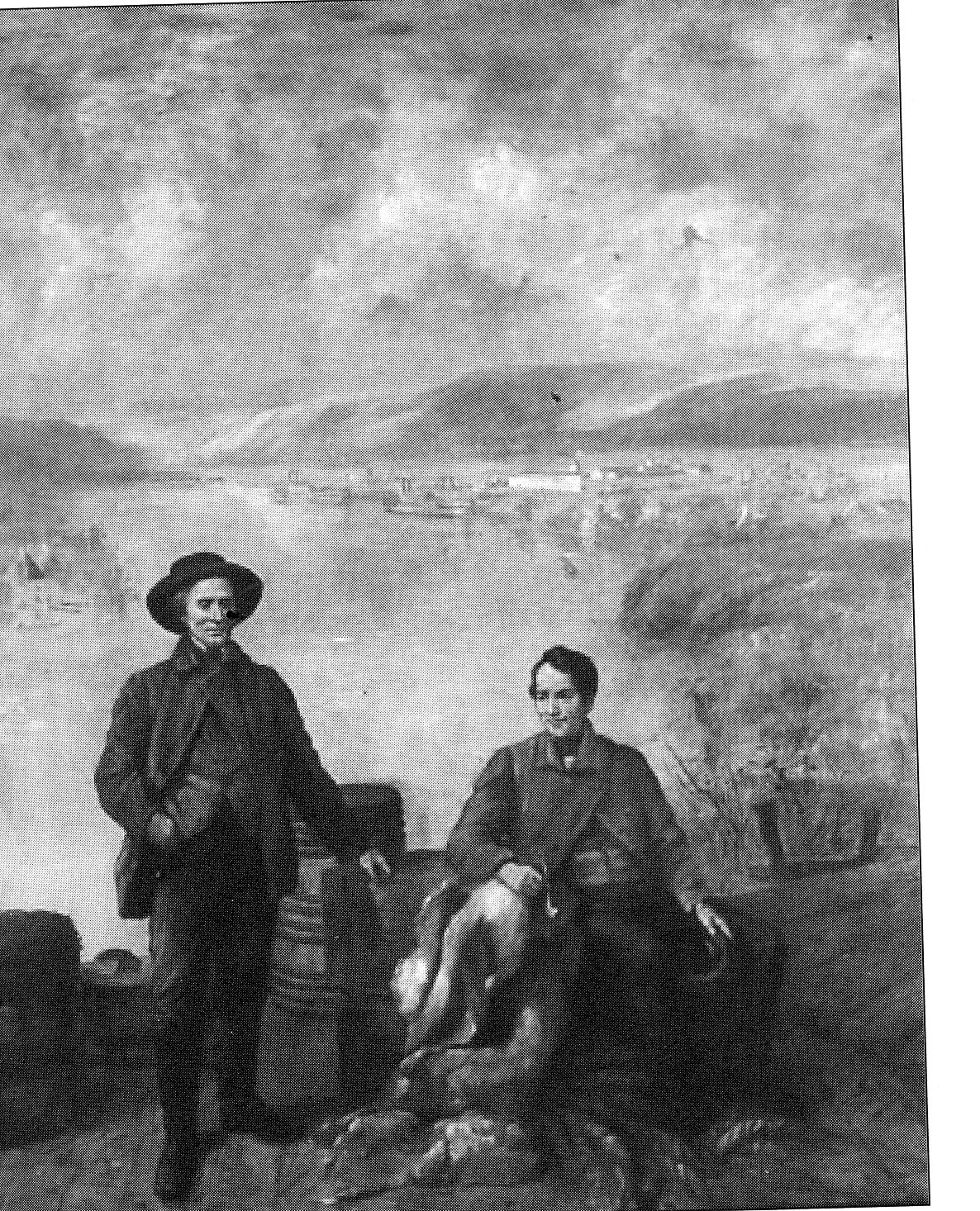
A fantasy vignette of Dawson (R) and Chouteau in front of Ft. Benton.

But there was an earlier episode, worthy of Game of Thrones.  In 1835 Alexander Harvey, another frontier hothead, had been frustrated by Culbertson's insistence on negotiating with the Crow at the siege of Fort McKenzie instead of using violence.  Harvey and Culbertson were barely restrained from violence between them by Pierre Chouteau, Jr. the company owner.  When Culbertson was away from Fort McKenzie, Chardon -- yet another drunk and hothead -- was sent to take over.  In January 1844 twenty Blood warriors came to the fort but were not admitted.  They were angry, killed livestock and then left, but Chardon and Harvey chased them.  The warriors set their trap first: Chardon's slave, Reese, was sent to reconnoiter from a hill.  He was shot in the head and died instantly, then was scalped, much grieving Chardon.  

Chardon and Harvey's trap was to aim their loaded cannon at the front gate, where the tribe customarily would gather while the chiefs came inside to negotiate.  Not only would they kill the chiefs once they were inside, but also they would fire the cannon through the open gate to kill as many as they could.  Then they could take all the furs as well as keeping the trade goods.

Soon enough a Northern Blackfeet party (who had no relationship with the previous attack) arrived and the machinery began to work.  The plan suffered when the chiefs sussed the plot and tried to escape, which made the people scatter but not fast enough.  Women and children were killed along with others, and the traders did acquire a lot of buffalo hides.  But that was the end of trade with the Northern Blackfoot for a long time.  Dawson was big, fire-haired, but much more patient, and certainly fair-minded. In the end he coaxed them to return. 

This is Jerry Potts' family.
The Bundles on the tripod are Sacred Calumets and their accessories.

Dawson's Blackfeet wife was called Kuta, and their children were James and Grace.  He also had a "wood's colt" whom he nevertheless watched out for, and a second marriage after Kuta died, to Pipe Woman, daughter of Running Fisher, produced a third son, Thomas Erskine Dawson in 1859.   Because of friendship with the father of Jerry Potts, he had taken that boy under his wing.  Through his wife he had ties to Little Dog, the same as Clarke had ties to Mountain Chief.  Family had big consequences for everyone.


Jerry Potts became famous as an interpreter and negotiator.

The problem with steam boats was not so much the boats as the notorious Missouri River, which changed channels, floated whole trees, emplaced sand banks and then removed them overnight, was deep and then shallow.  To make the steam, the boat had a heart of fire that sometimes escaped control.  Like the later railroad, the steamship companies saw the advertising advantage of subsidizing artists, scientists and noblemen.  Among them was Audubon, so Dawson got to meet his hero.

Most of these Scotsmen who came to work for the American Fur Company or had intersected with them in some way back in Scotland, formed a friendship network that was sometimes strained by violent temperaments that triggered outbursts from the indigenous people.  Many of the men had indigenous wives, whom Andrew claimed they loved and supported, as well as each other's children.  Indeed, Andrew himself had lost his father when he was eight and had been protected and guided by a friend of the family.  In the tribal world, uncles also took responsibility for children and widows.

There were times when Andrew was facing atrocities as ferocious as any in today's Africa -- mutilation, dismemberment, cannibalism.  He settles the dog-eating question once and for all:  everyone ate them and they were objectively tasty and tender.  Esp. if you didn't know what they were.


Andrew Dawson, back in Scotland for his last years.

This is a very careful work of scholarship on both the main narrative and the edited letters.  But it is also a roaring and amazing tale that only happened a century or so ago.  It is still just under the surface all the time around here.

NOTE:  I am not so careful as the authors and tend to conflate Culbertson and Dawson.  With Lesley Wischmann's help, I've made corrections after the first version.


Friday, August 27, 2010

PAST/FUTURE -- PASSIVE/ACTIVE: FORT BENTON

Sometimes the most subtle shifts have the most impact in the long run. I’m thinking about the shift from watching television to using a computer, which appears to be the same but is radically different. A television is a passive instrument: your only choices are on/off/change-channel. A computer is active: your choices are unlimited whether you are writing something, building database, or prowling the internet. A gameset is in between: you are acting voluntarily in a choice of ways within a limited context.

With that in mind, this is a story about books. Someone sent me an email saying they had been to Fort Benton, a wonderful (truly!) old (OLDEST) Montana town, and had been in a bookstore where they were told that “Bronze Inside and Out” was no longer available. EAACCCAKKK!!! I called a museum bookstore down there. (There are about four.) The girl said she had never heard of the book and there was no bookstore in town either -- just a little shop with a collection of old junk with one shelf of strange books. On Friday I nailed the Fort Benton contingent at the history seminar about the elusive bookstore and they assured me it was a MAJOR and ADMIRABLE -- in fact, STUNNING -- bookstore with terrific treasures all through it. I called there and got a very evasive owner. So I saddled up and went to scout yesterday. I like to see the whites of their eyes.

The little junk shop with a few books was there. Pretty good stuff, I thought. The guy is actually a saddlemaker and works in the back. He knew about the other bookstore: Riverbreak Books and Gear, 808 17th St., 406-622-5816. Tom Carrels, owner. It was indeed a terrific bookstore -- not just that. Zillions of hats and other outdoor kinds of stuff.

Some people will recognize this boomer life trajectory: South Dakota boyhood in Aberdeen; Missoula in the Seventies studying wildlife and landscape; then U Dub for a slightly more sophisticated degree, last ten years in Alaska. (Anyone know what ever happened to Jay Vest? Neither of us did. Last night I googled him. He’s a professor in North Carolina publishing books about Blackfeet, like, yetanother set of Napi tales.) Carrels has bought this historic two-story riverfront building and will create a hostel upstairs. His ideas are sound IMAO: not just history but also geological adventures on the river and surrounding land. Not just folks driving out from Great Falls for supper (it’s about thirty miles and there are good places to eat) but European backpackers and Calgary empty nesters in RVs. He doesn’t really understand the new books, ebooks, print-on-demand, Canadian, academic presses, wholesalers, self-publishing, etc. He’s just always bought books, objects, real things, maybe used and maybe new. He has good taste, meaning it’s a lot like mine. It was worth coming to check out. Easy to check the whites of eyes wide open.

I went on to the fort reconstruction and its museum. The women there called the men, some of whom I already knew slightly. Though presumably Fort Benton is a “Bob Scriver town” because of the Lewis & Clark monument and the portrait of Shep, they insisted they knew nothing about “Bronze Inside and Out,” Devotees of the Montana Historical Society, closely enough related to be assuming custody of the Scriver Blackfeet series of bronzes which is currently stored in Edmonton, they knew nothing about me. (The society finds me an inconvenience, an anachronism.) Though “Montana, The Magazine of Western History,” published by the Montana Historical Society, has printed two quarter-page ads and two reviews of “Bronze Inside and Out,” one man explained to me, “No one came here to us and asked us to buy a copy.” Passive.

That’s the key: they are passive television people. NONE of them uses the computer to look for information. The word “blog” scares them. The Internet sounds to them like a trap. They assume the internet will grab them, force them to look at dirty pictures, and blab all their confidential information to the neighbors. Meanwhile, their kids are texting like mad, talking to other kids all over the planet. They are very impatient with the older generation, and they are right.

So I make these big bold accusations and it turns out this generalization is WRONG !! (Not for the first time, and ever so cheerfully!) There are three blogs coming out of Fort Benton, as follows: http://fortbenton.blogspot.com/
http://mthistoryrevealed.blogspot.com/
http://viewfromthefbbridge.blogspot.com/ Active.

This idea of Fort Benton being blog-blind is my projection. Now I must go look in the mirror and ask myself why I have been so passive in the past that I didn’t find the Fort Benton blogs? (They still have not found mine, I think, though I just mailed them a complete guide to the publications of Mary Scriver.)

Fort Benton is where it is because that point on the river was as far into the interior of Blackfeet country as you could go on a steamboat. That meant the European aristocracy and the most enterprising of the early artists (like Audubon) could come to the heart of Blackfeet country on what was essentially a floating hotel. Regardless of what that meant to the visitors, it meant that shrewd and clever local eyes were watching as soon as they left St. Louis. And they are still here. Natawista was the resourceful wife of Culbertson, whose office will be replicated in this newly reconstructed fort, complete with log palisade. Her great-grandson was in my English classroom in Cut Bank a few years ago. He looked a lot like her and his personality was not so different either. Today, if you had five dollars for every Blackfeet living in Fort Benton, you might be able to buy an ice cream cone at the Tastee Freeze.

It appears to me that Fort Benton is operating on several levels. One is the sober historians and solid citizens who have raised the funds for and now operate this excellent and accurate fort reconstruction, according to historians and documents. The other is the entrepreneurs (saddlemakers and used book dealers) in the solid but decrepit actual historic buildings on the waterfront across from the sculpture promenade. They are still having adventures, open to possibility. I find myself -- as usual -- on the boundary. I began this post intending to find one type passive and one type active, but it’s more complicated than this. It’s more like this: Jack Lepley, one of the town’s revered history fathers, just finished a book on the last brothel in Fort Benton. What makes him think there are not brothels now? Maybe the last anything is still in the future.

It’s like this: Bob Doerck, another of the resident historians who has a formidable book collection, wanted to know if I’d written another book. Books have changed as much as brothels. I’m writing “books” but he’d not recognize them nor are they history. “History” is not always the best position for the future, but it’s a good foundation.