Showing posts with label Indian Writers. Show all posts

Friday, May 01, 2015

THANATOS ON THE REZ


Sculptured marble column drum from the Temple of Artemis at Ephesos, c. 325–300 BC.

I was looking for images to illustrate a post about Freudian concepts and the difficulty of reconciling them with modern neurology research, which partly confirms and partly laughs off Freud’s notions.  This image is supposed to be a portrait of Thanatos, the god of death.  

Here’s Eros, the god of life-force (in Freud’s terms, sex). younger and no doubt more naive.


Strangely, most of the modern images of both Thanatos and Eros are by kids.  Gothic, anime, dark winged, clutching.  How do they even know about this stuff?

I began teaching on the Blackfeet reservation in 1961 -- high school English.  I was still hoping to write and had signed up for the Famous Writers Course which returned my efforts with such mockery and cruelty that I soon dropped out, which is what they counted on.  Eventually they were sued for it.  This treatment made me vow to be kinder to my own students.  I kept hoping that some of them would be writers.

Some of them were, the ones who read books.  Dramatic, multi-syllabic, somewhere between rapping and raving, they were just barely touching the edges of political criticism.  They were often from the same cluster of families who had produced thoughtful young men for the half-century after the collapse of traditional Blackfeet life at the end of the 19th century.  Peace chiefs rather than warriors.  Which, of course, meant that like Heavyrunner they got massacred, but their children were adopted and raised by the scouts, who married women who could read.

 "Transition" by Bob Scriver


Some were tall and grave, a few were Napis, full of mischief, but those younger boys weren’t very productive.  The older onesdidn’t show their writing -- you had to wheedle it out of them -- but then there would be pages of careful handwriting with multisyllabic words that didn’t quite mean what the dictionary defined, but somehow -- poetically -- almost did.  It was like reading English as a second language, and I guess it was.

I stopped teaching, came back, stopped, came back.  Every time I came back I asked about these writing boys.  Sometimes I was told they were in cities. Then by the early Nineties I began to be told, in a small voice, turning away, “Oh, he’s dead.”  How did he die?  Vague answer.  Until someone who trusted me said, AIDS.  If they’d been on the rez, they’d probably have died in a car crash.  Or drugs.

I never saw drug tracks on arms. I often smelled marijuana, esp. on those who were around colleges, esp. the humanities people who were likely to be progressive and have a special fondness for Indians.  They also had the idea that they might inspire writers -- or write about Indians.  Their moral principles were very strict except about drugs.

When I was circuit-riding, I often went home late at night even when home was a hundred miles away.  Late at night with my Walkman blasting (if the heater was working well enough for the batteries to produce enough juice to play the cassettes) I was often enough passed by other vans, black with mirrored windows.  This was the Eighties.  Some of them had 38- plates, meaning they were from the rez.  When I asked friends, they looked at each other and laughed.  Some of them were at last prosperous.  I thought it was Indian preference hiring.


When I was in Saskatoon in the mid-eighties, I was on the board of the Friendship Centre which tried to help Indians.  I talked to the police.  They said there was a new mystery drug that was showing up at parties and that there were many deaths from people beating each other violently with no motives and not even weapons, though the service station I used was giving out as a premium slender screwdrivers long enough to reach a heart in a chest.  The police said they were really frustrated because no one was clear-headed enough to even tell what had happened.  The carnage was too random to interpret.  It must have been meth.

The last time I taught, at the beginning of the Nineties, some of the people in remote places had acquired the huge satellite dishes that would pick up porn stations.  The junior high boys knew how to operate them if no one were home, but no one cared much anyway except the women who didn’t like their soap operas messed with.  

One boy was emotional, resistant, and always sliding around on the floor behind the furniture, taking care to keep his butt against the wall.  He would tell me nothing.  I turned him in as a victim of sexual abuse.  He had a lot of therapy and I was not rehired.  

Rez health statistics are kept separate from Montana stats.  The Indian Health Service is federal.  State laws don’t necessarily apply to people on reservations.  Until this year, whites couldn’t even be arrested and charged, even if they had just beaten a woman near to death.


Maybe you’ve joked about “butt cracks” that are exposed by mechanics bending over car engines or plumbers kneeling under sinks.  I got to wondering whether there were a Latin medical term and looked it up.  The formal term is “Intergluteal cleft.”  Reservations have “intergluteal clefts” everywhere there are fundamental divisions.  I looked up “fundament.”

1. The natural features of a land surface unaltered by humans. 
2. A foundation, as of a building. 
3. An underlying theoretical basis or principle  
4.  (humorous)  a person's buttocks.

You can learn so much from a dictionary, even if you don’t get the definition quite right.  Like, “crack” is more than anatomy.  See above:  land, foundation, principle.  But where are my tall, serious, boys who wrote poetry?  Of course, they weren’t “mine” anyway.  Their mothers would tell me that in no uncertain terms.

There are two Blackfeet words I used to know: one was the word for the butt and the other was the word for death.  Those boys would be men about seventy years old by now.  They were only a little younger than me.  The more I think about it, the more I remember.  “Oosie” is what you sit on.  Vulnerability.  The target of an attack from behind. 

I think the word for death might be “inim” but the word is inflected to respond to circumstances.  It’s easier to use sign language:  hold your right elbow in your left hand with your right forearm and hand standing up straight like a person.  Then let the “person” fall to the left.
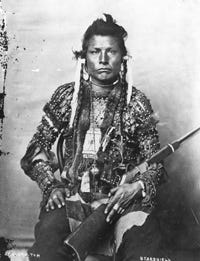


As far as I know, this man named Bear Shield never wrote anything. His culture was oral.  He may not have spoken English.  His main drugs were adrenaline and testosterone.


Friday, October 10, 2014

"INDIAN" WRITERS

http://alums.vassar.edu/news/2012-2013/121003-cedars.html

Dave Lull, library administrator and book alert friend, sent me this link this morning:  http://www.theamericanconservative.com/articles/off-the-literary-reservation/   I don’t read this magazine.  Googling tells me that Addington’s field is actually Latin America as interpreted in Manhattan.  (Once Americans figured out there were indigenous people below the Mexican border, they have “counted” them as US Indians.)  Her article is at least twenty years out of date in its point of view and references.  It mentions NO contemporary young writer.  (Sherman Alexie -- her key -- is nearly fifty.)  Her main point of reference is one of scandal, “The Education of Little Tree”, written by a racist white man who romanticized what white people like to think about Indians so thoroughly that the book is still a great little money-maker for the University of New Mexico Press.  This is reader’s choice, not a function of advertising or recommendations from Indians.  It’s interesting that this article is published where it is as the election approaches and the largely Democrat Indians may have enough numbers to swing elections.

Sherman has been able to exploit American publishing very ably, moving along the trends of the moment, most recently the sexuality of adolescents.  He writes about the rez, though he was from the category of families who teach their kids that the thing they must do is get OFF the rez and learn a profession -- in short, assimilate for prosperity and safety.  (These families are often single-parent with strong mothers.)  There is a certain amount of self-contempt involved, which is often converted into humor.  Sherman has said that he deliberately attended a white high school, and then went to Gonzaga, the missionary Catholic headquarters.   He began to write with the mentorship of Alexander Kuo, a Boston man who has spent his teaching life at Washington State University in the Palouse region, with occasional stints in China.  Sherman is protective of his family and never writes about their life in Seattle.  His sons must be adult by now.  

Alexander Kuo

Reflect on this.  The Montana Festival of the Book is happening in Missoula as I type.  This is presented as a major humanities event but has no particular connection to the University of Montana.  http://www.humanitiesmontana.org/programs/fob/2014/index.php  The meet and greets are rather expensive but the actual programs are free and there are a lot of them, with a good deal of emphasis helpful for writers who want to sell.

At 2:30PM today are scheduled simultaneously two events about Indian writers.  One is a panel of young NA writers featured in “Off the Path,” edited by Adrian Jawort.  The other is  “Wind and Bones: An Interartistic Tribute to James Welch, a karaoke-esque tribute featuring Lois Welch, Neil McMahon, Robert Sims Reid and others.”  This is possibly an echo of the multi-arts conference a month or so ago in Billings which centered on “Winter in the Blood,” the movie from the Welch book produced by Annick Smith’s sons.  All these people are white and prominent in the book world.  Guess where the attenders will go.   

Luckily, Jawort has another shot on a panel on Saturday with some other influential white writers and editors.  Unfortunately, it’s at 4PM which is sort of like having a seat in a fine cafe -- by the kitchen.  So this gives you some clues about why Young Indian Writers are a little neglected.

James Welch was a year younger than I am, so 74 if he were living.  His father was a childhood playmate of my former husband, Bob Scriver.  His grandfather was also named James Welch and was a Cherokee from the Carolinas.  James Welch Sr. made his living as a welder and as a hospital administrator, switching back and forth.  In the years James Jr. was in high school, the family was in Minneapolis.  James Sr. was doing well enough to buy each of his boys a car.  All the sibs are assimilated, off the rez, and doing well as far as I know.  James Jr. put in many extremely valuable and conscientious years on the Montana parole board, but no one wanted to read what he wrote about it in "The Indian Lawyer."  Maybe the French.  James Jr.’s mentor was Richard Hugo, a man who identified with the working class and who came from the Seattle area.  He was much beloved and a group formed around him in Missoula.

Hugo for non-readers

Now I want to go back and pick up some ideas.  I am not beloved in Missoula or among the larger Nat Lit crowd, so I have nothing to lose by being frank.  Let’s look at this from three points of view:  most readers neglect anything that doesn’t fit what they already know.  American readers are convinced that they know the real truth about Indians no matter what the Indians say.  This is in two historical conflicting streams:  those who portray them as degenerates who deserved to lose the continent to Europeans and those who portray them as angels in disguise and proper objects of mystic eroticism.  This has been noted many times but if you live on the edge of a rez, you run into both streams daily, even if you’re not NA.

both/and

The issue of literature in the sense of print on paper, composed of an alphabet, reading from left to right, is a European one.  The idea that it is a source of market-objects, prestige, scholarship, and religious dogma is also Euro.  But the North American indigenous peoples are Asian, genetically related around the Pacific Ocean -- not the Atlantic.  Apart from this genetic substrate, which goes to temperament and other physiological dimensions like endurance, the Asian experience with “written” communication is based on an iconographic alphabet (little pictures formalized into concepts and thus words) which often has a highly metaphorical bent, easily going to poetry.  It is fluid and allusive rather than having the Western attention to precision, analysis and reasoning.  This Asian mind-set is often apparent even in West Coast writers with Euro genetics, esp. the ones attracted to Buddhism.  The Maoris and Hawaiians have made common cause for decades now.

NA Lit was picked up by publishers who tried to exploit it without enough success for them to stay interested.  They didn’t know how to market “Indians”, except through the stereotypes, and patronized their writers, many of whom capitalized on the academic world -- not that much of an advantage to Manhattan publishers, though it’s a help with academic presses.  So the “renaissance” had a short trajectory in terms of best sellers and fame.  The public persists in the idea that “publishing” is some kind of honor, when in fact, it is venture capital in search of a profit -- which does not necessarily go to the author.

Adrian Jawort

Jawort is coming to writing through journalism, which means he is in tune and in contact with a world of dynamic NA thinkers and has constant access to a lot of smart Indian-focused talk.  He is bold and confident in a way that most academically dependent NA writers are not, least of all the ones at tribal colleges where politics controls so much.  Indian Country Today is the key and reservoir for these writers.  Another source is Indian law and lawyers and still another is the network of specialized social workers dealing with tribal families.  Both of these contexts are dependent on confidentiality and vulnerable to being twisted into the “depraved” context.  A few NA actors have used their status and contacts to support issues, but they are not writers.  Theatre is far better supported in Canada.

By going to grassroots publishing, Jawort is entering a world that is only beginning to exist.  The economies, the strategies, the ways of maintaining contacts without agents -- it’s a scouting job.  After talking to him, I have no doubt he’s up to it.  I hope his writers are as well.


Happy Columbus Day, illegal immigrants!