Showing posts with label Peter Matthiessen. Show all posts

Sunday, August 07, 2016

A CONDOR FEATHER STARTED IT


Early on in my adventure into blogging, I wrote something about the condors that were once on the prairie and in the Midwest.  I had swallowed whole the book called "Freckles" by Gene Stratton-Porter, a red-headed female ornithologist and photographer of the Limberlost, a swampy forest of hardwoods in Indiana.  Many girls know “A Girl of the Limberlost” which is about a girl with a poverty-hardened mother whose helper is a thinly disguised version of Stratton-Porter.  Fewer know “Freckles” which became a movie starring Audie Murphy.  After seeing it, I sent him a fan letter and received a nice note and photo in return.  But the star of “Freckles” was really a condor, who dropped a feather on the boy. 

There are articles about the Plains Indians’ relationship to condors, which included a dance imitating them.  But I had to go looking for those articles.  “Freckles” was one of my grandmother’s books.  When I was growing up, the bookshelves were salted with books from earlier generations, including my father’s books about explorers and natural history writers.  In addition, I was devoted to Isak Dinesen’s books.  

So when my post about condors attracted the interest of writers on Stephen Bodio’s Querencia  (stephenbodio.blogspot.com), that contact has meant I’ve kept up with his blog ever since.  Several fascinating people post there, including Cat Urbigkit, a sheep rancher and a natural history writer/photographer who knows antelope and wolves, and raises big guard dogs.  A good sample at http://stephenbodio.blogspot.com/2016/08/its-fairly-predictable-that-within.html


Traditional hunting trio

Steve himself was passingly a Montana writer in the Bozeman cadre before going on south to Magdalena, NM.  He’s a connected guy through Saluki dogs, eagles and hawks, fine guns, Eurasia and a first marriage to Betsy Huntington (who died of cancer) and a second marriage to Libby, a strong partner.  He is female-friendly without being icky, but he’s also an exemplar of manliness, which he has centered in Eurasia, one of the most horseback macho warrior territories on the planet.  Born in Boston, he came to natural history through the great museums that resulted from the exploits of men now often demonized -- both those who went out across the country like Teddy Roosevelt and those who financed expeditions sometimes preposterous and often deadly.


Peter Matthiessen

Bodio says:

I ate it all, indiscriminately, as I did that of a generation nearer my own; Peter Mattthiessen, and the playboy turned edgy artist and conservationist Peter Beard were obviously cut from the same cloth. It says something about my naivete that I never even thought of the fact that, as Betsy Huntington put it with mild exasperation, "All those people were richer than GOD".  I thought everybody had adventures and wrote about them, so I found ways, and did. Later I was inducted as a fellow into the Explorers Club, a sort of unofficial annex across the street. Bakewell was recruited as a member of the crew of the first circumpolar flight in the bar of the EC! Before the war, adventurers seemed to belong to the Social Register, the AMNH, and the Club. Kirk recently sent me some xeroxed pages about Carter Burden's Komodo Dragon expedition in the 20's (I have the book- isn't he the grandfather of the editor of Vanity Fair?), from a book called "All About Scientific Expeditions", and seeing that it also had Beebe  et al, I asked if it should better be called "All About Scientific Expeditions by New York socialites”?. . .

It was really a meritocracy, though, and you didn't have to be rich, a New Yorker, or even an American to belong.


But it sure did help to have money.  Might not save your life — it didn’t keep Rockefeller from being cannibalized.  The transcendent end of the scale was Richard Halliburton swimming nude in the reflecting pool of the Taj Mahal by moonlight.  By today, people have walked across Africa with a GPS in their pocket and David Quammen, a Bozeman guy, is part of the new natural history urgent exploration pursuing the deadly passengers on mosquitoes that “Spillover” on us, as deadly as tigers. Like HIV.

So here’s the swerve.  Having followed all the Brit 19th century explorations of Empire, I didn’t exactly walk in their footsteps but instead, parallel, came to Blackfeet country, where the earliest aristocratic and filthy-rich Europeans came up the Mississippi/Missouri to the high prairie.  At the time I didn’t know that history.  It gradually emerged and almost continued as a virtual pattern.  The Sixties with Bob Scriver was focussed on the life a hundred years earlier, which meant that every day was a century milestone of adventure.  Natural history museums were also a strong shared tie, both the big institutional ones and the Scriver Museum of Montana Wildlife, now dispersed.


This background prepared me for a decade-long writing friendship with Tim Barrus, at the end of years of intercontinental airplane travel by the gay community.  I heard about the inclusive relationships with all races and economic levels from bare survival to elegant hotels.  Atypical sexual orientations, rapidly surfacing to identified viability, turned out to be a kind of passport, an access to many other people outside the white male corporate hegemony.  Incredibly, sexwork gave trapdoor access to its underbelly.  (Women have always known that.)

What’s remarkable about T. is that he kept his attention always on neglected, abused, and traumatized children, mostly boys.  Because boys soon become men, this has resulted in a webwork of relationships and strategies, sometimes political but mainly focused on survival.  They are not made “normal,” but are inspired to help each other on their own terms, more humanities than science.  Now it’s not the airplane but the internet that is a way to explore.  

When I thought about boys huddled in cardboard boxes behind dumpsters in alleys, I thought about tough guys like Mattheissen surviving through the Tibetan mountain nights with strange foods and lurking pye dogs, in partnership with George Schaller, that redoubtable field biologist.  I thought that boys on the edge of civilization were as interesting as snow leopards, which are also maimed — at least the ones in zoos because they are caught by the foot.  Snow leopards cannot be taught to tell their stories, but boys can — even the ones who have been sexually abused, beaten up, dependent on drugs.  

Boys cannot and should not be kept behind bars, which is the solution our culture has for both leopards and troublesome kids.  It’s only another level of abuse.  I spent five years thinking about street animals when I worked animal control, but now I’ve spent ten years thinking about street boys.  When I saw some of their crazier vids, I thought of Peter Beard’s famous photo of himself jammed into a dead crocodile.

Peter Beard in a Crocodile

Only now am I becoming hopeful because of the new understanding that all life is connected, in process, interpenetrating, interdependent, and both constituting and exploiting the environment.  I live on the high prairie against the Rockies and never forget it, never let poetry lift my feet out of the grass, but now I want to know about my thinking instrument: my body as a recording organism up against the environment.  I watch the sky for falling condor feathers.  Or falling stars.


All that political thrashing we’re enduring is the death of another Empire, rather more various than the British one now jammed into the jaws of Brexit.  It’s a paper empire that lives on fungible exchanges through the Internet. I think it is doomed, but I don’t know what comes afterwards.  I’m interested in survival and therefore I turn to the “Smash Street Boys,” “Show Me Your Life,” and “Real Stories Gallery.”  I want to know how they make it through the night.

Friday, May 09, 2014

WHO CAN MIND-MELD WITH A SNOW LEOPARD?


Recently I’ve been working on the idea of the fourth part of the brain, a “virtual” part evolved after the cerebral cortex and activated by empathy that creates community.  The concepts alive in the community are a real part of individual thinking and always influence what we do, so it seems vital to reflect about this “Fourth Brain.”  There is not just one lobe to this “group think,” so I’ll make another little list.

The nuclear family’s understanding.  (If there is one.  Sometimes there is not when children are raised by alcoholics, addicts, blank persons.)

The cohort, which may or may not be “peers,” for instance in a classroom.

Media groups or platforms: most people, it seems, choose people who think as they do, so they cluster themselves around one point of view, even in one place.

Neighborhood, which might be a whole town in rural places, or just a few blocks.

The group to which one aspires and perhaps markets to.  Like fine writers who address social issues.

And there are negative groups, sometimes those with the stigmata of crime, profit, wickedness (however defined), weakness, or simple difference.   The Elite, the Famous. These are groups to fear, to punish, to suspect and destroy.  One can frame one’s standards to define them.
Sherpas taking a break in Tibet

One of the most intriguing groups is that of “Others,” those totally unlike oneself.  Some people are immediately interested and want to find out more, though it’s hard to predict what that “more” will mean to them.  Something to emulate or something to oppress?  Obscene black ghetto rappers -- are you intrigued or disgusted?  (Likely the sheer energy of such a group will attract your children, esp. if you control them too much.)  Old-time wise American Indian medicine men in full regalia with inscrutable faces?  Oh, how we love them!  A bit of a cliché, of course.

Peter Matthiessen with a snow leopard cub.

So I need a victim example and I’ll choose one who has stuck his head up by attacking the icon that is Peter Matthiessen and his sainted book, “The Snow Leopard.”  

Joel Whitney

The iconoclast is named Joel Whitney and he writes about Peter in “The Boston Review.”  He's not writing fiction, and he's not writing about fiction, but the fiction editor tells us what he looks for in writing.  I'll take that as typical for the whole publication. 

Junot Diaz

Junot Diaz, the fiction editor, is looking for writing "in which a heart struggles against itself, in which the messy unmanageable complexity of the world is revealed. Sentences that are so sharp they cut the eye.”  His example is Toni Morrison, for which we should be grateful since one editor’s sharp sentences are not the same as that of another.  It helps to know what kind of "sharp sentences" are meant.  I knew Peter Matthiessen a little, and he was no Toni Morrison, so we can assume that Joel Whitney is also no Toni Morrison since his background is quite like Matthiessen’s. The Boston Review was given an award by the Utne Reader, which I’ve always admired, so I suppose it's Left, minority-defending, and based among the East Coast liberals.

Joel Whitney was raised by his divorced mother, an East Coast wanderer as she took them from one job to another (law, art, teaching), and he is an epublisher, founder of “Guernica” emagazine, which is meant to explore the “crossroads of art and politics”.  Many prize-winners published there.   His family roots include Quakers and a “religious pacifist” father.  He received an MFA in 2004.  In other words, his “group” is the irreproachable chattering class, well-educated and well-connected.  I wouldn’t even know that he exists except for this article about Matthiessen, which is the point, isn’t it?

So the bone of contention is that Matthiessen was an imperial Orientalist who demonized his Tibetan Sherpa support team when he went with George Schaller to explore the top of the world.  (Matthiesson's wife had just died and he has been criticized for going off like that when his children needed him, though they were protected and the trip was a matter of two months, not years.)  So Whitney is stepping into a context of those who seek to unmask the saintly, especially writers about the “Other.”  Whitney seems to feel he knows about the heart of the Other, though I doubt he knows any sherpas personally.


Such people depend upon theory, which in this article is the high criticism of Edward Said, now also deceased, the author of “Orientalism” which is a take-down of the Imperial Western attitude that both elevates and oppresses Asians.  (I asked my very practical and anchored Chinese friend whether it is politically correct to say “Oriental.”  She said it was okay but pretty old-fashioned.)  All one afternoon I watched Said from about ten feet away during what the U of Chicago newspaper called “the Derrida Corrida,” about 1980 when deconstruction and post-everything was just taking hold.  The key idea is that words can mean anything, but it is possible to penetrate to the hearts of them (sexual overtone on purpose) and know what the speaker is revealing that would not be evident without clever analysis.  Said walked like a prince, wearing silk in subtle colors, as arrogantly confident as any caliph.  He was absolutely magnetic.

So Whitney is looking for evidence that Matthiessen didn’t really understand his porters and was an imperialist who demonized them, even as he sat around a campfire with them, quite like early fur traders in the far Missouri reaches, beyond the reach of any rescue, romantically facing the most horrible of horrors, like cannibals eating your companion.  But also laughing over the great joke of existence which is that to stay alive you must risk and suffer.  It’s not all liberal e-life.


When Matthiessen got back home to his context of American East Coast Buddhists (not much like the California Buddhists, I’m told) he wove the adventure through a lot of formal history of Buddhist ideas, found out through research.  Whitney is dismayed that he doesn’t include something about the Vietnam War or the carpet bombing of Cambodia, which were contemporaneous with visiting Tibet.  

Tukten was a ferocious old porter who later managed to send Matthiessen a delusion-cutting knife through the steady stream of American tourists.  Whitney objects that Matthiessen pairs Tukten . . . "with the animals, as if in a mythical rather than historical or political age.”  Whitney’s evidence for this, not mentioning the given of reincarnation, is Matthiessen wondering if Tukten once had been a snow leopard or an old blue sheep.  I feel rather that this was evidence of accepting the terms of the described person, Tukten undoubtedly being a reincarnationalist. 

Thich Nhat Hanh

You can read the article for yourself:  http://www.bostonreview.net/books-ideas/joel-whitney-matthiessen-snow-leopard-orientalism.  I do not know whether Joel Whitney can accept this analysis of his article written by someone so outside his political and class assumptions -- let’s say the granddaughter of Far West pioneers who has worked on the streets as an officer, who has supported small groups of religious idealists in Canada, who has a half-century relationship with Blackfeet.  In 1961 some of the old Blackfeet people I knew (not well) were as Other as Tukten, quite scary, though decades later it was a white guy from Boston who came to Great Falls to cannibalize little boys from his neighborhood.  (Bar Jonah.)

I find that one of my vital (very small) groups takes on writers who make their bones by deconstructing other writers who wrote about actual direct contact with the Other.  (Krakauer, for instance.)  I rather enjoy deconstructing the deconstructors, not least because it is so easy.  

They never accept the idea that the truly Other can NOT be understood, whether they are Tibetans, Egyptians, gay pornographers, homeless kids on the street, Blackfeet now dead, fellow mountain climbers, or Boston brahmins.  Which is not to say that the effort won’t do a person good and might make a writer famous if the attempt is made with enough style and picks the right target.  (It’s a little early to attack Matthiessen, though we've known he was dying for a year.)  Sentimentality will get sympathizers with the "Other" nowhere.  It is a characteristic of contemporary, prosperous, commodifying America, not stark, brutal Tibet.

Tibet

The point of “The Snow Leopard,” which I should reread as soon as possible, is that quite real creatures carry mythic meaning and the search for both animal and metaphor, entwined as they are, is always an internal journey.  Murray wants it to be social action.  I almost wrote “merely” social action.  This is not a priority of Buddhists, as far as I know.  Their shtick is acceptance.

Wednesday, April 23, 2014

"FAITHFUL ARE THE WOUNDS" by May Sarton: A Review

May Sarton in old age

For a long time I maintained a shelf of May Sarton books, beginning with “Journal of a Solitude” and then trying to keep up with the dozens and dozens of books she wrote.  Eventually, maybe after “Anger,” I parted company and sold the books.  I had intended to read “Faithful Are the Wounds,” but then sort of forgot it.  Now Peter Matthiessen’s death has propelled me back through it.  The book is transparently about Peter’s uncle, F.O. Matthiessen, who committed suicide in 1950.  But only about one aspect of the older Matthiessen, who was a close friend of Sarton’s -- the political side.  Still, she is tracing how that impulse comes out of the puzzle of family.


Like Peter, F.O. was a “Yalie,” but hardly a Bush-type.  “In 1923 Matthiessen graduated from Yale University where he was managing editor of the Yale Daily News, editor of the Yale Literary Magazine, and a member of Skull and Bones.  As the recipient of the university's Deforest Prize, Matthiessen titled his oration, Servants of the Devil, in which he proclaimed Yale's administration to be an "autocracy, ruled by a Corporation out of touch with college life and allied with big business".”  His teaching career was at Harvard. 

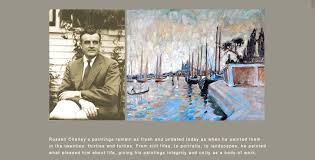
Russell Cheney and one of his paintings.

His lover was a painter, Russell Cheney, twenty years older than he, who died five years before “Mattie’s” suicide.  They were what might be called “diplomatically gay.” That is, the general public was unaware but the friendship circle just accepted it.  Sarton does not address this unless it’s too disguised for an outsider to know, maybe by switching genders.  There are no painters in the story.  On the other hand, the book is very much structured by dyad relationships, mostly brilliant men with supporting wives, with a fierce old spinster as a main character, presumably the clearest avatar of the author herself.  

The book was published in 1955, when professors were still brilliant, some of them still hoped Communism would not turn out to be monstrous so the Left could stay unified, and those Lefty men faced the Inquisition of McCarthyism, which did pursue F.O. Matthiessen.  This is the core plot line as the protagonist, Edward Cavan, struggles with his perhaps overly strong conscience and the demands to be bamboo rather than oak.  In the end he will not bend.  So falls.

May Sarton

As one expects from May Sarton, this is elegant, measured writing -- a little old-fashioned, but it suits the theme in that particular time and place.  She could call up the State House’s golden dome restoration glowing against all the red brick of Beacon Street without Unitarians feeling the wound of moving out of Number 25 next door.  In those days professors argued hard about lofty ideals and endlessly smoked nicotine cigarettes.   Faculty dynamics were as cut throat as they are now. Students were remarkably innocent of anything but pretensions.  Conversations take place in cafes, not naked in bed.  No one in this book eats pizza.
The State House on Beacon Street

The title comes from Proverbs 27:6, King James Version  “Faithful are the wounds of a friend; but the kisses of an enemy are deceitful.”   Mostly these friends were constantly insulting each other even as they struggled to understand and help. I didn’t recognize any kisses from enemies.  The book is in two halves: the incidents leading up to the suicide -- which was by throwing himself under a train, thus cutting himself in half. (F.O. jumped from a height.)  Then finally the reaction from friends and family before a description of the attack on his character by a Senate inquiry, not because of the suicide but because of his political leanings.  

Sarton’s trademark descriptions of settings of beauty are always there.  Now that I’ve looked for Russell Cheney’s paintings, I see the echo of images.  (He is CLEARLY nothing like Dick Cheney.)  It’s worthwhile to google to see the paintings just for the pleasure, but it has nothing to do with the plot.  http://www.russellcheney.com/hp.html

by Russell Cheney

In fortunate corners there are still traces of what Harvard and other Ivory Towers once were, but even that is eroded now by the tumult of the last half of the twentieth century.  In those days no one imagined that feminists could depose the president of Harvard.  Maybe the old dynamic of privileged prestige continues in BBC series like “Morse” and “Campion.”  But as Japan knows very well, what cannot be captured by violence and defiance can simply be purchased if one waits for the right moment.

A dyad type closer to power inequity is pointed out: that between industrialist achievers as steel-cold fathers who send their sons to university for status purposes but then appear cruelly destructive according to the abstract principles of their estranged sons.  This is not examined closely.  Still, it’s interesting that one of Peter M’s life-dilemmas was his in-house war with his father, who was the brother of F.O. Matthiessen.  “Edward Cavan,” F.O.’s stand-in, has this same shadow.  In fact, it’s a theme of the century, a tragic one as men make themselves inhuman for the sake of sons who find them exactly that.  It feeds back into the dilemma of marriages based on gender assignment: the strong, rational, achieving men and the warm, beautiful, elegant women.  Wallace Stegner is eloquent on the subject.  It can be a science vs. humanities conflict.

In the book the sister of “Edward” has married a man named Lucier and F.O.’s real sister was named Lucy.  She is portrayed as conventional, prosperous, the wife of a California surgeon, estranged from her brother, trying to understand but not succeeding.  I don’t know how factual that was.  I gather that there has been considerable controversy about some portrayals among those who knew the principals in real life.


In terms of generations, this feels like what I just knew the very tail end of at the University of Chicago, and even then it was a little anachronistic since gays were out and the hippie years had trailed off.  People were even a little like the Fifties, wanting to think in peace.  But then came that wild wave of post-everything thought in the academy and an opposite rising tide of sentimentality and therapeutic cheerfulness elsewhere, both of them ignoring growing poverty and unable to prevent the “sand wars.”  

So now we look around and see neglect everywhere -- from the decrepit bridges people are forced to live under, to financial arrangements that are out of control even for the one percent.  The air and water are terrifyingly endangered.  Food and meds may be poisoning us.  It’s time to march all over again, but how do we do that without tearing ourselves apart like Edward Cavan or deluding ourselves as do so many others in this book?  Is a life of sitting in a sheltered environment to read and write merely ineffective or might that finally be a source of salvation?

May Sarton at home.

In one of the homages to Peter M. a young woman declared that she found reading “Wildlife in America” to be unbearable and only did it out of a sort of Calvinistic discipline.  On what stack of mattresses does this terribly sensitive princess sleep at night?  (I don’t care who with.)  “Wildlife in America” was copyrighted in 1959, only four years after Sarton’s book.  You can buy it on Amazon for a penny.  Literally.  What sort of novel could May Sarton make of all that?  “Anger” isn’t strong enough.  Try “Rage.”  But then the princesses will simply flounce off in search of bling, pizza, and righteousness.  They need seminars like those Edward Cavan was supposed to be teaching.  Wounds teach one how to bear pain.

May Sarton as a young woman
  

Sunday, April 06, 2014

THE WRITING WORKSHOP IN MONTANA TAUGHT BY PETER MATTHIESSEN

Teller Wildlife Refuge, Corvallis, MT

In 1990 I was teaching in Heart Butte, in trouble with the bullying football coach administrators as usual, when somehow I heard about a writing workshop with Peter Matthiessen and applied.  I got in and arrived there late in the evening because I couldn’t leave school early and it was far away in the Bitterroot Valley, near Hamilton.  The retreat  was an old farm, the Teller Wildlife Refuge.  


I hadn’t been very aware of Matthiessen but my American lit teacher in high school, Katharine Tyler, had taught us that F.O. Matthiessen, Peter’s uncle, had been a very great man and his book, “American Renaissance”, was a landmark.  She was right, of course.  I don’t think she was lesbian, but that she loved gay men of the Whitman/Thoreau sort -- nonconformists.  F.O. was a quietly gay man who committed suicide in 1950, the year Peter graduated from Yale.  They had been close.  

Paul Sweezy (Left wing economist) and F.O. Matthiessen

As soon as I realized I would be meeting Peter, I did what I always do: accumulate his books and research his life. It always pays off, did for Isak Dinesen, Wendell Berry, Wallace Stegner, and Tim Barrus.

The women in the writing group were poets.  Richard Manning and Wilbur Wood have gone on with journalistic and activist work as well as teaching.  One man was a doctor: his essay was about the inner lining of the human kidney.  Another wrote about taking a kayak around the horn of South America and capsizing, barely surviving.  His book about it was eventually published.  In those days Bob Scriver was still famous, so though he’d divorced me twenty years earlier, that’s how the group saw me, except for Peter.  I had written about iniskim, fossil “buffalo” stones, and he knew about them, knew about the Bison Roundup in Moiese, had been in the Scriver Museum of Montana Wildlife, but he hadn’t expected me to know about F.O. Matthiessen or to report that my teacher considered him a very great man.

Everyone else had been there for dinner together and had speculated on what I was like, so two of the lady poets had waited up for me and we did a lot of excited chattering and story-telling.  I didn’t realize until later that we had been standing just outside Peter’s room’s door so he must have gotten an earful that wasn’t particularly literary.  He smiled when he saw me the next morning at breakfast and my hand shook when I poured him orange juice.


Later he was supposed to do a public reading and asked what books of his we’d brought since he hadn’t brought any.  I had nine or ten with me in a box and brought them all in.  He was slow returning them, and when I asked, he said he was waiting for a moment to sign them all.  In Montana at least, it’s a great thing to get authors to sign their books.  I asked him NOT to, because it would increase the value of the books so much that people would steal them.  I explained that there was no library in Heart Butte so the motivation would be high.  Anyway, I argued, if I truly read someone’s book and took it to heart, THAT was the value and the signature meant nothing compared to the writing in the whole book.  He was startled, but laughed and then agreed.

Richard Manning

Manning had been drawn into the workshop late so his essay had not progressed much beyond rough draft stage.  He’s written about how Matthiessen “took him to the woodshed” and also generously notes that it was enormously helpful to him, a sharp goad.  Peter himself tells about his first agent, a legendarily tough woman who returned one of his manuscript with the note (paraphrased):  “This is a well-written book about an exciting topic.  Unfortunately James Fenimore-Cooper wrote a much better version two hundred years ago.”  WHAM.  
Wilbur Wood

When we got to my essay, several of the guys were of a critical mood.  I said that buffalo were blade-shaped -- high at the back, comparatively narrow side-to-side -- which I knew because at the Bison Range the buffs are worked from above.  The guys -- who had only seen buffalo from the side -- said I was wrong.  Peter backed me up.  I had said that buffs have purple tongues and mouths, like chow dogs.  He said that using a comparison to domestic dogs diminished a majestic and dominant animal, so I should find another metaphor.  This time it was the guys who argued, but I understood what he meant.  

I still have my manuscript with Peter’s tiny penciled comments in the margins.  Richard Stern made his comments that way, but also would take a red pencil and completely rebuild sentences, moving phrases around with circles and arrows.  I had a bad habit of presenting information as I thought of it -- when it was really needed by the reader at the beginning of the sentence.  I still do that, but now I usually catch myself.  The lesson, of course, is revision.  For those of us who work that way -- not everyone does.  Not everyone should.

But this stuff is only part of what gives writing its value and in many ways it’s the least important part, the stuff that writing workshops are mocked for concentrating on.  What REALLY counts is the author’s ability to live life hard and sensuously, committing one’s whole self to paying attention and wringing out meaning -- or maybe just letting the meaning slowly come to the surface.  The words on paper are conveyances, not really the writing at all, which is in the living.


F. O. Matthiessen was of the opinion that scholarship was a form of social action.  Novels used to share that purpose, separating what was worth fighting for from the cheap thrills.  But “academic” is not the only mode and Peter has been able to step away from the apparatus of institutions.  There will be many stories coming out “about” him now: his cooperation with the CIA in Paris though F.O. had been investigated for being unAmerican; the real fate of David Rockefeller who was probably eaten by cannibals; his close friendships with Caesar Chavez and Leonard Peltier -- which I notice are being downplayed in the obits.  They like writing about the Paris Review a lot better though they are shocked at the idea it was a cover for his spying.  It appears that my summer’s tasks will include a lot of rereading from that shelf of books as well as some collateral writing.  May Sarton’s “Faithful Are the Wounds” (1955) is said to be about F.O. and I never have gotten around to reading it.  She was another woman who loved gay men.

Peter at the workshop.  I've forgotten the woman's name.

Writing, once on paper or screen, and made available, will have quite different significance in different contexts.  It seems to me that academics have understood Peter the least and environmentalists have appreciated him for the things that he himself valued the least: simple accurate reporting.  Politically he has been potent enough to arouse the ire of Indian editor and newspaper owner Tim Giago, whose newspaper has had far more impact than any Native American novelist or jokester.  I have no way of knowing what Buddhists think of, for instance, “The Snow Leopard,” except that it seems to be a fairly accurate account of the Tibetan wing of the movement.  

Workshop Attenders: Can't find a list of names.

He always moved through all these groups with dignity and respect, though slipping in a knife where he thought it would do some good. The irreproachably liberal Missoula-faculty organizer of this workshop, who was clearly basking in the glory of being close to Peter, asked him what he wanted for his birthday which happened during the workshop.  Peter -- with a straight face -- described an artisan hunting knife made locally and worth hundreds of dollars.  The indignant professor, who had thought of personally giving Peter a present, was taken aback.  Maybe he hadn’t known a knife could be worth that much.  Maybe he only owned kitchen knives or a Swiss army knife.

Peter was not a militant man, but he was often fascinated by lawless violence on frontiers of one sort or another, like that in Mr. Watson’s Florida which had an unlikely connection with Montana through people like Belle Starr.  He never tried to evade or sugar coat the evil of humans who twist and erase the planet they purport to love.  In the end he fought to stay alive as long as possible, but he died peacefully.  Both took courage and he had it.

Gone cosmic fishing.