Showing posts with label nurturing. Show all posts

Thursday, November 27, 2014

UNACCOUNTABLE BONDING


In places where there is a mix of animals, whether domestic or wild, sometimes there are odd couples.  Racehorse thoroughbreds, inbred for speed instead of emotional stability, are noted for pairing up cross-species.  A chicken or cat may become attached, dwelling in the horse stall or even on the horse’s back.  Children have been known to nap on the quietly shifting back of their favorite horse as it grazes.  Trainers have deliberately introduced goat-buddies to sooth a high-strung racer, whose genes cry out for company.  As Sid Gustafson never tires of telling us, a horse -- to be happy -- needs grazing, other horses, and movement.  Penning them into stalls, allowing only structured movement like periodic running on a track, stationary eating, and no interaction with other horses is a highly unnatural state imposed by humans.

If we’ll do all that to control the horse races for gambling, what might we do to control sex?  Likewise, we want that to be in boxes (stalls), in competitions, in stereotypical rituals just as much as horse-racing.  How else will we commodify it, the haves selling to the have-nots?  And we pretend that love is always about sex in spite of the evidence in front of us.


If you google cross-species bonding images, the kind of thing where a predator (usually a young animal) pairs with an animal normally its prey, you’ll find many photos of dogs with cats or cats with rats or African big cats with some sort of antelope.  The strangest is a baby hippo attached to a huge Galapagos land turtle in a zoo nursery.  These odd couples are often, but not always, produced by limited access to other living creatures, so that the instinctual hormonal need for attachment does the best it can with what is available.  We’ve all been fascinated that birds just hatched will assume that any handy Horton is their mother.
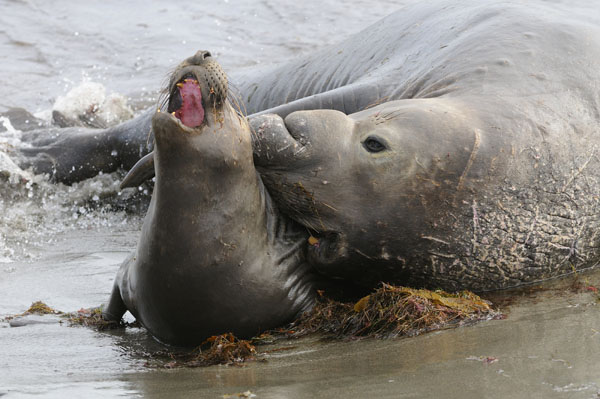

Media “culture” rarely depicts sex that includes the nurturing instinct, cuddling down together protectively.  They prefer the aggressive near-adversarial striving that other animals perform only for minutes when a female is “in heat.”  These instincts are specifically sexual and make males dangerous, like elephants in musth which lasts months and fills them to overflowing with testosterone until it runs out their eyes and stains their cheeks.  Male elk, bulls, stags, also come into season which provokes sometimes lethal fights and drives the control of a harem of females.  Human males like to fancy they are as powerful.  Certainly some are that dangerous.  Like huge wallowing bull elephant seals, they crush everything smaller, even the females they are trying to inseminate.

For a human society to persist in orderly fashion, many restraints and categories are invented, some of them involving the sequestration of the weak and small, some imposing armed law-enforcers and locking the uncontrolled into prisons.  But also we turn away, blanking out the knowledge that the weak are being ground under for the ego-support of the powerful.  In Great Britain there is currently a movement opposed to this willful blindness, activists and journalists naming big shots who have even thrill-killed their prey: children.  In the US, confused as usual, we’re still trying to figure out the Cosby conundrum.  We’ve finally realized that our athletic coaches have access to funny business in the showers.

But the price we pay for losing innocence and redrawing legal categories between unequals is a terrible ambiguity and we see ghosts everywhere, even when it’s a matter of violence without sex.  Outing gays -- who were quickly accepted as a new marketing opportunity except among those who still think all intimacy is about coitus -- has challenged culturally-defined gender-assigned roles strongly enough make us rethink a lot of things. 

prairie voles

We are having to consider the “morality of the flesh,” which means that ONE GENE in a prairie vole makes the difference between whether it pairs with one other vole for life or lives with splendor in the grass, going vole-to-vole-to-vole.  Clearly a fraction of all mammals will engage in coitus (maybe only attempted) male-on-male.  Cows, dogs.  Evolution seems to tolerate the loss of potential progeny because of the gain in armamentarium, esp. among the animals who are prey.  Two kinds of “horniness,” with a certain reciprocity between them so the warrior allows the lover to succeed and the babies to survive.

Then there is the morality of economics, which means that if there are far more women than men, then it makes sense to support many wives, esp. in a time and place where pregnancy was dangerous so that spreading out the coitus among a number of women meant that there will be at least aunt/mothers to tend the infants of women who died in childbirth.  And since infants often died, it made sense to produce a lot of them.

A Mormon family.

In modern times supporting a family has become such a burden that it is no wonder two women, declaring themselves lesbian, will form a household with children.  And no one is particularly surprised that men decline to be “captured” and choose to be the wandering bee rather than the fruitful flower.  But also we realize that many men have pair-bonded, with or without sex, quietly living together for decades, maybe with one partner as the primary who is the “front” and the other supplying the extra care so the primary can shine.   

Maybe most disconcerting is the realization that gender is variable, that there are people who are “inter-gender,” even physically, and that with modern surgery and molecules, it is possible to go from male to female or the opposite.  How people know where they want to belong and why is still a mystery.

Cupid and Psyche

“Love” has always been considered a category exploder, more unaccountable than cross-gender shifts or cross-species bonding.  Forbidden, impossible, rare and sometimes toxic or fatal, our imaginations are seized by the crystalline intensity of “pure” yearning for a culturely inappropriate relationship, even that between a grown man and a child.  

The attachment that forms between a teacher and his or her student has always been conditionally accepted so long as the teacher is male, even if the student is also male.  Richard Stern made his popular reputation on one book:  “Other Men’s Daughters,” which was based on his real-life attachment fulfilled in marriage that lasted until his death.  I could name other professors who simply took advantage of their position without marriage.  A female high school teacher will not have enough power to turn away the law and is likely to sit in jail, even pregnant.  Her lover may be too young to marry legally.

By Herbert Draper

We might call this the “Tristan and Isolde” effect, when the tie is seen as a toxic enchantment that can’t be resisted and is not exactly enjoyed.  “Romeo and Juliet.”  My radio is playing “Maria” from “West Side Story.”  We prefer to see these relationships as defying unreasonable social restrictions, crossing boundary taboos like a ruffian taken in by a nun, a white man saved by an Indian maiden, a black man marrying a white woman.  If it happens often enough, the social boundaries are rearranged or become so blurred that no who is sure which person belongs to which category.


But what about the adult man who loves a boy who loves him back?  Regardless of the historical examples of knight and squire, master and apprentice, “The Persian Boy,” we resist.  Maybe because history is also full of gruesome abuses, like boys castrated to preserve their voices or to be eunuchs to guard harems.  Circumcision is controversial.  Some cultures insist on drastic, mutilating, female clitoral excision.  At the same time women voluntarily have breast implants or labia removal in order to be more sexually attractive.  The battlefield remains the body.  Is that love?

Surely we can do better if we put our hearts and minds to it.  After all, Jesus was the result of a cross-species sexual act and, as a hybrid, he had a lot of things to tell us about love, the nurturing, protective kind.

Tiger and Wolf


Thursday, November 21, 2013

TWO EMBEDDED GENOME CODES


If poultry is descended from dinosaurs -- and I have no trouble at all accepting that, esp. considering the Tyrannosaurus Rex roosters still strutting around -- then there are two things that are deep, deep in our genome.  Both recently showed up in little stories on the internet.  One was an account by Ellen Chase, reposted by Nick Kristof, about some adopted chickens, one of which went blind.  Most of the chickens kindly guided and even fed the unfortunate hen, but the chicken at the bottom of the pecking order saw it as an opportunity and often attacked the blind chicken.  Sometimes the rest of the flock intervened and sometimes they didn’t.  Bullying is not just for bulls.  And it is not the strong alpha creatures who are bullies -- rather losers trying to improve their status.


The other was a video clip that shows a turkey hatching, sprawling on the table top totally disorganized, hearing the biologist cheeping at it (which he had been doing all along while the chick was still in the egg), recognizing the voice, pulling itself together, staggering over to lean on the man’s cheek, and going to sleep.   http://video.pbs.org/video/2165688049/   The poult was imprinted and from then on would yearn for and rush to him, just as it would have to its turkey mother.  Babies need moms, but they needn’t be biological or even female or even the same species.

These two behaviors are so deep that they are described as “instincts,”  hard-wired into the brain, which means controlled by the genome by producing protein molecules.  The genes, so old, are still there, no doubt pre-mammal code that promoted survival. (Maiasaurus, the “good-mother” dino laid her eggs in nests near Valier.)  These two coded behaviors were deep enough and protective enough that the mammals preserved them in their own cells.  (No animal was coded for surviving asteroid hits -- that was just situational, literally once in a lifetime or even many lifetimes.)

We are in a time when we are just now looking at the excessive amount of “bullying” behavior in humans and wondering whether that’s really a survival tactic after all.  It certainly is for the immediate success of the individual, but what does it do for the whole community?  Is it a force for consolidation or does it undermine every possibility of human progress by sowing fear, distrust and forced compliance -- which is always an energy and resource burner.

Konrad Lorenz and his imprinted geese

Clearly the imprinting phenomenon is useful and charming.  Mostly.  My mother taught us as small children to hang onto her skirt because there were three of us and she only had two hands, even if she wasn’t carrying something.  On the other hand, when we were needy we followed her around bleating like bummer lambs, which got in her way and drove her nuts.  For an individual trying to get things done, having been imprinted upon is not always pleasant.  When one imprints on a therapist, that worthy will keep it under control with appointments and a closed door.  It might be called a form of transference.

Feral dogs and boys will attach to each other -- dogs with dogs and boys with boys or even dogs with boys -- sometimes in communities (packs, gangs).  But if the pecking order within that community is unstable, then bullying will thin the group.  What is the proper balance between attaching to each other and dominating each other?  What is the best trade-off between the individual and the group?  Can we replace bullying with nurturing in some constructive way?

The news this morning is that scientists have learned how to insert DNA code into the genome -- not at random by infecting with a virus, but deliberately in a specific place as though with tweezers.  So now all we need is to build the right gene (we’ve made simple ones) and put it in the right place (a little trickier).  That neglects issues like the epigenome and methylation, but at least we know the latter exist.  They might be easier ways to affect behavior than inserting or deleting genes.  The genome operates like a symphony orchestra, so one flat note or timing lag can throw the whole composition into trouble.  Genes are interactive and there is no sheet music to hand out.

In the meantime, what are the changes to our health care, our government, our classrooms, our marriages/families that would support nurturing instead of bullying?  In some families, children not capable of forcing their way will be destroyed, if only by exclusion.  This past week a young teen boy, wearing only trunks, was thrown out of the house in sub-zero weather because he was aggravating his parents.  People talk of “survival of the fittest” and define fitness as dominance.  But were these adults "fit" to be parents?


Some mammal mothers, if frightened or disturbed, will eat their babies.  (Mink are notorious for doing this, which is why mink ranchers get nervous around noise and disorder.)  Is this the interaction of the protein molecule that controls T.Rex behavior with the protein molecule that controls Maiasaurus behavior?  (“I love you to death!”)  Is cannibalism a form of over-nurturing? (“I wanted to make him part of me.”)  If humans have both genes, is modern “civilization” somehow making them interact dissonantly?  

So many manufactured molecules are out there in the ground water, and no one knows how to remove them.  Some are coming from meds in the pee of humans who will die without them -- should we be filtering and recycling urine?  Filtering them from the water supply would be formidably expensive, but nowhere near the cost of inserting manmade genes into human cells.  (The cost of getting a readout is now advertised at a little less than a hundred dollars, without specifying the quality, extent or usefulness of the document.)


Above is a still from a horror movie called “Splice” that addresses the mixing of genes from different species by scientific means, one -- naturally -- being human.  Here's the link:  http://www.youtube.com/watch?v=8pIeSYhipUs  In discussing the film, the director, Vincenzo Natale, astutely says that horror films are one way of thinking about the scientific edges of human life and suggests that this specific film has an undertow of incest.  How can one address genes without sex?  And who can love us more than we can love ourselves -- if we ever get around to it.  Once a person is in forbidden territory it all turns up at once, even our longing for our missing prehensile tails.  (Wings are a different issue --  see Nicholas Cage in “Michael.”  Tails belong to “Alien.”  Then there’s feathers vs. leathers.)

Luckily, we can explore the culturome and the memes of individuals much more easily and quickly, though perhaps not more safely considering how some people survive.  I mean, it upsets them to be investigated, much less interfered with.  Still, it is a counseling truism that if one changes oneself, everything around one will also change.  To understand such atrocities as battering and trafficking, it’s necessary to look at both sides PLUS the larger context.  Is the survival value of being beaten up worth the survival value of belonging to someone powerful?  Is the survival value of beating up one’s partner somehow a kind of self-nurturing, sucking power out of women and children like a Skeksi extracting life from the Pod People peasants?  Some people seem to think so.  I think we need to risk interfering or else lose all our best evolved culturomes.  We are neither dinosaurs nor poultry, but we’re not proving it.

Skeksi from "The Dark Crystal"