Showing posts with label professional. Show all posts

Sunday, December 29, 2019

CERTICATION OF COMPETENCE FOR PROFESSIONALS

At one point in history, when "professionals" meant only lawyers, clergy, and doctors, no one was thought competent to judge them except themselves and therefore they were expected to watch and govern themselves.  As professions crumbled under the barrage of a culture interested only in money, predatory capitalism, their self-governance became inoperative.  There were too many financial reasons to cover up, deny, and evade, let alone be less than vigilant gate-keepers.

At the same time, speaking of "professionals" of things like operating heavy equipment, meant that these workmen became invested in proof of competence via certification.  Think of what this would mean in terms of running for political office!  How many politicians could pass such a test. (I do NOT mean IQ, which only tests the ability to pass a paper IQ test.)

"What does Certificate of Professional Competence (CPC) mean? A certificate of professional competence is a certificate required by all heavy vehicle operators and drivers over and above their drivers' or operators' licences. This ruling also applies to freelance operators employed by businesses."

"Certification is all about credentials. It’s what some people might consider “formal” education. Professionals who are certified in their area of specialty complete a course of study, pass a written examination, and must continue taking professional development courses throughout their careers.. . . these credentials do matter. In essence, having a credential represents a commitment on the part of the professional. It shows that they have set a goal for themselves and followed through to achieve it. The third-party stamp of approval validates the knowledge and professionalism they gained in the process.

Competency, on the other hand, has nothing to do with professional or formal education. Instead, it refers to the skill and knowledge needed to successfully complete a task.

Why is certified competency welcomed by heavy industry but shunned by today's professionals who undercut continued training and brush off ethical standards?  Professions were once considered humanistic but now they are seen as technical, which means to many that they are without ethics.

Montana is known as a state that deliberately keeps its oversight of doctors lenient because this makes it more attractive to doctors in spite of harsh weather and small cities.  Defining this in numbers and specifics would be politically dangerous.  People who have the resources and are aware of local limitations go to the big medical centers like Mayo.  I could give you examples if it weren't dangerous in a world of lawsuits.  Indian reservations are doubly vulnerable because the shocking debts of new doctors can be reduced by working on a rez and there is even less oversight, even more need.

At the time ('78) I was thinking about UU seminary, The Rev. David Pohl  was responsible for advising people like me and he was willing to talk about how difficult it was   He said that the MMPI paper test was one filter they used.  The version I took was the old-fashioned one.  I don't know whether the new version is used by the UUA.  "Minnesota Multiphasic Personality Inventory-2 Restructured Form (MMPI-2-RF), published in 2008, is a 338–item self-report measure linked conceptually and empirically to modern theories and models of psychopathology and personality."  Many contexts find it useful, not just ministry.  It's online.
I expect a person might buy a copy and work through it, but might need someone with training to interpret the results.  There's no chance Trump could focus enough to take it.  It's not a pass/fail test but a way to describe the whole person.

The next filter was the requirement for a BA or BS degree from an accredited college and the Graduate Record Exam which is an evaluation of academic skills.  Note the "accredited" qualification.  This step plus grad school makes UU ministry a "learned" version of religious leadership, certified by at least an MDiv degree.  But in theory, a UU congregation can call and certify anyone they consider worthy, even an uneducated person.  This is rarely done and doesn't necessarily transfer from one congregation to the next.  It is the pattern claimed by evangelical wealth-focused groups.

When I first felt the impulse to make this commitment, I paid a clinical psychologist to talk me out of it, since I was aware of having been divorced and working in a job that then was atypical for a woman.  (Animal control.)  The counselor was a woman and Jewish.  She said she had no concept of what a Christian clergy person would be asked to do, what qualities and competencies were needed.  The UUA later asked me to take an interview with another "professional" who turned out to have the same background and mystification.  So this was a niche sort of subdivision of mental health worker, mostly informed by pop movies.  "Shrinks" are often thought to be secular, non-religious because of being "scientific."

But this was also the result of a culture that in the name of tolerance had removed definition and description from religion.  "Religion" and religious leadership were completely undefined, undescribed in order to prevent something like what India just did, which was to impose a religious qualification for citizenship.  it started riots. They "get" the value of secularity.

The next, more serious hurdle was the Ministerial Fellowship Committee.  My own minister was the chair at the time.  This was my Ace Card that took me past all obstacles.  I did pretty well on hurdles, but his recommendation pushed them aside.  Personal influence is at the heart of most of these systems, not just ministry.  The Rev. Alan Deale was sharply aware of the problems of evaluating free and progressive individuals who were sometimes atypical enough to raise questions.  One example was an application he showed me.  It required a photo which my school district had used to judge race which they were forbidden to ask directly, (Even using photos jocularly at hiring meetings to judge how pretty the women were.) An example for qualification judges was that one person intended a "clown" ministry and his photo showed him in full makeup.  As the Fellowship Chair pointed out, the committee was unable to judge whether the makeup was well done, much less what the qualities of a good clown ministry might be.

When I got to seminary -- and I chose the stuffiest old traditional one -- I was startled by drug use, sleeping around. cheating on tests, and so on, but willingly joined a group focused on steady character.  Not all the edgy characters made it into pulpits, but some did.

The problem with professions can be listed this way:
  •   Lack of definition of what exactly the job entails, esp in a specialty.
  •   Pre-existing cultural influence.
  •   Enormous variety in the sorts of candidate -- and also in the sort of congregation or kind of law or medical specialty.  Part of being modern is being a specialist.  The kindly old standard minister has gone the way of the kindly wise old family practitioner and the kindly old town lawyer.
  • Prestige as a pure matter of wealth, nothing to do with learning or wisdom.
How do we get back to the old system?  We don't.  We need formal third-party certification of competence for professions.  Someone should start a business, a Good Housekeeping Seal of Approval. The trend has  been opposite -- to drop requirements and gatekeeping because it makes money to have students entering.

Saturday, December 27, 2014

THE POPE AND THE PROFESSIONALS

Pope Francis

Pope Francis is three years older than me.  We’re not “boomers” born during the triumph of winning a World War and feeling entitled to the wave of prosperity that followed.  We are professionals who remember “professing” in the sense of living according to belief, living as if  what we profess is vital, a calling, a sacred duty.  His profession is ancient and invested.  Mine (writing) is humble and a little shabby -- even trite -- but I DO profess without quite being an academic "professor," because I’m not teaching what is known -- rather seeking what is not known.  Writing the way I do it is a minor profession.  Income level has nothing to do with it.

Today the meaning of "professional" has diminished to meaning “dressing up” and even manicurists claim to be professional.  The Montana legislature is afraid their prestige will be damaged if anyone who is not dressed "professionally" shows up on the floor.  If Jesus were to try to visit them, he would not be able to enter wearing his nightgown as he seems to, not even if he borrowed a necktie. 

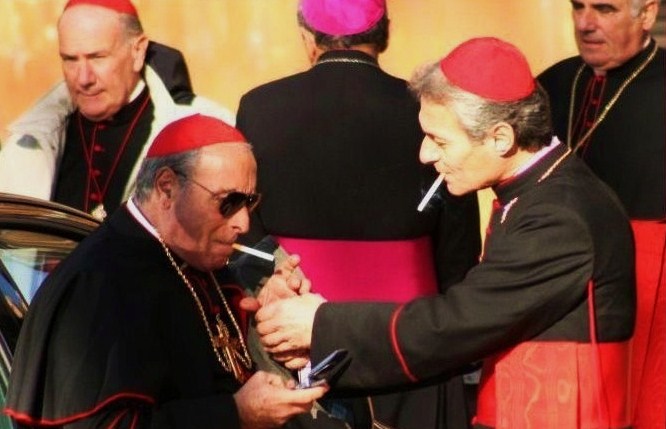
I’ve been reading the Diagnostic Manual of Mental Disorders and shaking my head because so much of it is not about “mental disorder” at all -- just attitudes that the culture doesn’t like.  The Pope’s list of “dis-eases” is so much more to the point.  So I'm going to repeat them here.  I don't mean them to apply to Cardinals so much as to authority figures and professionals here on the east slope, whether Indian chiefs or physicians.  At least Cardinals know how to dress.

One of the characteristics of professionals was supposed to be that they maintained the highest standards of behavior by monitoring each other.  This week we have heard about a doctor whose behavior sounds like beginning dementia and yet no other doctor will challenge him because of the lawyers, another set of professionals.  The lawyers leave it to the journalists -- are they professional?  I started to list Unprofessional People and stopped because it is too daunting:  judges who blame teenaged rape victims, doctors who threaten to kill nurses, legislators who lie and cheat.  Is it that we're looking more closely or that the times are too scary?  Is it a gaming mentality?

Has the art been swept for depictions of naked people?

The disease of feeling 'immortal' or 'essential'
'A curia that does not practice self-criticism, does not keep up to date, does not try to better itself, is an infirm Body'. The Pope mentions that a visit to cemeteries could help us see the names of many who 'maybe thought they were immortal, exempt and essential!'. It is the disease of those who 'turn into masters and feel superior to everyone rather than in the service of all people. It often comes from the pathology of power, the "Messiah complex" and narcissism'. 


The disease of excessive activity
It is the disease of those who, like Martha in the Gospel, 'lose themselves in their work, inevitably neglecting "what is better"; sitting at Jesus' feet'. The Pope recalls that Jesus 'called his disciples to "rest a little", because neglecting necessary rest brings anxiety and stress'.


The diseases of mental and spiritual 'petrification'
It is the disease of those who 'lose their internal peace, their vivacity and audacity, to hide under papers and become "procedural machines" instead of men of God', unable to 'weep with those who weep and rejoice with those who rejoice!'.


The disease of overplanning
'When the apostle plans everything in detail' and believes that, through this, 'things progress effectively, thus becoming an accountant. Good planning is necessary but without falling into the temptation of wanting to enclose or steer the freedom of the Holy Spirit... it is always easier and more convenient to fall back on static and unchanged positions'.


The disease of bad coordination
It is the disease of members who 'lose the community among them, and the Body loses its harmonious functionality' becoming 'an orchestra producing undisciplined noise because its members do not cooperate and do not live communally and have team spirit'.


The disease of spiritual Alzheimer's
That is a 'progressive decline of spiritual faculties' which 'causes severe disadvantages to people', making them live in a 'state of absolute dependence on their, often imagined, views'. We can see this in those who have 'lost their memory' of their encounter with the Lord, in those who depend on their 'passions, whims and obsessions'.


The disease of rivalry and vainglory
'When the appearance, the colour of  the vestments and the honours become the first objectives of life... It is the disease that leads us to become false men and women, living a false "mysticism" and false "quietism"'.


The disease of existential schizophrenia
It is the disease of those who live 'a double life, a result of the hypocrisy typical of mediocre people and of advancing spiritual emptiness, which degrees or academic titles cannot fill'. It often strikes us that some 'abandon the pastoral service and limit their activities to bureaucracy, losing touch with reality and real people. They thus create their own parallel world, where they set aside all that the others harshly teach' and live a 'hidden' and often 'dissolute' life. 


The disease of gossip and chatter
'It takes hold of a person making them "sowers of discord" (like Satan), and, in many cases, "cold-blooded murderers" of the reputation of their colleagues and brothers. It is the disease of cowards, who do not have the courage to speak upfront and so talk behind one's back... Watch out against the terrorism of gossip!'.


The disease of deifying the leaders
It is the disease of those who 'court their superiors', becoming victims of 'careerism and opportunism' and 'live their vocation thinking only of what they must gain and not of what they must give'. It might also affects the superiors 'when they court some of their collaborators in order to gain their submission, loyalty and psychological dependence, but the final result is real complicity'.


The disease of indifference to others
'When each one thinks only of themselves and loses the truthfulness and warmth of human relationships. When the more experienced ones do not offer their knowledge to the service of less experienced colleagues. When, because of jealousy or cunning, we rejoice in seeing others fall, rather than lift them up and encourage them'.


The disease of the funeral face
It is the disease of people who are 'scowling and unfriendly and think that, in order to be serious, they must show a melancholic and strict face and treat others - especially those, whom they think are inferior - with rigidity, harshness and arrogance'. In reality, adds the Pope, 'theatrical strictness and sterile pessimism are often symptoms of fear and insecurity about themselves. The apostle must strive to be a polite, serene, enthusiastic and joyful person...'. Francis invites people to be full of humour and self-irony; 'How beneficial a healthy dose of humour can be!'


The disease of hoarding
'When the apostle seeks to fill an existential void in his heart by hoarding material possessions, not because of necessity, but only to feel secure'.


The disease of closed circles
When belonging to a clique becomes more important than belonging to the Body and, in some situations, than belonging to Christ himself. Even this disease starts from good intentions, but in time it enslaves all its members becoming "a cancer"'.

The red shoes had to go, but no one said anything about socks.

The disease of worldly profit and exhibitionism
'When the apostle turns his service into power, and his power into a commodity to gain worldly profits, or even more powers. It is the disease of those people who relentlessly seek to increase their powers. To achieve that, they may defame, slander and discredit others, even on newspapers and magazines. Naturally, that is in order to show off and exhibit their superiority to others'. A disease that 'badly hurts the Body because it leads people to justify the use of any means in order to fulfill their aim, often in the name of transparency and justice!'


Here's a guy who can't go on the Montana legislature's floor.
Doesn't meet the dress code.  And he's not American.