Sunday, January 14, 2007

SLEEPY HOLLOW, SWAN RIVER

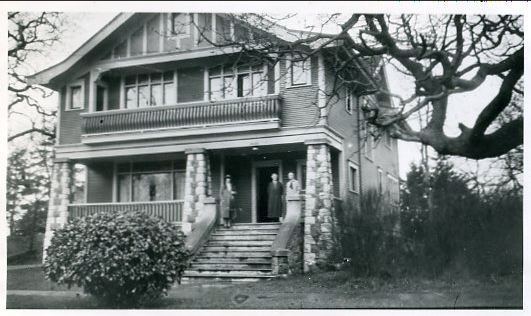
The Strachans seemed to love this place more than all the others in Swan River; at least there are more photographs and the people seem happier. Or maybe it’s just that the four children are growing up and that the quackgrass business is providing a little more income. The girls by the tree are May and Dolly Allen. People always seem to want to take photos of women standing in front of trees, as though they are dryads of some sort.


In winter the house is not quite so inviting. Is that a flagpole, a lightning rod, or a radio antenna? Perhaps it’s a power pole and they have electricity by this time.


Many, many of the photos of this place feature the porch. Some of the more moving photos are of the family relaxing in the last light after a day in the field. The men have white foreheads and the women look a little flushed from the hot stove.


On this particular occasion, there is a party. The three families present are Henderson (the friends from West Favelle who remained in touch right up until a few years ago when I had a Christmas card from Florence Henderson), Renouf (many French families up this way), and Allen. (Dolly Allen is one of May’s special friends.) The dog is an airedale. In some photos there is another dog, Waggles, a shepherd. This is the only place where dogs are included in the family photos. This photo is a little bit tipsy, but Strachan parties did not include alcohol.

At this point the family is still raising potatoes and onions, using their quackgrass pulling machine on their own fields. In other photos it is clear that Beulah’s goiter has begun to develop and she will be plagued with ill health for a while. Thyroid disorders were not understood to be due to iodine deficiency at that time, but she did evenually find someone who knew how to treat it without surgery.


This is the George Renouf home. They’ve been there long enough to plant trees and make a two-story addition to the house. These trees are not quite a windbreak since they’ve been pruned -- maybe meant more for shade.


Back at Sleepy Hollow, I hasten to point out that this is a staged fight over the “little brown jug.” It shows the pump, the woodpile and what I hope is the woodshed rather than the outhouse.

Friday, January 12, 2007

EAST GLACIER, MONTANA

The boundary created when Glacier National Park was ripped out of the side of the Blackfeet Reservation, like God taking Eve out of the side of Adam, caused three small towns to form, each serving in its own way the tourists who are their economic core. East Glacier was unique because of the “high-line” of the Great Northern Railroad which enters Marias Pass on the east side of Glacier Park and emerges at the west side of the Park, mostly tracing the southern boundary. It was the discovery of this pass by John Stevens that allowed the high-line to be built, just in time to keep the transportation business from migrating across the Canadian border to the Canadian railway.

For many years there was no highway for automobiles to cross through this pass, so folks who didn’t care to traverse the skyline route of “Going to the Sun” -- for instance, Charlie and Mamie Russell -- would load their autos onto flatcars in East Glacier, driving them back off in West Glacier where their cabin was a cool forest refuge in summer. The railroad station in East Glacier was the main debouching point for Eastern tourists, who were likely to stay in the flagship “Big Hotel,” built from huge Douglas fir logs brought in from the Pacific Northwest. The style was Adirondack; the view was Swiss in its mountain grandeur.

Behind the Big Hotel is a mountain peak with a kind of stone thumb on the side. To some this provoked thoughts of an old Indian woman with a dog companion; to others it was an Indian mother with a child following her. The name commonly used was “Squaw Mountain,” which became politically objectionable since “squaws” were supposed to be dirty, stupid, and easily dominated. The name has been formally changed to “Dancing Woman” or “Dancing Lady” mountain. Donald Little Dog and Joe Eagle Child suggested this because the mountain was once called Ikaki (“Small Woman” -- “aki” is the suffix meaning woman.) She was the mother of Curly Bear, a visionary, and a Holy Woman. The mountain is indeed a rather small mountain. Once some energetic young men carried up a load of sheets from the Big Hotel and draped the “thumb” in the style of Christos. Everyone was impressed and mystified to see it turn white.

One of those creative culprits was Terry Sherburne, who also installed and maintains the town’s NPR radio transmitter high on a ridge. When he is not climbing, he helps to run the Sherburne family motel, “Mountain Pine,” which has so many repeat visitors that they form a small summer community of their own. Across the street from the motel is the John Clarke Art Gallery, run by the daughter of John Clarke, Joyce Clarke Turvey. The present building was never John’s old art and woodcarving studio, though it stands on the same spot and is marked out front by the same mountain goat statue, commemorating the goat that was the logo of the Great Northern Railroad. Charlie Russell would have stopped in often to practice signtalk with his good friend, John, who was famously successful and good-natured in spite of being a deaf-mute. Or maybe these traits were an advantage!

The road along the side of the motel, on up the hill towards the East Glacier water supply, leads to a copse of tall evergreen trees among the meadows. A path threads through the trees to the old Clarke graveyard where John Clarke, his father Malcolm Clarke and his grandfather Malcolm Clarke are buried. It was the first Malcolm Clarke (then ranching in what has become Sieben, Montana, where Senator Max Baucus grew up) whose death triggered the Baker Massacre. One of the most elaborate gravestones is the tall Victorian marker for Helen Clarke, the original Malcolm’s daughter -- thus, Joyce’s great-aunt. Helen’s mother was a daughter of Mountain Chief, one of the most visionary and defiant chiefs. Helen was asked by the government to guide the process of dividing the reservation lands according to the Dawes Act. (She was also Montana’s first Superintendent of Schools, the first in Montana to own a piano, and an actress in a European touring company.) Her own family was assigned the allotment where the Big Hotel now stands and the family ranch is just to the west of the hotel and golf course. The fact that the Big Hotel was on the Clarke allotment (and possibly East Glacier was, as well) has snarled many legal matters of jurisdiction and title. Other members of the Clarke family also lived in East Glacier and their contacts with artists and movie stars often brought those celebrities to the ranch and the Big Hotel.

East Glacier itself has also had name changes. Once called “Glacier Park Station,” it was earlier called Midvale, which is still the name of the creek. The railroad, now the Burlington Northern and Santa Fe, still dominates the layout. On the west side, through an underpass, are the Big Hotel with its long sloping lawn, English perennial borders, dormitories, laundries and garages. In the early days Blackfeet people of some prominence and diplomacy were asked to put up lodges on the lawn and to present themselves in costume for interviews and photography. The white buckskin parade suits and familiar Sioux-style eagle feather warbonnets were what tourists expected. In the evening there might be bonfires for story-telling and Indian dancing. Today people like musician Jack Gladstone and historian Curly Bear Wagner give talks and concerts indoors by the big stone fireplaces.

On this side of town are also the saddle horse string, motels, a log youth hostel that was once a dormitory for railroad workers, and a forest of lodgepole pines interspersed with vacation homes. Several small and notable restaurants are also along this road. The golf course stretches up this way, sometimes invaded by moose and once occupied by a fox that had the impression that golf balls were eggs. When her burrow was found, it was packed with them. Bears are likely to climb up on roofs on this side of town.

On the east side of town along Highway 2 are a grocery store, motels, a bar, small businesses and homes. East Glacier has an elementary school. When the government began to replace much of the housing in Browning with tribally managed housing at the same time that the school population of Browning exploded, many teachers began to live in East Glacier, convoying the thirteen miles down to Browning when the weather was tough. Also, the tribe built some “middle class” houses here. This elementary school probably has a higher proportion of white students than any other reservation school, but is also a notoriously difficult place to teach because most of the parents are teachers!

In the middle of the highway through town is a huge hall that has served many purposes over the years: dance hall, skating rink, museum, two outstanding restaurants (one a cafeteria and one serving fine meals in the evenings only), and even a dwelling. In the Twenties “Mike’s Place” was a jumping dance hall. Until recently, the Lutz family operated here in the summer and on Big Mountain, a ski resort on the West side in the winter. Maureen Little Dog, the Lutz daughter, is particularly renowned for her marvelous pastries. Today the town is growing quickly enough to need a new laundromat and a new post office.

In the old days, during the long deep-snow winters, there were two grocery stories -- one on each side of the railroad -- because feuds would spring up between the sides so they wouldn't patronize the same store. If spring didn’t come soon enough, people ran off with each other’s spouses or even set fire to each other’s houses! Or so the stories go. Today, interestingly, perhaps because of the long-time presence of several highly-respected and productive gay people, the town is welcoming to persons of such orientation, but doesn’t support the flamboyant lifestyle of more tropical resorts. It’s a bit of a hide-out, but a person wouldn’t know that without living there long enough to hear rumors about who is in the witness-protection program.

Always, at the edges and the interstices, Blackfeet families have lived in small cabins, minding their own business. The road that goes along the railroad on the west side continues on to become what was once called “the cut-across” between East Glacier and St. Marys but is now usually referred to as “Looking Glass Pass.” A branch goes farther west into the beautiful campground at Two Medicine Lake where Wolf Rising Mountain presides and one can often see mountain goats far up the mountainside. These roads are closed in winter and sometimes the spring opening is delayed while cave-outs and avalanches are repaired. These happen often enough that no jurisdiction wants to claim this expensive road, so East Glacier merchants must band together and mount a political campaign to keep it open.

Since the drive is exceptionally beautiful, a sort of miniature Going to the Sun, the public helps to demand it be opened. It is always a favorite “loop” drive of mine, though I prefer to drive from East Glacier to the connection at Kiowa Kamp so that I’m on the inside of the roadway! One winter a bear hibernated at the top of the pass and we all went up in snowmobiles to snowshoe the last bit so we could lean over the little wisp of vapor coming out of a hole in the snow and smell bear breath. In summer I am always moved by the first sight of Browning out there on the prairie, so small and far away.

Tuesday, January 09, 2007

EARLY MORNING, SECOND SLEEP

Long ago I read a story about a Lutheran pastor in a small town (like Lake Woebegone) where people were judged by how early they got up in the morning. These were rural people with lots of chores so they needed an early start, but they had the idea that if there was no daylight yet, they could afford to take time for a cup of coffee at the local cafe. There, they could look over the crowd to see who was missing and also develop theories about how things ought to be done in that part of the world. A pastor was absent at his peril!

So this crafty Lutheran (Lutherans take the education of their ministers very seriously -- they are “learned” ministers.) would show up for coffee, participate, maybe guide the ideas a little bit, then go home and get back into bed for a few hours. Especially if he’d been at a budget committee meeting until midnight or had sat up with family in a death watch until that morning. (Lutherans still do that.)

I’m no longer a minister, but I do get up early, an old habit and one that my new cousin says she shares. For one thing, my back gives me trouble and wakes me up. Walking around a bit gets the kinks out of it so I can sleep again. For another thing, 4AM, my rising time in winter, means that I’m online for email just as the East of the nation begins to fire up but traffic is still light so that messages fly faster. I once had a cut-rate “owl” email account which I used at this hour. In the summer 4AM becomes 5AM via daylight savings time and since we have to turn off all our yard sprinklers at eleven, it’s good to get out there at first light, which this far north can be so early it’s practically the night before. The cats and I don’t convert well to and from daylight savings, so we just stay the same and let the world change around us. Squibbie stays up and checks out the neighborhood while Crackers and I have a little snack, read the paper, and return to bed.

For one month, early in my Valier life, I was the paper person -- meeting the truck at 4AM. But it was winter and there was a lot of snow that year. It was wearing out my little pickiup, and my diabetes was unsuspected -- much less addressed -- so I didn’t make it beyond one month. The town was relieved when I resigned because I wasn’t fast enough so their papers were late.

When I was in high school, my brother had a paper route and my mother had just returned to college after a twenty-year interval. I was in many plays then and would come home too tired to do homework, so I’d get up when they did to do algebra with a slightly clearer head and listen to the amazing European news for the day as the USSR struggled and writhed. Sitting up in bed while my cat snoozed himself dry alongside after a venture into the rain, I felt those early hours were good times. They still are a good time to read while the NPR station is playing classical music with whispered intervals. This morning I could hear the snowplows working their way around town and along the highway. I don’t turn on the floor furnace but use an electrical laprobe that an understanding friend gave me. While I’m at the computer, I use a “secretary’s buddy,” which is a little foot heater with fleece pockets for toes.

When I was really quite small, I once woke up before anyone else in the house. I could see out the window that the backyard was mostly shadowed -- it was on the west side of the house -- but the blooming mock orange bush (which I called a tree) was shining in sunlight. I badly wanted to go out to that cloud of white. My fingers were still small and awkward and the back door, which opened with a skeleton key, was doubly guarded with a little metal question mark that hung on the knob and stuck into the loop on the end of the key to keep it from turning. Triumphantly, I figured out how to get that piece of metal out and turn the key. Then the hooks on the screen, one of which was so high I had to really reach and one low so we kids could hook the screen when we came in.

The biggest hazard was the noise: jingling from the thin key guard, a “glock” when the mechanism of the lock turned, tiny “spinks” when the hooks were forced up, and then the long vibrating “schriiiingg” of the spring on the screendoor that kept it shut at the price of making it bang. But I got past all that and stepped out into a world only half-familiar.

It was early summer but days were already potentially hot. The backyard wouldn’t be too uncomfortable until after lunch when we kids napped or moved to the front. Now even its kid-beaten grass was dewy. Except for the birds, the world was quiet, mysteriously draped with those unfamiliar shadows. It was just strange enough to be exhilarating. I had to look up the spelling of that last word -- I’m losing my ability to spell. The root is Latin, “hilaris: to be glad,” like hilarity. Synonyms are “elate, exalt, animate, gladden, invigorate.” It was all those things.

Many happy memories involve early mornings; not least long ago when Bob Scriver would show up under my little apartment window with both horses saddled, ready for a morning ride across the prairie. Here in Valier in summer I can safely venture into the yard in a robe with a cup of coffee. Dreams still hover over my head even while plans for the day rise up inside it.

But that’s summer. In winter I go back to bed.

My new cousin in Portland, Kathy Rouzie, adds this comment. (She grew up in Ephrata, WA.)

I used to love to get up very early in the summer times (when it was so hot) and walk out to our horse pasture, which was a mile or so west of town and an easy walk. I'd catch my big tall sorrel mare and saddle her and go ride up the gravel road past the old Norton place to the high wheat fields and ride in them alongside the road. I was riding along like this wondering about a parked car I saw out there when my horse was startled and stopped abruptly. There were two people sacked out in sleeping bags there in front of me, with the wheat bending around them creating a green palisade. Sometimes I'd come across coyotes or deer out there, burrowing owls and all kinds of little creatures. I had a good view from the back of that tall mare and she was fun to ride, she was lively and athletic and observant. She was also fairly amiable, except that she was a bit coy and more often than not I'd be standing there with my bucket oats watching her big blonde tail flipping up as she danced away from me, just for high spirits and fun I think. She didn't really mind standing there while I put a halter or bridle on her, she just liked to play around first.

I like to stand on the back porch and look at the stars in the morning. Everything is quiet and they are so familiar to me, from years of sleeping in the back yard every summer (too hot inside the house in central Washington), from sitting on the roof leaning against the chimney with AH Rey's star book and a bit of red cellophane over my flashlight studying the constellations, from standing on a little hill up the street in Ephrata, looking down on my little town. And from watching the sky here in Portland, where there are so many trees. I remember when I first came to Portland, out on Palatine Hill, I was happy when I found the big cemetary on the hlll there, so I could walk and sit among the gravestones and look out on the city with a big space overhead, a nice big quiet place.

Monday, January 08, 2007

THE BIG BEAN EXPERIMENT

Can a Diabetes 2 patient have canned beans for lunch and stay within guidelines?

At noon I ate a can of Bush's Country Style Baked Beans, with a teaspoon of dry cocoa powder (NO SUGAR) sprinkled on top. (This keeps down chocolate addiction cravings.)

The can says a serving size is half a cup and there are 3.5 servings in the can at 160 calories each.

Fat, one gram. No saturated fat or cholesterol. Five grams dietary fiber. 6 gram protein. 16 gram sugars.

At 1PM, my blood sugar was 181.
At 1:15 PM my blood sugar was 195.
At 1:50 PM my blood sugar was 166.

I went out and shoveled off the front sidewalk.

Then my blood sugar was 135.

My guideline is a booklet from the Patient Education Center: "Type 2 Diabetes, Monitoring and Controlling your Glucose." (Online at www.patienteducationcenter.org)

It says these are the target numbers recommended by the American Diabetes Association:

Before meals: 90 to 130
2 hours after the start of a meal: less than 180
A-I-C (I don't know what that means, maybe target) Below 130 to 80

It appears to me that both the doctor and I were marginally correct, but that it would be a good idea for me to either eat a "real serving" or half-a-can at most with a salad, or to mix the beans with something low calorie and low glycemic. The Canadian "best practices" recommendations are that sugar is okay if it is less than 10% of the day's food intake. That's OVERT ACTUAL sugar. And schedule exercise after lunch instead of a nap.

It's almost impossible to get specifics out of anyone about this stuff. My guess is it's because no one really knows very much and, anyway, everyone is different.

From the point of view of global ag and vegetarianism, beans should not be off the table. Anyway, I like'em. Peas, too. Legumes in general. If cows ate them instead of corn, according to my ag mag, they would be happier and make better meat. A ranch girl should know that.

POOR BLIND TEDDY BEAR!

Someone recently forwarded me an article from a parenting magazine that was all about raising a compassionate child. It began with a little girl finding an ancient teddy and kissing its eye sockets to comfort it for the loss of the eyes. The author thinks children have an inborn capacity for compassion, but admits that “the tricky part is that their empathy must compete with other developmental forces, including limited impulse control... and their belief that their needs absolutely must come first.” In my opinion, George W. Bush shows the same profile. And so do many others, both voters and politicians.

But “my opinion” aside, what about compassion as the driving force of ethics? Can compassion (feeling sorry for someone or something) be a force for salvation? Certainly it features big in many interpretations of the New Testament, which figure Jesus as a protector of little lambs and cherubic children. Not much on the judgment side. And certainly it is a major component of Blackfeet prayer, which petitions the Force to have pity on we small humans. Presumably compassion is what is behind the opposition to abortion as well as the support for children’s health insurance or the Shriners. The Court of National Opinion can ease its criticism of sleazy politicians and greedy CEO’s or even outrageous media figures IF they will give money to charity. Bush hopes our “compassion” for the victims of Saddam Hussein will excuse his unauthorized war.

Compassion, suggests the Wikipedia, compassion -- as opposed to conferring benefit, which is altruism -- “is a sense of shared suffering”. I’d say that separated Abraham Lincoln from Bush right there. The latter doesn’t share much of anything.

But here’s another rather surprising example. The recent onslaught of blizzards has trapped and is starving and freezing thousands of cattle on the open range and in feed lots all across the Colorado east slope of the Rockies. When the governor and other officials asked PETA and the Humane Society of the United States for help with money to drop hay, the answer they got was cold indeed. “Oh, you’re just going to kill and eat those animals anyway. You’re going to make the profit from them, so you can feed them.” In other words, “we don’t share the suffering of livestock -- only that of cute little pets so that people will write checks to us.” Which explains why it’s so hard to get these people interested in ag reform: chickens in tiny cages, hogs on concrete, brutal slaughter methods, etc.

An even more outrageous document has been circulating about how Colorado’s catastrophic blizzards have been handled so well and so without massive help from the Feds, which brings the writer to conclude that Coloradans are much better -- certainly whiter and cleaner -- than the people of New Orleans, whose catastrophe was a poison-filled, corruption-riddled black mess.

There is a strong tendency to believe that bad people don’t suffer, “different” people like immigrants or Indians don’t suffer, and so on. If they do, we can’t imagine it and we figure they suffer because they made bad choices, unlike ours -- in short, they deserve it. Turning on them and pounding them farther into the ground is considered righteous -- not a choice. (This is an Avonlea sort of attitude, no doubt about it. At least if you ask Rachel Lynde, who is noted for being compassionate.)

Also, we have a strong preference for expressing compassion one-on-one so as to receive grateful thanks and admiration. To simply fund a decent program for child protection is not very rewarding. We want the horrific case, hopefully with video, so we can feel so good when it’s resolved. Movie stars, who live on a plane far above ours in financial terms, love to get involved in African waves of mass genocide, in hopes they won’t be struck down by destiny for having made out so well. (Don’t mistake me -- I think this is positive in the long run, educating celebrities not least.)

Everyone loves Indians so long as they’re the victims of massacre. Let them begin to make decent wages and control their own lives and the fans are outtahere. Same with women. Everyone will reach out a hand to help a little woman, unless she’s uppity. Watch out, Nancy Pelosi! (AN ASIDE: It was risky behavior for her to ask all the kiddies to come up and feel her gavel. Mommy behavior. It won’t be criticized as much as the Montana legislator who asked the Indian chair if his gavel was his war club. Why can’t a gavel simply be a gavel? And dignified. What is so threatening about this symbol of authority-keeping-order? Don’t answer that.)

I once housesat for a couple who liked to grow plants, but could not “bear” to prune them. Maybe they had the idea that it was not compassionate to discipline plants. Anyway, they were all straggling around turning yellow because they no longer fit their pots and didn’t get enough light. Some people treat kids that way -- thinking it’s compassionate. The author of this parenting piece claimed she had seen little kids spit in the faces of their parents, who merely laughed. She thought that was going too far. I’m glad there are limits SOMEWHERE.

Wikipedia also has an entry for “Idiot Compassion,” describing the thought of Chogyam Trungpa Rinpoche, Ken Wilbur, and others. To quote, “It refers to the tendency of spiritual practitioners (particularly Buddhists) to give people what they WANT as opposed to what they NEED, all in the name of being nice and compassionate.” So my doctor might have been resisting “idiot compassion,” which I rather expected and for which she has rather a reputation, in an effort to snap me out of complacency and put me on guard -- as a person MUST be with a chronic disease. The Wikipedia says that “idiot compassion” is a problem for Buddhists because REAL compassion is such a strong virtue for them. It’s so easy to slip over. I would say that the demand for “idiot compassion” has a very bad effect on Protestant ministers who serve at the pleasure of their flocks. (“Criticize US, buddy, and you’re OUTTAHERE!”)

Perhaps at the root of all this is our modern denial of suffering -- we are an anesthetized people -- and our demand that science or at least technology just fix it all. In the meantime, more and more people sink into poverty in our own country, genocide sweeps whole continents, and we have started a war that will make generations suffer deeply on both sides.

Remember the teddy bear in the beginning? He was the beloved toy of the little girl’s mother, who is the writer of the article. So how did he lose his eyes in the first place?

Saturday, January 06, 2007

SUGAR SHOCK

Off I went to the doctor in Great Falls, confident that I was going to be praised for my good work, and for keeping my blood sugar and blood pressure stats diligently. I thought I had only one weak spot: not enough exercise, since it mostly consists of my two-block jaunt to the post office and back. I resisted all Christmas indulgences related to food, feasting on the Montana Nutcracker Ballet instead.

Instead of a happy visit, I walked into a buzzsaw. She began with my lack of exercise, went on to my terrible crime of eating beans for lunch (“most people do not eat baked beans for lunch and anyway they are high in sugar”) and when I began to argue about my decisions, she jumped me for “being defensive.” She didn't like having my file so fat with statistics, saying they were useless -- then criticized me for scores back in October when I blundered. It was as though she were provoking a fight. I’m never one unwilling to oblige, though --as usual -- I ended up in tears. “I’m just trying to keep you from going blind and having your feet sawed off,” she said. “Most people have blood sugars in the 130’s!” Mine have been close to 100, which is normal. I think she thought I was lying. I think she considers me arrogant and denying reality. (She’s not the first.)

Then she was on, asking me about “wheezing.” I don’t wheeze. “Retaining fluids in the lower limbs.” I don’t do that either, now that I don’t fly anymore. I tried to move her to discussion of this new discovery about mice cured when capsiacin was used to prune back the pain nerves knotted around their Isles of Langerhans. She didn’t know about it, pursed up her mouth, said, “You’ll always have diabetes and you’d better get used to taking meds.” (I don’t take any meds except for my blood pressure.) I was just stunned. She has NEVER been like this before.

This is a small community and everyone knows everyone else’s business. Distances are long so I had an hour-and-a-half drive to ponder on all this and try to get a handle on it. What it sounded like to my counseling ear, more than anything else, was a marital argument, with the old refrain of “you’re being defensive.” I might have reacted badly, but the battle was on from the minute the door opened.

I have at hand a pretty informed Internet community. My cousin: “Could you try to convert your outrage into compassion for whatever is the problem with her?” My NEW cousin, who was a medical librarian for years: “The last time I checked, doctors were human.” My Montana niece, “Yeah, I’m picking up rumors about marital troubles.” It’s a second marriage to an older man, also a doctor.

Nevertheless, it took me overnight to get back confidence in my ability to manage this Diabetes 2 stuff. This morning I stood paralyzed in front of my oatmeal saucepan, wondering whether I dared throw in the usual frozen unsweetened raspberries. I’d already figured out that the news about the mouse pancreas treatment was NOT that capciasin is a wonder drug I ought to run out to buy -- the important part was that they were able to prune back those knotted-up autonomic nerve cells that were throttling the insulin producers. And the important part of THAT was that it suggests a whole new way of of figuring out Diabetes 2, which is really a metabolic syndrome problem, probably with a strong emotional component. (I raised this with the doctor but she didn’t address my blood pressure or lipids -- just hammered away on diabetes. Has someone related to her or maybe even herself developed the problem?) Is it wrong to be hopeful, to try to understand what scientists and doctors do and why? I say, resoundingly, NO.

This punishing, threatening approach to motivation can only encourage lying. Also, it assumes a rather old-fashioned view of diabetes, the little sugar-pig theory. The more enlightened folks are talking about the glycemic index, stress as a fundamental cause (which ties right in with the autonomic nerve factor), and the synergy among protein/carbohydrate/fat mixes. The Australian counselors, who seem pretty advanced to me, will say, “If you have toast for breakfast, why not add a bit of low-sugar jelly and an egg?” I’m finding that it’s the unbalance of JUST the carb that’s not good. High fat alone will also make high sugar.

The Aussies say, “If you really love mashed potatoes (which converts almost direct to glucose), why not mix them with mashed lentils, which are high-glycemic, go well with potato, and slow down the need for insulin?” They encourage the learning of a list of foods in order of glycemic impact on the pancreas, always working to find the highest glycemic, slowest digesting, foods and include them in one’s diet. It’s not just that sugar is sugar, it’s that sugar demands insulin right away or else loads up the blood.

Even smaller portions of forbidden foods -- like REALLY small! -- might be all right. But I don’t even LOOK at them, for fear of eating too much: a tablespoon instead of a teaspoon might be too much. I’m looking back at my old Weight Watchers lessons and thinking about weighing portions. When one looks at a can or package for “serving size,” it’s often startlingly small. Especially for a single person who feels obliged to eat a whole canful of food once it’s open. Little bowls of saved stuff often turn into mold.

But -- live and learn. I’ll keep eating beans for lunch, but I’ll mix a serving size with the same amount of baby spinach. Or I might get out the old slow cooker to guarantee sugar-free beans. Why shouldn’t people eat beans for lunch anyway?

I'm not supposed to go back until July.

"DON'T LOOK NOW" Reconsidered

A night or so ago I was sittiing reading when a red spot came through my window and traced around the room. My first impulse was to hit the floor. (The postmaster suggested that my second impulse should have been to wonder whether I could get back up again!) Then I realized that probably kids had gotten a laser of some sort for Christmas and were trying it out on the sparkly tinsel in my window. Or... it could have been laser sights on a gun someone got for Christmas.

In the end I decided I’d been watching too many scary movies in the evening, so I watched my “Anne of Green Gables” and “Tales of Avonlea” tapes to restore my sense of idyllic community. Today the DVD of “Don’t Look Now” came and I watched it. Those who have seen it will know that there is a sort of little red riding hood motif, extended into red blood, and it will probably take a few more nights of “Green Gables” to damp down my startle reactions again.

I wanted to see the movie because plainly “The Train Station Man” was meant to remind the viewer in some way of the 1973 rather notorious pairing of Julie Christie and Donald Sutherland. A choreographed scene of naked love-making between the actors was so intense that the rumor went around that they went “all the way,” as teens would say. Well, in 1973 they might have said that. (The actors claim they didn’t -- well, maybe technically. They are plainly aroused.) The naked shots are interleaved with scenes of the two people dressing separately afterwards, quite solitary though in the same hotel suite. Unexpectedly, the effect of dressing separately is to intensify the sexual entanglement. Strange that movies often almost ritualistically show lovers undressing each other, but I can’t remember any that show two people, even married people, dressing each other, much less as they do here, almost enrobing as they choose and enter their clothing.

A person has to fight to get sense out of this movie but in many other movies made since, one will have to push memories of it away. The writers and directors are clearly haunted: it has become a classic text. The key plot idea is simply that a couple has a little girl who drowns. They react in quite different ways. The rest of the story is a labyrinth of grace and dread. The Sutherland character is restoring a church, which he complains is itself partly faked. Two strange sisters appear, one of them blind but a “seer.” She “sees” the dead girl, much to the relief of the Julie Christie character. We are playing out here faith against reason in the context of a crumbling church overseen by a bishop who is compassionate but not very effective.

The movie, based on one of those spooky, “gas-lighting” stories by Daphne du Maurier, is packed with symbolic images, reiterations, echoes, irrelevancies. The main character, brilliantly exploited, is Venice, which one character describes as a “city preserved in aspic after a party when everyone has gone home.” In another place the same character says that because she is blind (albeit with second sight), the ancient canals, stairs, walkways, bridges are all safer than an ordinary place, because she can tell where she is by the echoes. Her sister cannot interpret them. Water and simulations of water abound.

The Julie Christie character is childish, all emotions and questions. The Bishop asks her if she is Christian and she says, “Well, I try to be kind to children and small animals.” She ain’t no thinker. The Bishop may be in sympathy. His tiny sleeping chamber has a sweet little painting of Jesus and lambs. But his work appears to have to do with the granting of divorces.

On the other hand, the Sutherland character is not that lovable either. The most appealing characters in the movie for me were the Italian workmen -- I think they are meant to be the “normal” background for what I interpret as an argument between faith and reason. When the “reason” figure, Sutherland, literally faces a huge heavy gargoyle figure being perilously replaced, we see the resemblance. The history of thought is not pretty.

Later the footing goes out from under him and he becomes a “dangling man.” It used to be that one went to college to learn such references, but nowadays Google is faster. The review below is from the Saul Bellow website:
“Baim, Joseph. "Escape from Intellection: Saul Bellow's Dangling Man." N University Review [Kansas City] 37 (Autumn 1970): 28–34.

"Sees Bellow is neither an intellectual nor a Jewish humanistic writer, but a mystical one who constantly encourages his heroes to escape history and "break the spirit's sleep" by refusing to see the Self as merely the product of its own historical past. In DM the hero finally rejects intellect and static definitions of the past as sole definitions of self. Joseph see-saws between reason and nihilism and finally experiences illumination through an intuitive experience that only comes when intellectual responses become impossible.”

So this is a highly intellectual “cinema as text” with Sutherland as the pivot. Maybe this is why Julie Christie, for all her attractions, strikes me as little more than a cocker spaniel in this story. And maybe “The Train Station Man”-- in which Sutherland plays a character mutilated, embittered, intent on a useless restoration of a train station when trains are obsolete -- restores Christie’s character's intuitive, sensuous, simple acceptance as a higher value. The background here is not the human church but the baptizing sea. Christie is not a neurotic and credulous onlooker, but an active creator herself.

But I doubt that more than a handful of people will see these movies on this “high concept” plane. More likely they just feel the spookiness and confusion of it all. The ability of a movie to juxtapose and otherwise manage timing, ambiguity, suggestiveness, is very powerful -- pushing the human brain’s deep need to see patterns and logical relationships by teasing and contradicting, then suddenly becoming explicit.

Don’t Look Now” is often compared to “The Exorcist” which I haven’t seen but which is horror movie involving the church and a little girl that was made about the same time. I was more interested to compare it with “The Village,” a recent film about what seems to be an idyllic small rural community, like a Mennonite community, where people who get out of step are mowed down by a red-caped lurker with huge claws. A blind girl and her cohort defy this creature out of a need to grow and explore. The real secret is finally revealed: this is not a village created by natural forces, but a deliberate avoidance of the real, modern, hustling world of the “outside.” I take this as a statement about religious community where people hide rather than addressing our often horrific times.

It is fascinating that a population that cannot discuss religious issues rationally or politically, will nevertheless accept being confronted with powerful and subtle arguments presented by image and character. Even the lovemaking, which has considerable beauty, is a short poem about how humans are at once bonded and alienated in an entwinement of flesh, a issue so deep that people pretend they don’t notice. “Don’t Look Now.” Ignore that red spot. It might be blood. Yours.

Wednesday, January 03, 2007

THE BEST GIFT: A NEW COUSIN!

This year’s Christmas present came a bit after Christmas but is no less welcome. Fate has handed me a cousin! Not a good friend who feels like a cousin, but a cousin who feels like a good friend! If you followed the series about Strachans homesteading on the prairie, you know that Sam and Beulah Strachan took a long trip to the West Coast. One of the places they stayed was in Victoria, B.C. with Sam’s cousin, George Ramsey Jr., and aunt, Mary Welsh Ramsay, in Victoria, B.C. I posted a photo of their house on Craigdurroch Road.


THOMAS WELSH (d. @ 1888) and JEANNIE GILLIS WELSH (d. @ 1900)
1. Jeannie Welsh, never married. (d. @1900)
2. Ellen Welsh Robertson (d. 1920)
3. Margaret Welsh, unmarried, died in early womanhood
4. Catharine Welsh Strachan (d. 1918)
5. Mary Welsh Ramsay (d. @ 1940-42)
6. Mina Welsh Allan, (d. @ 1954)
7. John G. Welsh b. 1866 (d @ 1938)

A few days ago Katherine Rouzie sat down at her computer and idly searched for a photo of the Ramsay house in Victoria. She found it, and me, and a whole set of cousins! We share Thomas and Jeanie (Gillis) Welsh as our great-great-grandparents. Our great-grandmothers were sisters. I’m the granddaughter of Sam Strachan, whose mother was Catharine Welsh Strachan, and she’s the granddaughter of George Dyer Ramsay and Mary Welsh Ramsay and daughter of Will and Jean Harcus. All you need to remember is that we are part of a Scots diasphora that landed in the Pacific Northwest.

Like my other Strachan cousins, Katherine is bookish -- in fact, a librarian -- with a warm, humorous, pretty face and an eye for color. She is married to an architect. But here’s the spooky part: she lives and has lived for decades just up the street from where I grew up in Portland -- yet we never knew each other. And it appears that through the Harcus side, a cousin married a Montana Rostad, so I’m related to Lee Rostad, the noted historian and scholar. Well, actually she would be my Harcus’ cousin’s mother-in-law. Let’s go at this the Indian way: they’re “all my relations!”

Katherine says that the Harcus home in Everett that I noted in my “Ranger Trip” blog was later replaced by a “much grander” home on (naturally) Grand Avenue. Will Harcus founded K&H Printing with his brother-in-law Kane, who built an identical house next door. The business is still thriving under different ownership.

Mary Welch Ramsay had a ruby and diamond wedding band which was handed down through Katherine’s mother and is now Katherine's wedding band, engraved “MW - GR April 21, 1881." Scots conserve and treasure the past, even as they light out for “the territories.” Now will come a long period of matching memories and tales, some happy and some sad, and of absorbing the difference it makes to approach our family history through the Welsh sisters. All this time my Strachan cousins and I have been celebrating Clan Strachan (“Not Timid, But Cautious”) and ignoring the Welshs. What the heck is THEIR family motto?

So far the best tale of all comes through the mother of Welsh girls, Jeannie Gillis Welsh. As recorded by Gene Strachan, here it is:

THE GILLIS STORY

John Brown Gillis was a ship builder on St. Simons Island off the coast of Georgia. His wife (I do not know her first name) died in childbirth about 1825 and is buried on the lslands, I believe. Gillis decided to take the seven children to Scotland via New York. He was a rich man and carried on his person $2460 for expenses. Gillis died in New York under dubious circumstances. The seven children, accompanied by a black servant, set sail for Scotland. The youngest child, a baby, died at sea and was buried at sea. The remaining six children were taken in by relatives upon arrival in Scotland.

The $2460 is an interesting story. When Gillis arrived in New York, he had put his money in a bank where it would be safe. Gillis had a partner in the shipyard business, a man by the name of Gibson, who made efforts (according to Matt Robertson) to draw the money. He did not succeed. The Gillis children were suspicious of Gibson and refused to give Gibson authority to draw the money. From this point it is not clear what happened, but the money lay in the bank for seventy years. Imagine, a small fortune in 1825 terms!

Apparently nothing was done to dispose of the money until about 1896 when Matt Robertson’s mother, Ellen Welsh Robertson, and his sister, Jeannie Robertson Abbott, found the money with the help of a banker. $2450 was in a bank in Albany, NY. [no mention of interest] By this time there were 72 claimants but few close heirs. The money was drawn and divided four ways.

Jean Gillis Welsh, Matt’s grandmother, received a fourth as she was the lone survivor of the six Gillis children. In 1896 the six Gillis children, other than Jean, had three living children. Each received one fourth.

Aunt Lily, wife of John Gillis Welsh, lived in a house in Scotland that was purchased, at least partially, from this money.


My great-grandparents and Katherine's great-grandparents are buried in the same cemetary in Oklahoma.

Tuesday, January 02, 2007

TO BE IN THIS NUMBER by Alane Rollings

This is a review of the fourth book of poetry by Alane Rollings, called “To Be in This Number.” And this is my blog so I will be as wandering, long-winded, possibly transgressive, and relatively irrelevant as I like. In fact, that may be far more helpful than the usual metaphors about “hearts,” “richness,” and “colors.” After all, the idea is to tempt you to read a book I enjoyed.

Let me lay out a little narrative line here. On the Montana “highline” (of the railroad because it runs just south of the Canadian border) where I live, they say there is a sunstorm every eleven years which causes extra rain which makes the berries more abundant and sweeter that year. (Note for metaphors: sweet, thorny, blooming, and, well, purple.)

THUS:

1928, the year Richard Stern the novelist and University of Chicago professor was born.
1939, the year I was born.
1950, the year Alane Robbins was born.
1961, the year I graduated from Northwestern University on the other end of Chicago from the “U of.”
1972, the year I gave up on my marriage to Bob Scriver, Montana sculptor (born 1914).
1983, the spring of my first year as a Unitarian Universalist minister after a four-year grad-school retread at the University of Chicago, including as many classes from Richard Stern as he would let me take. Maybe three?
By 1994, I’d left the ministry.
2005 was the year this book of poetry was published by the Tri-Quarterly Press at Northwestern.

If you want to make this daisy chain into a necklace, consider that Norman Maclean, who hired Stern at the U of C in the first place, was born (1902) and raised in Montana. His own semi-memoir, “A River Runs through It,” has become a classic.

Let’s get it out of the way. Stern’s best-selling novel, “Other Men’s Daughters,” and several others (“Natural Shocks”) were drawn from his departure from a conventional (and painfully cracked) marriage into another (overlapping as an affair) -- with a much younger student. No one is fooled by the disguises. I mean, most readers knew they WERE disguises, just not what was mustache, what was putty nose, and what was actual. The second marriage has endured.

Alane, now aged fifty-six -- against Stern’s seventy-eight -- is still a girl, but a girl with the chops of a professor, the ethics of a feminist, and the dilemmas of a beautiful woman raised in a loving, prosperous family in Savannah, Georgia, (Stern, Manhattan. Me, Oregon and Montana.) and then confronting the rough, corrupt, windy city of Chicago and a huge sea-change in society.

An age difference, I discovered when I fell in love with Bob Scriver (him, 47; myself 21) is very much like an international relationshop, with time replacing space. The differences constantly surprise, intrigue, and sometimes offend. But also, in my case, I was looking for a combination of adventure and protection, which Bob was willing and able to provide. Since we couldn’t make it last (blame it on success), I’ve been interested in these asymmetrical relationships, and interested in women who write about overpowering husbands, who often ironically draw their power from wives who are seen by outsiders as “lesser.” For instance, the poet Deborah Love was married to Peter Matthiessen and wrote a memoir called “Annaghkeen” which I found profoundly moving and helpful. Peter’s book about her death is “The Snow Leopard.” She drew him into the Buddhism that has sustained him ever since.

Another relationship with a difference in place and temperament -- but not age -- is that of Richard Benjamin (Manhattan) and Paula Ragusa Prentiss (Tulsa, Oklahoma). Benjamin’s personality is very much like that of Richard Stern. (Stern’s U of C undergrad students might not believe this, but I knew the Benjamins at NU and will swear to the similarity of the two Richards, both the formidable intelligence and the zany sense of humor plus a quite firmly rooted common sense.) Paula, as beautiful as Alane, is tuned to high-tension passions which is what makes her a ravishing actress. The archetypal story is Paula deciding to commit suicide (for the zillionth time) by wading into Lake Michigan. The beach is so gradual that she had to walk a very long way to get into water as deep as her waist. In the meantime, Benjamin -- carrying her coat over his arm -- walked along parallel on a long pier. When Paula stopped, with chattering teeth, Benjamin suggested mildly that he take her for a cup of hot coffee. She reversed directions. Meeting her on the sand with her coat, he took his dripping mermaid to the Hut, where the theatre crowd hung out. The adventure was much appreciated by all. If the Stern/Rollings literary alliance were to be made into a movie, it would be fascinating to see what it would be like if Benjamin and, say, his and Ragusa’s grown daughter, played the parts.

An illustration of the contrast between Stern and Rollings might be their reviews of “Clear and Simple as the Truth: Writing Classic Prose.” Stern’s praise is high but academic; Rollings says, “I’d like to have this book tattooed all over me!

If you want to know factual background about Stern/Rollings, there are books about Stern that include her briefly, like: “The Writings of Richard Stern: The Education of an Intellectual Everyman,” by David Garrett Izzo (3 Index citations) or “Richard Stern” by James Schiller (12 Index citations). They can be helpful.

There is always debate about the morality or good manners of writing intimately about one’s own life or remarking on other people who do that. Here is the position I take, which is lifted from Paul Tillich’s theological strategy. When asked whether God were a being or a nonbeing, Tillich invented a new category: “the ground of being” and assigned God to it. I guess I would invent something I would call “the ground of creativity” and say that it is crucial to the life of writing but doesn’t mean one has to stick to the facts. Different things rise from it under different circumstances.

This is especially relevant when considering Rollings’ work, since she is clearly an embedded person: in family, in region, in genre, in academic community, and in personal relationship. She is not exactly a “confessional” poet, but is clearly working with her own life. Consider her title here: “To Be in This Number,” lyrics accompanied on the cover by the relevant notes. Chosen? Saving remnant? The Saints? All rise from that ground.

People, especially females, who write about their own lives are accused of being narcissistic, which the frankly confessional ones celebrate. Rollings’ first poem, “Sweetness Night and Day,” begins with the childlike grandiose idea that no loved one will die if one loves them enough, carrying the burden of their memory, “Hoisting them around like a bag of newborn lambs sticking noses out to nuzzle me.” (That metaphor made me a fan. I see both real lambs -- my relatives raise sheep -- and Persian lamb coats on old ladies, astrakhan hats on sophisticated gents.) She gives them “constant reassurance of their actuality” while yearning to know who she is herself. The conclusion is “the only way to keep them was to hold as closely as I could all the borrowed elements that recompose me by the hour.” The two tropes that shape the poem are traveling on a river and sunrise/sunset. “In the limits of this place whose sweetness night and day, when love moves through in infinite streams, nothing can exceed.” So -- self-centered but knowingly, romantically.

The poems are announced as a “chain,” though at first we don’t know whether she means a “daisy chain” or a restraint or a linked set of events. The poems of Part I are arranged on a chronology. The second “Fire in the Water,” describes a terrible flood in the Twenties that echoes New Orleans today. It tells of a man who comes to himself, probably Rollings’ father.

Page-a-minute” is a title I don’t catch -- how can we ever hope to pick up on every reference in a poet’s mind? These poems assume a literary and historical background that fewer and fewer share, alas; but I can pretty much keep up. I know my muses, my fairy tales and even what a Moon Pie is, though I’ve never related it to menstruation before and never lived in a climate where a girl might be carried into the Minit Store cooler for recovery after fainting. I love the idea that the REM twitches of closed eyes are “secret reading.” The poet says, “I’m caught inside Time’s crooked bite.” Then she gives one last brief glimpse of her mother, nearly side-swiped by a bus, her dress wet and blown up “unveiling Mamma’s skinny legs,” her surprising vulnerability, and “our helplessness.” Children against a bus.

Gang of Four” is about those children and makes the chain theme explicit: “(I’d suggest, Let’s rest and make a chain...) And I know how, (We’ll braid the stems...)” The Edenic bliss of one’s tight circle of childhood friends can give one a fund of trust that makes possible stepping away to a looser set of relationships, often lifelong but “Ephemera entering the realm of the Perpetual.” You know the story of the grasshopper sawing away until nearly nonexistent?

Crossover” details love for Celia, the colored maid from another world entirely, and here’s the title of the book: It’s a line in “When the Saints Come Marching In.” Celia is the access to Rock ‘n Roll, Soul, and that wild world of music and despair that teaches a darker world of people to go all out, “dance big”, endure everything, and find God in the least of these.

Blood Sport” is a tennis poem -- I don’t know many of these. But I know about tennis at the U of C because my bedroom opened onto the tennis courts at the Faculty Club and in good weather the constant “pok - pok - pok” of the volleys rang all day. The poem is really about trying -- “Hit it!” -- and ends in a litany of athlete’s names. Scholars are even more strenuous and driven. This is about a different kind of tennis than professorial exercise. A sibling, maybe?

Saint Venus.” Lady Di. A lament for someone trapped.

The Secret Blackness of Red Roses.” (If Rollings has a tattoo, I’m betting it’s a black red rose) This poem is a quilt of quotes, like those old friendship quilts where women embroider sayings, each in its square, sew them together and present the result to someone. The quotes are from female writers, each unique, some more feminist than others, and all address the ambivalent relationship between mother and daughter. “I am downy duck,” is the beginning. “For us to bind with doubled thread, the beautiful, the Sublime” is the end.

There is one surprising part describing a male lover, “rocked me at the window, kissing, laughing...” A former parishioner of mine, a feminist therapist, after reading something I wrote about Bob Scriver, cried out in surprise, “Why, Mary, you married your mother!” Yup. But also a violent shouting father. (Stern can do that, too.)

That’s the end of the first series, taking downy duck to adulthood, when mother (hair like duck down) leaves, but lover comes.

Part II is linked through the years with Stern, who is literally worldly, going everywhere and often taking his wife along. Part III is linked by memory.

I have to say that as a former student who only knew a professor whom I then came to know as an author, it’s sweet to glimpse the husband-lover in “High Romance and Everlastingness.”

But this is too much. (Repeatedly Stern used to write in the margins of my stories, “too much.”) You should form your own opinions and associations. Maybe you’ll know more about Rollings’ world and be able to decipher her code more accurately than I. This book is a “ground of creation” that can be drawn on many times. And if you don‘t have every fact written in the margin, the poems can also be read as free associations, images in sequence, linked by one woman’s consciousness, ready for your own linked response.

Monday, January 01, 2007

DIABETES VIA GLYCEMIC INDEX COMMENTS ON COMMENTS

COMMENTS on GI Newsletter, January, 2007
AND COMMENTS on Tholzel who comments directly on the Newsletter posts.

First, my “comment principles” on medical matters.

1. I’m finding that primary research is so thin and hidden, so poorly understood by the media interpreters, that it would be a mistake to act on all the things that “may” pertain. I only passed the first half of Introduction to Statistics and am hopelessly innumerate (My checkbook never balances.), but even I can see that through strategies like putting everything in terms of percentages we are often radically misled. “100%” increase in something often means two out of a hundred cases instead of one, or something on that scale. Sometimes if you look at percentages instead of numbers, nonsense ideas like a half-a-person turn up.

As a consciousness-raising exercise, I read GNXP.com where the posts are heavily peer-reviewed by number-hip people. Things that seem convincing to me are sometimes derided and totally demolished with analysis.

2. I test everything against my own experience, which is atypical since I’ve careened across social class, educational level, disciplines, and geography. Sometimes it means nothing at all, but I myself act on it and am prepared to report what consequences I can perceive. Of course, if I were any good at it, I wouldn’t have Diabetes 2.

3. Much of my beef with medical news is sociological. That is, the discipline is socially priviledged to the point of arrogance, far too interested in money to really care about patients, and so scientific and lab-oriented that it has attracted a lot of -- shall we say -- “cold” people. They have separated themselves from ordinary folks so far that understanding is lost. Resistors are demolished. (Of course, this appears to be our culture norm.)

4. On the other hand, nice warm quacks abound. A sympathetic bedside manner often replaces real skill.

So -- my comments alongside those of Tholzel, who is “masked,” which means an automatic 10% debit in his credibility. (My rules.)

The points to address were suggested by Dave Lull. The original GI Newsletter comes from the University of Sydney in Australia. Most of the Glycemic Index interest and research comes from Australia where medicine is evidently less controlled by pharma-food industries. (The ones that sell prepared foods so you can eat stuff just like the bad stuff you used to eat, but purportedly “okay.”)

GI Newsletter:
"Dr Neal Barnard’s Program for Reversing Diabetes":

Tholzel:
"I hope you will also review and compare Dr. Richard K. Bernstein's
book "Diabetes Solution--the complete guide to achieving normal blood sugars." Dr. Bernstein says just the opposite of Dr Barnard -- that fat is an important part of nearly eliminating carbohydrates in order to return to normal blood sugar levels.”
Prairiemary:
Any doctor who puts his name on a plan is automatically suspect. It’s not medical info then -- it’s a marketing plan.

GI Newsletter:
"Does sugar cause diabetes?":

Tholzel
"It makes little sense to say that over-indulging in sugar for a few weeks proves excess sugar ingestion doesn't give you type-2 diabetes. T2 Diabetes doesn't come on in a few weeks--it takes half a life time of a pancreas being battered by a continual wash of excess sugar for it to eventually break down.
Prairiemary:
The question is medically irrelevant and misleading. It is the public that is misled. Around here, they still call it “sugar diabetes,” but the problem is far more complex and could just as justifiably be called something like “leptin malfunction” or the rather useful “metabolic syndrome.”


GI Newsletter
“Eating almonds is a good way to maintain a low GI diet.”

Tholzel:
“Except they don't want you to eat salted almonds. What they don't say is that there is no GI difference between salted and unsalted almonds. The anti-salt posture is an entirely different--non-GI prejudice.”
Prairiemary:
It’s nice that almonds help, but they only HELP and only a little. You don’t eat salted almonds because the salt makes your blood pressure go up and somehow that’s part of the same “metabolic syndrome as high blood sugar.


Another commenter:
At the bottom of some people being able to get away with eating lots of sugar, or of salt, or of any other food: individual differences, which thinking about led me to see: the benefit of some amount of self-experimentation before buying the "results" of research, especially when those results include a "take this drug" recommendation.
Prairiemary:
I quite agree that personal differences and local differences and even things like quantities, timing, co-eating other foods or exercise habits all have impact. The beauty of today’s situation is that we’ve got those little sticks and beepers that give us objective quantified feedback. It’s too easy to say, “Oh, I can eat ice cream because I feel okay afterwards!” Check the numbers. Also, by eating damaging foods but “only a little bit,” one might be using up reserves that might be needed in case of a major health challenges.


Another interesting phenomenon comes up in this exchange, which is that some anti-fat sentiments have nothing to do with high blood sugar levels, but are cross-overs from another category of food choice guides having to do with the humane treatement of animals. In other words, the suggestion that eating free-range chickens or being a vegetarian or vegan will heal diabetes. My own physiology needs lean meat (and I mean at least partly red meat) and a certain amount of fat, including vegetable oil.

I often think of a parishioner in Saskatoon who was a medical doctor herself and who had been thrown into near-paralysis and painful arthritis after being accidentally sprayed by a mosquito-control airplane. One of the rather “edgey” doctors at the University of Saskatchewan put her on nothing but sterile water and basic amino acids, then over weeks and weeks added back ordinary foods and kept careful detailed records of the results. It took a year for her to accumulate a short list of foods she could eat without bad reactions (not always foods one would predict as “healthy” at all!) , but the symptoms were much abated and she could go back to work. It was drastic, high-labor, and brave -- but it worked. It might not have. I wonder what has happened to her since.

Now -- it’s forty degrees and the sky is clear, but the footing is slick and the wind is blowing hard. Do I have the moral force to make myself go for a walk?

Sunday, December 31, 2006

THE NEW YEAR

It’s taking me a long time to look back over the year to recall events, much less decide whether they were good or bad and whether I ought to change my strategies. As far as writing goes, I’ve made steady progress -- or so it seems. But there were surprises, some of them close to derailments.

The hardest is the most recent, my brother surfacing in major distress, only to disappear again, and my other brother reacting as though this were all my fault. I had occasion to call several cousins, reminding me how different we all are, how opposite our goals can be.

My diabetes 2 diagnosis was shortly after Christmas last year -- in fact, I joked that it was “Christmas diabetes” caused by over-ingestion of chocolate, which was the bulk of the gifts to me. This year there was no chocolate, but two very long-time friends got so angry at me -- partly because they misunderstood or wouldn’t tolerate my near-belligerent defense of myself -- that we may have broken the links between us. They are still stuck in the idea that diabetes is simply a matter of being a little pig for sugar and that there’s no such thing as a diet that can’t be abused or ignored now and then. In fact, even my friend here in Valier who has the same diagnosis and restrictions that I do, still doesn’t realize that this is different. This is not something small and personal -- it’s not even reservation-wide or national. Diabetes is a worldwide pandemic that has hit us while we were all fussing around about bird flu. Personally, I don’t even think it can be explained by transfats and lack of exercise. I think something quite sinister is going on, perhaps a virus and perhaps a reaction to a change in our environment that we may have put there ourselves. Were you as surprised as I by the number of ordinary household objects that contain the same radioactive element that poisoned the Russian spy? Polonium?

Both the pharmaceutical and insurance industries have seized hard on diabetes and no doubt will escalate their interference. They are not interested in finding the causes, only selling us drugs, prosthetic feet and “diabetes counselors,” as well as creating many rules disqualifying diabetics and fat people from jobs. There are dire predictions about the impact on Medicare.

Clearly it was time for me to -- not diet! -- change the way I eat. Luckily, I had been moving towards it for years and, in fact, was raised on basic local foods and (truly!) walked two miles twice a day to high school -- sometimes four times a day. It wasn’t until I left Browning that I really gained weight. Now again I can wear all the clothes I wore as a minister in the Eighties. I expect to lose forty pounds more. I’m pleased that my skin is mostly elastic enough that I’m not entirely swags and bags. (I joke that my "double chin" has become a "pleated throat.") But my sense of myself is quite different. I’m on guard all the time. Sometimes I feel more withered and hollow than simply reduced. I’ve always thought I was tough, a survivor. No more.

The new awareness is that my chemistry (blood sugar, blood pressure) is constantly fluctuating through the day and that it reacts strongly to sadness, anger, grief, disappointment, and happiness. It appears that there is a strong tie-in between the autonomic nervous system (the one that sort of corresponds to a subconscious) and the endocrine system. Well, we knew that. But we didn’t know that in diabetics the ends of stressed pain nerves wrap around the Isles of Langerhans, the insulin-makers, and throttle them.

Who am I, this sack of flesh that doesn’t ask me what to do -- just does its own thing? I’m not the only one asking. Everywhere I see articles asking, “What is consciousness?” And how does one relate to community that is almost entirely food-focussed? Christmas feast, New Year’s party, come over for lunch, let’s bake cookies, can we take you to dinner... I keep saying I’m afraid I’ll find that, without knowing it, I’ve eaten something I shouldn’t. Everyone thinks that’s pretty funny. Would they think that if I were talking about alcohol or cigarettes?

This is the year my bio of Bob was actually accepted by a respected academic press. Clyde, who upgraded all my old photos to usable quality, says he has much confidence in the production values of the team now working on the manuscript. All summer there was a major exhibit of Bob’s bronzes at the Royal Alberta Museum, which kindly invited Helene DeVicq to the opening. Doug MacFie, the Clan Master for the MacFies in Canada, says that Bob’s great-uncles scattered across the prairie provinces and I will begin trying to locate the descendants. I’m thinking that Alberta may be a better destination for my small archives than the Montana Historical Society, which stonewalls me.

This is also the year I finished writing “Twelve Blackfeet Stories” and put it on the market through Lulu.com, print-on-demand. It can be bought through any bookstore, including Amazon and Powells, and is on listed Google in German and Japanese! I have confidence that as I do more publicity, as people write reviews, the book will begin to take hold and snowball. I’ll put more books on Lulu.com, many of them of only limited interest, as I work through digesting my father’s photo albums. It lifts the cost off my shoulders and is available even to people I don’t know. Clan Strachan has reconvened and accepted for their archives my manuscript of “Homestead Strachans on the Prairie.” I will still be looking for publishers.

This was a big year for blogging. Prairiemary.blogspot.com gets about a thousand hits a week. (For comparison, many books are published in a printing of a thousand copies.) When I was posting stories about being an animal control officer in Portland in the Seventies, I acquired quite a few new readers. The blog community, at least my part of it, is just my speed -- of course, it’s self-selected! Librarians, constant readers, naturalists, archeologists, geneticists, eclectic essayists and grumpy old guys in England. Not at all the shock gossips that the media portrays.

Soon I’ll begin to address my religious materials: the Blackfeet ceremonial bundle, my pastoral care experience, and a manuscript I call “Circuit-Riding,” which is about the nature of congregations and ministers, essentially groping for a theory of community “grounded in place.” There seems to be a high interest in what might be called “the anthropology of religion,” which was my focus at the U of Chicago. I’ve gathered material for a Guide to the Blackfeet Reservation and am sending queries. So my writing agenda is full-to-bursting and going well.

My house is aging faster than I am, though we were both created in the Thirties. The pickiup had to be resurrected -- luckily we have a gifted mechanic in town -- and my teeth are next in line. More money had better come in soon. The yard is still offensive to the neighbors, but I begin to see a bit of understanding developing in my own mind about just what I’m doing with it anyway. These last few weeks I’ve actually been sorting and filing boxes of materials I’ve carried with me for many years.

Maybe the hardest New Year’s Resolution to make is simply “carry on as before.” A new idea might be energizing -- the confirmation of an old one reassuring. But I simply don’t know where all this is going. I love the house, the cats, the computer, the way the light moves across the yard and through the trees. I guess that’s enough.

Friday, December 29, 2006

THE POLAR BEAR IN MY LAP

Not everyone has held a polar bear head in their lap. I have. Luckily for me, the actual bear was not present. I was holding a polar bear rug.

One of my jobs in the early days with Bob Scriver in the Sixties was to put the backings and edgings on bear rugs. In fact, with local bears that we mounted, I also had the task of cutting a gusset in the tanned bearhide armpits so the hide would lie flat and then dyeing the remaining relatively hairless area (in that respect bears are the opposite of humans) with alcohol tinted with shoe polish to blend with the fur.

Bob mounted the heads -- one does not say “stuffed,” and anyway the skin is mounted on an empty papier mache form -- and then tacked the hide out flat on the “bear table” (two pieces of plywood side-by-side, so 8’X8’) to dry. When they were ready for edges, I cut felt (green and gold) strips and scalloped the edges with a little tool that clamped to the edge of the table and worked by turning a handle. Then I climbed up on the table alongside the tidily folded bears and rolls of felt and spent long hours pleasantly while I sewed the edges onto the hides, turned them over to cut out their silhouettes in the gray backing, and then went back around the edge to sew the backing to the felt. Most bears, even grizzlies, fit on that bear table.

The polar bear, mounted by someone else, had been a rug for enough years to need new backing and felt edging, in its case, blue and white. It was way too big for the bear table. I took it out to the studio-residence and spread it out on the carpeted floor where it covered the entire twenty foot square area. We looked at it a long time, petted the rather yellow fur, looked at the molded face and glass eyes, rubber tongue, plastic teeth -- tried to imagine meeting this monster out in the dark snow of the Arctic.

A grizzly can’t help echoing a teddy bear a bit, but a polar bear -- though it is believed to have evolved from grizzlies -- has a sly, ravenous, flattened look about it. The most sympathetic photos show cubs, all fluffy and button-eyed. I used to know a polar bear in the Portland Zoo back in the Forties and Fifties when barred cages kept the animals in and a simple pipe railing kept the humans just a bit more than an arm’s length away. One day I found the lion sleeping with one long leg thrust through the bars and stroked the top of his paw. He woke with a start and stared at me in amazement. I often shook hands with the monkeys. But the polar bear cage was wrapped in extra heavy mesh wire. An admiring little boy had approached too closely and been swept against the bars by the bear, whose paws were so strong and jaws were so clever that even through the bars the boy was killed and partly eaten.

That bear had only one pipe dripping into a shallow cement pond. Now the polar bears are behind heavy glass that also sides a proper pool where they can plunge and cruise to an imitation ice floe, like the ones they depend upon as rafts and decoys for hunting -- done so cleverly that they hide their black noses with their paws. We’re told that their fur is not actually white but rather clear like fiber-optical filaments that carry messages. The fur conducts light to their skin so that they can make enough Vitamin D to store it through the six month winter. If you ever hunt a polar bear, remember not to eat its liver, which has enough Vitamin D to kill you.

Polar bears probably evolved from grizzlies because of climate change when the planet glaciated -- not so long ago that they can’t still crossbreed with grizzlies. Already good salmon catchers and not at all afraid of water, the animals gradually learned to catch seals and to swim longer distances. The darker ones died out and the bodies streamlined until the bear looked quite different. There is not enough time for them to make more adaptations before climate change catches up with them. The grizzlies are not yet affected by the thaw and will resent intruders.

I once talked about global warming with a professional geologist, a crusty old fellow who said in no uncertain terms that we are in the NORMAL last stages of a retreat of polar glaciers that began ten thousand years ago, stimulating humans to develop agriculture, cities, and all the resulting consequences -- including industrialization and the production of greenhouse gases. If the political right has refused to even admit that global warming happens, the left has refused to admit that even if we subdue our own contributions, the planet will still keep warming -- no one knows how long. Until it begins to glaciate again. The only safe prediction is change. We are not in control, though we may have a little influence and ought to use it for our own sake.

The human population of the Arctic, as dependent on ice and permafrost as any polar bear, has already begun changes that will slowly erode and then eliminate their culture as it is today. Culture and climate go hand-in-hand to form the substrate of life that sustains all humans, varying from one place to another, from one time to another. Easy to say “change,” if you don’t have to give up the place where you’ve always lived, the foods and songs and clothing you’ve considered part of yourself. Will we be more gracious than grizzly bears when the Inuit move south?

The polar bears are already resorting to cannibalism and drowning at sea because of having no ice floe resting places. The effect on humans may become just as destructive unless we become both more resilient and more generous with each other, weaving a meta-culture to sustain nations. Perhaps this is the logical next step in the human changes that caused the first farmer to pick up a hoe. Still, I grieve for that polar bear whose massive head overwhelmed my lap, while I am grateful that I knew even a bear who wasn’t really there.

Thursday, December 28, 2006

STEVE SOLOVICH

About this time of year, decades ago, my brothers and I -- little kids -- were in southern Oregon, where my cousins lived on family ranches. The highlight of the entire visit was going up through the uncut forest to see one of Steve Solovich’s caches. Solovich was a WWII captive who refused to believe that the war was over, so he lived as a fugitive in the dripping forest, making himself little shelters under half-downed logs or in tangles of debris. They were very hard to find and usually contained little more than metal drums of deer meat, salted or dried, his reserves in case hunting went bad. Ukrainian or Polish, he had had enough experience in “wilderness” to take care of himself.

Two quirks made people uneasy. One was a taste for milk. He would sometimes slip into a cow barn to help himself direct from the cow. The other was that he was fascinated by television. Sometimes at night one would get an eerie feeling and realize that Steve was outside watching over your shoulder through the window. No one worried about his rifle, but when he decided it was too hard to clear his summer bean patches with tools alone and began to steal sticks of dynamite, the authorities determined to go bring him in. In that country there are lots of hounds and varmint-hunters, so it wasn’t too hard.

Sorting through papers, I came across the packet of newspaper clips my aunt sent me in the Fifties with the thought that I would write them into a story, which I never did. But the tale has a sharper edge for me now. In the eighties, as an adult teaching college classes, my brother took a bad fall and landed on his forehead. When he regained consciousness, he did not seek medical help but went to my mother’s where he remained until 1998 when she died. He said he couldn’t work, though he seemed unhurt. His mind was different. He could not grasp that he couldn’t go on living in the house because we sold it in order to split the estate three ways.

His third paid rent for a few years. Then he tried living in his truck. In the town where he was, he said a community of Vietnam-era veterans parked together at night in a gravel pit -- for community and protection. The law left them alone unless they drank and/or fought. Finally he went to my aunt’s ranch where one slightly younger cousin was taking care of his aging parents. When the parents died, the cousin who was the main inheritor ordered my brother off. He went back to living in his truck but didn’t keep in touch, had no mailing address. By this time he was in his late fifties and I had moved to Montana again. My small house and tiny budget could not accommodate a second person and, anyway, he hates cold.

Now it comes out that he’d begun to think like Steve Solovich: we are at war, we cannot trust the government, one must stay hidden at all times. He surfaced just before Christmas in an emergency ward ICU with a major heart attack. Transferred to a VA hospital (he was a Marine for three years but was not in combat), he discharged himself. He did not complete the recommended testing, took only a small amount of meds with him, and left a bogus forwarding address. He’s old enough for Social Security, qualifies for both disability and VA help, but never completes any interview. If pressed, he spins a tale about being a sort of American James Bond undercover and is so convincing that he leaves the interviewer -- usually a young woman -- gape-jawed. When I make contact and try to supply facts, my other brother objects -- what if his stories are true? Can I prove they’re not?

The VA is used to this -- they have hundreds of people on the street, unwilling to say where they’re from, who should be contacted in the event of a crisis, or where they can be reached. The Iraq/Iran conflicts mean many of them are quite a lot younger. They don’t take their meds, so mental confusion is common, and the relatives who try to find them are now stymied by the recent medical privacy laws. They mix with illegal immigrants, whose ethic is secrecy and avoidance but protection of the hurt and elderly. And they are accepted by the counterculture, who live under the IRS radar. Many Vietnam vets found refuge on Indian reservations where people don’t ask, “Where do you live?” but rather “where do you stay?” All these groups and more are united by distrust of government bureaucracy.

I myself am refusing help with my gas bill because in order to qualify for help I would have to surrender to some mysterious body my bank statements for a year, my medical records, all evidence of investments or other income, etc. This information would be useful to certain people in this county, either politically or from a financially predatory point of view. There is no wall between county officials and private businesses.

Someone remarked to me, probably a rancher struggling with government regulations and restrictions, “It’s a helluva note when you can’t trust your own government.” A ninety-year-old Basque rancher from eastern Montana said on the radio last night that he sure wished we could go back to the old days when a man’s word was his bond. He knew it was a lost world and worked mostly because people stayed in one place, survived by being trustworthy within the community, and agreed on goals anyway. Family was still strong.

All this about my brother wouldn’t bite so hard if my own strategy hadn’t been to keep a low profile, maintain a modest lifestyle, and retire early to write. I was beginning to worry that I’d put off writing until I wouldn’t have enough mental grip, but now I find that the problem is not me -- it is that the publishing industry is in major trouble, reconfiguring and simply evaporating on all sides in ways no one expected. It would be nearly impossible to get writing published the old-fashioned way. (But it is an absolute snap for me to publish on this blog or even to create Print-on-Demand books.)

These days Steve Solovich couldn’t live in the forest because it is cut. The parts that are far enough away from ranches are full of drug dealers, marijuana growers and meth labs. One must be careful of illegal immigrant mushroom gatherers. “Wilderness” is globalized and the bears are replaced by human predators.

Solovich ended his days confined in a VA hospital. It did not please him, in spite of all the milk and television. I have no idea whether any family was ever located -- they may have been dead. I have no idea where my brother is. But at least I know he was alive this Christmas.

Tuesday, December 26, 2006

BEAR SPRAY CURES DIABETIC MICE!!!

style="font-style:italic;">http://www.canada.com/nationalpost/news/story.html?id=a042812e-492c-4f07-8245-8a598ab5d1bf&k=63970

Diabetes breakthrough
Toronto scientists cure disease in mice

Tom Blackwell
National Post
Friday, December 15, 2006

In a discovery that has stunned even those behind it, scientists at a Toronto hospital say they have proof the body's nervous system helps trigger diabetes, opening the door to a potential near-cure of the disease that affects millions of Canadians. Diabetic mice became healthy virtually overnight after researchers injected a substance to counteract the effect of malfunctioning pain neurons in the pancreas...

They also conclude that there are far more similarities than previously thought between Type 1 and Type 2 diabetes, and that nerves likely play a role in other chronic inflammatory conditions, such as asthma and Crohn's disease. ... The problems stem partly from inflammation -- and eventual death -- of insulin-producing islet cells in the pancreas.

Dr. Dosch had concluded in a 1999 paper that there were surprising similarities between diabetes and multiple sclerosis, a central nervous system disease. His interest was also piqued by the presence around the insulin-producing islets of an "enormous" number of nerves, pain neurons primarily used to signal the brain that tissue has been damaged. Suspecting a link between the nerves and diabetes, he and Dr. Salter used an old experimental trick -- injecting capsaicin, the active ingredient in hot chili peppers, to kill the pancreatic sensory nerves in mice that had an equivalent of Type 1 diabetes.

"Then we had the biggest shock of our lives," Dr. Dosch said. Almost immediately, the islets began producing insulin normally ... It turns out the nerves secrete neuropeptides that are instrumental in the proper functioning of the islets. Further study by the team, which also involved the University of Calgary and the Jackson Laboratory in Maine, found that the nerves in diabetic mice were releasing too little of the neuropeptides, resulting in a "vicious cycle" of stress on the islets.

So next they injected the neuropeptide "substance P" in the pancreases of diabetic mice, a demanding task given the tiny size of the rodent organs. The results were dramatic. The islet inflammation cleared up and the diabetes was gone. Some have remained in that state for as long as four months, with just one injection....

While pain scientists have been receptive to the research, immunologists have voiced skepticism at the idea of the nervous system playing such a major role in the disease.


***
This was one of those announcements that makes a person say, “Oh, that just makes SO much sense!” And then, “Capsaicin? The ingredient in bear repellant spray?” But then, “Well, what about the people who say they can quiet stomach ulcers with capsaicin?” Or “how does that hot rub-on stuff work anyway?”

Ever since my diagnosis with Diabetes 2, I’ve been reading and talking to people who say that there has to be more to it than just bad eating. A virus, a mutation -- what? Something this elusive is likely to be due to an interface: how two things fit together, key-in-lock. It appears that discovering the molecule called “leptin” has a lot to do with this. I need to Google leptin, geriatrics, pain neurons, autonomic nervous system, the Isles of Langerhans and metabolic disorder -- I expect a lot of others are doing the same.

We have a hard time seeing two dissimilar things as being parts of one whole: we see a heart and a lung -- rather than the complex outgrowths of each other that they are: the oxygenating synergy. So no wonder no one saw these little dots, “the Isles of Langerhans,” as anything but secreting bodies, nothing to do with pain neurons. What the heck are pain neurons doing in the pancreas anyway? But it seems as though there are a lot of cases of pancreatic cancer and what’s THAT about? It IS supposed to be very painful. Probably related to the environment.

I think of my classmate at Meadville who had the “flu” and afterwards had diabetes 1. I think of the years while working at the City of Portland with the best insurance in town and the cream of the doctors -- all the while showing symptoms of diabetes but never being diagnosed. Never being tested. In fact, never realizing my own self. Just beginning to have the overwhelming feeling that I’d better get out of there, better get back to Montana or I wouldn’t have many years left.

Now that I take blood sugar readings all the time, I realize that every emotion, every stress, even benign changes like getting off schedule, every small excess of any food but especially some foods, makes my blood sugar change. I’m not measuring insulin: they say it’s as bad to have a lot of extra insulin in your system as it is to have excess blood sugar. This is so touchy that if I notice my eyesight is a bit blurry -- usually while at the computer -- it’s most likely due to high blood sugar in my retinas, which makes them hold water and therefore thicken, changing the focus slightly. My blood sugar moves up and down as much as my blood pressure and responds to much the same things. Since both are controlled by the autonomic nervous system -- messengers of the brain that are not conscious -- it’s only natural that they would vary together. In fact, the eye doctor said he couldn’t tell whether my original alarming eye hemorhhages were due to one or the other.

A mouse cure does not constitute a miracle, but this appears to be a breakthrough on the scale of the discovery of the retrovirus or the prion. If it IS a cure for diabetes, it may very well be the key to chronic fatigue syndrome and fibromyalgia -- all those mysterious things that many doctors don’t believe exist. At my check-up next week I’ll be interested to discuss this with my doctor, a woman who thinks I exist. In fact, my niece -- who goes to the same doctor -- and I agree that this doctor thinks her patients should be treated with as much patience and dignity as her horses -- and around here that’s saying something.

Oh, and around here we know quite a bit about the usefulness of capsaicin bear spray, too. But to heal mice??!!!