Showing posts with label massacres. Show all posts

Friday, August 09, 2019

MASSACRES, FAST AND SLOW

Waking, I smell the stink of nearby forest fire.  The air is full of suppressed rain.  I think of the first massacre at Wounded Knee, not because of the weather, but because of the atmosphere of the country. I dreamt about it, worse than the Kardhasians, who are merely vulgar and flashy, because the Trumps are ghoulish in the 19th century way of the Clearance of the Prairies, the systematic killing of the people who had lived on this land since the glaciers retreated.

At Wounded Knee the massacre prompted by fear of dark people, though they were impoverished and their way of life was smashed, was one of the early uses of machine guns, the assault weapons of the time.  You probably recognize the photos of twisted bodies that were left in the snow, frozen in attitudes of agony.  What you probably don't know is that after the first killing wave when the children scattered into the brush, the officers called to them to come out, assuring them that now the danger was over and they would be safe, taken care of.  

When they came out, they too were raked by gunfire.  In the end when the soldiers and townspeople, ever curious, came to investigate the ground of murder, one baby was found still alive, under the mother who had fallen over the little girl to save her.  They did not kill the baby. They kept her as a trophy toy and raised her as a curiosity.  This is real.  You could look it up.  There is no photo of the president at the time (1890) grinning with his thumb sticking up like a weak imitation phallus.  But there was the same appetite for fame and destruction.

Zinkala Nuni as a baby, 
being held by U.S. Army General Leonard Wright Colby, ca. 1890


We're told there's a storm coming on Sunday.  We don't have hurricanes up here on the Montana Highline, except storms of the heart, the murder of girls and women one by one, forced to receive murder mixed with sex like all the other females of color over time and place.  (Zinkala Nuni died in 1920 of flu and syphillis given to her by her adopted white father, who raped her.) There is always a fringe of men, usually young, stuck in unemployment or drunkenness or grinding jobs who become enraged and unhinged.  They express it according to their times.  Along the High Line where it is often a truck driver's crime, esp. among those with felony records who cannot take a truck across the border, they leave the dead women along the road with the bottles of urine they fill because they don't have time to stop if they're going to meet their deadlines.  When the maintenance men come to cut the barrow pit grass they dread smashing the bottles, but they dread the bodies even more.

As Rachel Maddow has said vehemently, history is watching us.  Even during August recess, if it lasts, history is noting everything and will tell it through the times to come, as long as there are still people.  But the people who can are ignoring it.  Makes no nevermind to them.  Time to get ready for school with bullet-proof backpacks and emergency cell phones.  A family sit-down to decide what to do in case of massacre.

Erik Erikson wrote several books on the premise that certain prominent men can embody the key dynamic of their time and place.  https://en.wikipedia.org/wiki/Young_Man_Luther was the first.  (Not Martin Luther King, Jr. but the original Lutheran who prompted Protestantism.) Many have accepted the premise, including bios of Trump.  Some are more persuasive than others.  Of course, the ones paid for by the subject are only believed by the gullible.


In this linked article it is the bio of Trump's brother that is more revelatory than a recitation of The Donald's own scams.  Clearly, he was right about addiction.  It's just that someone told him Adderall is not dangerous or addictive.  They say he's also hooked on nose meds because of constant mucus drainage.  Whatever the cause, including age, Trump is sinking into dementia.  And so is the country.

In fact, it's a little difficult to separate the causes from the symptoms, given that some of the symptoms are so compelling.  For instance, video games are widely blamed -- vivid, violent, hypnotizing, often about war  -- but they are more symptoms of our gamification of everything than causes by themselves.  Gamification, commodification, and several other concepts are abstract, not often discussed, hard for many people to believe in as a "thing."  (Thingification is also part of this.)  Gamers admit that some keep score of mass shootings in the same way that vid games do: number of kills, number of shooters, time elapsed, and so on.  It's just part of the whole nation's score-keeping, as in sports.  Sportification.  

Winning becomes polarizing and leads to violence.  Extra points for tricky winning, like firing someone just before their retirement kicks in.  Winning becomes intimidation, like deporting people in circumstances that will kill them or orphan their children on the first day of school.  This is the part that's uniquely Trumpian.  Vicious retaliation, escalation.

Here's some catchup about gamification.  https://www.bunchball.com/gamification  I've been presented with the idea as a good thing for both schools and religious groups.  Improve results!  Kick up your scores!  It begins in kindergarten with ball games.  It you don't become a winner from the beginning, you will miss your chance to never have a formidable post-grad debt!  The TV shows about office politics are just gamification acted out.

Here's a checklist in case of gamification becoming deadly, a mass shooting.  There are quite a few lists like this online. Watch out for these traits.  Put a towel over the mirror while you read it.

  • Lack of empathy — an inability to feel or sense how one’s behavior affects others and their experience of pain or suffering 
  • Cruelty — a history of enjoyment of hurting animals or other people 
  • Sense of grievance — the feeling that others have hurt, taken advantage of, belittled or damaged oneself or one’s family or community 
  • Entitlement — the feeling that oneself or one’s family or community has special status, deserves special treatment or privilege 
  • When grievance and entitlement are combined, a feeling those who fail to recognize or even who actively attack one's entitled position deserve to be eliminated 
  • Intensified threat or attack — the affronts to special status are actually or perceived to be growing worse 
  • Access to means of attack 

Monday, May 05, 2014

"THE FAR-OFF WILD LAND: The Upper Missouri Letters of Andrew Dawson"


This is Tom Dawson, Andrew's son.  
The coonskin cap was out of the artist's trunk of special effects.  
He never wore such a cap.

Andrew Dawson (1820-1872) is not on Wikipedia.  Lucky him!  Known as the last “King of the High Missouri,” he was a key fur trader and an excellent example of Jim Webb’s tall, red-headed Scots who built this nation.  What I knew about him until this excellent biography was mostly about his son, Tom, who married Isabel Clarke and settled in East Glacier on the Blackfeet Reservation.  Someone needs to follow up on the idea that the east slope of the Rockies since Lewis and Clark has been settled in large part by “Celtic” whites with their love of a challenge and determination to make things work.  Their style, which was resistant to top-down governance and appreciative of wilderness, meshed well with the pre-existing Blackfeet world, even as it helped to destroy it.  Tom and Isabel's adopted daughter, Helen, was known to the granddaughter of John Clarke the woodcarver as "Aunt Helen."  Helen Edkins is still well-remembered by living people.  (She is not the same as Helen Clarke who also lived there and is buried there.)  This is a "local" story.

Here is the live webcam going into East Glacier from the East.  The bridge is a new rebuild.

First, I want to make a bit of a time-line as I find that this high east slope area is so much later in development than either the East or the Pacific Coast that I lose the relationships among them.  The dates are mostly based on “This Far-Off Wild Land: The Upper Missouri Letters of Andrew Dawson,” by Lesley Wischmann and Andrew Erskine Dawson.  Wischman is also the author of “Frontier Diplomats”, the story of Alexander Culbertson and his Blackfeet wife, Natawista.  Culbertson was the immediate predecessor and guide of Dawson.  Andrew Erskine Dawson, the collateral great-nephew, had his ancestor’s letters, which make up half of this book.  These Scots had been educated and because Dawson valued his family so much, he wrote many letters.  And because the family valued Dawson, they saved them.

Grace Scott Dawson 1794-1859
Dawson's beloved mother

1804-1806  The Lewis and Clark expedition.  Several Blackfeet boys killed by the expedition.
1808   John Jacob Astor founds the American Fur Company.
1820  Dawson is born in Dalkeith, Scotland, seven miles from Edinburgh.
1822  Ramsay Crooks establishes the St. Louis office of the AFC.  Ownership shifts from man to man and from good fortune to setbacks -- then good luck again.
1835  Crow siege of Fort McKenzie under Culbertson, which the latter ended with conciliation in spite of his own blood-thirsty crew.
1839  Culbertson sends Malcolm Clarke to be in charge of Fort Benton when he's not there.
1840  Back in Scotland, the young Dawson qualifies as a professional accountant but doesn’t “stick” and becomes unemployed.  What he really wanted to be was an ornithologist and he was an admirer of Audubon.  His embarrassed family pressed him to find a place in the world that would yield an income. 
1842  Andrew Potts, owner of the Edinburgh bookstore where Dawson often hung out, had gone to the American frontier, so his brother, still in Scotland, vouched for Dawson by writing to Kenneth McKenzie, a fur trader. Just then Andrew Potts was killed at Fort McKenzie, commanded by Alexander Culbertson.  It was a mistaken murder, but led to a deliberate and murderous retaliation that prevented safe dealing with the Blackfeet.
1844  Dawson arrives from Scotland.  At about the same time Chardon and Harvey arranged a revenge at Fort McKenzie that made trade with Blackfeet impossible for years.
1847  Dawson reaches the upper Missouri.  Part of his preparation was learning to ride a horse.
1847 - 1854  Dawson is at Fort Berthold and Fort Clark, located near the Mandan, Hidatsa, Arikara complex that had been a major trading hub but had been nearly wiped out by a smallpox epidemic in 1837.  The settlement was vulnerable to the steamboat passengers and crew who were vectors for deadly diseases.
1851  Marriage to the widow of a friend, Josette Garreau Desautel, because of the deathbed wishes of the friend.  He was also looking out for Jerry Potts because of friendship with his father.
1852  Birth of an outside-marriage child, Andrew, as well as his son James with "Kuta", as Josette was called (As well as "Mary.")  Their daughter was named Grace.
1854  Dawson moves to Fort Benton as the new factor.   This is the same year as another incident when hungry tribes were gathered to wait for their late commodities near Fort Laramie.  They killed and ate a lame cow belonging to a wagon train, which kicked up another dangerous fracas.
Clarke is very angry at being passed over and soon quits the company.    Dawson is popular and as a surrogate agent becomes involved in Indian allotments and gold strikes.  He helps to develop the Mullan Road that breached the Rockies before Isaac Stevens showed the railroad how to cross through Marias Pass.  In this period the steamboats were finally able to get as far as Fort Benton.  In short, he's a success.
1855  The Blackfeet treaty (Lame Bull)
1858  Rising in the night without a light, Dawson falls through the open trap door that leads to the space under the floor and breaks his back.  He survives but is crippled.  Heavy drinking was probably involved both before as a cause and after as a pain-killer.
1859  Thomas Erkine Dawson, Sr. is born.  His mother is Pipe Woman or Mary Fisher, Dawson's second wife.
1861- 1865  The American Civil War
1864  The upper Missouri fur trade essentially ends when Dawson retires back to Scotland.  This is the year that the Montana Territory was defined and legalized.
1870  Baker Massacre (which has several names) in retaliation for the murder of Malcolm Clarke, which was evidently due to old grudges from his Fort Benton days.  At the time of his killing he was living on a ranch near Helena.  It was a mistaken attack that killed friendly people.
1872  Death of Dawson back in Scotland.
1876  Battle of the Little Bighorn/Battle of the Greasy Grass
1885  The end of the buffalo
1889  Montana becomes a state.
1890  The Wounded Knee massacre

This fort has been reconstructed and part of it is an art gallery displaying the work of Bob Scriver.

The dynamics of Dawson's promotion to the head of the Fort Benton trading post are intriguing. Culbertson made the decision, but he had earlier sponsored Malcolm Clarke and had sometimes left him in charge of the Fort.  From Clarke's point of view, he had been doing this job for fifteen years and expected promotion.  Probably it was his temperament that disqualified him.  In a few years it provoked his murder, which triggered the "Baker Massacre."

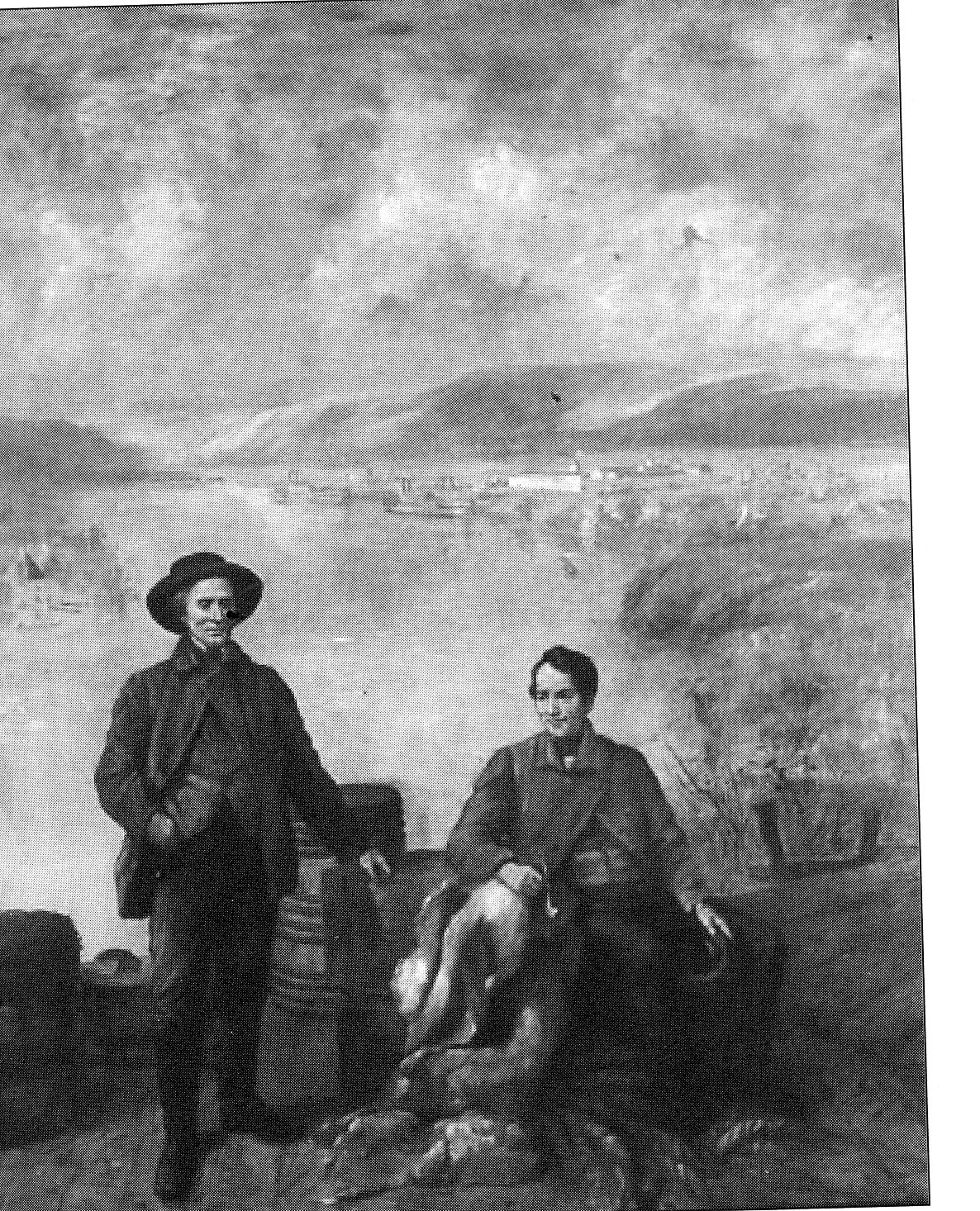
A fantasy vignette of Dawson (R) and Chouteau in front of Ft. Benton.

But there was an earlier episode, worthy of Game of Thrones.  In 1835 Alexander Harvey, another frontier hothead, had been frustrated by Culbertson's insistence on negotiating with the Crow at the siege of Fort McKenzie instead of using violence.  Harvey and Culbertson were barely restrained from violence between them by Pierre Chouteau, Jr. the company owner.  When Culbertson was away from Fort McKenzie, Chardon -- yet another drunk and hothead -- was sent to take over.  In January 1844 twenty Blood warriors came to the fort but were not admitted.  They were angry, killed livestock and then left, but Chardon and Harvey chased them.  The warriors set their trap first: Chardon's slave, Reese, was sent to reconnoiter from a hill.  He was shot in the head and died instantly, then was scalped, much grieving Chardon.  

Chardon and Harvey's trap was to aim their loaded cannon at the front gate, where the tribe customarily would gather while the chiefs came inside to negotiate.  Not only would they kill the chiefs once they were inside, but also they would fire the cannon through the open gate to kill as many as they could.  Then they could take all the furs as well as keeping the trade goods.

Soon enough a Northern Blackfeet party (who had no relationship with the previous attack) arrived and the machinery began to work.  The plan suffered when the chiefs sussed the plot and tried to escape, which made the people scatter but not fast enough.  Women and children were killed along with others, and the traders did acquire a lot of buffalo hides.  But that was the end of trade with the Northern Blackfoot for a long time.  Dawson was big, fire-haired, but much more patient, and certainly fair-minded. In the end he coaxed them to return. 

This is Jerry Potts' family.
The Bundles on the tripod are Sacred Calumets and their accessories.

Dawson's Blackfeet wife was called Kuta, and their children were James and Grace.  He also had a "wood's colt" whom he nevertheless watched out for, and a second marriage after Kuta died, to Pipe Woman, daughter of Running Fisher, produced a third son, Thomas Erskine Dawson in 1859.   Because of friendship with the father of Jerry Potts, he had taken that boy under his wing.  Through his wife he had ties to Little Dog, the same as Clarke had ties to Mountain Chief.  Family had big consequences for everyone.


Jerry Potts became famous as an interpreter and negotiator.

The problem with steam boats was not so much the boats as the notorious Missouri River, which changed channels, floated whole trees, emplaced sand banks and then removed them overnight, was deep and then shallow.  To make the steam, the boat had a heart of fire that sometimes escaped control.  Like the later railroad, the steamship companies saw the advertising advantage of subsidizing artists, scientists and noblemen.  Among them was Audubon, so Dawson got to meet his hero.

Most of these Scotsmen who came to work for the American Fur Company or had intersected with them in some way back in Scotland, formed a friendship network that was sometimes strained by violent temperaments that triggered outbursts from the indigenous people.  Many of the men had indigenous wives, whom Andrew claimed they loved and supported, as well as each other's children.  Indeed, Andrew himself had lost his father when he was eight and had been protected and guided by a friend of the family.  In the tribal world, uncles also took responsibility for children and widows.

There were times when Andrew was facing atrocities as ferocious as any in today's Africa -- mutilation, dismemberment, cannibalism.  He settles the dog-eating question once and for all:  everyone ate them and they were objectively tasty and tender.  Esp. if you didn't know what they were.


Andrew Dawson, back in Scotland for his last years.

This is a very careful work of scholarship on both the main narrative and the edited letters.  But it is also a roaring and amazing tale that only happened a century or so ago.  It is still just under the surface all the time around here.

NOTE:  I am not so careful as the authors and tend to conflate Culbertson and Dawson.  With Lesley Wischmann's help, I've made corrections after the first version.