Showing posts with label nature mysticism. Show all posts

Saturday, January 03, 2015

EMERGENCE

"The Philosopher Kings"
Soft Rock Canadian Band 

“The idea that there is some eternal essence from which all reality is derived gives a sense of the eternal. But such fantasies need to be abandoned along with the equally seductive idea (for the teenage male) of Philosopher Kings. In a sense I stand more these days with Heraclitus in thinking that everything flows, nothing stands still. To go as far as Nietzsche in suggesting that Being is an essential fiction probably takes the idea to the extreme but flow as a concept and as a metaphor is the (sic) essence of understanding complexity.”
David Snowden

“Emergence” is a formal principle like “synergy” which means two things interacting to create a third thing that is “better”, more complex.  I became aware of this first because of working with metal alloys in the bronze foundry.  They had to be molten to mix but bronze was copper melded with other metals and even silicon.  Each combination had its own characteristics.

Then I saw when working with dogs how “breeds” would mix.  Left alone, rez dogs become pye dogs (rustlers) or guard dogs (big and fierce).  I’ve watched the social development of the human rez to see what emerges.  It’s not genetic, but an alloy of systems and beliefs -- very complex, escaping the control of almost everyone who tries, somewhat impoverished by the weakened ties to the indigenous animals.

Here’s from that mysterious collection of unnamed people who write on Wikipedia.  “In philosophy, systems theory, science, and art, emergence is conceived as a process whereby larger entities, patterns, and regularities arise through interactions among smaller or simpler entities that themselves do not exhibit such properties. In philosophy, almost all accounts of emergence include a form of irreducibility (either epistemic or ontological) to the lower levels. . .  For instance, the phenomenon life as studied in biology is commonly perceived as an emergent property of interacting molecules as studied in chemistry whose phenomena reflect interactions among elementary particles, modeled in particle physics. . . Neurobiological phenomena are often presumed to suffice as the underlying basis of psychological phenomena, whereby economic phenomena are in turn presumed to principally emerge.”

There are three main afflictions that come from the idea of “emergence.”  One is the idea that it’s possible to get to a few basic essences as particle physics constantly pursues little bits.  Existence is bottomless and so is emergence.  Another is the idea that emergence can be predicted and a third is that emergence can be controlled.  As a sub-category, people don’t realize that emergence can change everything (the internet changed books, telephones, spying, the African continent, outer space) nor that emergence doesn’t stop.  Whatever has emerged will be the substrate for whatever emerges next and it will be equally unpredictable and uncontrollable.  That includes the human species.

I am Heraclitian and Taoistic in my response to this.  That is, seeking and changing.  Follow the flow.  There’s a lot more to read, but right now I’m going to follow the threads related to “religious naturalism”

Ursula Goodenough

“Examples are detailed in a 2006 essay titled 'The Sacred Emergence of Nature' by Ursula Goodenough”  “Science and Spirit describes her as a warm, brilliant and embracing woman, [whose] contradictions make up a harmonious whole – sort of like nature itself, and describes her book as a poetic and accessible bestseller.”  I'm sure she's a lovely person, but this interpretation is total nonsense, liberal cant and I’m tempted to be more rude by changing a vowel.  Note the commercial endorsement.  Mother Nature as product. 

Embracing nature as poetic and accessible will get you killed and eaten, as Timothy Tidwell found out.  If you think of emergence in terms of starting small and growing, what is most emergent at the moment is ebola.  If you think of emergence as something less concrete, it may be social.  It is likely to be biological in the broadest sense, like the new realization that horizontal gene-swapping among living entities is constant and everywhere, so what is emerging is (as usual) our consciousness.  It was there all along.  

Code cannot be confined.  (That goes for ideas as well as cell code.)  More practical is facing and adjusting to the major changes in the lives of people in the ebola-affected areas of Africa: political, economic, familial, emotional and in terms of relationship to the rest of the continent and planet.  The bats in SE Asia appear to be carrying antibodies for ebola.


Stuart Kauffman

So maybe I’ll go to a 2006 essay titled 'Beyond Reductionism: Reinventing the Sacred' by Stuart Kauffman, although that takes me back to Edge.org where old men are still fighting the Christian God.  “Kauffman frames a new scientific world view of emergence and ceaseless creativity, which, he notes, is "awesome in what has come to pass in reality, and God enough for me and many, where God is the creativity of the universe, yielding a global ethics of respect for all life, the planet, awe, wonder and spirituality cut free from a transcendent God."   

See what I mean?  Still in thrall to the old system, chained to the negative and metaphor.  ("God is love.")  Respecting "living things" but not inanimates like the breathability of the atmosphere or the power of geology.  Actually, this way of thinking is not emergent.  The trouble with any wiki is that it’s conventional.  Because it is drawn from a lot of people, even the “cutting edge” is conventional.  And the assumption that crowd-wisdom has value or meaning is always liberal.  They reject sin (legalities) but they don’t recognize evil (malevolence).  In their systems the indifference of the cosmos is never recognized.  Anyway emergence has nothing to do with such categories as living vs. dead.


It doesn’t matter how much a creature evolves, if the planet shifts and the shift pushes the creature out of its homeostatic stream, it’s gone.  No more evolution for that little swimmer.  But its absence will make ecological space for something else.  The temptation is to describe all the possible ecological niches and even to try to control them.  But eliminating bats will NOT eliminate viruses.  It might eliminate pollenization or insect control.  Are there robots for those?

An early argument (1904-5) for the emergence of social formations, in part stemming from religion, can be found in Max Weber's most famous work, The Protestant Ethic and the Spirit of Capitalism.”   Prosperity churches.  (Send money, send money, send money!) But I’m watching for “felt meaning” and for distinctions between the feeling of the sacred vs. religious institutions and technology.  Not seeing much.

I’m not going to pursue the emergence of schools of art or the emergence of the artist.  At one time I did a lot of reading about creativity but most of it was useless.  They did not deal with whatever it was that emerged in the Paleolithic mind that we now call art and creativity.  Why did they begin to strew flowers on the dead and make ornaments from bone and metal?  


The most important emergence sequence goes like this: code, cell wall, polarization between inlets and outlets, connecting structures within the cells, cells linking up into small creatures, small creatures evolving into specialized creatures, internal structures developing in the creatures, creatures forming groups, emerging internal structures of tissue enable “virtual structures” of felt meaning in a sensorium that guides actions and develops into a connectome of operations among senses and actions, giving rise to empathy and need to communicate which is an emergence of consciousness.  Sound management (speech) emerges, then writing which lets more complex history and thought systems emerge -- and so on.

“God” is an historically emergent concept based on family, kingship, and war.  This concept is an interpretation and has no reality.  Much violence has emerged from it, and this is one source of unconscious concepts interacting in ways that would, for instance, make a man believe he should kill his child or another man order all babies of a certain age to be killed.  But also emergent is the empathic and felt meaning of loving and protecting each other.  If the planetary conditions are favorable, it is possible to thrive with delight.  

Traces of ebola in Asia now.  No actual cases so far.

If planetary or social conditions are miserable, something will emerge that might be totally unexpected.  It was not the gay movement that made AIDS emerge -- it was cutting African forests for profit and building roads to take the wood to market.  It could be argued that same sex desire was set free by the pill because it undercut the reproductive component of marriage and let women earn their own livings.  Something is now emerging in Russia and something else in the megacities.  Something else among the indigenous peoples of the world -- in conversation forming a planetary sense of justice and participation.  The moguls don’t know, can’t know.  They look for profit and never see the small scurrying forces of little boys roasting little bats on sticks.

Jungle S'mores

Monday, June 16, 2014

LIBERAL CORRUPTION OF SPIRITUALITY

Montreal demonstrations against Quebec Liberals raising tuition.

So if spirituality is corrupted and prevented by rightwing Mancheism forcing everything into good/bad, thumbsup/thumbsdown, light/dark boxes, excuses for stigma and the relentless need for control, what are the equal opportunities for corruption from the left hand side of the culture: the liberals and do-gooders.  A moment of googling and I can make a list.  I’m not even counting mommieism.

1.  Spirituality becomes causes and causes mean institutions, marches and endless money raising.  Competitions, awards, speakers.  They have so much fun, they forget the issue.
2.  It’s always a great opportunity to be “holier than thou.”  Personal leadership often means personal arrogance.
3.  Spirituality sells, esp. if it’s from some anthropological “other” source like the Native Americans, the Tibetan Buddhists, ancient Chinese ideograms, etc.  Dream catchers, prayer wheels, little statues of Buddha or Ho-Ti.   Vids full of water, clouds and trees.
4.  Lots of things to do:  Classes, therapies, Tai Chi in the park, yoga at home, meditation.  Travel to exotic places.  (Tip: spirituality is never about things to do.)
5.  Discounting and ignoring the daily realities of life that need tending, all the while claiming to “rise above” all that dish-washing and bill-paying.  (No wonder there's nothing to do.)
6.  The always dependable short-cut through drugs.  (Alcohol works, but it’s a little downscale.  No liberal would be caught "huffing," would they?)
7.  Elitism.

All this is particularly obvious when it comes to the environment.  For many people “nature mysticism” almost defines spirituality and they will tell you solemnly that the mountains are their church.  But in the next breath they are wanting to pass laws about wilderness, march to preserve the plants and animals in the state they would like (lots of big predators, no game hunting, save every fish species), and make idols of sun phenomena like rising, setting, rainbows, sun dogs.  Pretty soon there’s a business conducting groups of worshipful people to watch wolf packs slip through the trees or whales make a big splash.

This is not spirituality.  Spirituality is when you aren’t apart from anything, observing it, but rather a shift of one’s internal consciousness so that you are participating, not even that -- in fact, you’re not even you anymore.  The boundary is gone.  You are being everything.

Nail down those boundaries.

Do I believe that?  Well -- I admit it’s more of a working premise than a developed way of life.  My boundaries are pretty tough and thick.  But I’ve had glimpses and they were vivid enough to make me work towards understanding.  I’m pretty sure that if there’s a rule, an institution, a course to take, a march, or any hint of bureaucracy -- that’s not spiritual.  I look at ads for books about “deep ecology,” “deep time,” despair work and so on, all promoted by attractive wise old women, and I think, “Wow, I’d better read that book,” but when I get them they are empty.  Full of the obvious.  The works of the entitled.  They talk about the rage and trauma, but it’s not really about them, even when they claim it causes them to have PTSD.  They are living nice lives, blameless, or they wouldn't be able to find a publisher.  I always think of that gaunt Somali woman with the dying baby, walking barefoot for miles on cracked hardpan in search of water.  Her cultural advantages are woven fabric, uncut, tied as a garment, and an old tin or plastic container for the water.  She might know a song.


Spiritually liberal folks like green things, they don’t like nuclear power, they ignore most science and math, they love Buddhism in its more theoretical aspects -- not detachment -- and they don’t climb mountains.  That’s for guys.  These spiritual women prefer the Elm Dance or the Spiral Dance and will give careful detailed instructions about how to do it properly.  They compose poems and songs.  They claim and dominate spirituality and it is all about humans.  Except other people's babies.  Other people should not have babies.  If they aren't raised properly with every advantage, who knows what they might do?

I go to a website about “simple living” and it announces a meeting at Starbucks to discuss what rewards and punishments might force corporations to make the world a better place -- meaning more like what they want it to be.  They worry about bees and arctic ice and they wear really elegant handmade jewelry.


Deep spirituality -- the deepest of any deep thing, the abyss -- is not about human beings.  There is an ancient approach called “kenosis” that is a dark vein through most major schools of thought, including all the sciences.  It means empty.  Nothing.  No meaning, no matter.  It’s not comforting nor is it meant to be.  It may require acceptance.

None of this means you’re off the hook for daily functioning.  You still need to do it all and do it as well as you can.  It doesn’t mean you should start a mail-order business about emptiness.  Spirituality means lots of don’t and doesn’t.  Not doing.

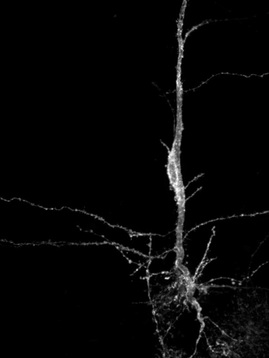
I don’t know what comes next.  In terms of brain development, I think what counts as evolution now is the brain/body/society complex interacting altogether as a whole, but I think it’s intriguing that new sensitivity and capacity seems to be arriving through single cells, the spindle cells.  Spindle neurons, also called “von Economo neurons” (VENs).  Will the next step after the bulging of the forehead to make room for the prefrontal cortex be the extension of antennae to escape the bony skull?  That’s sci-fi.  So far.

Ven spindle cell

In more practical terms, how do we get people to use the potentials they already have?  How do we grow into a culture that doesn’t encourage blows to the head?  (Ours DOES.  Also between men’s legs.  If I were a sneering feminist I might say "their second brain.")  I suspect a lot of people are being born without having that most recent mutation of VENs.  But it interests me that so much recent change is not the result of a whole new organ -- just more individual cell specialization in the society of collaborating cells that is a human body.  Fractal theory would suggest that society is the same: single human beings slowly accumulating change rather than institutions having a committee meeting and recording the ideal on newsprint taped to the wall.


As I sort all these stacks of paper, VERY slowly, I come across useful documents.  Just now, “Mapping a field: Why and How to Study Spirituality” by Courtney Bender and Omar McRoberts, Co-chairs of the Working Group on Spirituality, Political Engagement, and Public Life at the Social Service Research Council.  It’s an attempt at capturing the definition, the history, the political use of the concept of spirituality in various times and places, including a quick dip at magic, all that looking for ghosts in the spiritualist Eastern US.  They point out a sequence of trendy influences:  the Transcendentalists -- esp. Emerson -- trying to pull Hindu and Buddhist thought into their philosophy;  then the mystical wilderness (Muir) and the use of Native American thought (or what was thought to be NA thought); lately our love affair with love and the idea of orgasmic/drug-high access to transcendence; and now the engagement with theories of the cosmos and the ravishing telescopic views of the universe -- all supposedly spiritual sources and powerful enough to give rise to a new religious category:  the “nones,”  the people who declare they belong to no religion, attend no church, but consider themselves to be spiritual.

Maybe they just want to say that they are virtuous (love God and all that) but they do NOT want to be on a committee or attend potlucks or -- least of all -- pledge.  What relationship does this have to the Asian disconnect between being “spiritual” and undertaking social action, a relationship that is strong (almost obligatory) in the U.S.?  Mother Theresa just accepts suffering; Martin Luther King Jr. does not. 

Possibly my idiosyncratic insistence that the spiritual is an abyss, an indescribable depth not at all human, much less individual, is not that different from the Islamic refusal to picture God, to leave that metaphor totally undefined.  But Bender and McRoberts suggest that if only they had access to the social media evidence --  they might be able to capture a reliable description of the nones.  Maybe they should sit down for a talk with Ogi Ogdas and Sai Gaddam to come up with a “billion inspiring thoughts” about how to capture this information.  But no one goes to internet “spiritual sites” the way they go to sex sites -- do they?

Steve Jobs: "enlightened but cruel."