Showing posts with label Polar vortex. Show all posts

Saturday, April 25, 2015

PATTERNS AND CYCLES: SUN SEASONS


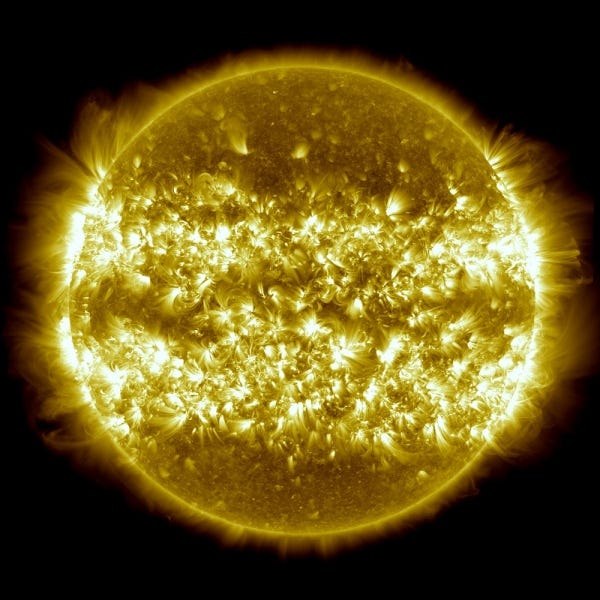
It was fascinating to learn that the sun has seasons. Earth seasons come from the tipping of the planetary axis plus close/far variations in the orbit around the sun. The sun’s seasons are more about internal relationships, not that they don’t affect us. Around here we’re aware of the eleven year cycle that is associated with rainy years and therefore with good saskatoon berry years and floods.


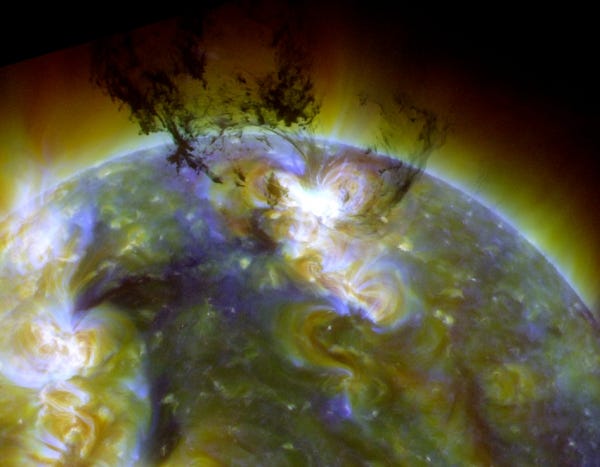
This is the first I’ve heard about the Gnevyshev Gap, “the lag between peak sunspot sightings in a year and a predictable wave of solar flares that follows.” Along the 49th parallel we can often see the jet stream hurtling across the sky and if it loses altitude, we lose shingles off our houses and limbs off our trees. This winter we learned about arctic oscillation and the polar vortex. The vortex is the area of coldest and fastest air on the planet. The jet stream is the outer edge of the vortex. It interacts with air pressure, temperature, and so on by moving north and south.

In terms of the sun, the bands of movement are due to bands of magnetism that pull the surface towards the center, then eject material so forcefully that it shoots into space and showers the earth with ions. To my mind such interwoven and cyclical patterns of energy are much more important to human life — as individuals and as societies — than any concept of “god.”
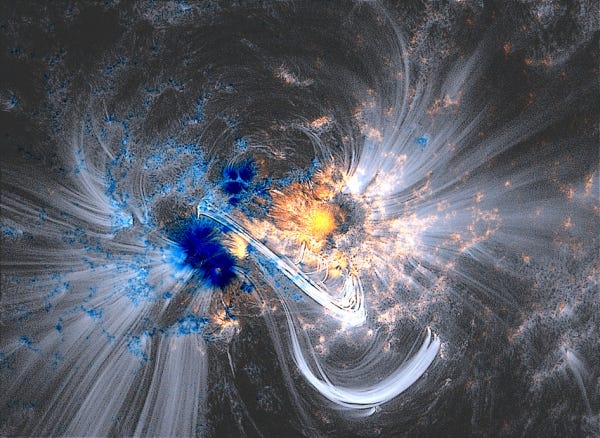


As I age, I sometimes have to stop and re-allocate my energy, looking at the magnetic bands and arctic vortexes. Scientific research is also morphing, not just adding facts but completely changing the concepts we thought were permanent. I like to think I’m aware and in tune with all this, but I’m probably not, and one of the abiding factors is knowing that my knowledge is incomplete.

My days are roughly in thirds: mornings are when I write (partly because in afternoon my brain energy runs low and I make a lot of typing and spelling mistakes), afternoons are when I move around doing maintenance and errands, and evenings are just random intakes: movies and books. My nights are also in thirds: sleep — writing for an hour or so before daylight — more sleep. I try to keep food, coffee and pills in sync with 6am brkfst-12 lunch-6pm supper. Hermits have to watch this sort of structure or one ends up just wasting time when the reason for being a hermit is NOT to waste time. The cats help. They believe in schedules and no matter how lost in ideas I get, they come to bump my rear as a reminder to me. They’ve learned not to meow (mostly) because I shout at them.


I’ve been in Valier, writing, for sixteen years now. Incredibly, publishing has so transformed that it probably needs a new name. On the one hand it has shattered into its parts: discovery, acquisition, production, promotion, delivery. Parts have disappeared, like reviews. Libraries are off-loading books no one checks out anymore but books are no longer pulped — instead they are recorded by vendors for resale, making available eternally what used to be on the market for about six weeks. With the help of computer translations, one can decipher writing and buy books across language boundaries.


This means that regional vs. global divisions are weakening. This means that the literature categories that used to be based on that division are falling apart. When I recently began thinking about Montana literature — a category I once assumed I would join — it had dispersed into ecological and sociological categories, east of the Rockies stretching into high prairies and leaving west of the Rockies in a sort of fancy rump Montana that requires money for lattes. Academic studies that once set up these definitions have fallen afoul of the “romance of the frontier”, pulling in many who live in a virtual world. But once here, the thin population, increasingly non-readers, means the universities produce people who must leave to find jobs.

I had greatly underestimated the degree to which writers in an academic frame of mind will form communities, which in bitter moods I call “circle jerks.” They are dying in windrows just now. So, as when trying to figure out the circumstances of a conception, one counts back from the actual birth, I count back from this wave of age-related deaths. What was happening seventy or eighty years ago? I arrive at war, which generally produces both readers and writers, hurrying up to wait. Paperbacks in hip pockets — now replaced by tablet screens.


War is always meshed with industrialization. Montana writers who enjoy industrialization like to write about Butte. Those who don’t, try to stick to indigeneity (injun-eity) and the dry grasslands. Valier began as open range, went to the industrialized and irrigated wheatlands with it’s connectome of million-dollar tractors, elevators, railroads, sea-going ships and now pump-driven wheel sprays. Impossible to imagine the next step.

Strangely, when I asked Gary J. Cook to help me think of “war” books by Montana writers, we could only think of his Vietnam-based, experience-grounded “Blood Trail,” and the law enforcement follow-up, “A Murder of Wolves.” What ever happened to the guy on a panel with me who wrote war memoirs?  He self-published and was very angry.



At least three social forces move against this awareness of how much Montana activity interacts with industry. One is the feminizing of the academy which has meant a shift to romance; another is the virtual technology of the computer and internet which do not lend themselves to action and land-centered sorts of stories; and the third (there may be more) is what locals used to call “granolas,” people like David Oien who is highly educated and even “spiritual” but very much involved in alternative agriculture (lentils, etc.), guardianship of the land, and worldwide networks. It’s a fascinating repeat of a kind of thinking in my grandfather’s world. Rodale. Green revolution (reconsidered). Hard to keep a granola from growing.
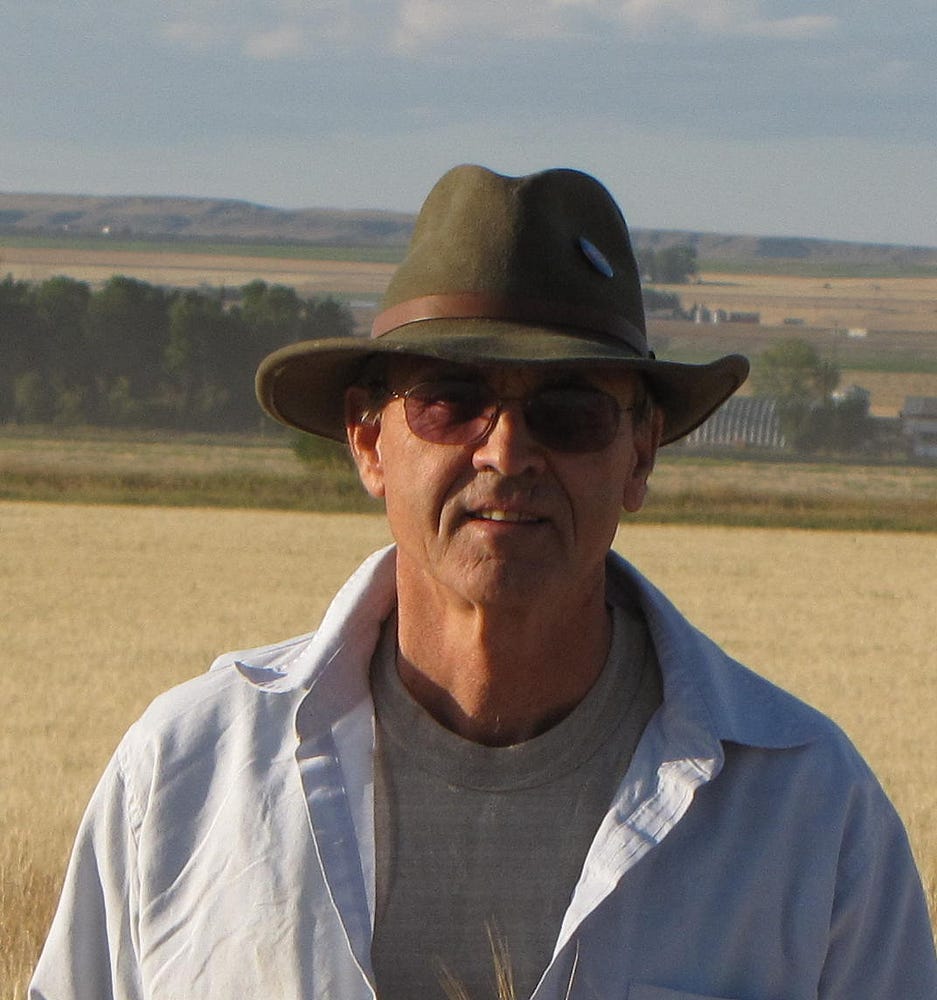


David Oien


Maybe the way into all this is strategy, which ties into electronic games. Maybe the youngsters who would otherwise imagine fiction are doing the same things but with avatars instead of protagonists. They’re also very much dominated by sports. “Game of Thrones,” anyone? These are rather gender-assigned, so the guys who used to struggle to write “the great American novel” have run into a disconnect that used to be bridged by agents and editors of both sexes. Maybe we’re just all pussies these days.


Tom Sheehan


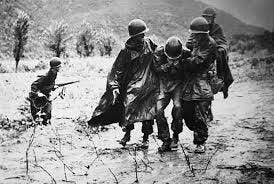
I’m going to set myself some little assignments. The first is to finally read the books Tom Sheehan sent me. He has a firm grasp of a number of genres but he is personally a veteran of the Korean War, the age-group just ahead of me. I’ll see what I can learn. I’ve resisted him earlier, though I like to read his material. It just seemed irrelevant to Montana writing as I was still thinking of it.

But now Montana has stopped existing for me. When I call or email the people in the defined circles of writers and those assigned to keep track of them, I get no answers. It’s partly debris from Bob Scriver. They think they know all about him and his shenanigans. Partly that I’m so aware of the Canadians. And realizing that peripheral academics (humanities) don’t understand blogs or blogging — consider them beneath their dignity. There’s a Gnevyshev Gap.

I want to write about a character who was real when Vollman met her: a female Afghanistan soldier, traditionally validated, entirely private, and not about sex. A crack shot, a sniper — not a truck driver. A person of landscape, self-determined. She slept a little ways from the main camp, but was very much part of it. I like that. Maybe I’ll make her a Blackfeet or Metis. I want there to be guns — not machines, but mechanisms.


Winchester .66, sometimes called "Golden Boy."


Thursday, September 18, 2014

DUST THOU ART


“Global warming” is just a newspaper tag for headline writers.  The real story is almost too complex to grasp.  I’ve pulled together a little link sequence that might help.

The snow in Greenland is black this year.
black (sooty) snow

The Polar Vortex is a phenomenon of the the polar cyclonic air stream (jet stream) that is evidently generated by open seas near Russia. 
and
Polar Vortex with Southern Excursion

If, like my cousin, you are busy remodeling your bathroom and don’t have time to read links, the bottom line is that the small changes in air temp over ice masses darkened by volcanic ash and soot from huge arctic forest fires (black ice) plus the energy made active by the loss of ice cover on Russian seas are the cause of our thirty-six degrees below zero winter last year and probably this year.  Maybe from now on.


But the air is not all that’s writhing.  Just as African countries keep changing their names, and groups of atypical people keep finding their old name pejorative so they have to invent a new one (“gay” is now “men who have sex with men” or MSM  and handicapped people are now "differently abled") what we’ve been calling a “polar vortex” is actually a "southern excursion" of the vortex.  As we learn more, the terms become more “granular.”   So “autism” turns into “autism spectrum” and then we all learn to say “Asperger.” 

Jin-Ho Yoon
“Normally, sea ice keeps heat energy from escaping the ocean and entering the atmosphere. When there's less ice, more energy gets into the atmosphere and weakens the jet stream, the high-altitude river of air that usually keeps Arctic air from wandering south, said study co-author Jin-Ho Yoon of the Pacific Northwest National Laboratory in Richland, Washington. So the cold air escapes instead.”

Bottom line:  my cousin had better think about more insulation in his bathroom or all his work may be undone by frozen pipes.

But here’s a line of thought and particles that is opposite in direction, a flow of air farther south that moves from Africa to the Caribbean and the Amazon.  “Dust in the atmosphere is associated with dry air. Obviously, dry air prevents moisture from gathering ultimately leading to a significantly lesser opportunity for convection, or vertical development of clouds. This dry, sinking air can sometimes cover a large area of the Atlantic Ocean, and sometimes, even more of the Atlantic Hurricane Basin.

“When that dry, Saharan dust is present, its sinking air would prevent a storm from developing. If a tropical storm or hurricane moves into an area of Saharan Dust then that dry air could get wrapped into the storm and eventually fall apart.”

Saharan dust

They say that soil analysis shows that the fertility of the Amazon forests is dependent on the nutrients stored in Saharan dust.  Smaller than a butterfly and not more powerful than the ax and fire.  Is this a new idea?  No, Darwin noted it!

“Ever since Charles Darwin noted "the falling of impalpably fine dust" while crossing the Atlantic during his famous scientific voyage aboard the Beagle, seafarers and researchers have observed African particulates far out to sea.”  and, worse, “Researchers have since found a variety of live bacteria and fungus in dust hitting the Caribbean, defying conventional wisdom among microbiologists that microbes could not survive a five-day trip three miles up in the atmosphere.  Disease travels in dust.

The Windward Islands in the Caribbean

"Swarms of live locusts made it all the way across alive in 1988 and landed in the Windward Islands," Shinn says. "If one-inch grasshoppers can make it, I imagine almost anything can make it." A 2001 study by USGS researchers found that the number of viable fungus and bacteria in Caribbean air is two to three times higher during dust events than during normal weather conditions.”  Bugs are disease vectors.  Climate changes mean new territories for bugs.


I’m beginning to reconsider my tolerant attitude about dust, esp. since it’s probably carrying industrial poisons from the surrounding fields.  Everything is now so "Roundup Ready" that the farmers are turning to paraquat, much more poisonous to humans.  If they treat it as though it was Roundup, people will die.

Fukushima fallout

Some worried a lot about radioactive Japanese fallout from Fukushima, since people in Oregon know that everything from Japan finally reaches the Pacific shore on the ocean current gyres, but maybe we should be more worried about “China haze” from the industrial explosion there.  I remember my aunt, who was a WWII army nurse stationed in Oxford, talking about smog there (from coal smoke particles plus moisture) so thick that at Harrod’s one could not see the counter tops clearly.  What did that do to the children born in those years?

China haze, industrial progress
  
Before she enlisted, my aunt was the head surgical nurse in one of the Great Falls hospitals and said the ice was often an inch thick at the base of the operating room windows. These are not new issues.   But now we wonder whether the dust of outer space, the dust of meteorites and comets, might not be carrying bacteria.

“Life is thought to have arisen in the Archaean aeon, some 4 billion years ago, when Earth was blanketed by a thick noxious atmosphere tinged orange with hydrocarbon smog. The seas and the land were both barren then, and the raw materials of life – water, air, rocks – were bathed in lethal ultraviolet radiation. The planet’s surface was marred by a steady stream of violent volcanic eruptions, asteroid bombardments and icy comet impacts. How could that alien, volcanic, comet-battered globe produce living molecules? The story is that minerals – quartz, pyrite, clays, and the like – must have provided the safe, shielded environments that spawned life.” 

. . .most minerals (two out of three, in fact) arise as a result of biological processes.” . . .

iron in sediments -- the reason blood is red

“The earliest microbes were ‘chemolithoautotrophs’ – a fancy name for cells that get their chemical energy from minerals, in order to make their own biomolecules from scratch.” . . .

“ . . .the Great Oxidation Event (GOE), [was] the single most dramatic event in Earth’s mineral evolution.”  Oxygen in the atmosphere went from 2% to 20% and that changed everything.

“Life arose from minerals; then minerals arose from life. The geosphere and biosphere have become complexly intertwined, with numerous feedback loops driving myriad critical natural processes in ways that are only now coming into focus.” . . .

“Microbial weathering greatly enhances clay mineral production, and enhanced production of slippery clays has ‘lubricated’ down-going plates of rock and accelerated tectonic events – at least, that’s how the story goes.” . . .

So it comes down to gumbo!  Caleche!  The stuff that is so slippery that the builders of the Pyramids used it slide those huge blocks of stone up ramps.  The stuff that makes my house change shape.  The stuff that traps all wheels and makes progress impossible.

What a metaphor for our slippery, shape-changing, clogging cultural beliefs!  Everything is connected.  Everything is significant.  Everything signifies.


Thursday, September 04, 2014

FALL MEANS FALLING AWAY

Available at www.lulu.com/prairiemary

We’re just emerging from a cold spell, though it wasn’t arctic -- not even all that cold except it felt that way after summer and we sort of resented it because there have been only scraps of summer, mild and intermittent.  We kid about our turbulent weather, but it’s at least something to talk about and at best something that keeps a person adapting and planning.  Always carry a jacket.

The real cold was in the middle of last night when the gray woolly blanket of clouds pulled away from the dampened earth and stars like stilettos pierced the sky.  When I was circuit-riding and sleeping in my F-150 van with real bedding instead of a proper sleeping bag, I’d sometimes park for the night in someone's yard up one of the valleys around Bozeman.  On a night like last night, suddenly clearing, I could count on waking at 3AM and having to walk a bit to get my blood moving again.  No regrets.  It was beautiful, sort of exalted.  The family dog always came along, but refused to come into bed with me when we got back to the van.  It would have been warm for me, but confining for the dog, who planned to sleep all day anyhow.

As I write, I can hear Roger out there with the many-times-welded town grader, trying to get some stability out of the graveled dirt streets while it's still damp.  The townsfolk, esp. the men and esp. the ones who are recently moved here, fixate on the state of the streets and incessantly nag about them.  The soil base is unstable, no proper storm drains were ever installed, and everyone screams  when they hear the amount of money that would be necessary to pave the grid. But they’re like that about everything.  Imagine living in the same house with them.

The kittens' fav playground equipment.

The summer was so wet that my yard is well on its way to being a grove of trees and I’m seriously entertaining the idea of letting that happen.  But at the same time, the previous summer was so dry and the winter was so cold (thirty below) that there are a lot of dead limbs up at the tops of all the town trees, sticking out of the leafy boughs below.  


The birds, esp. hawks, appreciate that and perch at the very tips.  The bare limbs fall down in the usual high winds, and I hoard them into a pile.  At first I was going to decorate the house with them -- make archways and woven gates, maybe even some kind of free-standing art project.  But then I thought that it would be better not to attract attention in this town.  They don’t like difference.

When the adults criticize anyone, their children listen carefully because they know that if they perpetrate mischief against THOSE people, they won’t be punished.  I nailed up some sort of Iroquois-looking masks high on the trunks of some of the trees, but no one notices them.  People are not observant about subtleties -- only the major things like mown lawns and the state of the streets.  But I’m fifteen years older than when I moved back to the prairie, and now I don’t have the energy and vision for any major projects except writing.


The pile of limbs, some of which are fairly big, made a good jungle gym for the growing feral kittens, as well as a place to dodge hawks.  I figure if I leave the branches uncut into stove billets, they’re less likely to be dragged off, but there are fewer and fewer of the old fringers who used to have wood stoves.  I’m not dependent on wood -- it’s just a backup.  But the day may come.  Both gas and electric infrastructure are aged.  Not just at my house -- the whole grid.  Every now and then it fails for a few hours.  And they just asked for another price hike.

Squibbie claiming the space under the lawn recliner.

There’s only one feral cat left: the Smudge, who is bereft now that the Skeezix is gone.  I hope that little gold-and-white cat is alive.  It was the only kitten I spared when three female ferals had babies at once.  Skeezix was adopted by the Smudge -- one of the three “mothers” -- to be both her baby and her playmate.  They actually had the same mother.  


Smudge and Skeezix stayed in the yard when all the others disappeared.  Now Smudge sleeps alone and the aging indoor “marmot,” Squibbie, resents even that.  When she has the energy, she chases Smudge.  I would like it if the Smudge joined the house cats.  She’s slender and big-eyed, like a sort of striped trout, and comes meowing softly when I call but won’t let me touch her.  If I trapped her, I could not afford to spay her, or even drive to the free-spay clinic.  So she lives like a bird, on her own, “free.”  Except for food I supply.  Like feeding birds, for the pleasure of watching.


The scientific explanation for the severe winter is paradoxically global warming.  The pattern is that the seas along the Pacific coast of Russia are warmer, which thins the ice and even allows it to melt.  The relationship between air and water is one of energy, as expressed in heat, so that air pulls up energy from open water and carries it across the land just as the water carries it in the huge gyres of the sea.  Normally, there is a steady stream of air, a conveyor belt jet stream, that travels west-to-east across North America roughly at the border between the US and Canada.  We can see it in cloud patterns; we feel it when it comes lower to the ground.  In summer it travels farther north and in winter it comes south, both times passing over us here on the East Slope high prairie.

They say that because of the energy picked up over the open Russian waters, the jet stream gets jags in it that poke down towards the equator.  Normally the stream keeps the arctic air on the north pole side, but when one of the bends -- like a shaken rope -- loops over us, the “polar vortex” forms and brings that air down.  Strangely, there is warmer air north of it so that the true arctic at the same time has atypically warm weather.

We know to stay prepared for blizzards, starting in August.  We've already had one.  I discovered that my pickiup had run completely dry of coolant!  No damage that I can detect.  At least I poured in the new supply through the right hatch.  Once I filled the windshield wiper reservoir with anti-freeze.  The oil change man was horrified, but it worked pretty well.  I have two new tires and new windshield wiper blades.  Before we freeze, I need to remember to hose out the back.  


Living in the cab is a big fat spider, or series of spiders.  This time of year she gets serious about killing flies, which is why I like her.  Somehow she survives my infrequent provisioning runs -- sometimes I see her clinging to the side view mirror with all her legs -- and always replaces herself with an egg sac somewhere.  If I forget to go out and roll up the windows at bedtime, she weaves a pretty web across the opening, so I guess she’s an orb spider.  Soon -- maybe now, because I haven’t gone to look -- the stubble fields will have silky coverlets of spider web, meant to ride the wind, carrying babies to colonize unknown worlds.


This time of year (actually most of the times of the year) this house makes funny little noises: creaks and pops.  I don’t investigate much.  There was a micro-mouse in the house, too small to set off a spring trap, so I got some sticky traps and caught the rodent, but the trap wasn’t fastened down -- I haven’t used them before -- so the mini-mouse was rattling around behind the heaviest furniture for a few days until it either died or broke loose.  Squibbie was fascinated but there were four traps and she stepped on one, doing a screaming tarantella until I caught her and ripped it loose.  We’re both feeling the learning curve.

Sun comes in low and further south now, revealing dust and fur wisps as well as the consequences of my popcorn habit.  Usually by the time I quit writing and get the vacuum cleaner, the floor is in shadow and no one comes to visit anyway, so the chore sinks down the to-do list even farther.  Now we’re due for a week of decent warm weather.  Maybe I’ll work on the yard.  Fall is a falling away, but I’m sure what from.  Or to.  I just know to keep going.


American Prairie Reserve