Showing posts with label Tom Sheehan. Show all posts

Sunday, April 26, 2015

TOM SHEEHAN WRITES ABOUT WAR among other things

Tom Sheehan

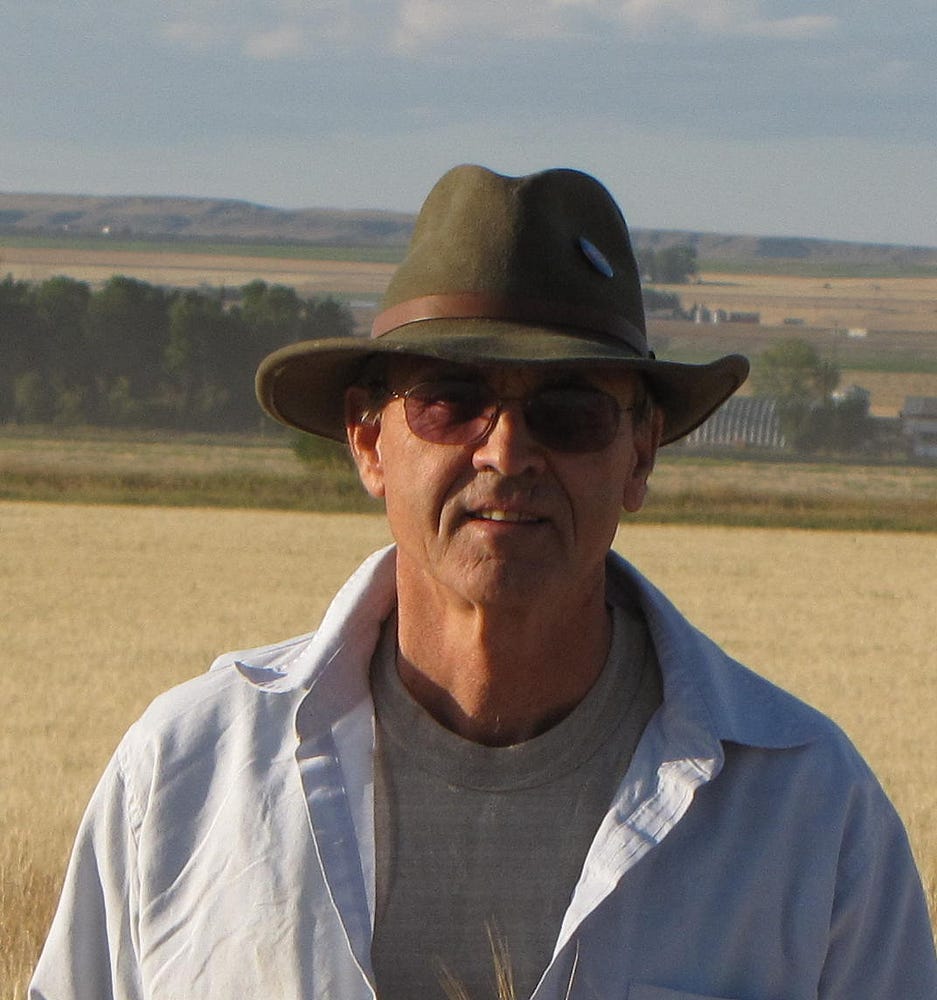
I might be the only person in Montana who knows Tom Sheehan, so I feel obligated to fill in this blank.    He’s very American, a veteran of the Korean War, and a long-time employee of Raytheon in Saugus, Massachusetts.  He wins all sorts of prizes but the Big Five publishers take no notice.  Somehow he manages to write in an old-fashioned plot vs. character way while all the time being curiously modern.  Hard to explain.  He writes about shooting, horses and bad guys -- all with extraordinary names and detail -- but he also manages a poetic grasp of detail and landscape.  He doesn’t stay in categories very well, but once he chooses his “method,” he knows what he’s doing.

So here’s what he did with one short story.  The title is “Aces and Eights” which is the hand of cards that the frontier gambler Will Bill Hickok was holding at the time of his death.  Bob Scriver did a sculpture and so have others. It’s kind of an American folk tale.

by Gib Singleton

In this version the main character is Sergeant Charlie Twohig who so loves to gamble that the cards are like an extension of his hands.  Hear the word echoes?  I think they’re rooted in Sheehan’s brain.  Some people don’t like the Hickok/Twohig reminder.  Writing workshop people sometimes classify alliteration with comma errors -- to be extirpated at once!  (I think it’s part of the Hemingway obsession.)  Nor do they appreciate the metaphor joke about hands of cards in hands who play cards so much that the cards becomes extensions of hands.  But this story is woven out of “tells,” the little giveaways of tick and gesture that a gambler can’t help happening but which are very helpful to a really “ace” player.

Tom Sheehan

The plot points come along like cards coming down.  The men are in a convoy of LST’s, frying under the sun, trying not to think about Ceylon, their ultimate destination.  An early scene is Twohig manipulating Corporal Tally Biggs into cutting cards for stakes.  His hands literally itch and he has a kind of “high” that he attributes to the heat but also to the prospect of a winning streak.  The heat is so intense that when a sweat-soaked soldier leans forward, there is a little explosion of steam from his back.  Biggs asks Private Jake Breda whether he has ever felt so intensely excited that he was sick from it.  Breda ("breed her") says only on his wedding night.  (This is an old-fashioned story.)  A little thread of sex weaves in.

Corporal Tally Biggs comes to sit by Charlie, who calls him “Twig”.  Twig suggests that without his ever-present cards, Charlie would seem naked.  Twohig agrees and gets him to cut cards though Biggs has already lost a lot of money to him.  Biggs is obsessing about sharks in the Red Sea but doesn’t twig to card sharps.

Having had enough fun with Biggs, Charlie moves to Captain Redmond.  The gambler has nothing but contempt for every one -- they’re all losers.  Redmond is ugly, stuffy, wearing a tie in the heat.  Twohig “accidentally” kicks his “box.”  But Redmond has aces in his pocket, letters from Twohig’s wife.  She clearly loves her mad gambler husband in spite of being much superior to him, but out of concern for him, she has betrayed him.  Redmond “has never had, owned or partaken of a woman for any extended period of time, though he knew how deep the hooks of a good, true love went.”  And he falls in love with his fancy of what Twohig’s wife is like:  “big of bust and hip, blond hair, bue eyes, skin like buttermilk, and tremendously good in bed.”  

Korean Graveyard Registration

Gradually we realize these men are not going into combat.  They are a “Graveyard Registration” company meant to find and ceremonially bury the dead, even the ones of their own company who die in the course of performing the task of search and burial.  Victims of ghastly torture need to be buried and the sight of them sticks to the insides of one’s eye, even in sleep.  Another writer might have gone into detail about rot and so on, but Sheehan only gives a few nasty little anecdotes.

Sheehan knows that the real story is in the uncomfortable relationships among the men, misunderstanding each other, keeping secrets, and building up hatreds and obsessions while somehow struggling forward with their assignment.  So the greedy gambler, who suddenly hits a period of good luck he would not be able to believe except that his health seems to be losing a long battle with tropical parasites and that interferes with his thinking.  He is so resented that his lethargy is interpreted as gold-bricking so he is pushed on and on.

This is genre writing -- for the people.  This is the sort of story that lends itself to telling around a campfire, oral literature.  But that would lose the little trills of poetry.  (“A licorice sensation ran through Charlie Twohig.”  I’m still thinking about that one!  Sweet, dark and a little funky -- twisted?)  But I’m thinking that all these hot-wire boundaries:  prose/poetry, written/oral, are just more academic distinctions from workshops.  When such fences are disregarded by writers with real skill and a strong sense of plot, they become powerful.

Part of the surprise in this story is how it all turns out in the end when all the little clues and tells pay off.  I won’t give it away, but in the end Charlie Twohig is no match for Redmond.

Tom Sheehan

From “Epic Cures: A Collection of Stories by Tom Sheehan.” (2005)  Press 53, PO Box 30314, Winston-Salem, NC  27130

I came to know Sheehan by reading his short stories on “Rope and Wire,” a website that refuses to give up the Westerns of the Fifties when the veterans were trying to find their feet.  Sheehan has almost 400 stories on this site: every one of them in the Western template.  Something unjust and terrible is happening, a hero with a clever name decides to do something about it, he faces impossible odds but wins in some improbable way.  The site owner doesn’t allow sex, which discouraged me, but Sheehan deftly leaves sex out.  I thought it was his taboo, but as I look at this collection, I see it was not.

http://www.ropeandwire.com/authors-spotlight Sheehan served in the 31st Infantry Regiment, Korea 1951 and graduated from Boston College in 1956. His print/eBooks are Epic Cures; Brief Cases, Short Spans (from Press 53); A Collection of Friends; From the Quickening (from Pocol Press).

Books from Milspeak Publishers include Korean Echoes, 2011, nominated for a Distinguished Military Award and The Westering, 2012, nominated for a National Book Award. 

His newest eBooks, from Danse Macabre/Lazarus/Anvil, are  Murder at the Forum, an NHL mystery novel, Death of a Lottery Foe, Death by Punishment and An Accountable Death. 

His work is in Rosebud (6 issues), The Linnet’s Wings (7 issues),Literary Orphans (4 issues including the Ireland issue), Ocean Magazine (8 issues), Frontier Tales (9 issues), Provo Canyon Review (2 issues), Western Online Magazine (9 issues).

His work has appeared in the following anthologies: Nazar Look, Eastlit, 3 A.M. Magazine, Appalachian Voices,  Jake’s Monthly Recollections, Lady Jane’s Miscellany, Loch Raven Review, Rusty Nail, Red Dirt Review, Erzahlungen, R&W Kindle #2 and; 4, Peripheral Sex, Storybrewhouse, Wheelhouse Magazine, Home of the Brave, Green Lantern Press, River Poets Journal , Writers Write and A Tall Ship, a Star, and Plunder.

He has 24 Pushcart nominations, and 375 stories on Rope and Wire Magazine. A new collection of short stories, In the Garden of Long Shadows, has gone to press with solid pre-release reviews and will be issued by Pocol Press this summer. 

Tom Sheehan, the family years


Saturday, April 25, 2015

PATTERNS AND CYCLES: SUN SEASONS


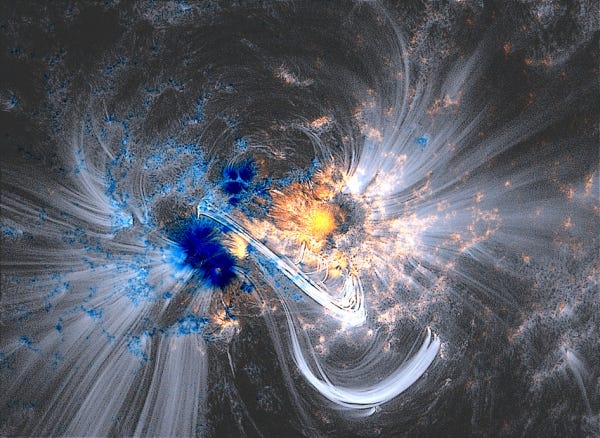
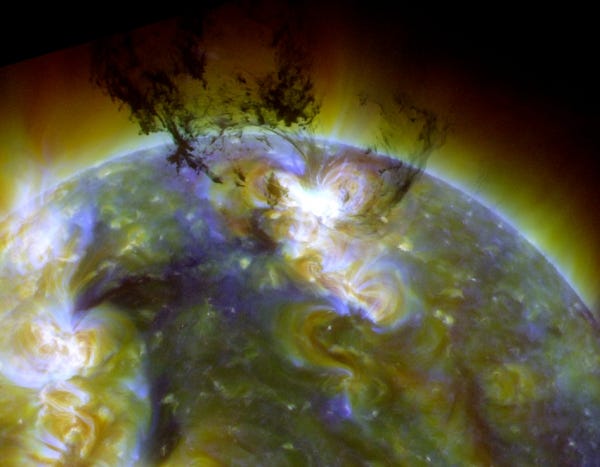
It was fascinating to learn that the sun has seasons. Earth seasons come from the tipping of the planetary axis plus close/far variations in the orbit around the sun. The sun’s seasons are more about internal relationships, not that they don’t affect us. Around here we’re aware of the eleven year cycle that is associated with rainy years and therefore with good saskatoon berry years and floods.


This is the first I’ve heard about the Gnevyshev Gap, “the lag between peak sunspot sightings in a year and a predictable wave of solar flares that follows.” Along the 49th parallel we can often see the jet stream hurtling across the sky and if it loses altitude, we lose shingles off our houses and limbs off our trees. This winter we learned about arctic oscillation and the polar vortex. The vortex is the area of coldest and fastest air on the planet. The jet stream is the outer edge of the vortex. It interacts with air pressure, temperature, and so on by moving north and south.

In terms of the sun, the bands of movement are due to bands of magnetism that pull the surface towards the center, then eject material so forcefully that it shoots into space and showers the earth with ions. To my mind such interwoven and cyclical patterns of energy are much more important to human life — as individuals and as societies — than any concept of “god.”


As I age, I sometimes have to stop and re-allocate my energy, looking at the magnetic bands and arctic vortexes. Scientific research is also morphing, not just adding facts but completely changing the concepts we thought were permanent. I like to think I’m aware and in tune with all this, but I’m probably not, and one of the abiding factors is knowing that my knowledge is incomplete.

My days are roughly in thirds: mornings are when I write (partly because in afternoon my brain energy runs low and I make a lot of typing and spelling mistakes), afternoons are when I move around doing maintenance and errands, and evenings are just random intakes: movies and books. My nights are also in thirds: sleep — writing for an hour or so before daylight — more sleep. I try to keep food, coffee and pills in sync with 6am brkfst-12 lunch-6pm supper. Hermits have to watch this sort of structure or one ends up just wasting time when the reason for being a hermit is NOT to waste time. The cats help. They believe in schedules and no matter how lost in ideas I get, they come to bump my rear as a reminder to me. They’ve learned not to meow (mostly) because I shout at them.


I’ve been in Valier, writing, for sixteen years now. Incredibly, publishing has so transformed that it probably needs a new name. On the one hand it has shattered into its parts: discovery, acquisition, production, promotion, delivery. Parts have disappeared, like reviews. Libraries are off-loading books no one checks out anymore but books are no longer pulped — instead they are recorded by vendors for resale, making available eternally what used to be on the market for about six weeks. With the help of computer translations, one can decipher writing and buy books across language boundaries.


This means that regional vs. global divisions are weakening. This means that the literature categories that used to be based on that division are falling apart. When I recently began thinking about Montana literature — a category I once assumed I would join — it had dispersed into ecological and sociological categories, east of the Rockies stretching into high prairies and leaving west of the Rockies in a sort of fancy rump Montana that requires money for lattes. Academic studies that once set up these definitions have fallen afoul of the “romance of the frontier”, pulling in many who live in a virtual world. But once here, the thin population, increasingly non-readers, means the universities produce people who must leave to find jobs.

I had greatly underestimated the degree to which writers in an academic frame of mind will form communities, which in bitter moods I call “circle jerks.” They are dying in windrows just now. So, as when trying to figure out the circumstances of a conception, one counts back from the actual birth, I count back from this wave of age-related deaths. What was happening seventy or eighty years ago? I arrive at war, which generally produces both readers and writers, hurrying up to wait. Paperbacks in hip pockets — now replaced by tablet screens.


War is always meshed with industrialization. Montana writers who enjoy industrialization like to write about Butte. Those who don’t, try to stick to indigeneity (injun-eity) and the dry grasslands. Valier began as open range, went to the industrialized and irrigated wheatlands with it’s connectome of million-dollar tractors, elevators, railroads, sea-going ships and now pump-driven wheel sprays. Impossible to imagine the next step.

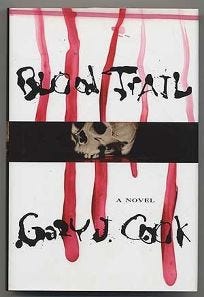
Strangely, when I asked Gary J. Cook to help me think of “war” books by Montana writers, we could only think of his Vietnam-based, experience-grounded “Blood Trail,” and the law enforcement follow-up, “A Murder of Wolves.” What ever happened to the guy on a panel with me who wrote war memoirs?  He self-published and was very angry.


At least three social forces move against this awareness of how much Montana activity interacts with industry. One is the feminizing of the academy which has meant a shift to romance; another is the virtual technology of the computer and internet which do not lend themselves to action and land-centered sorts of stories; and the third (there may be more) is what locals used to call “granolas,” people like David Oien who is highly educated and even “spiritual” but very much involved in alternative agriculture (lentils, etc.), guardianship of the land, and worldwide networks. It’s a fascinating repeat of a kind of thinking in my grandfather’s world. Rodale. Green revolution (reconsidered). Hard to keep a granola from growing.


David Oien


Maybe the way into all this is strategy, which ties into electronic games. Maybe the youngsters who would otherwise imagine fiction are doing the same things but with avatars instead of protagonists. They’re also very much dominated by sports. “Game of Thrones,” anyone? These are rather gender-assigned, so the guys who used to struggle to write “the great American novel” have run into a disconnect that used to be bridged by agents and editors of both sexes. Maybe we’re just all pussies these days.


Tom Sheehan


I’m going to set myself some little assignments. The first is to finally read the books Tom Sheehan sent me. He has a firm grasp of a number of genres but he is personally a veteran of the Korean War, the age-group just ahead of me. I’ll see what I can learn. I’ve resisted him earlier, though I like to read his material. It just seemed irrelevant to Montana writing as I was still thinking of it.

But now Montana has stopped existing for me. When I call or email the people in the defined circles of writers and those assigned to keep track of them, I get no answers. It’s partly debris from Bob Scriver. They think they know all about him and his shenanigans. Partly that I’m so aware of the Canadians. And realizing that peripheral academics (humanities) don’t understand blogs or blogging — consider them beneath their dignity. There’s a Gnevyshev Gap.

I want to write about a character who was real when Vollman met her: a female Afghanistan soldier, traditionally validated, entirely private, and not about sex. A crack shot, a sniper — not a truck driver. A person of landscape, self-determined. She slept a little ways from the main camp, but was very much part of it. I like that. Maybe I’ll make her a Blackfeet or Metis. I want there to be guns — not machines, but mechanisms.


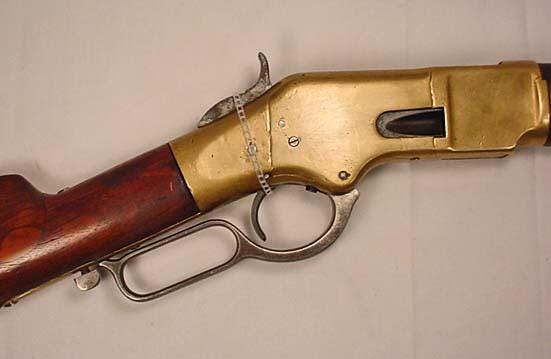
Winchester .66, sometimes called "Golden Boy."


Thursday, October 30, 2014

TOM SHEEHAN: A TWO-GUN WRITER AND POET

Tom Sheehan

Tom Sheehan writes in two genres:  template Westerns and poetic encomium.  You could say he's two-fisted.  He writes novels as well, but those are long guns.

The short stories are mostly on www.ropeandwire.com.  The template is Fifties TV series lasting 45 minutes. The main character is going along.  He is observant, resourceful, and responds to need.  Something unjust happens.  After considerable trouble, possibly the use of weapons, the hero restores order.  The language is old-fashioned, frontier style, and full of poetry disguised as exaggerated folk metaphors.  Very often a boy is involved.  The setting is an integrated virtual world, coherent and derived from (mostly) reading or movies -- entirely believable in terms of the story.  It's like an excellent pocket watch that circumscribes a virtual world, then takes the back off to show the springs and cogs moving the plot along.  We know what will happen, but not quite how, so the puzzle proceeds.

As an example, I’ll just discuss the latest short story, though they all meet the same criteria.  “Chase Holman” is a boy who makes miniature lead soldiers.  He’s kidnapped and the narrator, a trapper named Edward Joseph Dundeen (“Edjo”) who is a Highlander and therefore a moral man, accidentally passes the kidnappers and their victim on his way to “Juice Slattery’s” place to sell the furs on his packstring of mules.  He says, “Juice’d buy a bucket of old grease from me. . .”  But he doesn't realize he saw a kidnapping.

When he gets to town, he learns about the crime. For the mother’s sake (Grace, wearing yellow, who fainted on learning of it so that she was lying there on her back with “them big yellow you-know-whats prouder’n any mountains we ever knowed."  She's elegant and gracious, maybe like Grace Kelly.)  For her sake as well as the generous reward, Edjo sets out to retrieve the boy.  That boy, even when rolled up in a rug and draped over a horse, had the presence of mind to drop one little lead soldier at a time for clues, each little soldier with a personality and role of its own so they become characters in the story.  At the end point, he drops two together outside the hideout of the kidnappers.  The subtext of the story -- which like all Tom's stories creates a virtual world complete in itself -- is the lead soldiers creating a strategy of miniature not-quite-scouts, a virtual world inside the author's world.

Edjo’s mind is on pie.  He says the boy will be back “in his Mom’s kitchen in a matter of hours, having three-minute eggs or a day-long soup off the back end of her stove, sure as shooting.”  Just before the shooting begins, the boy pretends to drop one last little figure and kneels to pick it up, giving Edjo a clear shot at the bad guys. “It was sweet and smooth as eating lemon meringue pie.”

Maybe the best way to explain the poems is to just include one:

The Tom Sheehan Family

BURIAL FOR HORSEMEN
(For my father, blind too early.)

The night we listened to an Oglala
life on records, and shadows remembered
their routes up the railed stairway like
a prairie presence, I stood at your bed

counting the days you had conquered.
The bottlecap moon clattered into your
room in vagrant pieces . . . jagged blades
needing strop or wheel for stabbing.

great spearhead chips pale in falling,
necks of smashed jars rasbora bright,
thin flaked edges tossing off the sun.
Under burden of the dread collection,

you sighed and turned in quilted repose
and rolled your hand in mine, searching
for lighting only found in your memory.
In moon’s toss I saw the network of your

brain struggling for my face the way you
last saw it, a piece of light falling under
the hooves of a thousand horse ponies,
night campsites riding upward in flames,

the skyline coming legendary.


http://sassafrasmag.wordpress.com/category/issue-3/page/2/  is one place to find “Born to Wear the Rags of War” -- difficult to find a better poem for Memorial Day.  It is printed as prose, but is surely poetry celebrating companions -- more than that -- blood brothers in the Korean War, each wearing the rags of war as they rest together where their various "fathers’ sperm has flung them" to defend a motley but beloved nation.  All Souls Day is November 2.

http://www.milspeak.org/Tom%20Rare.htm  is the location of more poems and insightful comment on them by Laurel Johnson of the Midwest Book Review.  Tom’s dignity, bonded friendships, grand sweep of history interacting with geology, love of strategy, and homely metaphors are appreciated by women in a way that other war poetry is not.  He has a classical mind, tenderly marching through the generations, seeing that he is a link between his father and his sons.


And then there’s this:

“A few years ago we borrowed $60K from a local bank to print a book not yet written. Ten pals each signed a $6k note. It was a book about our hometown, how we wanted to keep what was escaping us, the memories, the fragile memories. We paid the bank off in five months. We sold 2500 copies at $42 each and have a self-sustaining account for scholarships for Saugus High School students. Four kids have been helped in college. It's the John Burns Millennium Book Associates Scholarship. John is 89 years old and was coeditor with me; he was an English teacher in the Saugus school system for 63 years and I know hundreds of people who say he was the best teacher they had at any level. And we wanted to keep our memories intact. The book was called, A Gathering of Memories, Saugus 1900-2000 .”

This is a way of life that has somehow slipped away, or maybe it’s just that our attention has been diverted by school shootings and football players who are rapists.  People in this Saugus life have histories that go way back, know the big sweeping foundational literary works that Europeans and Americans used to share with pride, and use their rather abundant personal resources to celebrate their heroes.  

But I snapped at Tom when he sent more poems, signing off with the advice to “enjoy.”  “Enjoy” is for pie.  This work is not bakery goods: not sweet, not consumable, not for easy praise, though he admits he’s a “praise eater” who hopes to be told it’s good work and will even go out of his way to find someone (like me) who thinks heroes are good, old friends are a worthy subject, and Massachusetts is a place to live and celebrate.  They make movies about such lives with grand old actors -- Paul Newman or Clint Eastwood -- playing the lead but they are never supposed to be poets.  Thirty-five years at Raytheon Corporation as a writer and analyst” with occasional forays into the wild world of the West or even his family roots in Ireland is a life I can’t even imagine.    Well, I can -- but I imagined it was gone since we're long since past the Fifties.  

http://www.inkpots.net/Interviews/Sheehan.html  My hopscotch jobs and aborted careers don’t add up to anything vaguely like Tom’s world, but somehow we meet in print and in an appreciation of this tumbling, story-generating planet.  It’s not a matter of enjoyment because sometimes it’s a racking pain nearly unsurvivable.  Tom doesn’t deny that, meets it with dignity, family, and fine words.  That's praiseworthy.  But would Robert Frost say, "Enjoy?"

Saugus, Massachussetts