Showing posts with label geology. Show all posts

Friday, September 13, 2019

AS THE OCEAN RISES

Many people base their identities, esp. when they are dependent on the world as they knew it growing up, on the land as it shaped culture and even the DNA of the inhabitants.  This was more reliable when people stayed in one place so there was little interference from people who know a different land.  Nothing changed very quickly, so what one's great-grandpa told the youngsters stayed true.  Then they could talk about race.  But there were always stories about a land that sank beneath the sea, like Atlantis.


It has been one of the great hardships and scary confusions that big important people talked about a land "bridge" between Siberia and Alaska.  Politicians capitalized on of fear of Others and guilt about the Euros invading America, pushing back and infecting and murdering the people who were already there.  They pictured a line of early people in single file "invading" America by marching across a narrow "bridge."

In reaction, the indigenous people of the Americas declared that they were ALWAYS in America, sprang up mysteriously already shaped into tribes right where they are.  This defied the historical written records of the last few centuries when they were displaced from the east coast, died in pandemics, turned against each other, and tried to find safety on reservations.

Today talking about the Bering Land Bridge will get you into an hysterical fight about something that happened ten thousand years ago.  Among the onslaught of new information that has upended what we thought we knew, is the slow realization that we were all wrong.  There was no "land bridge."  It was a low country, quite broad and stable for a long time until the melting of the polar caps made sea level rise enough to submerge the whole area, something like Bangladesh today.  It's called Berengia and people lived there for thousands of years.

In fact, around the world all the lowlands began to act like Atlantis, the legendary country that sank beneath the sea.  The lowlands that once connected the British Isles, recent enough to have been recorded, were called "Doggerland".  The English channel was not a channel then, any more than Berengia was a land bridge.  This is a map of Doggerland, made from evidence found in new technology.


More recently, another lost land, not quite Atlantis, has been found under the Mediterranean Sea,  It existed 140 million years, before there were people there, but nevertheless named "Greater Adria."  Later it got shoved beneath southern Europe—was broken up and pushed deep under Europe where pieces are submerged in magma, "earth hell."


"Geologists have reconstructed, time slice by time slice, a nearly quarter-of-a-billion-year-long history of a vanished landmass that now lies submerged, not beneath an ocean somewhere, but largely below southern Europe.
The researchers’ analysis represents “a huge amount of work,” says Laurent Jolivet, a geologist at Sorbonne University in Paris who was not involved in the new study. Although the tectonic history of the landmass has been generally known for a few decades, he says, “[T]he amount of detail in the team’s systematic time-lapse reconstruction is unprecedented.”

"The only visible remnants of the continent—known as Greater Adria—are limestones and other rocks found in the mountain ranges of southern Europe. Scientists believe these rocks started out as marine sediments and were later scraped off the landmass’s surface and lifted up through the collision of tectonic plates. Yet the size, shape, and history of the original landmass—much of which lay beneath shallow tropical seas for millions of years—have been tough to reconstruct."

“The Mediterranean region is quite simply a geological mess,” he says. 'Everything is curved, broken, and stacked.' In the new study, van Hinsbergen and his colleagues spent more than 10 years collecting information about the ages of rock samples thought to be from Greater Adria, as well as the direction of any magnetic fields trapped in them. That let the researchers identify not just when, but where, the rocks were formed."

It turns out the variations in the height of the ocean caused by melting, as we are seeing before our faces on photos and TV graphs, have profound impacts on everything else.  When the sea level was relatively low, as it was before, the early evidence was found of the peopling of the Americas by boatsmen riding the Japanese gyring current that carries SE Asia debris from monsoons to the coast of South America.  Estimates are arrival about 60,000 years ago.  Some of the evidence is what might be called "sailor's knots" made by a people with that technology.

"Other researchers who use seismic waves to generate computerized tomography–like images of structures deep within Earth have created an “atlas of the underworld”—a graveyard of slabs of crust that have sunk into the mantle. This research shows that portions of Greater Adria now lie as much as 1500 kilometers below our planet’s surface."

https://www.sciencemag.org/news/2016/11/atlas-underworld-reveals-oceans-and-mountains-lost-earths-history

Losing beneath the oceans whole near-continents, the more recent with established dwellings, and miles of seacoast where today's wealthy people love to live, is only part of the consequences.  The persisting and present continents guide the currents that flow among them, which affects the echoing streams of air above.  The changes of temperature at our poles affect forces like the jet stream that push our climates across the land, but also submerging something like the Panama isthmus will make a new path for the giant sea currents.  

The existence of human beings is due to the major part of their beings as culture rather than more rigid flesh-embedded responses.  But it means change.  At the least the preservation of Manhattan will mean a sea-wall around the island.  But on the global scale the climate and seasons will change drastically, causing droughts as well as flooding.  Many populations will not survive as nations.


It's not just the mistaken notion of the Bering Straits being a "land bridge" that is too old-fashioned to persist, but also the idea that humans, with our relatively short lives, can keep on believing what the new scientific technologies are teaching us enough to cope with them.

Saturday, August 22, 2015

THE WORLD IS ON FIRE


REYNOLDS CREEK FIRE

The real challenge to “Western” (Abramic) religion did not come through theology influenced by math or morality. It was the mountains that did it. That’s a metonymy (using a part to stand for a whole) a metonymy that is not just partial but also a shift in focus that led to an obsession with control and dominance, the prioritizing of logic and adversarial reasoning (legal), the use of written language rather than spoken language, and the drawing of boundaries superimposed on natural phenomena.

The bold raw confrontation with nature which is presented where I live on the eastern slope of the Rocky Mountains challenges all that. Unless it is screened by an aesthetic attitude (“Oh, how beautiful!”) or an itch to summit, it reduces human efforts like settlements and their crops down to dots on a landscape that includes vast sky.

The study of geology began the empowerment of sciences that previously had been reduced to Just-So stories. More even than human experience in awe of the mighty forces of what turned out to be plate tectonics, the evidence of fossils, sedimentation, and earthquakes told us the world was a totality of evolving, constantly displacing, interactional events that reduced us to incidental, even if we named an aeon after ourselves, the anthropocene that claims to have profoundly altered the planet. You think a huge algae bloom, a few degrees of warming, or even an asteroid impact is “profound”? It only is to ourselves and other life forms, and not to all of the latter. The planet has existed through far more challenges. But we won’t.

Survivors of the Twisp fire deaths.

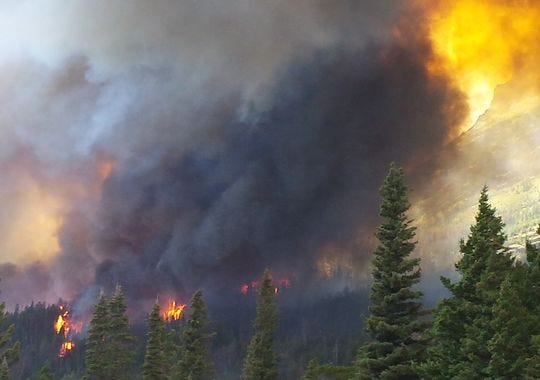
At the moment we here are confronting not the burning bush of the Bible, but the burning mountain. It’s not the flames, it’s the smoke that brings the message. A fire whirl, a cyclone of flames, is very impressive, but not so ominous as smoke. At least last evening that’s the way it seemed. I parked at the western edge of town for a while to watch the progress of a great dark murk of a sky-wide cloud, mostly smoke, moving onto the prairie, an accumulation of what they tell us was the smoke from the Twisp fires that killed four firefighters, added to the Glacier-area fires.

Often at sundown whatever clouds there are will lift up over the mountain ridge line and let the setting sun shoot through. If I’m reading in my front room, it will suddenly be in my eyes, coming level through my west windows. Last night that strip of clear sky was pale blue satin with just a faint hint of the mountains. After dark that clarity would increase in a great curve we call a Chinook Arch and a cold wind would shake us hard for an hour or so. Since my house hunkers among trees, that means occasional smacking blows from dead limbs falling. There are a lot of them this year because of the harsh winter.

These are phenomena, experiences, which can then be explored and calibrated and compared by rationality, measurements, graphs and comparisons. We were having an “average” fire season: 2,364 fires burned 243,168 acres. (Starting June 1 and referring to a region that includes Idaho and Montana.) In 2012 those numbers were 3,433 burning 1.5 million acres — that’s the record. Now we appear to be approaching those numbers.

Undefined or addressed are things like mosaic fires, nothing to do with Moses, but wandering combustion that takes patterns through the forest according to local subtleties like dampness or density, reacting differently through old burns than through new growth.

Fires are named for their locations and as small fires kindle and then merge, the names capriciously make them seem like more or different when they are contiguous. Almost as capricious are the names of places, which might be indigenous or more likely some local nickname that got onto a map, often based on stigmatized people (because they stand out) or repetitions of nature (Willow Creek, Deer Creek, Sweetgrass Hills), but what the heck is a “twisp”?
Beetle-killed trees.

There are still beetle-killed stands. Depending on maturity and altitude, some of this mosaic burn will regrow easily because the seeds are there. The worst is fire so hot that it removes even duff and peat. Of course, the beetles die, too.

Australians know a lot, since their continent has been founded on cyclical sweeps of conflagration shaping vegetation and a climate that is largely dry heat. It does not rain often. In some places, never. Can you call it a drought if it’s always like that? For the displaced English, that rainy place, there was a lot to learn. It was hard to accept wild fire.

Science tells us that we are creatures of oxygen, which was only a feature of the planetary air after zillions of years of vegetation using up carbon dioxide, thus creating a poisonous (to some) atmosphere based on oxygen, a volatile element that became the basis of our cell-life, a quiet combustion supported by our red blood cells that carry it through our bodies once our lung alveoli have taken oxygen from the atmosphere to the core of our bodies so the blood system can carry it through the liquid vessels of our flesh.

Some say "The Thing" is an AIDS parable, but there are several versions.  
Arness was the "Thing" in the first one, 1951.

Recently in films there have been a lot of images of fire, like people on fire. One of the early attempts to make this real-seeming was filmed in Cut Bank. James Arness in an asbestos suit was supposed to be “the Thing” from outer space. (Fire was supposedly the only thing that would kill it.) He was actually on fire. Now there is a computer program that makes things seem engulfed. The Cinematheque and Smash Street Boys love it and soon their vids showed flaming skateboards and bicycles.

What is this attraction? "The Burning Man, “a weeklong communal art installation event in which participants arrive with everything they need to survive for the duration” attracted nearly 66,000 people last year.


Spring-boarding off the Celtic “pagan” ceremony of scapegoating one person to protect the rest, this tangle of events is experience-based, pre-theological. This year it was Stinking Biting Bugs that plagued them. “Where did they come from?” asked everyone. Probably from THEM, the attenders. And the bugs, several species, would be impossible to confine to a wicker cage for burning. When humans get hypnotized by One Big Thing, they forget the power of a zillion little things. God is a swarm.

That is, one’s deity is always drawn from human experience, maybe one’s own and maybe that of a tribe. I was talking to a Methodist minister, casually, and said something about God as an abstract concept, maybe.  You know, like "the Force."  He was aghast and blurted, “If I thought God wasn’t a loving person, just like a human being, I would die.”

He IS going to die, but it has nothing to do with the nature of God. It has nothing to do with human beings either. It is embedded in the nature of life, the experience of life, that it is both holocaust and breath. When the smoke is too thick, no one knows what the fire is doing and it’s impossible to go into the air to survey it or suppress it. But then comes the wind and everything changes. As for your death, the bugs will take care of that.

This morning in Glacier National Park

Monday, September 09, 2013

GEOLOGICAL METAPHORS ON THE EAST SLOPE OF THE ROCKIES


The term Allochthon in structural geology is used to describe a large block of rock which has been moved from its original site of formation, usually by low angle thrust faulting. From the Greek "allo" meaning other and "chthon" designating the process of the land mass being moved under the earth and connecting two horizontally stacked décollements and thus "under the earth". . .

An allochthon which is isolated from the rock that pushed it into position is called a klippe. If an allochthon has a "hole" in it so that one can view the autochthon beneath the allochthon, the hole is called a "window" (or Fenster). Etymology: Greek; 'allo' = other, and 'chthon' = earth.

In limnology, allochthonous sources of carbon or nutrients come from outside the aquatic system (such as plant and soil material). Carbon sources from within the system, such as algae and the microbial breakdown of particulate organic carbon, are autochthonous. In streams and small lakes, allochthonous sources of carbon are dominant while in large lakes and the ocean, autochthonous sources dominate. (Eby, 2004)

The term "allochthonous" is also used in the social sciences, as the opposite to autochthonous.

I love all these geological structure words and the concepts they suggest.  I understand them a lot more easily than I can understand structural concepts that come from human geometry and engineering, like cyber-technical stuff.  So let me see what I can do with this great set of words I just found.  They’re right out of the Rocky Mountains.

Since I’m already reflecting about the current situation on the Blackfeet Rez, which is highly emotional and affects individuals in ways that both evoke and justify passion, what might be gained from looking at the forces in terms of huge masses of stone, especially since the rez is on the east slope of the Rockies where the geology is much affected by subterranean forces?  I left in all the links so non-geologists can check out definitions.  You’ll note that much of this is relevant to oil fields and mineral deposits.  I’ll proceed in a simplistic way.


Structural geology is the study of deformations and stresses and the resulting patterns.  This is what “doodlebugs” (exploring geologists) look for: the patterns that are likely to have created underground capture pockets for oil and gas, or that may show igneous intrusions (volcanoes) that pushed up deposits like the gold in the Sweetgrass Hills along the Canadian border.  


One of the phenomena produced by these forces is a huge block of stone that has been pushed along a weak layer of rock to a new place, usually from low down on the block.  It may be a klippe. “A klippe (Danish for cliff or crag) is a geological feature of thrust fault terrains. The klippe is the remnant portion of a nappe after erosion has removed connecting portions of the nappe. This process results in an outlier of exotic, often nearly horizontally translated strata overlying autochthonous strata. Examples of klippes include:  Chief Mountain, Montana.”


“A nappe or thrust sheet is a large sheetlike body of rock that has been moved more than 2 km (1.2 mi)or 5 km (3.1 mi) above a thrust fault from its original position. The term stems from the French word for tablecloth in allusion to a crumpled tablecloth being pushed across a table.”

Autochthonous is a word I use a lot as a synonym for indigenous, something that developed where it is, out of the potential and materials right there.  I haven’t used allocthonous, something that came in from another place like the Euro-culture wave that came in over the top of the pre-existing peoples on the prairie.  In this case, they didn’t "rumple the tablecloth," they burned holes in it and tore it into pieces.  And then, to pick up the reference to limnology, they threw water on it and all sorts of things floated in.


A fenster (you know, fenestration or defestration: windows, holes; jumping out windows) is a place where it’s possible to see through the overlying allocthonous to the indigenous underneath.  I’m trying to think about what a cultural “fenster” on the Blackfeet rez might be.  Is it North American Indian Days when everyone comes to dance to the drum?  Is it Piegan Institute which supports the Immersion Blackfeet Language School?  Is it the Museum of the Plains Indian where artifacts are displayed and explained?  The Catholic church is clearly not one, though Father Ed tries to make places in the European Mass where the indigenous symbols and values are included as “fensters.”  

But who is sophisticated enough to know what are true fensters?  My criteria would be geological: if it relates to life on the prairie in the buffalo days, then it’s a view of the original autochthonous culture.   It might not have anything to do with material culture: a buffalo robe is not necessarily a fenster.  Taking in a child who has no home IS a fenster, a cultural practice arising from the group that traveled together on the prairie.  A discussion circle that included elders (who are now my age and older) might happily identify fensters as guides for future decisions.

Typically, the basal detachment of the foreland part of a fold-thrust belt lies in a weak shale or evaporite at or near the basement.  Rocks above the décollement are allocthonous, rocks below are autochthonous.  In my view it is clear that the “evaporite” was the buffalo -- that’s what evaporated -- and that the “weak shale” remains economic.  NOT military or even political.  People begin to rebel when they feel they are starving, or shut out from success.  This is a moral issue: all human beings “deserve” enough to eat, a decent place to live, educated children and so on.

When all the supply is on one side (often allocthonous) and the demand is on the other side (often autochthonous) what fensters will help us understand and think of stabilizing the culture “strike and slip”?  Chief Mountain is a klippe that gives us a literally outstanding reference point, in this specific case a guide to where the 49th parallel is, so what are the cultural klippes that will help us all figure out where other “lines” are, even the ones that mark arbitrary allopolitical boundaries? 

At present the tendency is to use strong personalities as guides.  The more prominent they are, the more chief, the more likely to attract attention, but that doesn’t mean they are useful, and often they have become prominent by using the slippage between the allocthonous overburden and the autochthonous substrate.  At the worst they can be Samson in the Temple, which is an old Euro Bible story about a man who pulled the stone temple down on his own head.  It’s in Judges 16.  


But this Samson, Will Sampson, gentle giant, would not have done that.  He bailed out of the cuckoo’s nest. In him was the deep ignited fire of a passionate autochthonous heart.  

Thursday, March 07, 2013

"NAPI'S LOOKOUT: THE STORY OF WILLOW ROUNDS"


Looking north across Birch Creek.
Willow Rounds likely just out of the frame to the right.

Over the years there have been many local historians who converted local history into small chapbooks.  Especially there were women who enjoyed this work of taking stories from talk to print, small cumulative interviews about the families who settled their area.  Among them were Helen West in Cut Bank, Dorothy Floerschinger in Conrad, and Olga Monkman in Choteau.  I knew all of them slightly, but didn’t really remember Dorothy Hamaker until Paul Wheeler sent me a copy of “Napi’s Lookout: The Story of Willow Rounds,”  (1967) which is just north-east of Valier and part of the Canal Company complex history, including the Conrad brothers’ ranch empire.  Seeing her photo jogged my memory.

Maybe a dozen or more of these historians of the local would regularly stop in at Scriver Studio to swap stories, rather like early trappers hanging around a trading post.  Some of them wrote about Indians, some wanted to check out details in stories formally published by George Bird Grinnell or James Willard Schultz, some had family histories entwined with Bob’s sojourn as a band teacher and justice of the peace or with the Browning Merc, and some wanted to write histories of their towns from founding to the present.  Charlie Russell had firmly established the relationship between story and art; Ace Powell never let us forget it.  The product of the talk-to-print impulse was self-publishing, usually printed by a local newspaper plant.  I suppose they were composed on a linotype and the photos were pasted in on layout sheets.

The concept of the Axis Mundi is that the location of the individual is a sort of picket pin around which the person organizes their understanding of life, both practical and spiritual, which is why these historians were clearly located where they wrote.  Usually that point is a town or ranch.  Not so common is what we might call “the Long Town,” which is built along a stream or possibly an important thoroughfare like the Old North Trail.  “Willow Rounds” is a place along Birch Creek, the southern boundary of the Southern Blackfeet or Piegan sub-group of the Blackfeet (Siksika) nation.  The Hamakers ranched there.

In terms of the history of the US, “town” as a compact settlement was a northern way of development, but “plantation” as a long shore-tracing string of locations was southern.  The Blackfeet reservation has three “resort” towns (East Glacier, St. Marys, and Babb), two “old-timer” settlements (Heart Butte and Starr School) and one hub governmental town (Browning).  But there are also several important “Long Towns” (Badger, Two Medicine, and Birch, which is shared on the south shore with Pondera county settlers).  Because they are based on ranches along rivers, their histories include a series of floods.

Hamaker notes several major floods: 1908, 1948 and the Really Big Flood in 1964.  A 1948 aerial photo in the booklet surprised both Paul and I by vividly showing that the “rounds” that gave Hamaker’s ranch its name was not the many tipi rings that are in that valley, but rather round clearings formed by camp circles of the lodges pushing back the brush.  The ranch had a number of owners through the years and that continues to be true.  In the early days, when timber and lumber were both scarce, the practice was often to convert existing houses to new uses, which was made easier when the floods moved whole buildings along to new locations.

This part of the country is formed by ancient volcanic eruptions in the Pacific Northwest that covered the area with fine dust, a very ancient seabed made of limestone, and the scraped deposits of glaciers only ten thousand years old -- all of it eroded by the rush of  water when the glaciers melted.  Hamaker lived in an area called “Bullhead,” because it contained “soap holes,” something like quicksand, in which a bull could sink so far that only its head stuck out -- barely enough to throw a rope on to haul it out.   “In the one map reference from The USGS (United States Geological Survey) the soap holes are in a closed drainage system. The water flows in and does not flow out. This has caused the shales, sandstones and limestones under the bentonite beds to have eroded away, forming depressions in which bentonite from the surrounding area can accumulate.”

Hamaker doesn’t take an anthropological approach to Indians and uses the old-fashioned terms “buck” and “squaw” that suggest they are a different species.  Also, to her all bears are fierce and must be shot.  She came to the territory in 1910 so this is not surprising.  She sees through the lens of local life, so the berries are described in terms of recipes:  “put rhubarb in your sarvisberry pie to give it a bit of tang.”  And yet she knows the Napi stories about buffalo berries, how Napi saw their reflection in water and kept trying to pick the mirrored fruit until frustration drove him to thrash the bushes and curse them with terrible thorns, which weren’t a curse at all, since then they protected small animals, tender plants and even a calving cow with a thick skin.

She describes “Napi’s Lookout” as a high point excellent for watching or flagging signals, and speaks eloquently of an old man who arrived up there without warning, sang mourning songs all day, then slipped away at nightfall.  She says that in the early days the trees were full of burials -- which were not buried but lifted up after being sewn into hide shrouds.  I always wondered what happened to them and she says they were poked down and cut open in search of artifacts, those emotion-laden and occasionally valuable bits of material culture.  She tells us that if you are looking for someone, you should go a little north into Canada and check the “guest book” at “Writing on Stone” where there are many pecked images as illustrated in the movie called “Meek’s Cutoff”Spopee (Turtle) was there, though no one is sure which Spopee.

Hamaker’s understanding of Blackfeet religion is as a sort of child’s version of Christianity, but then her understanding of Christianity is also the simplified and sentimental version of Edwardian times.  She writes poetry infused with it, careful to rhyme and scan.  Near the end of the book is a passage that illustrates her approach so I’ll quote it:

“It was on just such a mission [looking for a calf] that I had to tether my horse and creep into a thicket.  Stooping low beneath the thorns, I discovered a bed of glorious deep-blue violets, cleverly hidden in a silvery bed of leaf-mold.  “Cold Maker” had not yet completely left the valley, and it was delightful to see something bright, alive and cheerful.  One must bow humbly and very, very low sometimes if he would perceive God’s blessings and Nature’s wonders.”

Dorothy Hamaker has many heirs today.  Oddly, most of the ones I know are male singers.  Meeting the way the early trappers used to rendezvous, Jack Gladstone, Wiley Gustafson, Ken Overcast, and all the “cowboy poets”  travel through the “long towns” across the prairie.  They form temporary axles for the wheeling universe along the Long Road of Time.  How’s that for a metaphor?

Thursday, January 26, 2012

"BECOMING DINOSAURS" by David Trexler


When people aren’t cautioning us about following Rome into the crash of civilization, they’re warning us about going extinct like the dinosaurs. They’re just trying to scare us, right? Well, right and wrong.


I first met David Trexler when he was about nine or ten years old. We often stopped in Bynum to check out the rock shop because Bob and the Trexlers were long-time tourist business owners. In the Sixties one night Bob Scriver and I went down because David’s mother was selling her skeleton with an arrow embedded in it. (Not HER skeleton, but she owned it, kept it in a case to show tourists.) Marion, widowed, needed some money fast, but Bob decided against the skeleton. In the Sixties we didn’t know about the dino eggs but they were probably in the buckets around the room.


Here’s a media account of the dino egg story.

http://www.lacusveris.com/The%20Hi-Line%20and%20the%20Yellowstone%20Trail/The%20Rockies/Dino_Hunter.shtml


Now David Trexler is all grown up, a full-blown paleontologist with a Master’s degree from the University of Calgary. And he has written a book: “Becoming Dinosaurs: A Prehistoric Perspective on Climate Change Today.” It’s both reassuring and scary. Reassuring because climate change is not as cut-and-dried simple as the media makes it out to be. But there are still a lot of variables out there and some of them -- the most scary one, in fact -- have not been considered until only a few years ago. You ever hear of “methane clathrate”? Me, neither, but if you did, I’ll bet it was in the news coverage of the big ocean oil rig explosion and spewing. One of the problems -- maybe causes -- relates to this material of methane clathrate clogging the pipes and valves of the rig.


Methane clathrate is basically ice that burns, even explodes. It forms in cold water and there are huge deposits on the “shelfs” of land under the ocean along the coasts. If the ocean deposits -- or any other methane clathrate deposits -- get to a certain temperature, they will be released as gas and rise to the surface. There could be enough released to sharply increase global temps to unendurable levels or even to smother nearby oxygen breathers.


Methane, you know, is the gas that cows and frat boys contribute to the atmosphere at the literal end of their part of the food chain. But the amount is trivial compared to what comes out of smokestacks, cars, and various natural processes. It is part of a molecular dynamic that shapes what life can exist on this planet. Only a few centuries ago humans figured out that “air” was actually something, that it had constituents, and that they changed -- much less found ways to understand how the proportions of gases have varied over the millennia, why, and how that affected living beings. We still know a very limited amount about these unseeable gases.


If we keep on with global warming, it will not just mean that you can grow plants farther north. (Today the Great Falls Tribune had a story about changing the boundaries of the growing zones.) Mostly people are thinking in terms of gradual change, gradual enough to deny. But global warming could easily heat the ocean, which is our moderator of temps planet-wide, enough to release a LOT of methane ice at once which WILL create an actual apocalypse, a sharp rise in planetary temperature over a period in between one and two decades, which will kill a very high proportion of humans and other living things. This has happened at least once in history, according to the records preserved in geology.


Most of the thinking about global warming has been in terms of a household thermostat. We like gradualism -- so we have time to adjust. Our understanding of evolution has also been that it was gradual. But lately there has been new willingness to consider sharp changes -- for instance, genes that relocate or precipitate a cascade of changes. Likewise, there has been a new understanding of geological processes. It’s hard to envision a mountain jumping, even as one looks at photos of Mt. St. Helens erupting, and harder to think about its impact on the atmosphere once the effects are very high.


Much of the thinking about the effects of methane ice melting is described by D. Dorritie on a website called www.killerinourmidst.com and there are other sources of information, but David Trexler’s book is a colorful, thoughtful, deeply informed description that will have you pondering how to take action. The OTHER and quite bright side of understanding methane clathrates is that the deposits are holding energy (methane is natural gas, right?) in amounts that dwarf any oil or coal deposits on land. Now that we know it’s there, and if we can figure out how to “mine” it, we will have a source of energy that can last a very long time.


I’ve been thinking a lot about “short term” morality, which is expedient and can bring in quick profits -- maybe at very high cost, like borrowing against payday at an exorbitant interest rate -- as opposed to “long term” morality which might mean saving or waiting because of the future benefits and resources. It’s also the difference between a few people “making a buck” now and everyone profiting in the long term on a dinosaur scale.


People like David Trexler who work daily, hands-on, with the bones of life forms long gone, while living on the east slope of the Rockies, knowing that those mountains are the THIRD cordillera thrown up by plate tectonics and then worn down to a peneplain, feeling the sense of embeddedness and participation that one gets from living here under high winds and relentless cold, can step away from the greed and markers of success in the cities and corporation board rooms. Grounding in science becomes infused with a kind of mysticism, a protective merging with the land. Okay, it’s religion. It supports a morality.


I’ll go even farther and say that industrialization -- world-wide -- has resulted in a kind of “frakking” of the heart, but this landscape and awareness of its long history since it was part of Gondwandaland, the unified first land mass, will restore you. “Becoming Dinosaurs” is an excellent meditation manual.

Wednesday, July 06, 2011

I CAN SEE IT FROM HERE

Some years ago I wrote a manuscript I called “Heartbreak Butte” about teaching in this remote foothills Blackfeet reservation town for two years, 1989-91.  Predictably, I was fired before I could get to the third tenure-granting year, and as predictably the manuscript was full of whining and resentment.  Now I’m revising it.  One of the things that I did RIGHT was to keep on thinking about the situation and looking for real solutions that weren’t just vengeful.  More about all that later.  
One of the criticisms from publishers (and there were conventional publishers then) was that there was too much geology, something like the criticism that Norman McLean got about his early logging stories:  “There are too many trees!”  The old split between city editors and country writers.  But I see that this manuscript is four times too long and I’ve composed other manuscripts that follow up on this geology angle.  Nevertheless, I hate to just throw out all those rocks, so this seems a good place and time to get them into print.
_________
One summer I attended a literary conference honoring Wallace Stegner after his death.  It was held in his boyhood town, Eastend, Saskatchewan, which is just to the north of Havre, Montana.  At about the same time, it was revealed that a complete skeletal fossil of Tyrannosaurus Rex had been discovered not far away.  It had been kept a secret for several years, because such a find is very valuable -- not just the fossil itself, but also the tourist value of the location.  Quickly, the organizers of the conference arranged for the chief paleontologist to come speak to the literary conference.  (And just as quickly, an enterprising ranch wife put her kids to work baking and decorating dinosaur cookies to sell.)
"What was it like here when the dinosaur was alive," asked someone.
The paleontologist scratched his head.  "Well, the first thing to remember is that there was no "here" then.  One hundred million years ago -- the dinosaurs died out around sixty-five million years ago -- the continents we know now were still together in one mass, Pangaea.  The whole continental mass was much closer to the equator than it is now -- or so we think -- and the weather may have been entirely different.  Quite tropical."  The audience was fascinated.  Prairie people live by the weather.
In the Sixties, the year after the Big Flood, Bob Scriver, his grandchildren, and I had been prowling around the bluff above the Cut Bank Boarding School, idly looking for arrowheads, when we realized we were standing over the complete skeleton of some kind of dinosaur:  head, ribs, legs and tail -- all where they ought to be.  Galvanized by our find, we rushed home to the telephone and tried to find out what we ought to do.  No expert or organization we could locate got very excited.  "Just leave it alone," they said.  "There are lots of dinosaurs."  Crest-fallen, we tried to just forget about it.  So far as I know, it eventually eroded away.
In the June 20, 1996,  Glacier Reporter,  an organization called the Blackfeet Human Rights and Sovereignty Coalition paid for an advertisement covering an entire page to accuse the current Tribal Councilmen of allowing a fossil to be sold for $25,000 which was then resold by a "Canadian firm" for $1,000,000.  Fossils large and small had been "rustled" off the reservation for years and in fact the Council had passed laws against it, but this was the first time anyone had gotten so aroused.  Nothing attracts attention like the words, "one million dollars."  
Much more than a million dollars has been pumped out of the reservation as a legacy of the Cretaceous Era.  Huge oil and coal fields in Alberta hint that there is still more oil and natural gas left under the Blackfeet lands.  As technology advances, resources that were left behind as uneconomical to recover have now become accessible.  Mining companies long to get back to the Sweetgrass Hills, sacred land for the Blackfeet and other tribes, in order to try cyanide heap leach mining on Gold Butte, where a conventional mine was played out decades ago.
But the most valuable legacy of ancient geology is still the Rocky Mountains, the upheaval of sedimentary ancient stone that was later carved by glaciers into Glacier National Park.  It is a major tourist attraction, but the value of the mountains is beyond visitor industries.  Because the clouds coming inland along the storm tracks and jet streams must drop their moisture on those mountains to lighten their load and rise over to the prairie, the mountains themselves constantly feed a myriad of streams that carry water down and out across the dry rainshadow on the eastern side.  The East Front of the Rockies has the fortuitous combination of sun and dependable running water that can create prime grass country.  Of course, because the air has risen, dropped moisture, and then compressed in descent, winds blow constantly -- warm winds that are called "Chinooks" in winter.  They can strip snow off the land in hours.
This is high country -- the prairie comes up from the east in a long easy-rising slope that is imperceptible unless you are watching an altimeter or driving a heavy load.  When the wind comes from the east, it is hot in summer or cold in winter.  Once in a while, a slow bubble of extreme cold drifts heavily from the Arctic and sits . . . and sits . . . and sits, until the foam seats of pickups are like blocks of wood and you must not touch metal without gloves.
The Rocky Mountains are relatively young mountains thrown up by tectonic forces under the continents.  Beneath the Rocky Mountains are other, older mountains, formed over many millions of years of colliding forces.  However the combination of forces worked, the mountains of Glacier Park were overthrown up from the Flathead Valley, so that the oldest stone is some of the oldest on the face of the planet, and the younger layers are on the bottom.  The stone is sedimentary, accumulated as limestone at the bottom of seas when tiny sea creatures died and their skeletons drifted down, as aeolian sediments blown in by the wind, and as volcanic dust, probably mostly from the volcanoes of the Pacific Northwest Ring of Fire.  All of this has been compressed under great weight and heat in the past.
The prairie is also sediment, but moving and shifting whenever the cover of grasses is disturbed, and worn down into coulees and valleys where ever watercourses tumble down from the mountains.  It is estimated that the land has risen three times and been worn away into bench and coulee just as many times.    One more upheaval may be underway now.  No one knows for sure how many periods of drought have set the dirt free to blow or how long the rainy periods may have lasted, except that there have evidently been no trees for a very long while.  No water.  Prairie fires set by lightning or humans.
Huge structures best observed from satellites still persist from the thousands of years ago that glaciers crept down to cover the northern half of Montana, even scooping into the mountains.  Along what would become the United States/Canada border, volcanic action raised a line of hills which during the glacier ages became islands in the ice:  the Sweetgrass Hills, the Cypress Hills, Old Man Lying on his Back, the Bear's Paw Mountains.  Vegetation on the tops of these hills is ancient.  Deep in the earth, poking up through the sediments of the prairie, came blisters of lava that didn't surface, finding ways through cracks and forming what would be-- when the land was worn down again -- buttes and dikes of stone.
Plants and animals must have thrived along the southern edge of the glaciers, just where the climate was too warm to allow the ice to persist, so that there was always water.  And no doubt human beings found their way back and forth along this ice edge, just as they found their way north and south along the east slope of the Rockies until they formed the Old North Trail.  Travois marks are still visible on that trail.  No wonder the people thought of the four sacred directions when their north/south axis was the mountain ramparts and their east/west axis was a green edge along the blue glacier.  Human beings have been on this prairie so long that there seems to be a Blackfeet word for "mastodon."  It may have become the word for bull, "stumik."  
Ten thousands years ago the glaciers began to melt again and form huge impounded lakes, more like seas.  For centuries they deepened, until they found gaps in the hills and finally the gigantic glacial lakes of Montana swooshed down through the southern part of Idaho and through the bed of what is now the Snake River, pounding through lava in what is now the Columbia River and continuing to the Pacific Ocean.  This is how the rivers made such deep gorges through the volcanic rock-- with irresistible force and long-term erosion.
Long ago as this happened, there may have been witnesses.  To this day the Blackfeet don't like or trust water.  They have flood legends, which pleases Biblical universalists.  Their story about the origin of death involves a wager between Napi and his wife over whether a stone and then a buffalo dung will float or sink.  In the end, death wins and it is the woman's bet that makes it so.  So much do the Blackfeet distrust water, that even when they were starving they refused to fish.  An effective form of discipline was water thrown on a child or even up its nose.  Today some Blackfeet are assimilated enough to enjoy fishing from the shore, but few own boats.
A rancher on Milk River ridge, a glacial moraine, once showed me a place on his land where road-builders had dug for gravel.  Where the hillside had been trucked away, the layered remains of three glaciers were clearly visible because of the different colors and textures of the soils.  The rancher pointed out sorrowfully that the middle layer carried wonderfully fertile soil from what must have once been Canadian forest, but the top layer was full of rocks.  "If only the order had been different," he lamented,  "I could grow so much more barley!"  Yet they say that when the glaciers crossed a huge limestone deposit in Canada, ice carried limestone on down to Montana, powdering the stones nicely on the way, and scattering the mineral so that it enriched the grass.  
Sometimes the huge boulders called "erratics" were brought along by glaciers and left sitting solitary so that grass grew up around them, until the buffalo used them for scratching or shade and wore a dirt moat around the bottom.  Hawks perched on them and the Blackfeet found them full of stories.   Just as boulders were left, huge chunks of ice were left embedded in the land.  These melted, forming potholes or "kettles," perfect for ducks and geese.  Around the little potholes grew willow breaks and bush berries, so that humans and animals could stop in the shade or find shelter from the wind.
Along the old North Trail, north of the Sweetgrass Hills and Milk River Ridge, is a place good for scaring buffalo over a cliff.  A meadow nearby offers good grazing, and then an abrupt drop, so that buffalo falling over it would be killed or crippled enough for human beings to finish them off with a spear or a club.  Many of these places can be found.  Layers of ancient bone are interspersed with layers of charcoal where the hunters got rid of their offal.  These people were fire-users, setting fires to renew the grass or drive animals.  Some say the Blackfeet got their name from walking through burnt grass.
At Head-Smashed-In Buffalo Jump, where today there is a fine provincial museum, the archeologists have sifted down through the layers of bone char until they came to the bottom.  They estimate that the jump is roughly the same age as the Egyptian pyramids.  This place near Fort Macleod got its name when a smashed-in human skull was found among the buffalo bones.  The archeologists envision a man running ahead of the buffalo, taunting them to make the thundering monsters chase him and leading them to the cliff-- but when it was time to leap aside, by accident getting swept over in the huge thunder of the herd.
No need for those long ago prairie people to build pyramids.  The outcrops of the land provided plenty of high places.  The land was their life and they fitted themselves to it inseparably, drawing from it not just shelter and water, but also their understanding of time, their sense of fitting behavior, and their endless stories.  The day, the month, the seasons, were their clock.  They watched the sky.  Generation after generation the babies came, grew up in families and cohort groups who taught them how to be human, went out onto the land alone to seek a vision, fought skirmishes that brought joy and grief, made love, talked about everything, sang often, sometimes danced-- until they grew too old and their voices shrivelled into silence.  Then they were wrapped and left on a ridge or perhaps high in a tree with all their material belongings.
This way of life has been described as "deep community," an evolved relationship among land, plants, animals and humans where everything fits together into an ecosphere that sustains lives disciplined by the good of the group and the inevitability of hardship.  Over thousands of years the sensory world becomes numinous, holy, so that everything has meaning in the sense of poetic depth.  The people dream in order to tap their deepest intuitions.  Today many yearn after this way of life. 

Friday, September 10, 2010

THE GEAR JAMMERS CONVENTION

It really wasn’t fair. The worst weather so far this fall -- and we’ve had spates of pretty uncomfortable weather (worse that than if you’re trying to harvest)-- hit just as the Glacier National Park Gear Jammers convention celebrated the Centennial anniversary of the Park itself in East Glacier. Ray Djuff was there -- usually it snows when Ray gets to the Park -- once so badly that he woke up to discover he was the only one left in his motel. Even the owners had gone, leaving him a note and a shovel.

This time Ray was an organizer and had asked me to speak about Bob Scriver, specifically in terms of the Scriver Museum of Montana Wildlife, which had been on the Park tours for the last fifty years. Since I couldn’t remember what time I was supposed to be scheduled, I went up in near-dark to get there by nine AM. I was a little daunted to drive through the underpass and confront the Big Hotel with a giant white marquee tent -- the kind used for weddings in the Hamptons -- pitched in the middle of the putting green out front of the grand old log hulk of the lodge. The famous English border garden along the front path was only a little raggedy but the footing was uncertainly slick.

Leaving everything (including the bronze of “Lone Cowboy” I had brought for show and tell) in the pickup, I went up to the lobby, seething with masses of middle-aged to outright elderly former Gear-Jammers and their wives. The majority of attendees were being loaded into the famous Thirties open tour buses, now proudly rebuilt and restored to their bright red glory, to cross Logan Pass in the fog. In a way they wouldn’t even notice because their heads and talk were so full of stories from the past: embarrassments, near-deaths, pickles and triumphs. As one man said, “That summer job as a Gear Jammer opened up the world for me. I was never the same again.” He became a geologist. (Also a Unitarian.)

These men (no women) were carefully chosen for good judgment, mechanical savvy, person skills, and (I suspect) good looks. Most of them seemed to have hung on to those qualities. The oldest Gear Jammer was in his nineties. Some wives had been maids at the complex of hotels, or waitresses (there were also waiters) who were given preference if they had musical or theatrical skills. The performances at Many Glacier were seedbeds for many careers, great and small but always proud.

The original pattern for this complex of hotels was European with hiking paths connecting lodges. The idea was for the Great Northern to be the feeder for the destination. Since the headquarters of the railroad was in Minneapolis, at first many of the employees were healthy Scandinavian descendants of Minneapolis railroad employees, but the advertising leaned heavily on the mythology of the American Indian, specifically Blackfeet, among whom the conviction had taken deep root that Two Guns Whitecalf was the model for the head of the Buffalo Nickel. Ray has been investigating this claim along with his other treks through archives and stacks. For a while Blackfeet in splendid buckskin parade suits and full Sioux headdress met all the trains and presenting evening programs.

But ordinary rez folks were not welcome, including Bob Scriver and I. The idea was that this was an elegant resort and people should be dressed up, which we weren’t. Then in the days of Red Empowerment it occurred to the tribe that employment in the Park was a no-brainer and they forced the issue, so almost every clerk and maid was Indian. Now the tide is running towards Europe again. Brownie’s, which admittedly is not the Big Hotel but houses many kids for the summer in the Youth Hostel upstairs, employs SIX Lithuanian women (young and beautiful, oh yes) who return year after year. In the winter they go to ski resorts. They are, quite simply, resort professionals. Now once again after supper the Blackfeet come to the lodge to give talks in front of the giant fireplaces, but they are the likes of Jack Gladstone, CD’s available, professional Blackfeet troubadour.

Not many people attended my talk, maybe twenty, but they held their focus while slowly freezing and didn’t leave quickly. My own breath was coming in a plume. They did remember and they had stories to tell, though many were retired and it was clear that the world had passed some of them by -- sometimes in ways they were not aware of, like all the computer access. “Where can I get this?” “Go to the computer.” “Oh, I never touch those things.” “Get a twelve-year-old to help you.” I thought twelve was not too embarrassingly young. Actually most five-year-olds are fairly competent now.

The Great National Park systems were brilliant in several ways. First of all, they really were cathedrals to a lot of people, though I get sick of hearing them raved about just because they are steep mountains and you can see a long way. Second, for the people who work there in summer -- often returning year after year -- they are a reservoir of friendship, experience, and testing that is quite comparable and maybe superior to a classroom. Third, for the local people who actually interact with these folks, they are access to the “outside.” When you live in “God’s Country,” as we arrogantly claim, it’s easy to ignore the rest of the world.

But I could NOT get my audience to understand who Indians are, as various and unaccountable as any other group. I could not get them to see writing as anything but a clever bourgeois pursuit rather like needlepoint, best devoted to friendly subjects. I didn’t even try to get them to see (and did not try) that the “glaciers” are nearly gone and that it is near the end of whatever the warming period of the planet is called. But I think that the man to whom plate tectonics came as a thunderclap in the news while he was driving a red bus full of Minneapolis matrons over Logan Pass -- that man understands without me having to tell him. I said, “Geology is nearly theology,” and he nodded.