Showing posts with label morality. Show all posts

Sunday, January 19, 2020

WHERE IS HATHAWAY NOW?

The mismatched pair of detectives stand looking at the crime scene, which they had been sent to because of concerns about something like the death of a child.  One is a tall thin man who once thought of being a priest.  He didn't exactly lose faith, just sort of misplaced it.

"It's hard to take," says Hathaway.  "Where are the guides for a culture like this one? How are we to cope with infanticide?"

Marigold snorts.  She never loses anything.  "Can you fry a small fish?"  She is belligerent, uses anger as her fuel.  What she loses most often is her temper but not to the point of being blind.

"Yes, I know the Tao and Verse Number 60 about doing things very carefully in a nourishing way."  Hathaway was used to the academic practise of identifying sources.  He couldn't quite stop.

"Your problem is that you can't focus.  You think about the vast universe instead of the small specifics of a particular case."

"Ah, yes."  Hathaway was always wryly aware of his troublesome and troubled nature.  "But my mind with its go-with-the-flow way of thinking is capable of catching fish.  I can think like a fish and predict where it will swim."

"Depends on the kind of fish.  Bottom feeder?  Top-of-the-food-chain?  Maybe not a fish?  We gotta keep our options open here."

"What I like is a case like those invading Asian carp, big fat fish that jump right in your boat!"

"Not always safe."

A gunshot rang out.  Both hit the ground.  Reality is always intervening.  This time the reality was that they were out in a wooded area with a very nervous policeman who came from the city.  He had thought he saw a bear.  "I just fired into the air to scare it off!" he said in a shaky voice.  The two detective scowled at him as they knocked the dirt and leaves off their fronts, pretending to be composed though they weren't.  They both carried notepads and scribbled in the man's badge number.

"There are no bears in this whole state," Hathaway said evenly, always relying on research though it's never possible to know for sure where bears are.  Then their minds went back to the case at hand.

"Just where is this dead child," demanded Marigold.  The officer pointed behind a bush.  The form was very small and had a bit of tarp thrown over it.

Hathaway had no children because he was not able to guarantee them a reliable future.  Marigold had no children because if anything happened to them she would not be able to stand the loss.  But life outwitted her, because to her mind all the children were hers and she could not bear the loss of any of them, not even the worst and most aggravating.  Gingerly, she turned back the tarp.  

It took a moment for them to focus on what they were looking at.  ("Stages" refer to the Carnegie stages of development. ... Week 1 to Week 8 (GA 10)are considered the embryonic period of development. Week 9 to week 37 (GA 11-39) or birth are considered the fetal period of development. First month (4 weeks) after birth is the neonatal period of development.")


"Is this a baby or a fetus?" asked Hathaway. "Has it passed week 37?"  He didn't know everything after all.

Marigold was enraged.  "Of course it's a baby.  The stage it's in is totally irrelevant."  She paused.  "Is this a human fetus?" she demanded.

"Looks like it to me, but is this a deliberate abortion or a natural miscarriage?  Did it happen here or was it brought from somewhere else?"

"Don't you dare call this little mite 'it' when he or she was certainly a child, a baby, a human being even though incomplete."  Marigold was indignant and Hathaway was contrite.  He recognized the justice of that.  But was this far enough developed to be either he or she yet?

Going to what was obvious, he said, "There's quite a lot of blood.  Who would do an abortion all alone in the woods? Or was there someone else involved?"

"Someone who knew it was a crime, you idiot!"  Luckily, Hathaway made it a practice to ignore all name-calling.

"You're full of love, Marigold," he said mildly.  "I expect the mother was desperate one way or another.  We'll have to know the motive."  He thrust his hands into his pockets, a little harder than necessary.  "Well, anyway, if this is a fetus rather than a baby, it's not a case for murder detectives."  

"Maybe we'll have to get a higher authority to decide that."  The two of them stepped back to make way for the coroner's crew with their snapping cameras and evidence collecting bags.  The body bag they had brought was so much too large as to be useless.  The naked little curled bit of flesh fit into a small zip-lock evidence bag.  But they were trained respectful people who didn't make jokes.

The cop who was worried about bears had been abashed and to keep out of sight had been poking around in the underbrush.  Pretty soon he found something he wasn't really looking for.  "Detectives??" he called.  He was pretty sure this discovery might redeem him.

They came slowly, watching where they stepped as was their habit.  The cop had found the mother, quite dead and quite young.  She was sprawled in plain sight with no evidence of struggle or footprints, not even those of her own tennie runners.  Her jeans were pulled up but darkly stained with blood.  Her nail polish was black and her hair was pink.  Her long sleeved shirt might hide both tattoos and needle marks.  The cop went to call the coroner's crew to come back.  They would need their body bag after all.

This was not morally debatable or even unusual.  The detectives made their notes according to their usual pattern of description, estimates, possible theories.  The main question was what caused the death, but as they say in all the best cop shows, that would depend on what the autopsy showed.

Back in the car, returning to the station, the two detectives didn't say much.  The predictability of the girl's death almost overwhelmed the earlier surprise of a baby that wasn't quite a baby yet.

Finally Marigold asked, "How old is a fetus before it becomes ensouled?" She didn't quite expect an answer but Hathaway had thought about it years earlier.

"Some equate it with 'quickening' which is when the mother first feels the fetus move.  Pope Benedict wanted it to be the moment of insemination."

"Oh, God," said Marigold.  "My cat is pregnant.  Last night it was on my lap and I felt the kittens myself.  Do kittens have  souls?"

"Where would Benedict say the girl is now?  Francis would take her into Heaven."

"But where does a fetus go?

"Limbo.  Maybe that's where we are ourselves."


Thursday, January 16, 2020

CAN RIGHT MAKE MIGHT?

One forecast was that today the temp would rise to 8º or even 10º.  Instead, the temp "high" is now supposed to be double digit sub-zero.  I don't know what's going on but I'm imagining two guys fighting over the controls at the weather center.  What it means in practical terms is a big fat bill next month and worry about the plumbing right now.  I'm afraid to take a shower for fear of causing some kind of glitch because of hot water in the system.  After the $800 bill for making the kitchen sink drain (replaced all the piping from sink to sewer), I'm very jumpy.

The other variable is Blue Bunny finally beginning to have kittens.  She's had two so far: white and gray.  They seem licked and fed but Bunny won't stay in the box with them.  Should I bring the box out?  Should I bring the newborns and put them in my shirt pockets to keep them warm?  Why should I worry when the last thing we need is more kittens?

After watching Maddox interview Parnas last night, it's clear what we all suspected:  Trump is deeply involved, cynically and viciously, in destruction and continues to be even as his mind deteriorates.  Parnas, who always appeared a clown with a grin and an engorged thumb, was rational, clear, and while not exactly charming, at least reasonable.  His lawyer never intervened. There are a great many people involved, collaborating. 

So we're all trying to understand the various strategies interacting in hope of some intelligibility by summer.  The people who have known the facts but were holding off until the "dam is broken" are beginning to act.  But I'm dismayed to realize how thin is the understanding of basic concepts, even among the people most involved.  The Rule of Law seems to be very hard to understand.  The closest many people come is the handbook in high school of things for which a person could be penalized.  As one grown man informed me, if it's not in the handbook it's not an offense.  His son was in trouble for something no one ever imagined a student would do.

This is a clue.  "High School" is fairly standardized -- within broad limits -- but the whole idea is not the Rule of Law for the Good of All, but rather it is the prevailing sentiments of winning at sports, getting into college, and being popular.  Also, having the right "things."  In a small town this set of standards spreads through the community.  But it not written down.  It is a norm set by looking at each other.  

When I was in high school (mid-Fifties), one had to wear a white blouse with a round collar and a circle pin.  A tiny bit of variation was allowed, but when I wore a colored blouse with a pointed collar and a pin that was square -- quelle horreor!  So I got defiant and started wearing my father's tartan neckties in the belief they made me seem like a Scottish school girl.  Instead, people asked if I were pledging for some sorority.  I ignored them.

Bandy X Lee speaks of "shared psychosis" or what will google as "Folie à deux."  Much of this stuff is spoken of in French, as opposed to being approved by Latin, which hints at scholarly education rather than dubious deviation.  Yesterday I talked about "norming", not in the statistical sense but as a way of getting a group on the same page.  (Okay.  I admit it.  I'm mixing the metaphors and languages but the concepts are also mixed.)

Some norming is very helpful and even civilized.  I was once at a conference with mixed US and Canadians.  We were milling around while waiting for doors to open.  A Canadian woman remarked in a very loud voice,  "In MY country we queue up!"  We Yanks were abashed and formed a line.  Canadians are considered slightly more civilized. (Except in Quebec, which is French.)

Let's go to boundaries.  People seem to crave to know where the line is, what is "in" and what is "out."  Listening to Parnas last night, it became clear that he thinks he and his co-conspirators were perfectly reasonable and legitimate by corporation rules or -- wait!  Maybe by mafia rules.  (Make that World Mafia.) Whichever, no one in the group questioned the boss or what he wanted.  That's who they "belonged" to.  To their minds, this is natural law.

In contrast, the Russian legislature just turned out not to belong to PutinQuelle horreor!  Mitch McConnell seems to think all Republican senators belong to him, but he may be grievously mistaken.  I hope.  Of course, it's smart not to signal disagreement --- ask the Russians -- and if you do, avoid all windows.  But Parnas, maybe thinking about certain people who self-strangled to keep themselves quiet, has evidently decided that telling everything will make him safer.  Esp. if he can keep everyone interested in something besides the real secrets, like Epstein supposedly keeping sexual secrets when his real secrets were probably international spying.

Somewhere is someone who knows things about McConnell.  But so many of these people who have grown into a group shared psychosis have not considered the possibility that their circle could fall open and that a larger world sees them in quite a different way than they see themselves.  What they thought was privilege and entitlement is only arrogance -- and criminal at that.  

Shifting boundaries that question the rule of law are everywhere.  My twitter feed is full of northern indigenous people who refuse to recognize the nation of Canada or the authority of the Queen.  They aren't Christian necessarily, so where does "Right" go for authority?  Before the Rule of Law, invented to deflect war, there was Might.  Might makes Right.  The indigenous people of Canada are facing  the Might right now.  The Royal Canadian Mounted Police could do them great harm.  What do moral principles matter?  They had the Right to clean water, so we say, but they didn't get it.  Onlookers have no power to boss Mounties around.


What is best and taken for granted by one small group will be challenged by the larger groups, but how can we escape the trap except by trying to figure out a morality that includes the whole planet and not just the human beings.  Many moralities cannot be reconciled with each other, much less one designed for some kind of enforced uniformity.  In the end, like the pro-life movement, many moralities are case-by-case and specific to one time and place.  Can we get by with a principle?  Like that one?  It's hard work.

Saturday, August 24, 2019

A PRINCIPLE OF MORALITY/ETHICS

A strong criticism of the new religious view that I describe -- vast and wondrous but hard to grasp -- comes from thinkers that describe "ethics and morality", one being a practical companion to the other.  The thought is particularly challenged by early StarTrek plots, which were explorations of the 19th century discovery that cultural evolutions of people who stayed in one separated place, like an island or a valley, resulted in unique ways of life.  The basic theme was that they could get themselves into inconvenient and even civilization-destroying predicaments, but that the Enterprise crew should not intervene in the usual Empire-powered way.  This did not "catch on" in the larger American mind.

The continuing confirmation of how intertwined is being of any kind has to be understood as coming from sources like Quammen's "horizontal evolution" or the context of ecology where one adaptation responds to the next.  This moral/ethical principle is inevitable and universal relationship.  Not only is it our fault that the arctic is melting and the Amazon/Siberian forests are burning, all due to the most innocent hamburger or Sunday afternoon drive, but also who I am is the result of all of time before me and will determine what happens to future living things everywhere on the planet.  It's a pretty impossible burden to bear, even by keeping it in mind all the time.  One of my early influences was the parable of visiting the past and stepping on a dragonfly that was a crucial element in evolution. 

In seminary ('78 to'82, which seems necessary to say since so much of thought is chronologically anchored by names and events) we were concerned about Jim Jones, partly because one classmate knew someone who died there, and about economic inequality which seemed a matter of advantages rather than any deep mammalian drive to dominate.  All we had to do was jigger society a bit.  But there were classes aimed at equipping us to do battle for the good, the right and the inconvenient.

One of the most valuable basic courses was from Don Browning, who addressed reality first by defining the methods of decision making.  Were we depending upon rules, in particular classic Christian rules; upon principles; on the example of individuals; in terms of resulting good; in the numbers of people spared?  Does the end ever justify the means?  When discussing some concrete puzzle back in Portland with my much-respected minister, he was jaunty but truthful to himself when he said, "always."  Do what may be destructive but justified.  He lost a bit of my respect at that point.  I'm intolerant, which is often a characteristic of morality.

We spent a lot of time on the sort of dilemmas one must act on in hospitals, like whether to excise a wide disfiguring area of flesh in order to make sure a cancer has been eliminated, or would it be better to just take an amount away that had a high percentage of effectiveness?  We did not address any of the questions about fertility that preoccupy the right, the trope of the helpless child or pre-child who is vulnerable to death.  If we did think about babies born without being viable outside the womb, we didn't talk about the emotional, only the rational.

But the practical presentation of ethics at a major university was limited.  Meadville/Lombard was included in a "cluster" of small denominational entities and our student body was required to meet all the standards of a U of Chicago MA at the School of Divinity, a stringent set of classes and tests that some felt were unjustified for nice suburban congregations.  Having to pass a French test was an early hurdle.  We knew that we were technically admitted to the Div School because in their original founding documents they were required to include a certain proportion of actual practicing clergy among their Ph.D. candidates.  We were a fudge to compensate for the change of society from learned clergy to a more therapeutic and enthusiastic sort.

I knew that I was only attending the UofC because of being admitted as an inclusion from M/L (I turned 40 there) and was a bit embarrassed about it.  I never could have been admitted on my own, though my GRE scores were pretty good.  But I was very much in favor of a meritocracy that gave the minds there so much respect.  They were indeed brilliant.  But only in one way.  The poets among us at M/L were hamstrung by the tests.

The Div School depended upon discretion.  If a person (not necessarily from M/L) wrote an exam text that didn't meet the PhD standards and style, the answer was taken to a faculty woman, a nun, who personally judged it with total secrecy.  She approved of poetry.  She never handled any of my tests and I did learn a bit of print French, but it was a fudge.  Big universities do that.  Is it ethical?  No one asked until now.

The personal case that stuck with me was the final test of an ethics class which was made in a private oral interview.  I went to it exhausted, insufficiently prepared, not entirely persuaded of the material, and feeling stubborn.  I should have been flunked, even by own standards.  But the professor, making what he considered an ethical choice, gave me a B, which at the U of C is about the same as an F.  I was only going to be a congregational minister.

He considered me a lesser mind destined for a lesser role and therefore deserving of exemption from the higher standard.  Later, back in Montana, I heard an education professor say to another professor that he had lower standards for tribal students because "they'll only go home and teach other Indians anyway."  Many indigenous people have depended on D.Ed. degrees to be a move towards professional life.  I made an offhand remark once to one of these tribal people (very respected and effective) that this was true and he never felt the same about me again.


Gatekeepers who stoop in this way evidently think we'll never figure it out, but we do.  The results of this silly wound stick with us, even after we understand that the gate was only necessary because a fence had been established to exclude us unless we had a favor from a controlling class.  So one ultimate moral concern of this new radical monoexistence (which is full of variation) has to be about the placement, nature and justification of fences of every sort.  Gender, nation, employment, skill, education, ability and capacity must be carefully invented and then torn down when no longer justified.

Friday, June 26, 2015

LONG MORALITY VS. LONG STRATEGY


On the way to Cut Bank.


To Cut Bank today early — only 30 miles — to get the rest of my groceries, frozen and dairy plus cheap canned goods. The road is a secondary with tertiaries branching off to ranches and rocker oil pumps. The mountains are mostly bare of snow and stand in vague stony array behind a smoke scrim. The roadsides are full of sweet clover and alfalfa, bushing out over the asphalt, alternating yellow and purple, waving as high as the little pickiup’s doorhandles. The irrigation canals are topped up, hay will soon be ready to cut.

This time I’m thinking about the Supreme Court’s decisions and also about the number of guys around here who are veterans of the “sand wars.” It’s coming down to a comparison of “morality” and “strategy,” son of SunsteinMorality is the sum of the survival wisdom of a specific time and place. Nothing theological about it but rather Levitican or Pauline because it is generally recorded in writing as rules, even commandments. But in the effort to enforce the rules, we freeze into law justifying punishment or those who disobey are stigmatized.

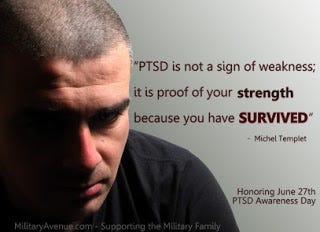
I was reading about veterans who have PTSD, which is pretty much stigmatized in military cultures because backing off from danger won’t work in combat. Therefore, they don’t say a lot about it either. But some suffer a LOT. In a small town like this one the drug that comes easiest to hand is alcohol. In sophisticated circles they call it “self-medicating.” Around here it’s more like “getting drunk enough to sleep.”


Let me be clear: PTSD is a change in the brain, it is not an emotional weakness but a linking, a conditioning, that has wired things together that ought to be processed and separated. This is a chemical, molecular reaction and SHOULD be addressed with meds that can help reverse it. Alcohol will not. It borrows the relief from the future so that like any addiction, the deficit comes due as soon as alcohol intake is stopped. And it erodes every aspect of bodies, not just livers, as well as minds.

Add to that our social acceptance of alcohol, so that the drinker is welcomed to the warm darkness of neon and buddies, a comforting habit often learned in military service. Drunk people are funny and loose — in the beginning. It’s only later that the bad stuff creeps in. For a while Valier had no taverns, but the oil boom has turned a pizza and beer refuge into a place where the parking lot can bloom with fistfights. The strategies of other things to do get bypassed. Drinking begins to take more money and more risk: a DUI, a car crash, maybe even the loss of a job or a life. The high-pay rural industrial jobs — oil, mono-crops with monster machines, wind farms, grain elevators — that are scattered among the ranch lands cannot tolerate anyone with diminished attention and reflexes.


In the few months I taught in Cut Bank, the kids told me about keggers as though they were a naughty entitlement, a reward for winning. Adults pay for the kegs — enablers looking for identification with winners. Most people think about drinking in terms of morality but not with the unforgivingness for hard drugs. They know meth will make you crazy but can’t see the harm of alcohol because it’s always been there, while meth is new. Slowly, gradually, booze leads them into the craziness of bad judgment and links it to sex and the highway. Fucking giveth babies and driving fast taketh away lives.

So morality in the form of an ironclad rule NEVER to drink, to be a teetotaller, a Mormon-all-by-yourself if necessary, might HAVE a strong justification. A few people have the will power to do it, even if their local milieu is constantly luring them. Bob Scriver suddenly quit smoking — no laws posted in public places, no patches, no electronic vapors. He learned smoking in the military where it was a reward, a soothing near-liturgy, a displacement of sex, a little intimate language as well as a casual sharing with strangers, a little respite for thought. I don’t know why he quit. He was a secretive guy. He said he just realized one day that he was being bullied by little white cylinders full of leaves. I do think it helped that I’m a non-smoker.


But if you can’t just throw a lever like that — which is also in part a matter of brain-wiring — then you must go to strategy, maybe a more formal and conscious version of Cass Sunstein’s “nudging”, self-imposed rather than required by laws. A strategy for breaking addiction to alcohol that is related to PTSD is going to be harder than just taking up golf. Not every doc is smart about helping.

The sort of drugs that will help must be “titrated” and there may be a category of them with enough variation that one will work with this person’s molecules and the next one won’t. These are very subtle meds, not suitable for chugging. Indeed, a slight variation of dose or regime can make the difference between working and not working, so there’s a lot of fiddling. That’s part of what I mean about strategy. This is a kind of high-monitoring that doesn’t mean peeing in a cup or blowing a breathalyzer score, but rather the kind of thing that diabetics do with their little machines. It should be accompanied by a lot of encouragement from sympathetic and understanding others. If the morality of those significant others is too fine and lofty to provide that, if they can’t see their own self-interest, then that might mean a Big Change. Like leaving.

Our cultural morality had been so restricting and so rigid, that we’ve reasonably rejected a lot of it. Our youngsters have questioned and discarded a lot of the rules that were meant to reinforce the privilege and superiority of authorities. But too many have gone on to drop even valuable moralities and a few vulnerable and terrified people have been crazed with morality, judging and executing those they disapprove. We do not know what strategy will address this. At least not yet.


Science has opened dialogue on a lot of things we took for granted and thinking about some of their questions is truly transformative. But a sub-category of science — technology and computer-driven statistics — which is heavily laden with profit-strategy — has fallen into the trap of “from IS to OUGHT,” a familiar but sneaky tendency to want to keep things as they are, so as to defend them as somehow moral meaning sacred.. Some of these things are juggernauts that would be very hard to block.

I personally would like to separate sports from schools at every level, but there would be screams of rage. I know because I once preached a playful sermon on why football is sacred to some people and the feedback was furious. The strategy so far is to invent better football helmets. Moral outrage over the sexual entitlement of star athletes or, with younger kids, what goes on in the shower room, seems impossible to change. Statistics say these things are widespread and suggest they are so deeply rooted in our physiology that they can’t be changed, only managed. Like war.


Brave young men, unless they are concussed.


It’s enlightening to compare Obama’s strategy with Scalia’s institutional morality. I think we need to think about “long-morality” and “long strategy.” Scalia’s two-millennium-old-rules no longer fit the world. Obama’s in-the-moment practical strategy may save lives from “pencil death” caused by failure to fund human basics. In the long run this kind of strategy might create a new culture, one we can be proud of. One where, when we go to war, we realize that the real costs and damage will come AFTER peace is achieved, rebuilding lives as well as structures. One that will reach out across the continent through the heat into the little dark air-conditioned drinking emporiums where veterans cluster to heal and perhaps to ponder a new morality.

The boys come here straight from football.

Monday, June 22, 2015

CREATING A PERSON


Now we have established that the human creature is an aggregate of cells that can take in information from the world outside the skin.  We have seen that a little molecular bunching on the end of a chromosome will decide which of the two basic categories of male and female.  And we have understood that there are many variations and stumbles.

An infant comes to the world exterior to the womb already shaped by the months of formation.  Molecular glitches, wandering pathways of tubes and connections, DNA altered slightly by the epigenome or the central stem of the helixes or by interference from the mother’s system -- all this means no two babies are alike.  Their potentials will be met by the various baby care strategies of the place, an ecology that demands practices from putting the baby in a sling on the back of the mother or an older sibling, to putting the baby in a container like a baby carrier swung/propped everywhere, to leaving the child with a lot of others or in the care of a few people focused on food and cleanliness.  One baby can tolerate his treatment, another is always unhappy, and some will die.  The lucky will be happy.


At or close to origin, humans are random, varied, and organic, meaning they just grow every which way, sometimes leaving out parts or adding too many.  As soon as other humans can get at them, and either a blue or a pink blanket is wrapped around them (assuming they are in a prosperous gender-dyadic place), forces will be applied to get them to conform so as to survive in that place.  I have a relative who was born with no thumb: the surgeons moved her big toe to take the place of the thumb.  It works.  She's old enough to be a granny now.

Experiments show that the convictions created in the child during the earliest years will be the “truth” to him or her and only experiences verging on trauma can change them.  The negatives are more intense than positives.  Day care groups can trigger lifelong yearning for a stable pair bond.  Or it can go the other way, so only a group can feel “normal.” 

Learning is achieved by interacting with the surroundings in ways that inscribe the interaction -- through the neural information sent to the brain -- on memory, sensations inscribed on the molecules of the cells.  (We still don't know exactly how.)  To get there to the brain, the sensory information is sorted once at the point of acquisition (ears, eyes, nose), maybe filtered or sorted somewhere else, probably more information is added through previous memories, and finally THEN arrives in the brain where behavior originates.  If the behavior is welcomed (babbling, toddling) it is reinforced and continues.  If it is discouraged (“don’t eat THAT!) it dies out.


Early learning in the interest of fitting into the community becomes “moral,” which is a big part of “religion.”  Morality is what your community wants you to do and is a reason for punishing you or even killing you if you don’t do it.  Survival of individuals, families and communities depend on morality -- though sometimes that’s an illusion, because the original moral basis is gone.   (Leviticus' prohibition of mixed fibers is laughable now.)  One is no longer endangering everyone by doing this forbidden thing.  A good match between moral conviction and the reality of what is dangerous is a good indicator of success and happiness.

The following material comes from a theory:  Relational Models Theory developed by Alan Page Fiske, an anthropologist.  The idea is basically that people are living in one of four kinds of social group:  


“Any relationship informed by Communal Sharing presupposes a bounded group, the members of which are not differentiated from each other.  Distinguishing individual identities are socially irrelevant.  Generosity within a Communal Sharing group is not usually conceived of as altruism due to this shared identity, even though there is typically much behavior which otherwise would seem like extreme altruism.  Members of a Communal Sharing relationship typically feel that they share something in common, such as blood, deep attraction, national identity, a history of suffering, or the joy of food.  Examples include nationalism, racism, intense romantic love, indiscriminately killing any member of an enemy group in retaliation for the death of someone in one’s own group, sharing a meal.”


This state is opposed by An Authority Ranking relationship . . . a hierarchy in which individuals or groups are placed in relative higher or  lower relations.  Those ranked higher have prestige and privilege not enjoyed by those who are lower.  Further, the higher typically have some control over the actions of those who are lower.  However, the higher also have duties of protection and pastoral care for those beneath them.  . . . examples include military rankings, the authority of parents over their children especially in more traditional societies, caste systems, and God’s authority over humankind. 

In Equality Matching, one attempts to achieve and sustain an even balance and one-to-one correspondence between individuals or groups.  When there is not a perfect balance, people try to keep track of the degree of imbalance in order to calculate how much correction is needed.  . . .  If you and I are out of balance, we know what would restore equality.  Examples include the principle of one-person/one-vote, rotating credit associations, equal starting points in a race, taking turns offering dinner invitations, and giving an equal number of minutes to each candidate to deliver an on-air speech.


Market Pricing is the application of ratios to social interaction.  This can involve maximization or minimization as in trying to maximize profit or minimize loss. . . . all utilitarian principles are applications of Market Pricing, since the maximum and the minimum are both proportions.  Other examples include rents, taxes, cost-benefit analyses including military estimates of kill ratios and proportions of fighter planes potentially lost, tithing, and prostitution.
(An interesting related essay:  http://newramblerreview.com/book-reviews/economics/the-mischievous-science-of-richard-thaler)

Since the first group we know is usually family, we get many of our ideas about how groups ought to be from that source.  Parents are the first authorities.  A bad experience with that -- oppression or neglect  or abuse -- can make that pattern an anathema for the rest of a person's life.  People are aware that except in the military or some corporation, America is supposed to be a democracy -- "Equality Matched" -- but it is clearly "Market Prices."  This dishonesty has bad consequences.  One cannot base morality on "bait and switch."  

Bruce Bennet Strachan correcting workbooks

My father, publicly dedicated to the principle of cooperation, was revealed when he would say about some family decision, "We'll take a vote and then I'll decide."  He never could understand that there was no use in a vote if he overrode everyone's preferences.  Neither did he ever feel the growing resentment among us.  This is not an unusual pattern.  He felt morally entitled, but so did we.


Saturday, June 20, 2015

THAT'S DISGUSTING !

Once in a while I come to write a post knowing what I want to say, pinning it on some tale or phenomenon that seems to work well, so I can unfold the thing coherently.  Then I go to Google to check spelling or dates, and the whole story goes cattywampus.  I had it all wrong.  I have to start all over again because my thinking was based on false assumptions.  Of course, that’s good to find out BEFORE I post.

Nina Strohminger

This time it was an Aeon (the online magazine), an article from a woman named Nina Strohminger.  I had just finished a post intended to dissect the parts of what we call “religion” because the meaning has been so confused and misused.  As an important component of “religion,” I offered spirituality and contrasted it with morality on the basis of boundaries.  Morality is always drawing boundaries between “what is done” and “what is NOT done.”  Spirituality is removal of boundaries, radical inclusion.  Nina gave morality the role I had given spirituality, but her indicator was not sin but “disgust.”  At her website she includes a link to her idea of includes the Strohminger Grotesque Art Database. It’s a ZIP file that I can’t open so far.  Here’s the banner: 


In the end I had an academic scandal.  It was clear that Nina was an upstart defiant critic of a stuffy professor.  This squib advertises Colin McGinn.

“Disgust has a strong claim to be a distinctively human emotion. But what is it to be disgusting? What unifies the class of disgusting things? Colin McGinn sets out to analyze the content of disgust, arguing that life and death are implicit in its meaning. Disgust is a kind of philosophical emotion, reflecting the human attitude to the biological world. Yet it is an emotion we strive to repress. It may have initially arisen as a method of curbing voracious human desire, which itself results from our powerful imagination. Because we feel disgust towards ourselves as a species, we are placed in a fraught emotional predicament: we admire ourselves for our achievements, but we also experience revulsion at our necessary organic nature. . . Existentialism and psychoanalysis sought a general theory of human emotion; this book seeks to replace them with a theory in which our primary mode of feeling centers around disgust. “The Meaning of Disgust” is an original study of a fascinating but neglected subject, which attempts to tell the disturbing truth about the human condition.”

Colin McGinn

It is a Puritan point of view with a prurient subtext.  A cover for abuse.


Then I find out about McGinn.  He is a sexual harasser who in 2013 was forced to leave his job.   An example of his attitude is a faculty meeting where he joked about feminists dripping hot wax on their nipples.  The reaction of the nearly all-male group was laughter. Disgusting. He claimed he was misunderstood due to cultural differences, humorlessness and his own superior intellect and knowledge of philosophy of language.”  Even more disgusting.  But not surprising.  I’ve long seen the philosophy Ph.D. as a hiding place for skinny boys with bad breath and no love life who tried to excuse everything with their own brilliance.  At least by now they don’t try to be UU ministers. 

Nina is not a feminist, but one who defends the right to be disgusting, grotesque, repulsive, an outsider (as female academics are sometimes seen).  Not because the judgment of them is mistaken, but that they also ought to be included in the valuing of life -- on moral grounds.  The problem always is that if one draws everyone into the circle of acceptable, what’s still out there?  Charles Manson?  But he’s only insane.  Can insanity be repulsive now that we don’t chain them in dungeons anymore?  A long list of rebellious creators like Pasolini or deSade have made it a point to BE disgusting, because that gives them a vantage point for raking culture.  They are identified as transgressive, but also admired and valued.  Why is that? Because of their morality, which urges protection of the small and weak, honesty and fairness in government, and the erotic.  They work between stigma and compassion.  Disgust is a justification for stigma: the dark, the poor, the infected, the uneducated are "disgusting."

Nina’s doctoral thesis is entitled “The Hedonics of Disgust.”  Thus, she is or ought to be defining her morality over against the conventional vanilla establishment standards, which empowers white males.  She also wants acceptance of her own moral code by the establishment because it signals acceptance of her work as “good.” She seems to be addressing propriety, defying rules about fat or nudity or gender.  I wonder how far she would take this idea.  I wonder whether her moral boundary isn’t ignoring what is not merely disgusting but evil.  Is that a real boundary?  I wonder how much she knows about the Mineshaft, dedicated to disgust as a sexual turn-on.  

Martha Nussbaum

Martha Nussbaum at the University of Chicago in her book, “Hiding From Humanity: Disgust, Shame, and the Law (2004)” was taking on a similar subject but from within the establishment.  Sleek, blonde and lawyeresque, Nussbaum was welcomed with open arms, very much within the mainstream.  I read it, approved, and by now have forgotten what she said exactly.  Bland, starched, near-Puritan.  The contrast is in Nina’s images of the grotesque, which I will NOT forget.  I’m NOT disgusted, but what can you expect from someone who watches CSI-Miami?

I had wanted the next step forward in my “body loop” version of developing humanness to be empathy.  Empathy is an extension of the brain, mostly through the eyes and the mirror cells scattered in the prefrontal cortex above the eyes.  It comes from the phenomenon of seeing someone do something and simultaneously holding an echo of the “doing” in one’s own brain.  It is possible to “echo” emotions in the same way and, in fact, it is this phenomenon at the core of a number of human capacities, as though the eye-beams were physical neuron connections.  In fact, people say they can “feel” eyes on them, even if they can’t see the watching person.

Charity or compassion without empathy is oppressive, even sometimes as bullying and destructive as hatred and violence.  People tend to think of empathy as a thought exercise when it is actually a dark brain "feeling" once the information comes in through the eyes.

Langewiesche’s most recent article in “Vanity Fair” describes a soldier riding alone in the back of a military transport on its way to murdering the five captives with him, a fact he is not quite registering.  He shares a cigarette, one of the captives gifts his “worry beads” to the soldier, two of them -- one an adolescent -- lean against the oldest man and cry.  Even in a print description our sympathy goes to them; description makes them human.  

There in the back of a dark, jolting truck -- trying not to think -- was an indelible challenge to the soldier’s identity, not because of any moral code but because of “feeling with” the captives.  Being a soldier means denying empathy for enemies.  He is unable to prevent the execution of the captives because of the force of mainstream dominance. 

Conversion of St. Paul -- Caravaggio

Denying empathy is the essence of stigma: one has no need to understand lesser beings -- they are considered mindless animals or automatons if they are considered at all.  Empathy is an animal ability, but the capacity to deny it is human.  I think Nina and friends have it upside down.  A primitive form of empathy is a basic component of being animal, closely related to “theory of mind” which is how predators predict what prey will do.  Morality comes later when people are gathered into groups, close together and competing.  It can be arbitrary, as mucky as hatred itself.

I’m on the side of feeling things but I would never exclude rationality or forcefulness from the complexity of a person’s identity.  And I would rule that “soul” is maybe part of identity but never part of morality.  Soul, if it exists, is not a creature of the community, but an essence of a person that connects it to the universal, the “Over-Soul,” if you like, while paradoxically validating its individuality.

Empathy is our access to other people.  We can obey the demands of our particular subculture and appear entirely moral, but without being in sync with others, absorbing them, learning what they know, we are not fully human.  The following is from a review by Maria Popova of Ollie Sacks’ latest book, “On the Move: a Life”

“Who we are and who we become is in large part the combinatorial product of the people and ideas we surround ourselves with — what William Gibson so memorably termed our “personal micro-culture” and Brian Eno called “scenius.” The more different those people are from us, the more they expand the echo chamber of our own mind, the more layered and beautiful the symphony of the spirit becomes. Nowhere is this self-expansion via relationship more evident than in the friendships between great artists and great scientists, one of the most heartening examples of which is the friendship between legendary neurologist Oliver Sacks and the poet Thom Gunn.”

Maria Popova


Of course, today it’s possible to have a worthy, soul-deep relationship with someone without ever meeting them, without worrying about conventional morality.  My friendship with Tim has been like that.  The more different those people are from us, the more they expand the echo chamber of our own mind, the more layered and beautiful the symphony of the spirit becomes.

Cinematheque - Barrus