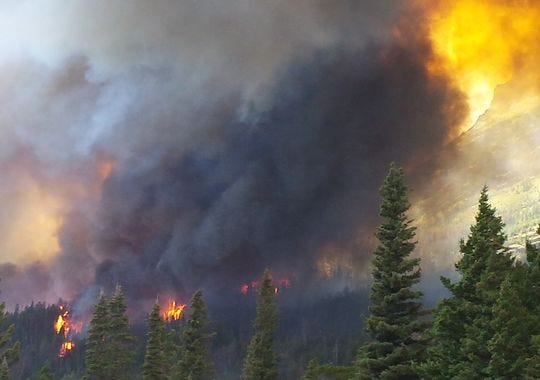
These are samples of theatrical gels for stage lighting that are labeled "bastard amber." All three are very like the light in Valier this evening, which is a more intense version of the light all day. The "Sheep" fire (as far as I know) is at Essex in Marias Pass and has closed both Highway 2 and the railroad, intermittently since they're using it to fight the fire, bringing in men and equipment and taking out the trees and slash they've cut to make a fire break.
Now we're smelling something like incense. It's deeply, intuitively ominous, as though Vesuvius were nearby and we ought to leave. This is true. But there are fire everywhere.
At 7:30PM the light is diminished, now red as old blood. There was not supposed to be wind until tomorrow, but there is. If this house were on fire, I would not be able to tell because it is already full of smoke. I would have to see flames, and the wind is making the leaves outside flicker against the nightlight, the street lights, which give sodium light, yellow. And my porch light is on -- a yellow bug light.
These are meant to be reminders, not facts. Thoughts may added over time. Please feel welcome to contribute thoughts. I'd like this post to be a bit more dynamic than usual, possibly a good basis for classes or books or at least papers.
BOUNDARIES FOR THE RESERVATION
There can be no boundary but the ecology for the original Blackfeet -- that is the boundary was enforced by economics: what there was to eat.
Original boundaries were changed and changed again, so they weren’t real boundaries, only convenient temporary boundaries for off-rez people.
Boundaries actually became “border states” -- that is the land on either side of the Medicine Line (49th parallel) exploited the line.
Gerrymandered boundaries were Dawes Act among “owners”, the “mineral strip” where the oil was, conveniently shifted to the Cut Bank side. The “Ceded Strip” which eventually became the Badger-Two Med wilderness that cooperating forces want to save from exploitation.
Historical: the habitual locations of bands, Campbell’s granges, river valleys that become settled enough to feel like communities.
At least two unacknowledged sociological splits, one between the north and south rez and one between the resort towns and the strictly Indian towns. Maybe one between stockmen in the foothills and grain farms on the flats.
In the Sixties the incorporated town of Browning was considered an island of jurisdiction with the rez, like an embassy but for the State of Montana.
MEMBERSHIP
The history of enrollment lists: who made them for what reason and how were they preserved.
“Blood quantum” and what it really means: genome or pedigree (descent)
Cultural divisions (originally white v. indigenous)
What is the meaning of an Asian basic genome? Are there local, tribal, epigenomes? (meaning environmental forces turning genes on and off)
Some tribes have gone to residence as a requirement for tribal membership.
Impact of the differences between enrolled and unenrolled and “enrollable” but not registered? Money, access to services, entities that “help Indians.”
Self-defining of tribes by tribal members
DEMOGRAPHICS
A. The four confederated tribes on the South Piegan US side (Including Scabby Robes)
B. Gros Ventre
C. Metis/Cree Chippewa
D. Fur traders their tribal wives (Including Iroquois and Hawaiians)
E. Military
F. Mercantile (including whiskey and commodities)
G. Mexican
H. White government vs. white entrepreneurs
I. Romantics: white American, European, blacks
EDUCATION
Gender-assignment both in indigenous and white classes and subjects.
Government schools on the rez, possibly residential
Government schools off the rez.
Carlisle’s impact on the Blackfeet
American Indian Art Institute’s impact on the Blackfeet
The one-room school houses of the early days
The Heart Butte school
The Free School
The Catholic school
Blackfeet Community College
Winold Reiss’ summer art school at St. Marys
COMMERCE
Fur-trade vs. bison meat and robes
Handling of commodities
Whiskey trade
Licensed Indian Traders
Entertainment: show house, bowling alley, Glacier Studio, video, radio
Banking: the “Indian” bank
Mercantile, lumberyard, grocery businesses
Infrastructure coops: electricity, telephone
Passage: highways, RR, transmission lines
Natural resources: mineral (oil and coal), forest, water
Blackfeet Environmental Office: Solid/Hazardous Waste,Underground Storage Tank Program, Air quality, Water quality, Wetlands, Brown fields, Non-point source. General Assistance Program
Law enforcement: Federal, International border matters including Homeland Security, Immigration, CIA, and others.
Tribal court system: judges, lawyers, interaction with tribe
History of the Browning standalone law enforcement years: City Magistrate and officers. Relation to Justices of the Peace, jail, and how began and ended.
ANIMALS
A. BISON
B. Horses, horse racing, first horses, rodeo, working horses, the genetic impact of cavalry and railroad horses, mules
C. Sheep: first domesticated "crop." Why no goats?
D. Chickens and other poultry vs. "prairie chickens"
E. Hawks and owls
F. Burrowers
G. Game animals: deer, moose, elk, mountain goat, mountain sheep
H. Predators: bears, mountain lion, bobcat/lynx, wolverine
I. Fur bearers: mink, beaver, fisher, sable?, muskrat
J. As meaning markers for religious ceremonies
K. Waterfowl, esp. migrators
ARTIFACTS
A. Definitions needed.
B. Sacred objects
C. Antique objects
D. Objects with trade inclusions from more recent times, like bucksin parade suits
E. Who is a qualified expert? A scientist, a collector, a maker, an enrolled person?
F. What is the status of replicas?
G. What is a museum and what is a shop? Auctions?
CEREMONIES
Stick game
Horn Society
“Indian Days”
Pipe bundles
Sun Lodge
LANGUAGE
Understanding that language through its grammar and vocabulary assumes a specific worldview and understanding Siksika assumptions.
Spoken language compared to written language.
Stories only told under certain circumstances.
Variations and versions
Gender-assigned variations
Local drift.
Shifts in world view caused from going from oral to written.
Relearning a language that is not in writing.
English as a second language
Political implications: names on maps, heritage, reinforcement of enrollment.
Junior at the U of Montana with a double major in anthropology and Native American studies.
SAFEGUARD BADGER TWO MEDICINE LAND (from the GF Tribune, Aug. 24, 2015)
I was raised with the traditional values of my people, and found peace in the outdoors.
As a Pikuni warrior and veteran of the United States Marines, it is not only my duty to protect my country and lands but my obligation. It is my obligation to uphold our traditional life and to protect our natural resources for future generations. A Pikuni (or Blackfeet) warrior was shown a code of ethics by his/her elders and the proper protocol for war. For the Pikuni, it was a warrior’s obligation and duty to defend the rights of both the land and the people. Above all there were two distinct reasons a Pikuni warrior would defend and give their life for if necessary — the children, and the land.
The children are the future of the Pikuni and the most innocent members of the community. The land gives us life, and nature is what provides us with all the necessities of a good life. For thousands of years, my people defended our territory, battling disease, starvation, genocide, and forced colonization. We have seen our territory shrink vastly, but still we continue to defend what natural resources we have left, and share them with our future generations.
“Nit-sit-ta-pi-ksim-stat”, which in Pikuni means “Think Native,” the literal translation when broken down linguistically means “Real People Thinking.” Nit-sit-ta-pi which means “Real People” or better Human Being, the word my ancestors used when referring to not only themselves but all the idigenous groups of the North American continent.
Nature and our mother earth provided life for my people and every part of it was considered living. Thus many names in my language including places, plants, rivers and mountains have animate meanings. We understood the power of nature and the importance of respect we had to show to it in order to survive. The natural world is where my people found spirituality. Across the world, different cultures have constructed libraries, temples and churches for the purpose of gaining knowledge or places to worship and pray. My people are no different; we believe the power of knowledge and worship is in these animate elements of nature.
Our warriors are noted in several books for their bravery and aggression toward enemies who threatened the Pikuni way of life. Today, Native Americans serve in the U.S. military at the highest rate per capita of any minority group. Some of these veterans make up the Blackfeet Veterans Alliance and Blackfeet Warrior Society.
To my people there are these designated places which are reserved as “sacred lands.” Badger Two Medicine is one of those places; this is our “holy land”, and our “old country.” Not just a specific river or mountain, but all of it, from the prairie flats to the mountain front, and every body of water and stone upon it. By understanding the Pikuni culture and connection with the land, we can understand why it is essential for a healthy life.
I urge any outside entity to respect sacred land. I wish to share and pass on the phrase nit-sit-ta-pi-ksim-stat, or “think like a human being,” when considering violating the laws of my people. Badger Two Medicine is our Vatican, our “holy land,” and is there to be kept in its natural state, to gain knowledge and worship. I advise any oil companies to honor and respect the beliefs of my people.
Jesse DesRosier is a junior at the University of Montana with a double major in anthropology and Native American studies. From Browning, he is a member of the Blackfeet tribe and a veteran of the United States Marine Corps, 2007-2011.
________________________
Below are a few of Jesse's distinguished non-tribal family members.
"Montana Indian reservation administrator. Fred Choteau Campbell, was born in Shawnee, Kan., in 1864. In 1890 he entered the U.S. Indian Service as a teacher in Genoa, Neb. He was later sent to the Fort Peck Indian Agency in Montana and in 1898 was appointed superintendent of the Fort Shaw Indian Training School. Campbell also served as superintendent of the Blackfeet Agency for ten years before becoming the district superintendent for Montana, North and South Dakota, Wyoming, and Idaho. Campbell retired from the Indian Service in 1932. Campbell's daughter Mary Freda married Peter LeRoy DesRosier, a Browning, Mont., merchant. Campbell died on October 5, 1942, in Portland, Oregon." [Campbell is arguably one of the best Indian agents the Blackfeet ever had."
"Drugstore owner in Browning, Mont. Peter DesRosier was born in 1873 in Providence, R.I., and moved to Havre, Mont., in 1892, where he was employed by the Broadwater and Pepin Company. He later opened the DesRosier Drug Store. In addition, he was postmaster at Browning from 1915 until 1921 and raised cattle on the Blackfeet Reservation. DesRosier also founded a theater in Browning. Peter DesRosier's wife, Emma Jane DesRosier, was active in several community activities in Browning. Peter and Emma Jane DesRosier had four children: Lauretta Mary, Peter LeRoy, J. Stuart, and Patricia Alouise. Peter DesRosier died on 29 Dec. 1932. Peter LeRoy DesRosier was born on 4 Apr. 1902 in Havre, Mont. He worked as a customs inspector, deputy game warden, and was the subsequent owner of Glacier Drug Company in Browning. During World War II he served with the 79th Battalion of the U.S. Navy Seabees. He was married to Mary Freda Campbell (1898-1961), daughter of Fred Choteau Campbell."
Bob and I used to go to a movie at the Park Theater, run by another relative, Ledbetter, and then have ice cream sodas at Roy's drug store. He had red hair, like Campbell. I never really thought about whether he was enrolled. The Park Theater and maybe Glacier Drug had been rebuilt after fires, but after the last fire the Park Theater ("the show house") was not rebuilt. The Broadwater-Pepin mercantile building was derelict and torn down by Bob Scriver with a crowbar. The nails were square and Bob hammered them out to recycle. The lumber was used to build the Scriver Taxidermy Studio, which is now the Blackfeet Heritage Center.
I've admired Jesse since his elementary school days. Clearly, he's still growing and what an amazement that is! Ik soka'pii !!
There are so many posts here now that people are not looking through the directory or even used the search strip. But I know that students in particular are looking for info from the early newspapers. I thought this might be easier and maybe I'll add photos.
Davidson Loehr was in the class admitted to Meadville/Lombard and the U of C Div School just after mine. We were both "retreads" hitting our forties. The M/L classes were very small, 6 or 4 or maybe 10. The faculty was only 3. It was easy to get into M/L if you had a good patron (both Dave and I did) but, once in M/L, as part of the “cluster” of seminaries of many denominations, we had access to all of them. We earned an MA at the U of C as a part of our D.Min. An MA meant 3 rigorous tests (meant to filter good Ph.D. candidates) and passing a French exam.
The dirty little secret was that fewer and fewer M/L people could handle the U of C MA, and they began to fight the requirements. Not only that, they got stuck before they qualified for the in-house D.Min., which were finally just commuted down to M.Div. This and economic realities have gradually led to the sale of the ML building and separation into a Chicago Loop “address” with no campus. Quality of preparation for ministry is a separate issue, because it goes not to only how rigorous content should be for “learned ministers” (as opposed to “inspired ministers”) but also brings in what is sometimes called “formation,” which is really more like being “psychologically sound.” It gets called “spiritual.”
In raw practical terms, it meant “don’t rock the boat” and “don’t challenge the faculty.” I had a friendship with David that was based at least partly on boat-rocking. He was troublesome enough that the faculty asked him to leave. (Not a formal expulsion, I think.) He had impressive academic chops and a strong mentor, Langdon Gilkey (a truly fabulous man, gone now), so he just transferred over to U of C on their terms and got his degree there. He’s a member of the Jesus seminar. http://virtualreligion.net/forum/ and others.
David arrived at M/L with a total woodshop (he made double-digit hourly wages building counters and bookshelves while I made $8 an hour transcribing at the Law School) and a piano. He was also an excellent photographer, a fine singer, a good cook, and a divorcee. As a minister he was charming and contentious and got fired from his church for claiming the WTT catastrophe was a CIA plot of some kind. It’s amazing to see him here on video, the wise old man, saying things I suppose he supposes will please the judges for a big prize contributed by Bill Gates.
See what you think.
__________________________
I've had a few hours of smoky drive time suitable for thinking while I pass the combines going round and round and smell the newly cut alfalfa, nearly overwhelming. I'm much harsher than David.
I still can't find online any offer from Bill Gates about predictions, esp. about religion.
1. Gates and Jimmy Carter have proven with solid evidence that if enough money is provided, things like malaria or ebola can be prevented. IF the adults can be prevented from taking the mosquito nets off the childrens' beds so as to catch fish with them. IF the ebola patients can be provided with care that is ordinary in the better US hospitals, the death rate goes down from near universal to something like 60% and a vaccine was soon at hand. It just takes money and determination. The reason it isn't done, or is done in a way that puts thousands of people on a leash, is that keeping people needy can control them.
2. The climate is already shifting. In a few hundred years the patterns and intensities will be entirely different. Every coast city will be destroyed unless it can survive partially submerged. Every vegetation growing pattern will change. Every insect population will move around, mostly north, and the birds will go with them.
3. Natural resources are close to used up. That includes exotic metals. We will soon be sifting through the trash piles to recover them. Fertile soil is a natural resource we are also using up. We can replenish the minerals but not the microlife biotics which are part of the fertility. Combine with changing water resources, and we will probably lose much of the major grain resources that have made population expansion possible. This means famine and displaced populations.
4. The travel and transmission resources across the planet are inadequate and collapsing. Even the satellite systems are meeting their end-of-life projections.
5. Capitalism is 500 years old and wearing out. We need new ways to mediate the whole with the individual. That includes a transformation of what we think of as nations, which are no longer nimble or fluid enough.
This means that the world -- not just the Western world or the developed world -- is going to lose population and quality of life both abruptly and more drastically than we are imagining. I expect the population to be at least halved. Maybe down to ten per cent. There will be MUCH trauma, but I don't think it will be like the dramatic dystopian movies. More of a quiet withering.
The religion problem is that we are limited fleshware trying to get our minds around what is by definition without any limits. As the rude saying goes, we keep trying to eff the ineffable. But we aren't taking advantage of what we have. Thinking is done with a whole body, and as well with a body of other people.
The practical solutions we will develop will mean cooperation instead of competition, solar and vegetable energy, maybe abandonment of parts of the planet, and surprising new developments that come out of what looks like chaos. We already have more genders than we can understand, race is a dissolving concept, skills we once valued are now useless and others need to be invented.
More of all this is already with us than we realize. Those who educate themselves through experience are closer to the truth than the school-goers.
This month’s Vanity Fair includes an article describing hook-up culture in terms of the new sortware programs. The idea is a pic, thirty words or less of self-description, and an address. Maybe it starts out a date, maybe it starts frankly with a question about whether things normally considered perversions are okay with you. It sounds like prostitution, but without any money.
What echoed in my head all the way through the article was San Francisco in the first wild gay freedom days after penicillin and before HIV. Someone asked, “How much sex would men have if they could?” The answer was “more than you can imagine.”
Close contact (I’m not saying “intimate”) is related to disease because the best vector for human diseases is another human. That’s sort of like the best food for humans, the one that includes all the basic elements, is other humans. But cannibals end up eating the other person’s diseases as well as their vitamins. So the brain disease called Kuru was not cured but was avoided when people stopped eating human brains.
Scientists are working hard to find ways to eliminate HIV virus from the human body. They can do it with monkeys’ parallel SIV virus. Well, some of the time. They’ve got a number of strategies going, some of them as ingenious as a chess game. But monkey behavior, when the monkeys are in cages, is pretty easy to predict and control.
The one element of every disease that can never be brought under control is the behavior of human beings. The people who are into serial shagging are adult, well-educated, gainfully employed, attractive, etc. etc. and they are destroying their ability to form relationships long enough and reliable enough to raise children. They know that. But they do it anyway.
I’m guessing that most places are not as dominated by glamour and status as Manhattan and it’s Manhattan or similar urban centers that seem to be “into” these hook-up games. I mean, there’s a certain amount of bed-hopping that goes on everywhere, but then the chief of Great Falls police says that drugs reach into every community in the state. He says that today he sees the arrests of the children of the people he arrested when he first started out. But it’s quiet and behind the scenes. The game of hooking-up isn’t so much fun if no one is watching.
Both of these are related to economics. In a money-based society where marriage or extra bucks for a really good car or house can make the difference between success and just-getting-along, sex is not just Tinder, but also illegal or legal tender. The question is, like the state of the environment, is it sustainable?
In a society as malleable by media as ours is, we come up to these sudden culture pivots every now and then. This one is much defined by the conviction of movie writers that a man/woman relationship is the center of the universe. They also believe that sex and love are the same.
The problem is that social scientists in the real world, as well as scientists working at experiment benches (who may like their work because they’re antisocial) are finding that sex, like most things, is a continuum. I was explaining to the Trash Roll-Off Lady who is generally “hip” but hadn’t yet gotten past the idea that male “homosexuality” is real and inborn and that there are only two options, like a questionnaire: M or F. Instead, research suggests that the desire dial evidently is set early in gestation of the fetus -- anywhere from male, to a mix, to female, to children all the way down to null. None. But that’s just a potential. Add environment, personality, circumstances, etc. Add the molecular influences on sex as one goes along: self-generated, purchased, by-products in food, recreational drugs, infections, gut bacteria.
Just now I read an article from Aeon.com about how cells form a film. It was about how adjacent cells attach to each other. In my simplistic version, there are potential sites for attachment spaced out along the surface of the cell. Inside the cell there are filament structures, sort of bones or frames. If the tip of one of these filaments contacts a point of attachment, then a connection is formed and the sheet of cells widens. It seems to me that’s a nice metaphor, because it relates the internal world of the entity to the many potentials for connection. But it’s still basically random.
What if a person ideally suited for a lifelong attachment full of joy and fulfillment is standing next to you at the bar in the illustration for this story, but you’re so busy hooking up on your iPhone that you never notice her or him. (Do these services include both sexes -- um, I mean the array of possible desire modes and genital configurations?)
Another new concept is that of the person as a process, a constantly renewing and developing entity, shaping according to the forces it meets, even defying or departing from the double helix, through the epigenome. What if this person is the love of your life, not because of decades shaping and being shaped by you, but because they happen in a random world to turn out just like you. But then along comes a major plot twist and neither of you is the same anymore. I guess you can’t blame a computer for that.
So where is the line between guessing compatibility by a flash on the tiny screen of a smart phone, and enough actual time together to discover whether you can make a real connection? I think it’s a moving boundary and it all depends and nothing is forever.
But the potential for real damage in this half-roulette, half cyber-game, sort of approach is pretty high. Naturally for the men and maybe even some of the women, that might be part of its attraction, flirting morbidly with the idea that this might be Jack the Ripper. Or that this might be someone who will give you HIV.
The real challenge to “Western” (Abramic) religion did not come through theology influenced by math or morality. It was the mountains that did it. That’s a metonymy (using a part to stand for a whole) a metonymy that is not just partial but also a shift in focus that led to an obsession with control and dominance, the prioritizing of logic and adversarial reasoning (legal), the use of written language rather than spoken language, and the drawing of boundaries superimposed on natural phenomena.
The bold raw confrontation with nature which is presented where I live on the eastern slope of the Rocky Mountains challenges all that. Unless it is screened by an aesthetic attitude (“Oh, how beautiful!”) or an itch to summit, it reduces human efforts like settlements and their crops down to dots on a landscape that includes vast sky.
The study of geology began the empowerment of sciences that previously had been reduced to Just-So stories. More even than human experience in awe of the mighty forces of what turned out to be plate tectonics, the evidence of fossils, sedimentation, and earthquakes told us the world was a totality of evolving, constantly displacing, interactional events that reduced us to incidental, even if we named an aeon after ourselves, the anthropocene that claims to have profoundly altered the planet. You think a huge algae bloom, a few degrees of warming, or even an asteroid impact is “profound”? It only is to ourselves and other life forms, and not to all of the latter. The planet has existed through far more challenges. But we won’t.
Survivors of the Twisp fire deaths.
At the moment we here are confronting not the burning bush of the Bible, but the burning mountain. It’s not the flames, it’s the smoke that brings the message. A fire whirl, a cyclone of flames, is very impressive, but not so ominous as smoke. At least last evening that’s the way it seemed. I parked at the western edge of town for a while to watch the progress of a great dark murk of a sky-wide cloud, mostly smoke, moving onto the prairie, an accumulation of what they tell us was the smoke from the Twisp fires that killed four firefighters, added to the Glacier-area fires.
Often at sundown whatever clouds there are will lift up over the mountain ridge line and let the setting sun shoot through. If I’m reading in my front room, it will suddenly be in my eyes, coming level through my west windows. Last night that strip of clear sky was pale blue satin with just a faint hint of the mountains. After dark that clarity would increase in a great curve we call a Chinook Arch and a cold wind would shake us hard for an hour or so. Since my house hunkers among trees, that means occasional smacking blows from dead limbs falling. There are a lot of them this year because of the harsh winter.
These are phenomena, experiences, which can then be explored and calibrated and compared by rationality, measurements, graphs and comparisons. We were having an “average” fire season: 2,364 fires burned 243,168 acres. (Starting June 1 and referring to a region that includes Idaho and Montana.) In 2012 those numbers were 3,433 burning 1.5 million acres — that’s the record. Now we appear to be approaching those numbers.
Undefined or addressed are things like mosaic fires, nothing to do with Moses, but wandering combustion that takes patterns through the forest according to local subtleties like dampness or density, reacting differently through old burns than through new growth.
Fires are named for their locations and as small fires kindle and then merge, the names capriciously make them seem like more or different when they are contiguous. Almost as capricious are the names of places, which might be indigenous or more likely some local nickname that got onto a map, often based on stigmatized people (because they stand out) or repetitions of nature (Willow Creek, Deer Creek, Sweetgrass Hills), but what the heck is a “twisp”?
Beetle-killed trees.
There are still beetle-killed stands. Depending on maturity and altitude, some of this mosaic burn will regrow easily because the seeds are there. The worst is fire so hot that it removes even duff and peat. Of course, the beetles die, too.
Australians know a lot, since their continent has been founded on cyclical sweeps of conflagration shaping vegetation and a climate that is largely dry heat. It does not rain often. In some places, never. Can you call it a drought if it’s always like that? For the displaced English, that rainy place, there was a lot to learn. It was hard to accept wild fire.
Science tells us that we are creatures of oxygen, which was only a feature of the planetary air after zillions of years of vegetation using up carbon dioxide, thus creating a poisonous (to some) atmosphere based on oxygen, a volatile element that became the basis of our cell-life, a quiet combustion supported by our red blood cells that carry it through our bodies once our lung alveoli have taken oxygen from the atmosphere to the core of our bodies so the blood system can carry it through the liquid vessels of our flesh.
Some say "The Thing" is an AIDS parable, but there are several versions.
Arness was the "Thing" in the first one, 1951.
Recently in films there have been a lot of images of fire, like people on fire. One of the early attempts to make this real-seeming was filmed in Cut Bank. James Arness in an asbestos suit was supposed to be “the Thing” from outer space. (Fire was supposedly the only thing that would kill it.) He was actually on fire. Now there is a computer program that makes things seem engulfed. The Cinematheque and Smash Street Boys love it and soon their vids showed flaming skateboards and bicycles.
What is this attraction? "The Burning Man, “a weeklong communal art installation event in which participants arrive with everything they need to survive for the duration” attracted nearly 66,000 people last year.
Spring-boarding off the Celtic “pagan” ceremony of scapegoating one person to protect the rest, this tangle of events is experience-based, pre-theological. This year it was Stinking Biting Bugs that plagued them. “Where did they come from?” asked everyone. Probably from THEM, the attenders. And the bugs, several species, would be impossible to confine to a wicker cage for burning. When humans get hypnotized by One Big Thing, they forget the power of a zillion little things. God is a swarm.
That is, one’s deity is always drawn from human experience, maybe one’s own and maybe that of a tribe. I was talking to a Methodist minister, casually, and said something about God as an abstract concept, maybe. You know, like "the Force." He was aghast and blurted, “If I thought God wasn’t a loving person, just like a human being, I would die.”
He IS going to die, but it has nothing to do with the nature of God. It has nothing to do with human beings either. It is embedded in the nature of life, the experience of life, that it is both holocaust and breath. When the smoke is too thick, no one knows what the fire is doing and it’s impossible to go into the air to survey it or suppress it. But then comes the wind and everything changes. As for your death, the bugs will take care of that.
Some new information is just clutter or comes from a dubious source anyway, but when serious and careful science turns up a lot of facts that eventually lead to a new understanding of the world, everything can demand a reconfiguring, and that can lead to a revolution in the way of doing things, often one overdue. Every small habit a person has developed over the years can be challenged. The way we eat, dress, and treat each other are now in the middle of several slow revolutions.
The most fascinating problem to me is the necessary reconciliation between psychotherapies based on introspection and cultural definitions (What IS violence? WHY are people depressed?) and the fMRI and tissue studies of the brain, not just defined as a blob-in-a-skull, but as an information system throughout the body and through empathy between people. Freud’s insights have been confirmed, enlarged, and knocked clear off the couch. Now we have a whole new set of questions.
I woke up this morning trying to think through the difference between being conflicted and being bipolar. This is because of reading about anxiety according to the work of Joe LeDoux, whose book “Anxious” is an explication — not a cure for anxiety so much as a map of how molecules interacting create cells that record danger so that the body can react, then using various internal sequences and processes to create an emotional state that our culture calls “anxious.” The message is not that we’re taking the wrong pill or ought to be doing Tai Chi, but that fear and anxiety are complex, not necessarily related, and part of being a human still more unconscious mammal elements than any lately defined DSM intellectual constructs, mostly based on the lives of a specific class of entitled people sitting as a committee.
DSM-5 Panel: Gambling Disorder
Bipolar is one of those sort of literary diagnoses like paranoia and narcissism. I mean, they are plot elements for novels: fancy names for an array of emotional states that are unpleasant but that the culture likes to sling around as shorthand and that — once named — they see everywhere. Bipolar is supposed to be moods alternating through time for some biological reason. For a while you’re really “up” and even a bit over the top (mania) and then for a while you go “down” and become depressed to the point of paralysis.
Conflicted is more old-fashioned, with two internal forces (either thought or emotion) that are present at the same time, grappling. The alternation is only because circumstances will favor one side or the other at any given moment, but not because the other side is gone. The constant conflict may irreconcilable, lifelong. Half of it may be ecstatic or erotic, while the other half is torment, unendurable. This can be produced by the state of the body (tortured) or may create a state of the body (impossible longing). Consider the child abused by a parent, a kind of Xian archetype that ends in crucifixion.
Clues have been sought through split-brain studies which discover that two sides of the organ have assigned kinds of awareness. Or through dissociation, which is a reaction of the mind/body when under extreme duress, like abuse or sexual violation that challenge the identity. The conscious mind can organize a sub-category. This leads to the idea that an identity is not one permanent “object” but rather a constantly rebuilt and fluid body of understanding. We’ve known that people can have multiple personalities and that authors or actors can “inhabit” fictional personas. But a conflicted person who claims one side or the other can be disconcerting. They can strongly assert opposites.
Inner conflict, which is always uncomfortable, driving towards resolution, can become unbearable. People may try to act out the conflict or seek situations that will duplicate the problem. Think of “Hurt Locker,” that vivid movie. It’s not just about adrenaline addiction.
The bomb disarmer in his armor.
“The Hurt Locker.”
One would think that if a person could get close enough to the individual and take one side or the other, whatever seems healthiest or resolvable, that would solve the problem. But it’s a little like disarming a bomb, easily taking the situation enough out of balance for an explosion. Not everyone is brave enough to intervene, or they may be getting involved in an effort to resolve their own inner oppositions. Maybe they’re just wrong.
Another problem is secrecy, esp. when dealing with families. “Conflicted” may be the family dilemma, like those who demand “respect” in a culture that despises poverty or ignorance or divergence from the norm. It becomes an inheritance, but one constantly suppressed, always growing more powerful and more toxic. On the other hand, it can drive achievement. But the very fact of the achievement can cause the conflict to return, like a strong wind rekindling embers.
Life itself, quite apart from any physical or familial or psychological issues, is irreconcilable. We love those who abuse us; we fuck those who infect us; we eat what will destroy our bodies; we die. We die. We die. Sometimes for no good reason and in spite of all the efforts of others. AND we abuse those we love, we infect those we fuck, we destroy our bodies and spend a lot of money doing it. But even if we were the most irreproachable people on the face of the planet, we would still die.
Fritz Perls
The therapist Perls, who had managed to escape from a lot of things, was fond of creating a dialogue by placing two chairs to speak aloud each side of a conflict, the client actually moving from one chair to the other or imagining a representative of the problem in the other chair. Perls did NOT sit in either chair. He did NOT become the controller and resolver. He watched the conflict and sometimes he listened the conflict into at least accommodation.
My interest in Crime Solution Investigation programs is that tiny clues and traces can sometimes bring resolution to some question of justice. This is a good thing for writers to think about. (Therapists are hopeless.) But justice will not keep anyone from dying. A conflicted person is not helped by justice. There is really no cure except to just keep going and to practice mercy when one can.