By “hooking up” I don’t mean what is called, here on the rez, “snagging.” (Finding a partner for -- ahem -- affection.) Any snagger looking for help from me would be in deep trouble. What I’m talking about is how one thing attaches to another -- the metaphor rather than the Saturday night dilemma.
I once saw a cell’s surface -- probably an animation. I’d always thought of a cell as being rather like a pingpong ball -- a smooth round object albeit very small. (Of course, I knew about amoebas, but I figured their boundaries just came loose.) The animation showed that the surface of a cell -- round or not -- is bumped, indented, pierced, and flourescing with teeny structures. Ion pumps stick through the cell wall so they can move molecules in and out. There are small “docks” where antibodies attach -- or maybe viruses. And so on. Surprisingly mechanical appurtenances. Little hooks that meet little loops. Some meds are designed to have loops that occupy the hooks that would otherwise be snagged by viruses. The loops and hooks -- docks -- are shaped to accept only certain molecules.
On thought, I realize that a cell is a middling-large structure of the flesh -- underlying it is the structure of the molecule, which is atoms stuck to each other with electromagnetic force. (I don’t know how cells stick together to make organs and muscles -- Velcro? We know that chromosomes are connected to their partners by tiny zippers.) Actually, most molecules are assemblages of other molecules with certain characteristics that make them form chains or balls or jungle gyms.
It wasn’t until prions came along that we learned that molecules had to “fold” a certain way, which arises from the subtle forces among the atoms. Since atoms come in different isotopes, depending on THEIR components (protons, neutons and the circling electrons), the kind of atom used to build a molecule can put the electromagnetic forces -- the glue and dotted lines -- in the wrong places to fold properly. The result, as in Mad Cow Disease, can be fatal to the entity created by the supposed proper coherence of all these little parts. They just don’t do what they’re supposed to do.
Now that I’ve established my metaphorical pattern, let’s move to talking about the creature that is Society or -- with a little indulgence from you -- to a Tribe. The fish I’m after is white people who try to “hook up” with a whole tribe, whether for business or as reporters or just because they want a relationship with “Indians.” My point is that they usually can find no point of attachment that is really helpful to either.
The most common “hook up” is not unlike snagging. A young male writer or adventurer comes to a rez town and goes to get a beer. While looking around, he spots what looks like an Indian who soon joins him to help him drink beer. This becomes the point of attachment and, of course, “our” young man from then on is treated to a beer-joint view of the rez. He hears a lot of jail gossip, violent opinions about the tribal council, and speeches about the need for law and order. Drunks are always in favor of law and order, even as they describe the most ghastly of offenses which they claim to know are overrunning everything.
Or maybe it’s an anthropologist or sociologist who comes and he or she asks around in stores for wise old people who know about the past. Pretty soon they’re bumping around in the country and find someone who looks pretty old who tells them lots of stuff. When the anthro (who is the fiftieth that summer) leaves with a notebook full of colorful information, the “old person” goes to the trunk in the back bedroom to peek in their copy of “The Old North Trail” to see whether they got it right. Hopefully, the anthro left some bucks on the table.
A modern phenomenon is the group “hook-up.” Some church or other service organization decides it would be great to bring a group of teenagers to the rez to do good. So someone local has to make a list of needed “goods” and arrange for accommodations for a bunch of teens who virtually live in the shower. With luck they bring their own supervisors.
In the business context the Tribal Council has finally created a port in its fort, so to speak, by presenting Siyeh (a wholly-owned subsidiary) as their ion pump, the entity that is ready to receive and interpret proposals and even initiate some of their own. These are people with the knowledge and skills to sit down in a conference room and address both the sales pitch and the paperwork that follows. Not everyone will want to use this opportunity, feeling that they should be more entrepreneurial by cultivating their own gatekeeper. More shortcuts.
In the past visiting academicians often had to rely on a friendly white person to get access to personal stories or photos. For one thing, academics rarely have enough money to make a long trip or stay in motels long enough to make contacts. Since the Blackfeet Community College was founded, this has become another way to make contact, but they don’t seem to have any person designated to field stray explorers, anthros, or academics. Instead, such persons come to sit in the Commons and what follows is rather like the beer-drinker’s bond except that it is politically centered. The lingerers -- who are not always teachers -- love politics. These are the people who’ve been sitting together to talk since paleolithic times. Now they often use French theory though they’ve never read the original texts. Deconstruction, post-colonial, the “Other.” That sort of thing.
Now and then a person who is not attached to any rez group will become a focus of inquiry. Sometimes such persons really are historians and ritualists. Maybe promising athletes. White inquirers often fall in love with them and idealize them in books, so that the inquirer -- as opposed to the tribal member -- will seem specially gifted and lucky to have been honored with this person’s attention. Once a person -- often presented as very old -- is the star of one book, soon he or she attracts other authors.
Most of these points of access are meant to fend off curious outsiders, isolate them somewhere so they won’t meddle, and keep their ideas away from the children. They are defensive structures rather than nourishing. Nourishment is brought in by tribal members who go out to conferences, much as hunters once went out to bring back meat. Sometimes -- esp. when dealing with schools -- it’s hard to figure out what happens to that food when it gets back to the tribe. Is it quickly eaten? Is it discarded as unpalatable? Does someone hoard it?
One of my shortcomings (which for ego reasons I maintain are generally misplaced virtues) is that I often let metaphors run away with me, so let me bring this back to reality. Since I’ve been blogging, I’ve clearly allowed Google and Blogger to become hooks and loops of my cell skin, so people who are trying to find out about artifacts, ancestors, and other matters make contact with me.
I’m not a Blackfeet. I try to figure out which people or offices inquiries ought to reach and to guide them there. This is both so that I won’t be accused by the Blackfeet of trying to act like one and horn in on their world, and so the inquirer can go ahead and explore if they are tactful and energetic enough to follow up.
But I love hearing about it. Once in a while there is even something about my own past, like the message from Mildred Colbert’s grand-niece. Miss Colbert, a Chinook Indian, was my fourth grade teacher and the grand-niece sent me a photo of Miss Colbert’s grandmother. I forwarded it to one of my “tribes” -- the Vernon Grade School Class of 1953 -- and they put it in their “medicine bundle,” their scrapbook. None of us is Indian but we claim Mildred Colbert in a way I doubt she ever thought about. We’re hooked up.
Tuesday, March 28, 2006


Thursday, March 23, 2006
THE GLYCEMIC INDEX AND ME
The glycemic index is supposed to score foods according to how quickly they are digested into the blood. Foods that practically go straight into the blood stream (making glucose levels go up quickly and abruptly) are “high” glycemic and those that take a while to go into the blood stream are “low” glycemic. The benchmark (reference point) might be glucose itself (100) or white bread (100). The score of the food is not obviously related to whether it’s carbohydrate, fat or protein -- it’s IN ADDITION to the other characteristics of the food.
In general, foods that soft, sweet, fluffy or processed (mixed with chemicals or puffed or reconstituted) tend to have HIGH scores and those that are compact, fibrous, chewy, and plain -- think roots -- are low scorers.
The idea is to eat foods with low scores. Just look on the list when you’re deciding on a veggie or fruit and pick one low. And the preparation can make a difference as well: noodles that are al dente are low, but as they cook longer and get mushier, they go up the list. Some kinds of rice are high and others are low. Wild rice is low, but it’s not even a rice -- it’s grass seeds. A big old baking potato is high (it’s been sitting there converting into sugar) but a small new potato is low (it still thinks it’s a root).
Of course, you need to eat what’s low fat and not load up with protein (hard on the kidneys). And now pesticides can be a worry or “germs” when foods are coming from undeveloped countries. I’m not even going to mention politics.
So these are my principles. (Subject to change):
BIG MARY MOONSHINE’S THEORY OF DIABETIC EATING
1. Eat more or less the way Weight Watchers’ recommends. Most of us have done the drill so many times (we always lose before we gain again) we’ve got it down pretty well. Units and all that. If you feel left out, go find a group to join. If you feel insecure, buy one of those dishes with three sections: one big (meat) and two littles (starch & veggie). But remember a bowl on the side for your salad.
2. Forget government recommendations. It’s all puppetry with the hand of big ag inside anyway. Forget any recommendation from a “name” doctor and greet the American Diabetes Association with scepticism as well. (Major corporations pulling strings there as well. Most of the glycemic theory is developed in Australia. I can imagine some promo guy at General Foods screaming, “Curse those Aussies and their kangaroo Internet!”)
3. Boiled grain of some kind is a good breakfast. (I have a Scots bias to oatmeal, but don’t eat the “quick” stuff.) I was raised on cracked wheat mush every morning, just like Laura Ingalls Wilder. I never did put cream and sugar on it. Now I don’t put jam and butter on it anymore. Cut dried fruit into it or frozen berries, but not the kind frozen or canned in syrup -- the unsweetened kind from bags. Or fresh! Throw in nuts. Wheat germ. Flax seeds. (Steady there. Watch the calories and -- ahem -- effects.)
4. Panini presses for sandwiches are great because they convert oaty, nutty, seedy bread into a compact, slow to digest mass that tastes good. My formula for the sandwich is meat, cheese, green stuff, and then use your imagination: tomato, green pepper, marinated stuff like red sweet pepper, onion, olives, sauerkraut, pickles, peanut butter, radishes, etc. and then some kind of sauce with zip to it: horseradish, honey-mustard, hot ketchup -- I’m about to try chipotle mayonnaise to see what that’s like. If the sandwich doesn’t have some zing, it might not register that you ate.
5. Rule of thumb: for every ounce of red meat, an equal ounce of green leaves, like bagged spinach or other salad. I’m trying to wean myself off of creamy dressings. I still miss Green Goddess. We had a horse that loved it, and I did, too.
6. Supper is meat the size of a pack of cards or the palm of my hand. A starch. A salad. Veggies. Maybe a fruit. I’m exploring foreign starch staples like cous-cous. Throw beans into everything: big red ones, little black ones, garbanzos, green.
7. When you just canNOT stand it any longer, a supply of non-fat, non-sugar pudding mix made with skim milk. Don’t just get chocolate -- try pistachio, butterscotch, etc. If you have an ice cream machine, try freezing it. Or get low-fat fruit-flavored yoghurt and run that through the machine.
8. High quality strong coffee. Alfalfa tea. Regular tea chilled and mixed with skim milk, when I need reviving. NO POP. NEVER. NO BOOZE. NEVER. I haven’t messed around with hot chocolate, having quickly given it all away as soon as I was diagnosed.
9. Curiously there are two common substances that really do bring down one’s blood sugar: cinnamon (one teaspoon in one’s morning mush is good) and vinegar (all those marinated veggies and salad dressing). But there’re a lot of phony claims for this and that, too.
10. Food is attached to exercise. You MUST exercise. You cannot eat a stringent enough diet to lose weight and still get enough nutrition to be healthy. Walking or whatever movement one does MUST be done consciously and diligently or the dieting means little. This is the hardest part for me. I just don’t like to move around, though it’s easier now that my weight is twenty pounds less. Now that my blood sugar is controlled enough for my eyes to work properly, I end up reading again -- which is great but sedentary. If only it used more calories. It’s NOT that I watch TV. My TV antenna fell down years ago and I don’t have cable or satellite. (I do watch one movie at a time on video or DVD.) I do hunch over the computer hour after hour. I should set a timer.
11. Glucose/insulin is highly psychoactive. Now that I’m monitoring all the time, I see that one of my best indicators of sugar overload is a down-trending mood and up-trending fatigue. If the stats are good, I feel cheerful and energetic. Of course, it helps to feel like a success.
12. One of the hard things was getting past feeling defective. Over the years I’ve been “accused” of being diabetic though tests always said I wasn’t. Older females loved to play the game of “what’s the matter with Mary?” (My mother decided it was lupus. I have no lupus symptoms.) So it was a temptation not to tell anyone about my diagnosis.
But I felt that I was in solidarity with the Blackfeet tribe, which is facing and battling diabetes even as it steals their sight and their feet and their longevity. So I tell everyone, esp. store keeps who haven’t realized they’re missing a marketing opportunity by not stocking plain food. The upshot is that I find a remarkable number of other people have diabetes. Some have had it for years and I never suspected.
Diabetes is often presented as hereditary and inescapable, but there is a small minority that considers the possibility that a virus, a mutation, a pollution, might be out there. Studies show that diabetes, or at least glucose metabolism, is hitched to just about everything else in the body from emotion to liver function to breathing to athlete’s foot. The key to the problem might not even be in the Isles of Langerhans after all -- might be cortisol levels, corn sugar, cleaning sprays.
At least I can be fairly certain that I’m not going to die of tuberculosis like Thoreau or arsenic poisoning like Louisa May Alcott. Every age has its perils -- this is the one that intersects with me. So I’ll handle it! With my glycemic index at hand!
In general, foods that soft, sweet, fluffy or processed (mixed with chemicals or puffed or reconstituted) tend to have HIGH scores and those that are compact, fibrous, chewy, and plain -- think roots -- are low scorers.
The idea is to eat foods with low scores. Just look on the list when you’re deciding on a veggie or fruit and pick one low. And the preparation can make a difference as well: noodles that are al dente are low, but as they cook longer and get mushier, they go up the list. Some kinds of rice are high and others are low. Wild rice is low, but it’s not even a rice -- it’s grass seeds. A big old baking potato is high (it’s been sitting there converting into sugar) but a small new potato is low (it still thinks it’s a root).
Of course, you need to eat what’s low fat and not load up with protein (hard on the kidneys). And now pesticides can be a worry or “germs” when foods are coming from undeveloped countries. I’m not even going to mention politics.
So these are my principles. (Subject to change):
BIG MARY MOONSHINE’S THEORY OF DIABETIC EATING
1. Eat more or less the way Weight Watchers’ recommends. Most of us have done the drill so many times (we always lose before we gain again) we’ve got it down pretty well. Units and all that. If you feel left out, go find a group to join. If you feel insecure, buy one of those dishes with three sections: one big (meat) and two littles (starch & veggie). But remember a bowl on the side for your salad.
2. Forget government recommendations. It’s all puppetry with the hand of big ag inside anyway. Forget any recommendation from a “name” doctor and greet the American Diabetes Association with scepticism as well. (Major corporations pulling strings there as well. Most of the glycemic theory is developed in Australia. I can imagine some promo guy at General Foods screaming, “Curse those Aussies and their kangaroo Internet!”)
3. Boiled grain of some kind is a good breakfast. (I have a Scots bias to oatmeal, but don’t eat the “quick” stuff.) I was raised on cracked wheat mush every morning, just like Laura Ingalls Wilder. I never did put cream and sugar on it. Now I don’t put jam and butter on it anymore. Cut dried fruit into it or frozen berries, but not the kind frozen or canned in syrup -- the unsweetened kind from bags. Or fresh! Throw in nuts. Wheat germ. Flax seeds. (Steady there. Watch the calories and -- ahem -- effects.)
4. Panini presses for sandwiches are great because they convert oaty, nutty, seedy bread into a compact, slow to digest mass that tastes good. My formula for the sandwich is meat, cheese, green stuff, and then use your imagination: tomato, green pepper, marinated stuff like red sweet pepper, onion, olives, sauerkraut, pickles, peanut butter, radishes, etc. and then some kind of sauce with zip to it: horseradish, honey-mustard, hot ketchup -- I’m about to try chipotle mayonnaise to see what that’s like. If the sandwich doesn’t have some zing, it might not register that you ate.
5. Rule of thumb: for every ounce of red meat, an equal ounce of green leaves, like bagged spinach or other salad. I’m trying to wean myself off of creamy dressings. I still miss Green Goddess. We had a horse that loved it, and I did, too.
6. Supper is meat the size of a pack of cards or the palm of my hand. A starch. A salad. Veggies. Maybe a fruit. I’m exploring foreign starch staples like cous-cous. Throw beans into everything: big red ones, little black ones, garbanzos, green.
7. When you just canNOT stand it any longer, a supply of non-fat, non-sugar pudding mix made with skim milk. Don’t just get chocolate -- try pistachio, butterscotch, etc. If you have an ice cream machine, try freezing it. Or get low-fat fruit-flavored yoghurt and run that through the machine.
8. High quality strong coffee. Alfalfa tea. Regular tea chilled and mixed with skim milk, when I need reviving. NO POP. NEVER. NO BOOZE. NEVER. I haven’t messed around with hot chocolate, having quickly given it all away as soon as I was diagnosed.
9. Curiously there are two common substances that really do bring down one’s blood sugar: cinnamon (one teaspoon in one’s morning mush is good) and vinegar (all those marinated veggies and salad dressing). But there’re a lot of phony claims for this and that, too.
10. Food is attached to exercise. You MUST exercise. You cannot eat a stringent enough diet to lose weight and still get enough nutrition to be healthy. Walking or whatever movement one does MUST be done consciously and diligently or the dieting means little. This is the hardest part for me. I just don’t like to move around, though it’s easier now that my weight is twenty pounds less. Now that my blood sugar is controlled enough for my eyes to work properly, I end up reading again -- which is great but sedentary. If only it used more calories. It’s NOT that I watch TV. My TV antenna fell down years ago and I don’t have cable or satellite. (I do watch one movie at a time on video or DVD.) I do hunch over the computer hour after hour. I should set a timer.
11. Glucose/insulin is highly psychoactive. Now that I’m monitoring all the time, I see that one of my best indicators of sugar overload is a down-trending mood and up-trending fatigue. If the stats are good, I feel cheerful and energetic. Of course, it helps to feel like a success.
12. One of the hard things was getting past feeling defective. Over the years I’ve been “accused” of being diabetic though tests always said I wasn’t. Older females loved to play the game of “what’s the matter with Mary?” (My mother decided it was lupus. I have no lupus symptoms.) So it was a temptation not to tell anyone about my diagnosis.
But I felt that I was in solidarity with the Blackfeet tribe, which is facing and battling diabetes even as it steals their sight and their feet and their longevity. So I tell everyone, esp. store keeps who haven’t realized they’re missing a marketing opportunity by not stocking plain food. The upshot is that I find a remarkable number of other people have diabetes. Some have had it for years and I never suspected.
Diabetes is often presented as hereditary and inescapable, but there is a small minority that considers the possibility that a virus, a mutation, a pollution, might be out there. Studies show that diabetes, or at least glucose metabolism, is hitched to just about everything else in the body from emotion to liver function to breathing to athlete’s foot. The key to the problem might not even be in the Isles of Langerhans after all -- might be cortisol levels, corn sugar, cleaning sprays.
At least I can be fairly certain that I’m not going to die of tuberculosis like Thoreau or arsenic poisoning like Louisa May Alcott. Every age has its perils -- this is the one that intersects with me. So I’ll handle it! With my glycemic index at hand!
Sunday, March 19, 2006
STEVE POLLOCK: Homeboy Superintendent
GF TRIBUNE “POLLOCK MAKES BLACKFEET HISTORY”
Steven Pollock’s family is honoring him today with a ceremony at 10 AM on the campus of the Blackfeet Community College in Browning.
Pollock made Blackfeet history when he was appointed in mid-February as superintendent of the Bureau of Indian Affairs on the Blackfeet Reservation.
“This is a historical moment because Steven is the first Blackfeet tribal member to hold this position of superintendent,” said Betty Cooper, a tribal council member and Pollock’s aunt.
Keith Beartusk, regional director for the Rocky Mountain Region of the BIA, said Pollock is not the first Native American to return to his home as a BIA superintendent, but this is a first for the Blackfeet.
“I would agree that this is a historical moment,” Beartusk said Monday. “Other tribes, even within this region, have had this, but this is a first for the Blackfeet.”
As superintendent, Pollock is in charge of all tribal programs except for law enforcement and education, according to Beartusk. He manages 60 full-time employees and that will double during the summer, Beartusk said.
Pollock is a civil engineer, and in that capacity he worked for the Blackfeet years ago. He worked for the U.S. Forest Service and most recently served as a dam safety officer for the Rocky Mountain Regional Office within the BIA.
Pollock’s appointment took effect Feb. 19.
______
Here are Pollock’s own words as quoted by the “Glacier Reporter” in the March 16 issue: “This is beyond my imagination and beyond my expectations. I thought about the job. Is it meant for me to take on responsibility and try to help our tribe as it grows and becomes a sovereign nation? I believe very strongly this is where I was meant to be.
“We are here to assist at the will of the Tribe. No longer is the BIA the paternal father of the Tribe. The Tribe stands on its own now. It’s up to the Tribe to determine its own destiny, now and forever... so I pledge on behalf of the BIA that I will cooperate. I will assist, I will endeavor to see our Tribe succeed.
“This is really important to me. On my first day, driving to Browning to go to work, I saw children waiting for the bus, and I thought, what is their world? What is Browning to them? Is it a world of hope and promise?... I hope so. It’s our responsibility as leaders to provide that for our children.”
_________
Comment by myself: I remember Steve Pollock as a high school English student. He was conscientious, intelligent, and easy-going. In a climate where political tumult prompts people to dredge up old grudges and complaints, I don’t hear any about Steve Pollock.
The first Indian agents were mostly the winners of political spoils and the dregs of Civil War survivors. The idea of “faith-based” management meant that the Blackfeet were assigned a Methodist minister as superintendent in spite of early contact with Jesuit Missions, thus touching off yet another source of division in a climate already divided. Then the Indian superintendent started a war with the school superintendent, driving another wedge. Division has been the Devil afflicting the tribe ever since.
Every time I hear the phrase “Brokeback Mountain,” I don’t think of Annie Proulx’s story but rather of the actual mountain up behind Heart Butte named “Major Steele’s Back.” If it ain’t broke, it sure is sagging. The real Major Steele was agent in the James Willard Schultz days and both of them had back problems. Schultz found that “l’herbe” (today we’d say “grass”) helped relax his own back but Steele resorted to morphine. To disguise his zonked-out state, he did business through a little closeable hole in his office door, rather like a speakeasy door or maybe the doors of the early trading forts. Finally the reservation doctor blew the whistle on him.
We’ve come a long way since then. Bill Grissom, agent in the Sixties, was a earnest and intelligent man who was a genuine hero during the 1964 Flood, operating heavy equipment himself as well as organizing search and rescue operations 24/7, following up with emergency measures to house survivors, and then planning years of rebuilding. (Too bad they didn’t have someone like him in charge in New Orleans.)
There have been Indian BIA superintendents in Browning already, but none who were “homeboys.” Pollock joins many other quiet achievers. People who drive through Browning and say, “Oh, it’s so depressing,” cannot see the real changes. No one invited them to the Honor Ceremonies and there’s no reason why they should have been. This is a matter of deep satisfaction for the Amskapi Pikuni, something neither Schultz nor Steele ever imagined.
Steven Pollock’s family is honoring him today with a ceremony at 10 AM on the campus of the Blackfeet Community College in Browning.
Pollock made Blackfeet history when he was appointed in mid-February as superintendent of the Bureau of Indian Affairs on the Blackfeet Reservation.
“This is a historical moment because Steven is the first Blackfeet tribal member to hold this position of superintendent,” said Betty Cooper, a tribal council member and Pollock’s aunt.
Keith Beartusk, regional director for the Rocky Mountain Region of the BIA, said Pollock is not the first Native American to return to his home as a BIA superintendent, but this is a first for the Blackfeet.
“I would agree that this is a historical moment,” Beartusk said Monday. “Other tribes, even within this region, have had this, but this is a first for the Blackfeet.”
As superintendent, Pollock is in charge of all tribal programs except for law enforcement and education, according to Beartusk. He manages 60 full-time employees and that will double during the summer, Beartusk said.
Pollock is a civil engineer, and in that capacity he worked for the Blackfeet years ago. He worked for the U.S. Forest Service and most recently served as a dam safety officer for the Rocky Mountain Regional Office within the BIA.
Pollock’s appointment took effect Feb. 19.
______
Here are Pollock’s own words as quoted by the “Glacier Reporter” in the March 16 issue: “This is beyond my imagination and beyond my expectations. I thought about the job. Is it meant for me to take on responsibility and try to help our tribe as it grows and becomes a sovereign nation? I believe very strongly this is where I was meant to be.
“We are here to assist at the will of the Tribe. No longer is the BIA the paternal father of the Tribe. The Tribe stands on its own now. It’s up to the Tribe to determine its own destiny, now and forever... so I pledge on behalf of the BIA that I will cooperate. I will assist, I will endeavor to see our Tribe succeed.
“This is really important to me. On my first day, driving to Browning to go to work, I saw children waiting for the bus, and I thought, what is their world? What is Browning to them? Is it a world of hope and promise?... I hope so. It’s our responsibility as leaders to provide that for our children.”
_________
Comment by myself: I remember Steve Pollock as a high school English student. He was conscientious, intelligent, and easy-going. In a climate where political tumult prompts people to dredge up old grudges and complaints, I don’t hear any about Steve Pollock.
The first Indian agents were mostly the winners of political spoils and the dregs of Civil War survivors. The idea of “faith-based” management meant that the Blackfeet were assigned a Methodist minister as superintendent in spite of early contact with Jesuit Missions, thus touching off yet another source of division in a climate already divided. Then the Indian superintendent started a war with the school superintendent, driving another wedge. Division has been the Devil afflicting the tribe ever since.
Every time I hear the phrase “Brokeback Mountain,” I don’t think of Annie Proulx’s story but rather of the actual mountain up behind Heart Butte named “Major Steele’s Back.” If it ain’t broke, it sure is sagging. The real Major Steele was agent in the James Willard Schultz days and both of them had back problems. Schultz found that “l’herbe” (today we’d say “grass”) helped relax his own back but Steele resorted to morphine. To disguise his zonked-out state, he did business through a little closeable hole in his office door, rather like a speakeasy door or maybe the doors of the early trading forts. Finally the reservation doctor blew the whistle on him.
We’ve come a long way since then. Bill Grissom, agent in the Sixties, was a earnest and intelligent man who was a genuine hero during the 1964 Flood, operating heavy equipment himself as well as organizing search and rescue operations 24/7, following up with emergency measures to house survivors, and then planning years of rebuilding. (Too bad they didn’t have someone like him in charge in New Orleans.)
There have been Indian BIA superintendents in Browning already, but none who were “homeboys.” Pollock joins many other quiet achievers. People who drive through Browning and say, “Oh, it’s so depressing,” cannot see the real changes. No one invited them to the Honor Ceremonies and there’s no reason why they should have been. This is a matter of deep satisfaction for the Amskapi Pikuni, something neither Schultz nor Steele ever imagined.
Friday, March 17, 2006
"REALIST VISION" by Peter Brooks
"Realist Vision" by Peter Brooks. ISBN 0-300-10680-7
His website:
www.law.virginia.edu/lawweb/Faculty.nsf/FHPbI/A269
Also see Yale University Press (yalebooks.com)
There’s an old joke about an anthro who goes to darkest Africa and meets a chief. The chief likes him and wants to give him a wife, but the anthro says he already has a wife and pulls out a photograph to show the chief. The chief looks closely and says, “She’s very small and flat, isn’t she?”
The point is that we forget that the only true version of reality is another set of reality exactly like the first -- even a photo is a selection, a redaction, a virtual indicator. Though important artists at the first part of the 20th century took a long leave from depictions of reality in order to explore and argue about what might be “realer than real” through cubism and so on, the at least recognizable rendering of reality some way or other has persisted for both artists and writers. This book by Peter Brooks is a collection of essays about that. The first essay begins: “I think we have a thirst for reality.”
What that means in the age of photography, reality television, psychoanalysis and deconstruction (to get at our “real” motives), is what Brooks sets out to explore. His second sentence is “Which is curious, since we have too much reality, more than we can bear... We thirst for a reality that we can see, hold up to inspection, understand.” Like that anthro’s portable wife. An intimacy with the life of another.
The writers considered are Balzac, Dickens, Flaubert, George Eliot, Zola, Gissing, Henry James, Joyce, Proust, Woolf. One has to remark that they’ve been considered before and probably will be again, which suggests that they are preserving something important to us. This reconsideration reveals new layers.
A few of the artists are shocking, though the cover art, a 19th century gent on a Paris balcony, is charmingly impressionistic and the “key” engraving from Alain-René Le Sage, which shows a man being tempted by the devil to look into houses with their roofs removed, is conventional in engraved style.
Then comes the unsettling work of Lucian Freud, not just the nudes but also urban buildings. Courbet, Millet, Ford Madox Brown, Ingres, Marville and Braquehais (both photographers), Delaroche, Monet, Manet, more Caillebotte, Degas, Tissot, Estes, Duane Hanson, John DeAndrea and back to a portrait of Lucian Freud’s huge male model, exposed and seemingly dumped on a pile of rags. Some of these are quite charming -- even TOO charming -- and some are, like DeAndrea’s polyvinyl nudes,so disconcertingly real that even an African chief would think they might take a breath. It's hard to think about them because the scramble of the senses in trying to assimilate them. It's beyond apologizing to Duane Hanson's janitor because one thinks he's real, because it puts us smack between reacting and intellectualizing.
Brooks patiently teases out why these works were considered shocking at the time, why some of them have become wallpaper now, and what there is to understand in them yet -- no matter that we are too sophisticated to remark on nudes or even stare if anyone is looking. In the process of considering Brooks’ thoughts we “see again” and our reality is deepened. He writes gently, humanely, and with a huge breadth of background. The discussion is often intimate, about the nudes or even genitals (Nana’s “sexe” as a symbol in Zola), and yet he neither veers into eroticism nor into medical dispassion. He is mature in a world that seems never to value maturity. I have no idea how he got that way, but I intend to use him as a role model.
I was trying to think of a contemporary writer I would consider as writing this quality of fiction -- true but penetrating -- and came up with Ursula LeGuin. I would love to read what Brooks thought about a sci-fi and fantasy author who is more realistic than most New Yorker or Atlantic short story writers. I’ll bet you ten dollars she knows that story about the anthro's small flat wife and has reflected on it. I wonder if she reads Peter Brooks.
His website:
www.law.virginia.edu/lawweb/Faculty.nsf/FHPbI/A269
Also see Yale University Press (yalebooks.com)
There’s an old joke about an anthro who goes to darkest Africa and meets a chief. The chief likes him and wants to give him a wife, but the anthro says he already has a wife and pulls out a photograph to show the chief. The chief looks closely and says, “She’s very small and flat, isn’t she?”
The point is that we forget that the only true version of reality is another set of reality exactly like the first -- even a photo is a selection, a redaction, a virtual indicator. Though important artists at the first part of the 20th century took a long leave from depictions of reality in order to explore and argue about what might be “realer than real” through cubism and so on, the at least recognizable rendering of reality some way or other has persisted for both artists and writers. This book by Peter Brooks is a collection of essays about that. The first essay begins: “I think we have a thirst for reality.”
What that means in the age of photography, reality television, psychoanalysis and deconstruction (to get at our “real” motives), is what Brooks sets out to explore. His second sentence is “Which is curious, since we have too much reality, more than we can bear... We thirst for a reality that we can see, hold up to inspection, understand.” Like that anthro’s portable wife. An intimacy with the life of another.
The writers considered are Balzac, Dickens, Flaubert, George Eliot, Zola, Gissing, Henry James, Joyce, Proust, Woolf. One has to remark that they’ve been considered before and probably will be again, which suggests that they are preserving something important to us. This reconsideration reveals new layers.
A few of the artists are shocking, though the cover art, a 19th century gent on a Paris balcony, is charmingly impressionistic and the “key” engraving from Alain-René Le Sage, which shows a man being tempted by the devil to look into houses with their roofs removed, is conventional in engraved style.
Then comes the unsettling work of Lucian Freud, not just the nudes but also urban buildings. Courbet, Millet, Ford Madox Brown, Ingres, Marville and Braquehais (both photographers), Delaroche, Monet, Manet, more Caillebotte, Degas, Tissot, Estes, Duane Hanson, John DeAndrea and back to a portrait of Lucian Freud’s huge male model, exposed and seemingly dumped on a pile of rags. Some of these are quite charming -- even TOO charming -- and some are, like DeAndrea’s polyvinyl nudes,so disconcertingly real that even an African chief would think they might take a breath. It's hard to think about them because the scramble of the senses in trying to assimilate them. It's beyond apologizing to Duane Hanson's janitor because one thinks he's real, because it puts us smack between reacting and intellectualizing.
Brooks patiently teases out why these works were considered shocking at the time, why some of them have become wallpaper now, and what there is to understand in them yet -- no matter that we are too sophisticated to remark on nudes or even stare if anyone is looking. In the process of considering Brooks’ thoughts we “see again” and our reality is deepened. He writes gently, humanely, and with a huge breadth of background. The discussion is often intimate, about the nudes or even genitals (Nana’s “sexe” as a symbol in Zola), and yet he neither veers into eroticism nor into medical dispassion. He is mature in a world that seems never to value maturity. I have no idea how he got that way, but I intend to use him as a role model.
I was trying to think of a contemporary writer I would consider as writing this quality of fiction -- true but penetrating -- and came up with Ursula LeGuin. I would love to read what Brooks thought about a sci-fi and fantasy author who is more realistic than most New Yorker or Atlantic short story writers. I’ll bet you ten dollars she knows that story about the anthro's small flat wife and has reflected on it. I wonder if she reads Peter Brooks.
Wednesday, March 15, 2006
HARD SPRING
Some years come onto the east slope of the Rockies with a great softening of rain and warmth, so that the leaves unfold with gratitude and the grass leaps up to meet the new calves. This one (2006) is so dry and still so cold that it keeps the ground stony and the chlorophyll unkindled. Maybe it’s better for the births of calves to have plain earth so long as the rancher provides plenty of feed and bedding -- even shelter. One rancher explained how he trucked a length of 4-foot-in-diameter culvert pipe out to the field and heaped it up with manure on both sides, then filled the bottom with straw. He says the calves crowd into it gratefully.
I’m sure it’s warmer than this house when the temps get really low, but in fact we’re teetering back and forth over freezing -- ice, puddle, ice, puddle, ice -- depending on where the sun is shining. When I sit reading, I don’t realize I’m getting hypothermic until I stand up and find myself stiff, a bit confused, surprised when I look for my big thick fleece shirt only to find that I have it on but remain chilled. The cats go out in the stiff dun grass and sit right at the edge of a shadow of a building, as though either the cold were a carpet or the sunshine were a blonde and polished wooden floor, too slick to sit on. I have more rugs than usual on the floor indoors, in case of mud, and they sit on the rugs, but at the edge or, even better, one corner.
That is, Squibbie (the self-appointed sentinel tortoiseshell) moves all day between one edge and another, hoping to be disguised as she scans the long alley to the east, the short (but more trafficked) alley that runs north and south parallel to the lot line. (This lot is at the meeting of a T.) Crackers, the big blonde broad-butted cat with a sinus problem as bad as mine (sometimes I have to stop and listen to figure out who is making that terrible snoring: the cat or me), sleeps all day with her face pressed into the warm electrified bed. She’s more truly crepuscular -- active at dawn and twilight.
We’re having a leash law problem so at every hour I’ll be quietly reading when a cat shoots by and either dives under the bed (Crackers) or leaps to the top of the etagere (Squibbs) with tail expanded but trailing -- not held upright as usual. When I go to look for the intruder, I might find someone’s big fat lab or it might be Caspar, the cat from across the street. Caspar has tended to leave us alone after his winter adventure. He was napping on top of the family’s sporty yellow car, nicely arranged on the sunwarm metal, when the Mom came out and drove to work several blocks away. She wondered what all the laughing and pointing was about -- surely, she had remembered to comb her hair. When she parked, Caspar launched into space and went off like a bottle rocket. Everyone figured the cat was heading home. But it was two weeks before he got there. It was evidently a sobering experience, though some argue that a kind but tyrannous old lady pulled him into her household. If so, she never gave him anything to drink, for his first act on coming home was to rush to the bathroom for his customary source of water.
Aside from cat adventures, this spring is memorable for me in two ways: after a lifetime of being accused of having diabetes, always exonerated when the blood tests showed otherwise, I finally DO have diabetes. Somewhere I had read that when a person reaches the tipping point in their life, they can -- by following all the good health rules -- move back physiologically by ten years. I’m embarked on this and have lost between fifteen and twenty pounds besides slowly gaining stamina by walking. In fact, my body “snapped back” so easily that I can only attribute it to having done all the right things at the same time that I indulged in the wrong things. I ate my cracked wheat mush and THEN scarfed chocolate. Up until my dog-catching years (the Seventies) and the ministry, I was really pretty healthy.
My mother was a farm girl who -- between the Depression and her father’s mismanagement of their prune orchard -- grew up on home fresh eggs, chicken, garden vegetables and -- through the winter rainy winter -- homemade bread with applesauce on it. She thought this was a normal way to eat. Combined with the nutrition lessons promoted by the government during WWII, her standards made her insistent about balanced meals -- NOT hamburgers and milk shakes except when we were traveling.
I have no doubt that this diabetes can be managed, though it seems to take a lot of time and thought.
The other factor this spring is having sold my biography of Bob Scriver. The University of Calgary Press board has voted unanimously to publish “Bronze, Inside and Out.” I’d thought I wouldn’t talk about it until I had signed a letter of agreement, which is what they do instead of a contract, but neither side is waiting around. We’re both at work on the long series of tasks that will produce -- NEXT spring -- an actual book one can put on the shelf. I’m very glad that it’s this particular press and proud that my editor really loves the book for its own sake -- not because she is impressed by Bob Scriver.
But fiscal restraint is the call of the day -- there won’t be money for either of us until the sales begin to roll in. I have no doubt they will, even if by then Bush has brought the world crashing down on our heads. It’s a funny book, a love story in several ways, and a tale of success against all odds. But editing, proofing, and getting permissions is harder than writing.
Truly, this spring is hard. We’re realizing that drought is no longer a matter of a set of bad years from which there is recovery, but is a constant state. Almost everyone by now knows someone who has been killed in Iraq and we are not sure what for. We’re advised to “cowboy up,” but some are becoming a little too armored against loss and disappointment. Old age creeps among my friends and former students, now and then taking one of them off in cold jaws. The Blackfeet obits often attribute the death to diabetes. I yearn for a wood stove, but anyway there’s not a lot to burn on the prairie.
I bought this house almost exactly seven years ago, on the way home from the C.M. Russell Museum Benefit Auction. It was the most reckless and the best thing I ever did. (All gratitude, again, to my mother whose estate made it possible.) It’s the reason I could get the book written, the way I reconnected with the best parts of myself as well as my best friends, and one of the ways I beat off diabetes as long as I did.
It’s a hard spring but the cats and I survive here in slightly more elegant fashion than the calves in their culvert. Quite independent of the temperature, the days are getting longer and the poplars, in spite of twenty-below-zero temps a few weeks ago, are extruding those sexy little purple pollen tassels. Crackers and I will sneeze but then we’ll smile. Squibbie,in the meantime, is watching the geese (who are already pairing up) and thinking about our location on a major migratory flyway. Cats are killed by "bird flu."
I’m sure it’s warmer than this house when the temps get really low, but in fact we’re teetering back and forth over freezing -- ice, puddle, ice, puddle, ice -- depending on where the sun is shining. When I sit reading, I don’t realize I’m getting hypothermic until I stand up and find myself stiff, a bit confused, surprised when I look for my big thick fleece shirt only to find that I have it on but remain chilled. The cats go out in the stiff dun grass and sit right at the edge of a shadow of a building, as though either the cold were a carpet or the sunshine were a blonde and polished wooden floor, too slick to sit on. I have more rugs than usual on the floor indoors, in case of mud, and they sit on the rugs, but at the edge or, even better, one corner.
That is, Squibbie (the self-appointed sentinel tortoiseshell) moves all day between one edge and another, hoping to be disguised as she scans the long alley to the east, the short (but more trafficked) alley that runs north and south parallel to the lot line. (This lot is at the meeting of a T.) Crackers, the big blonde broad-butted cat with a sinus problem as bad as mine (sometimes I have to stop and listen to figure out who is making that terrible snoring: the cat or me), sleeps all day with her face pressed into the warm electrified bed. She’s more truly crepuscular -- active at dawn and twilight.
We’re having a leash law problem so at every hour I’ll be quietly reading when a cat shoots by and either dives under the bed (Crackers) or leaps to the top of the etagere (Squibbs) with tail expanded but trailing -- not held upright as usual. When I go to look for the intruder, I might find someone’s big fat lab or it might be Caspar, the cat from across the street. Caspar has tended to leave us alone after his winter adventure. He was napping on top of the family’s sporty yellow car, nicely arranged on the sunwarm metal, when the Mom came out and drove to work several blocks away. She wondered what all the laughing and pointing was about -- surely, she had remembered to comb her hair. When she parked, Caspar launched into space and went off like a bottle rocket. Everyone figured the cat was heading home. But it was two weeks before he got there. It was evidently a sobering experience, though some argue that a kind but tyrannous old lady pulled him into her household. If so, she never gave him anything to drink, for his first act on coming home was to rush to the bathroom for his customary source of water.
Aside from cat adventures, this spring is memorable for me in two ways: after a lifetime of being accused of having diabetes, always exonerated when the blood tests showed otherwise, I finally DO have diabetes. Somewhere I had read that when a person reaches the tipping point in their life, they can -- by following all the good health rules -- move back physiologically by ten years. I’m embarked on this and have lost between fifteen and twenty pounds besides slowly gaining stamina by walking. In fact, my body “snapped back” so easily that I can only attribute it to having done all the right things at the same time that I indulged in the wrong things. I ate my cracked wheat mush and THEN scarfed chocolate. Up until my dog-catching years (the Seventies) and the ministry, I was really pretty healthy.
My mother was a farm girl who -- between the Depression and her father’s mismanagement of their prune orchard -- grew up on home fresh eggs, chicken, garden vegetables and -- through the winter rainy winter -- homemade bread with applesauce on it. She thought this was a normal way to eat. Combined with the nutrition lessons promoted by the government during WWII, her standards made her insistent about balanced meals -- NOT hamburgers and milk shakes except when we were traveling.
I have no doubt that this diabetes can be managed, though it seems to take a lot of time and thought.
The other factor this spring is having sold my biography of Bob Scriver. The University of Calgary Press board has voted unanimously to publish “Bronze, Inside and Out.” I’d thought I wouldn’t talk about it until I had signed a letter of agreement, which is what they do instead of a contract, but neither side is waiting around. We’re both at work on the long series of tasks that will produce -- NEXT spring -- an actual book one can put on the shelf. I’m very glad that it’s this particular press and proud that my editor really loves the book for its own sake -- not because she is impressed by Bob Scriver.
But fiscal restraint is the call of the day -- there won’t be money for either of us until the sales begin to roll in. I have no doubt they will, even if by then Bush has brought the world crashing down on our heads. It’s a funny book, a love story in several ways, and a tale of success against all odds. But editing, proofing, and getting permissions is harder than writing.
Truly, this spring is hard. We’re realizing that drought is no longer a matter of a set of bad years from which there is recovery, but is a constant state. Almost everyone by now knows someone who has been killed in Iraq and we are not sure what for. We’re advised to “cowboy up,” but some are becoming a little too armored against loss and disappointment. Old age creeps among my friends and former students, now and then taking one of them off in cold jaws. The Blackfeet obits often attribute the death to diabetes. I yearn for a wood stove, but anyway there’s not a lot to burn on the prairie.
I bought this house almost exactly seven years ago, on the way home from the C.M. Russell Museum Benefit Auction. It was the most reckless and the best thing I ever did. (All gratitude, again, to my mother whose estate made it possible.) It’s the reason I could get the book written, the way I reconnected with the best parts of myself as well as my best friends, and one of the ways I beat off diabetes as long as I did.
It’s a hard spring but the cats and I survive here in slightly more elegant fashion than the calves in their culvert. Quite independent of the temperature, the days are getting longer and the poplars, in spite of twenty-below-zero temps a few weeks ago, are extruding those sexy little purple pollen tassels. Crackers and I will sneeze but then we’ll smile. Squibbie,in the meantime, is watching the geese (who are already pairing up) and thinking about our location on a major migratory flyway. Cats are killed by "bird flu."
Tuesday, March 14, 2006
LIVER-EATIN' JOHNSON
From the Billings Gazette Sunday Magazine for March 20, 1966
by Mary Strachan Scriver
First -- the Hawken rifle and the Bowie knife... Then the shadow of a massive, red-bearded man... Mysterious, but just coincidence? Or -- is he Montana’s famed mountain man, Liver-Eatin’ Johnson, reincarnated for the sculptor?
A huge shadow darkened the reception desk at Scriver Museum of Montana Wildlife. I looked up and screamed. Bob Scriver came out of the workshop, stopped dead in his tracks, staring. “My God!” Scriver’s voice was hoarse. “It’s Liver-Eatin’ Johnson.”
The shadow’s maker -- a massive man with blood-red beard -- stared back. “I just wanted an admission to the museum,” he said softly, almost apologetically. “I’m Bob Swinford from Cascade, CO. I truck cars across the country and...”
“Yes, but---” Scriver put in, “You look like the Liver-Eater.”
Scriver knows the looks of the Liver-Eater. Siince the winter night Hubert Bartlett, Browning gun dealer, showed him the Hawken rifle and Bowie knife the Liver-Eater carried, Scriver has been digging for every bit of information possible about this fmous Montana mountain man.
Johnson, named John Johnston, who’s figured in plenty of blood-curdling tales, came into Montana after a hitch in the Civil War. He fought Indians, hunted, trapped, cut wood for steamboats on the Upper Missouri, was a deputy sheriff at Coulson in the early 1880’s, a lawman at Red Lodge. he died in Los Angeles in 1899.
He got his nickname in the spring of ‘70 at Fort Hawley on the Musselshell. Sioux shot a white woman and a nephew picking berries near the fort. The fort’s men took after the Indians, killed 24, scalped the corpses and cut up the bodies. Johnston, a wood cutter at the fort, held out a Sioux liver stuck to the tip of his scalping knife. “Any you boys take yore liver rare?” The “boys” stared at Johnston’s blood-smeared beard. From then on John Johnston was “Liver-Eatin’ Johnson.”
Facts and fantasy surrounding Johnson fascinated Scriver. He wanted to sculpt this huge mountain man. When Swinford cast his shadow across the museum desk, it was almost as if the Liver-Eater had been reincarnated for the sculptor.
All this was explained to Swinford, who agreed to stay for supper, be measured, photographed, posed and reposed. Being a model for a statue of a mountain man fit right in with Swinford’s leisure interests. He’s explored, hunted treasure, fired a Hawken rifle, trapped on snowshoes.
Based on Swinford, the clay model of Liver-Eatin’ Johnson practially leapt to life iin Scriver’s hands. It now stands in Scriver’s studio and will be cast in bronze and put in the art gallery of Museum of Montana Wildlife or in galleries in New York, Tucson or Dallas where Scriver’s work has been shown.
Sculpting the Liver-Eater is another step along the way of life Scriver decided was to be his. Ten years ago friend persuaded him to submit an entry in the Montana Historical Society contest for a statue of Charles M. Russell to be placed in the Hall of Fame. Scriver’s entry did not win, but the experience made him decide he was meant to be a sculptor.
He was born in Browning, son of Thaddeus E. and Ellison Scriver. Thaddeus founded Browning Mercantile Co. in 1909. Son Bob was fascinated by the oldtimer’s tales of Indians, rustlers, stagecoaches and wagon trains. He roamed the countryside after school hours, sketching animals, cowboys, Indians, and modeling with clay dug from river banks.
After high school he went to Dickinson State College in North Dakota, played in the college and city bands, and then studied at Vandercook School of Music in Chicago whee he was graduated with a bachelor of arts degree.
Bob returned to Browning High School as a teacher. Soon the band was winning superior ratings in state competitions. In his spare time, Bob hunted with Indian friends and built a kayak. In summer he lived in a tipi at St. Mary’s with his wife and small daughter while he built a more permanent summer cabin. Later he taught in Malta.
Then came World War II. Bob served as a sergeant and was first chair cornet in the U.S. Army Air Force Band, Alaskan Division. When the war was over, he had a bursted blood vessel in his head, which made him unable to bear the pressure necessary to produce high notes, his little family had broken up, he had lost the thread of his former career.
For several years he was an ice-cutter, a professional musician, a mink rancher, a photographer and a common laborer. Then he went back to teaching music, but the life no longer satisfied him. His hobby of taxidermy began to grow into a business. As a sideline he modeled a set of small animals and sold them to tourists.
So -- in 1956, encouraged by his friends who’d seen his Russell entry, Scriver made the start in a career of sculpting. With two empty lots, $500 and an old red truck, he build Scriver Taxidermy and Art Studio.
Buying two old warehouses with the $500, he demolished them, board by board with a nail puller and hauled the lumber to his lots. He constructed a building of his own design, put in the wiring and plumbing.
In 1959 business growth justified addition of the Museum of Montana Wildlife -- a main hall of full mounts of each major mammal in the state, a diorama room, featuring miniature game animals in realistic settiings, and an art gallery containing a complete collection of his sculpture.
The taxidermy business paid for the sculpture, but sculpture has begun to attract attention. With suport of Kennedy Galleries in New York and Rosequist Galleries in Tucson, Scriver will give sculpture his full time when present taxidermy obligations are fulfilled.
His sculpture ranges from cowboys and Indian and the Liver-Eater to character studies and portraits.
Leisure-time activities are quiet moments of sketching and painting in the outdoors, a slab of venison and homemade bread in his saddlebags, or playing with his pets. His grounds, home and workshop are full of animals -- horses, eagle, fox.
After years of hunting, Scriver believes all animals should be protected except those that are destructive or needed for food.
His aim is to keep what remains of the West from vanishing and to preserve the vanished West in bronze.
Reprinted at the request of Dorman Nelson, who is writing about Liver-Eatin’ Johnson.
by Mary Strachan Scriver
First -- the Hawken rifle and the Bowie knife... Then the shadow of a massive, red-bearded man... Mysterious, but just coincidence? Or -- is he Montana’s famed mountain man, Liver-Eatin’ Johnson, reincarnated for the sculptor?
A huge shadow darkened the reception desk at Scriver Museum of Montana Wildlife. I looked up and screamed. Bob Scriver came out of the workshop, stopped dead in his tracks, staring. “My God!” Scriver’s voice was hoarse. “It’s Liver-Eatin’ Johnson.”
The shadow’s maker -- a massive man with blood-red beard -- stared back. “I just wanted an admission to the museum,” he said softly, almost apologetically. “I’m Bob Swinford from Cascade, CO. I truck cars across the country and...”
“Yes, but---” Scriver put in, “You look like the Liver-Eater.”
Scriver knows the looks of the Liver-Eater. Siince the winter night Hubert Bartlett, Browning gun dealer, showed him the Hawken rifle and Bowie knife the Liver-Eater carried, Scriver has been digging for every bit of information possible about this fmous Montana mountain man.
Johnson, named John Johnston, who’s figured in plenty of blood-curdling tales, came into Montana after a hitch in the Civil War. He fought Indians, hunted, trapped, cut wood for steamboats on the Upper Missouri, was a deputy sheriff at Coulson in the early 1880’s, a lawman at Red Lodge. he died in Los Angeles in 1899.
He got his nickname in the spring of ‘70 at Fort Hawley on the Musselshell. Sioux shot a white woman and a nephew picking berries near the fort. The fort’s men took after the Indians, killed 24, scalped the corpses and cut up the bodies. Johnston, a wood cutter at the fort, held out a Sioux liver stuck to the tip of his scalping knife. “Any you boys take yore liver rare?” The “boys” stared at Johnston’s blood-smeared beard. From then on John Johnston was “Liver-Eatin’ Johnson.”
Facts and fantasy surrounding Johnson fascinated Scriver. He wanted to sculpt this huge mountain man. When Swinford cast his shadow across the museum desk, it was almost as if the Liver-Eater had been reincarnated for the sculptor.
All this was explained to Swinford, who agreed to stay for supper, be measured, photographed, posed and reposed. Being a model for a statue of a mountain man fit right in with Swinford’s leisure interests. He’s explored, hunted treasure, fired a Hawken rifle, trapped on snowshoes.
Based on Swinford, the clay model of Liver-Eatin’ Johnson practially leapt to life iin Scriver’s hands. It now stands in Scriver’s studio and will be cast in bronze and put in the art gallery of Museum of Montana Wildlife or in galleries in New York, Tucson or Dallas where Scriver’s work has been shown.
Sculpting the Liver-Eater is another step along the way of life Scriver decided was to be his. Ten years ago friend persuaded him to submit an entry in the Montana Historical Society contest for a statue of Charles M. Russell to be placed in the Hall of Fame. Scriver’s entry did not win, but the experience made him decide he was meant to be a sculptor.
He was born in Browning, son of Thaddeus E. and Ellison Scriver. Thaddeus founded Browning Mercantile Co. in 1909. Son Bob was fascinated by the oldtimer’s tales of Indians, rustlers, stagecoaches and wagon trains. He roamed the countryside after school hours, sketching animals, cowboys, Indians, and modeling with clay dug from river banks.
After high school he went to Dickinson State College in North Dakota, played in the college and city bands, and then studied at Vandercook School of Music in Chicago whee he was graduated with a bachelor of arts degree.
Bob returned to Browning High School as a teacher. Soon the band was winning superior ratings in state competitions. In his spare time, Bob hunted with Indian friends and built a kayak. In summer he lived in a tipi at St. Mary’s with his wife and small daughter while he built a more permanent summer cabin. Later he taught in Malta.
Then came World War II. Bob served as a sergeant and was first chair cornet in the U.S. Army Air Force Band, Alaskan Division. When the war was over, he had a bursted blood vessel in his head, which made him unable to bear the pressure necessary to produce high notes, his little family had broken up, he had lost the thread of his former career.
For several years he was an ice-cutter, a professional musician, a mink rancher, a photographer and a common laborer. Then he went back to teaching music, but the life no longer satisfied him. His hobby of taxidermy began to grow into a business. As a sideline he modeled a set of small animals and sold them to tourists.
So -- in 1956, encouraged by his friends who’d seen his Russell entry, Scriver made the start in a career of sculpting. With two empty lots, $500 and an old red truck, he build Scriver Taxidermy and Art Studio.
Buying two old warehouses with the $500, he demolished them, board by board with a nail puller and hauled the lumber to his lots. He constructed a building of his own design, put in the wiring and plumbing.
In 1959 business growth justified addition of the Museum of Montana Wildlife -- a main hall of full mounts of each major mammal in the state, a diorama room, featuring miniature game animals in realistic settiings, and an art gallery containing a complete collection of his sculpture.
The taxidermy business paid for the sculpture, but sculpture has begun to attract attention. With suport of Kennedy Galleries in New York and Rosequist Galleries in Tucson, Scriver will give sculpture his full time when present taxidermy obligations are fulfilled.
His sculpture ranges from cowboys and Indian and the Liver-Eater to character studies and portraits.
Leisure-time activities are quiet moments of sketching and painting in the outdoors, a slab of venison and homemade bread in his saddlebags, or playing with his pets. His grounds, home and workshop are full of animals -- horses, eagle, fox.
After years of hunting, Scriver believes all animals should be protected except those that are destructive or needed for food.
His aim is to keep what remains of the West from vanishing and to preserve the vanished West in bronze.
Reprinted at the request of Dorman Nelson, who is writing about Liver-Eatin’ Johnson.
Monday, March 13, 2006
Diabetes and the Cosmos
For a long time I’ve been fascinated by the puzzle of how it is that each of us is who we are. Because my basic college education was in theatre, I’ve taken a humanities approach to a person: the inner thought, the cultural influences, and so on. This has been pretty much an advantage, since it gave me a sympathy and viewpoint that didn’t mean being patronizing or controlling. To the more scientific or mechanistic types, I was often unexpected. One of the basic assumptions of the humanities -- that humans are unendingly complex and surprising -- kept me from being too dogmatic or too worried about being self-disclosing, since by the time people read and understood what I said about who I was -- I was already gone on to something else.
And so it has been as I explore diabetes. This metabolic disorder is not part of me, it IS me. It is the power of my thought, the limits of my endurance, and maybe the length of my life. Therefore, it’s a pretty fascinating subject.
What’s more, it connects me to the whole Blackfeet tribe as they struggle with this phenomenon, but it separates me from all those who still eat in a way that produces diabetes, and it raises political issues about why corporations are allowed to treat diabetes as a marketing opportunity by preventing change in both food and medicine. Their idea is to invent medicines that will keep us eating things that are bad for us in the first place, instead of just returning to older habits.
Doing the things I need to do to stay healthy also puts me out of sync with many social patterns. My friends like to eat late, go to bed with full stomachs (I have acid reflux, which means I’ll soon wake up miserable), drink wine, and eat wonderful desserts. On the occasions when they are doing this, they talk about exactly the sort of fabulous humanist ideas that I love most. I hate sitting at the table with celery and club soda, yawning, just so I can share the talk. This is another way the Internet has enriched me -- the conversation at the computer table goes on in print all the time.
This, of course, connects me to genetics and the amazing ideas coming out of the study of humans in the paleolithic and after. We’re not just talking about the American obsession with monocropped corn, we’re talking about the original conflict between Cain, the animal guy, and Abel, the plantsman: Abel being the one that developed when the glaciers withdrew, evoking agricultural and cities. Jacob and Esau, a reiteration, as I see it. (Even today, the Jadaweed herdsmen swoop down on the villages who depend on small gardens.)
And that, in turn, engages me in reading about proteomics, the study of the proteins that genes make, turning them on and off, using what elements are at hand, creating a human from a little egg and sperm and then operating it like a spaceship: turning the burners on and off, shaping the hull and engines, allowing hitch-hikers whether benign, co-dependent, or hostile, guiding the “ship” through the world with greater or lesser success.
That’s all very fancy. Let’s look at the “concrete.” I am my own research project, sticking my finger and testing blood four times a day. (Most people do twice.) The tips of my fingers are looking like colanders, but finger sticks are not as bad as I thought, mostly due to the invention of a little spring-loaded instrument that only makes a hole the right size to get a bead of blood that fits on the little tab that goes into the machine. This is FAR better than the old diabetes test, which was a stick to hold in the urine stream like today’s pregnancy test. This modern method is pretty accurate and only takes a minute -- 45 seconds after the blood is put on the little tab.
The harder part is getting a handle on what the scores mean. Some say that 80 to 120 is “normal” but all the literature says that one’s doctor must define one’s own ideal range of scores. My own doctor just said to call her if I go over 300 for several readings in a row. I’ve barely gone over 200 a few times. Mostly I score somewhere around 130 with dips as far as 80. (Oddly, that’s my most usual blood pressure as well. What can THAT mean?) I can’t predict -- times I think I’ve eaten all the right things don’t correlate, but exercise always brings the score down. I figure a quick jaunt around the nearby park drops the score between ten to twenty points.
Other things are very subtle. The ghost of my menstrual cycle (I’m 66 years old) is there: at the time PMS would have been, my scores are high. Is this one of the contributors to PMS? Or is there something in the hormone predominant at that time that resists insulin? If I have strong emotion -- anger, fatigue, excitement -- it affects my scores. (The happier I am, the “normaller” they are. Or is it the blood sugar level that is tripping the emotion?) I have not craved sugar or chocolate. I HAVE craved fats. (I’m losing weight on purpose. Close to 20# so far.)
The literature is full of amazing things. One is that insulin is secreted in the brain as well as the pancreas. (Diabetes makes you dumb?) The brain is one of the big glucose-users, so I guess it makes sense. If you have more or less insulin in your brain, are you a better or worse thinker? Does your thinking ability go up and down according to brain insulin, independent of the pancreas and general digestion? It seems that low brain insulin is related to Alzheimer’s -- but which causes which?
Diabetes is actually not just a shortage of diabetes but also the inability of a cell to accept and use it. Some meds kick up the Isles of Langerhans so you make more insulin (some argue that this is not a good thing because you can “wear out” the Isles) and other meds (Metformin) encourage the cells to receive the insulin. I started out taking both kinds of med, which dropped my blood sugar down so low I was incoherent. Now I’m not taking any diabetes med, but I’m taking blood pressure medicine.
It seems clear that blood pressure is somehow related to diabetes, but no one knows quite how it works. I had been taking spirolactone as my blood pressure med, but it works by being a diuretic, wringing out water from the body so there is a smaller volume of blood circulating. But if I went on a high old chocolate binge (been known to do that) it would be very possible that I could increase the sugar content of this reduced-volume blood so far that it became thick as syrup and wouldn’t circulate properly anymore. What really brought this home to me was the Mayo.com website which said that if the above pertains, “get to a doctor as fast as possible. Get someone else to drive as you will soon not be able.”
I guess a lot of people know that there are two types of diabetes: I and II, but now -- rather like hepatitis -- there are beginning to be third types, though there is not agreement on what the third category means. One version is that Diabetes III is when you’ve had Type I, or “juvenile,” for long enough, the many doses of insulin (esp. if the person feels free to eat almost anything so long as it’s balanced with the proper amount of insulin) will cause that person to develop Type II diabetes, producing what they call “Type III.” But others refer to Type III as the type produced when a brain stops making insulin. (They don’t say how this differs in symptoms or how they can tell if the pancreas is still functioning.)
I was surprised that the ADA was so resistant to low-glycemic diets until I realized that it meant that the corporations who produced “ADA approved” foods that look like beloved but high glycemic foods would withdraw their support unless this view were maintained. Thanks to the Internet, I go right over their heads to Austrailian websites, which admire low glycemic theory. My handyman lost a lot of weight by making a list of everything he ate, looking up their calorie content, and crossing off the five highest foods. (He said potato chips were at the head of the list.) One can do something equally effective by making the same list and then looking up their glycemic values -- and crossing off the five highest foods!
Some frame the problem of Type II diabetes/weight loss and so on as a premature aging problem: the idea is that we either have clinkers in our systems (these are the anti-oxidant theorists) or that we simply aren’t getting the nutrients we need (the supplement theorists). Diabetes is linked with high cholesteral as well as high blood pressure as well as just being fat. When you get into this area, plenty of people have miracle meds to offer, all the way from familiar vitamins to substances that are Germanic in their multisyllabalism and impossible to sort out in terms of interactions and efficacy. Most are untested -- just theoretical.
And no one wants to think about environmental contamination, whether something in the air, the water, the food, the cleaning materials, or the teflon on our pans.
Another interesting suggestion is that getting the proper amount of sleep correlates with the incidence of diabetes -- it has to be enough but not too much, it’s highly individual, and no one knows whether sleeplessness makes you diabetic or sleep knits up the raveled sleeve of glucose metabolism.
I’m just thrilled that I can lose weight, read (again -- oh, blessed eyes!), walk and eat at least some things that I like. Or is it that I like them because I can eat them with no bad effects? So long as it’s not late at night and I’m not also drinking wine.
And so it has been as I explore diabetes. This metabolic disorder is not part of me, it IS me. It is the power of my thought, the limits of my endurance, and maybe the length of my life. Therefore, it’s a pretty fascinating subject.
What’s more, it connects me to the whole Blackfeet tribe as they struggle with this phenomenon, but it separates me from all those who still eat in a way that produces diabetes, and it raises political issues about why corporations are allowed to treat diabetes as a marketing opportunity by preventing change in both food and medicine. Their idea is to invent medicines that will keep us eating things that are bad for us in the first place, instead of just returning to older habits.
Doing the things I need to do to stay healthy also puts me out of sync with many social patterns. My friends like to eat late, go to bed with full stomachs (I have acid reflux, which means I’ll soon wake up miserable), drink wine, and eat wonderful desserts. On the occasions when they are doing this, they talk about exactly the sort of fabulous humanist ideas that I love most. I hate sitting at the table with celery and club soda, yawning, just so I can share the talk. This is another way the Internet has enriched me -- the conversation at the computer table goes on in print all the time.
This, of course, connects me to genetics and the amazing ideas coming out of the study of humans in the paleolithic and after. We’re not just talking about the American obsession with monocropped corn, we’re talking about the original conflict between Cain, the animal guy, and Abel, the plantsman: Abel being the one that developed when the glaciers withdrew, evoking agricultural and cities. Jacob and Esau, a reiteration, as I see it. (Even today, the Jadaweed herdsmen swoop down on the villages who depend on small gardens.)
And that, in turn, engages me in reading about proteomics, the study of the proteins that genes make, turning them on and off, using what elements are at hand, creating a human from a little egg and sperm and then operating it like a spaceship: turning the burners on and off, shaping the hull and engines, allowing hitch-hikers whether benign, co-dependent, or hostile, guiding the “ship” through the world with greater or lesser success.
That’s all very fancy. Let’s look at the “concrete.” I am my own research project, sticking my finger and testing blood four times a day. (Most people do twice.) The tips of my fingers are looking like colanders, but finger sticks are not as bad as I thought, mostly due to the invention of a little spring-loaded instrument that only makes a hole the right size to get a bead of blood that fits on the little tab that goes into the machine. This is FAR better than the old diabetes test, which was a stick to hold in the urine stream like today’s pregnancy test. This modern method is pretty accurate and only takes a minute -- 45 seconds after the blood is put on the little tab.
The harder part is getting a handle on what the scores mean. Some say that 80 to 120 is “normal” but all the literature says that one’s doctor must define one’s own ideal range of scores. My own doctor just said to call her if I go over 300 for several readings in a row. I’ve barely gone over 200 a few times. Mostly I score somewhere around 130 with dips as far as 80. (Oddly, that’s my most usual blood pressure as well. What can THAT mean?) I can’t predict -- times I think I’ve eaten all the right things don’t correlate, but exercise always brings the score down. I figure a quick jaunt around the nearby park drops the score between ten to twenty points.
Other things are very subtle. The ghost of my menstrual cycle (I’m 66 years old) is there: at the time PMS would have been, my scores are high. Is this one of the contributors to PMS? Or is there something in the hormone predominant at that time that resists insulin? If I have strong emotion -- anger, fatigue, excitement -- it affects my scores. (The happier I am, the “normaller” they are. Or is it the blood sugar level that is tripping the emotion?) I have not craved sugar or chocolate. I HAVE craved fats. (I’m losing weight on purpose. Close to 20# so far.)
The literature is full of amazing things. One is that insulin is secreted in the brain as well as the pancreas. (Diabetes makes you dumb?) The brain is one of the big glucose-users, so I guess it makes sense. If you have more or less insulin in your brain, are you a better or worse thinker? Does your thinking ability go up and down according to brain insulin, independent of the pancreas and general digestion? It seems that low brain insulin is related to Alzheimer’s -- but which causes which?
Diabetes is actually not just a shortage of diabetes but also the inability of a cell to accept and use it. Some meds kick up the Isles of Langerhans so you make more insulin (some argue that this is not a good thing because you can “wear out” the Isles) and other meds (Metformin) encourage the cells to receive the insulin. I started out taking both kinds of med, which dropped my blood sugar down so low I was incoherent. Now I’m not taking any diabetes med, but I’m taking blood pressure medicine.
It seems clear that blood pressure is somehow related to diabetes, but no one knows quite how it works. I had been taking spirolactone as my blood pressure med, but it works by being a diuretic, wringing out water from the body so there is a smaller volume of blood circulating. But if I went on a high old chocolate binge (been known to do that) it would be very possible that I could increase the sugar content of this reduced-volume blood so far that it became thick as syrup and wouldn’t circulate properly anymore. What really brought this home to me was the Mayo.com website which said that if the above pertains, “get to a doctor as fast as possible. Get someone else to drive as you will soon not be able.”
I guess a lot of people know that there are two types of diabetes: I and II, but now -- rather like hepatitis -- there are beginning to be third types, though there is not agreement on what the third category means. One version is that Diabetes III is when you’ve had Type I, or “juvenile,” for long enough, the many doses of insulin (esp. if the person feels free to eat almost anything so long as it’s balanced with the proper amount of insulin) will cause that person to develop Type II diabetes, producing what they call “Type III.” But others refer to Type III as the type produced when a brain stops making insulin. (They don’t say how this differs in symptoms or how they can tell if the pancreas is still functioning.)
I was surprised that the ADA was so resistant to low-glycemic diets until I realized that it meant that the corporations who produced “ADA approved” foods that look like beloved but high glycemic foods would withdraw their support unless this view were maintained. Thanks to the Internet, I go right over their heads to Austrailian websites, which admire low glycemic theory. My handyman lost a lot of weight by making a list of everything he ate, looking up their calorie content, and crossing off the five highest foods. (He said potato chips were at the head of the list.) One can do something equally effective by making the same list and then looking up their glycemic values -- and crossing off the five highest foods!
Some frame the problem of Type II diabetes/weight loss and so on as a premature aging problem: the idea is that we either have clinkers in our systems (these are the anti-oxidant theorists) or that we simply aren’t getting the nutrients we need (the supplement theorists). Diabetes is linked with high cholesteral as well as high blood pressure as well as just being fat. When you get into this area, plenty of people have miracle meds to offer, all the way from familiar vitamins to substances that are Germanic in their multisyllabalism and impossible to sort out in terms of interactions and efficacy. Most are untested -- just theoretical.
And no one wants to think about environmental contamination, whether something in the air, the water, the food, the cleaning materials, or the teflon on our pans.
Another interesting suggestion is that getting the proper amount of sleep correlates with the incidence of diabetes -- it has to be enough but not too much, it’s highly individual, and no one knows whether sleeplessness makes you diabetic or sleep knits up the raveled sleeve of glucose metabolism.
I’m just thrilled that I can lose weight, read (again -- oh, blessed eyes!), walk and eat at least some things that I like. Or is it that I like them because I can eat them with no bad effects? So long as it’s not late at night and I’m not also drinking wine.
Wednesday, March 08, 2006
SLUMMING
This is rather a risky blog topic, but maybe a necessary one. An online eZine takes as its focus all the dark underclass phenomena, third world contexts, places where people are poor, addicted, enraged, and -- for most folks -- “other.” Reservations are candidates for this intepretation.
The eZine begins by interviewing some legitimate people, then throws in drunks and bartenders, and picks up enough entry points for the responding anonymous commentators to express scorn, contempt, solidarity, incredulity, or whatever -- all in bad language and from mostly cynical points of view. As one onlooker remarked, the comments all sound the same no matter what supposed location is under scrutiny.
There is a genre of modern Native American story that is close enough to this to become confused with it -- maybe two genres. One is like Ian Fraser’s “On the Rez” where some adventurous white guy buddies up with a needy drunk and tours the underside of the local scene in the belief that he’s getting the “real truth” about Indians and that this makes him privileged in some way, like some cavalryman in the old Fifties movies who cozies up to Iron Eyes Cody and is told he’s “heap brave.”
The other is more like “Pow-Wow Highway” in which David Seals (who may or may not be Indian) takes the reader through a series of picaresque adventures, violent and ludicrous at once with moments of tenderness and mysticism tucked in here and there. This is really meant more for the NA reader but can be for whites, like “Stay Away, Joe.” Many people come to believe this is “really” what Indians are like.
Oddly, many whites find this sort of story attractive. I used to know a rancher who took a week off once a year and went to stay on skidrow in a major city, observing the down-and-out wrecks there. He couldn’t explain it. Was he trying to motivate himself to succeed on the ranch? Was he tempted to give up the battle and join the street people? Was he trying to reassure himself that even these failures were human? I asked, but he couldn’t say.
Clearly movies like “City of God” (a ferociously violent movie about gangs in a South American slum) and books like the recent “A Million Little Pieces,” which fell apart when it turned out the author grossly exaggerated his own wickedness, have a hold on us strong enough to evade our BS detectors. They’re hailed as “true” or “brave” or “real” as though getting up and going to work and school every day was just an illusion, not real. As though it didn’t take guts to answer that alarm clock every day. Maybe a lot of people feel in the “daily grind” as though nothing is really happening. Because tales of addiction, pain and crime are outside of what most of us know, we have no way of judging them. And we grossly underestimate the pain to ourselves and others.
Nasdijj is one of the more recently unmasked writers of this type. His blog was SO outrageous that it was too incredible not to believe -- how could anyone make such stuff up? He was writing about trying to help young mixed race boys overcome AIDS, abuse, starvation, and maltreatment by the health system. I read “The Boy and his Dog Are Sleeping,” his book about helping a boy die. It won prizes. But also the same man (under his real name) won prizes as a gay porn writer -- the same gift for the vivid detail, the stunning scene, the pathetic combined with heroism, served him well in both contexts. He mixed reality with fantasy. Even trained therapists have a hard time sorting such stuff out (one’s own reactions being so strong as to fuzz up judgment) so how is an ordinary reader supposed to manage?
This eZine doesn’t go as far as Nasdijj, but it does stir up enough mud for anonymous people to vent a lot of misspelled and scurrilous nonsense. As soon as a sort of critical mass is achieved, the bottom feeders begin to snap and snarl at each other, creating a verbal barroom brawl. The Zine, all this while, can claim innocence.
I suppose one might worry that outsiders would think this is really what Indians and reservations are like. I think only foolish outsiders would be deceived. In fact, the most damage is done on the reservation, esp. among youngsters trying to get a sense of who they are and what their role in the world might be. They are most susceptible to this poison. They might begin to think that meth addiction or alcoholism is normal, that all adults are violent, and that these problems are inescapable when, in fact, that misery CAN be resisted, escaped, thrown aside.
I’m not unaware. Take the little know-it-all description of the reservation bar scene. There are far fewer of them than there ever have been in the past. The worst in the modern past (Napi, Minyards) have been gone a long time. The worst in the historic past was in Robaire, next to the Catholic mission which had also been pushed off the rez by the Methodist agent. The last trace of Robaire was washed away in the 1964 flood. One summer I lived in a house that had been empty so long that drunks had gotten in the habit of drinking in the yard. Rather than run them off, I listened to them. They were pitiful.
I’m not saying there aren’t wicked forces on the rez. But I AM saying that just like anyplace else, the forces for good are also there and growing stronger. In the meantime, I’m glad there are so many people who sound as though they’ve spent too much time with a beer in their hand, yelling at the TV set, who have now set down the beer and taken to the keyboard. I just wish they would be a little more reflective and analytical. Maybe they have something good to say under all the cussin’ and frothin’.
The eZine begins by interviewing some legitimate people, then throws in drunks and bartenders, and picks up enough entry points for the responding anonymous commentators to express scorn, contempt, solidarity, incredulity, or whatever -- all in bad language and from mostly cynical points of view. As one onlooker remarked, the comments all sound the same no matter what supposed location is under scrutiny.
There is a genre of modern Native American story that is close enough to this to become confused with it -- maybe two genres. One is like Ian Fraser’s “On the Rez” where some adventurous white guy buddies up with a needy drunk and tours the underside of the local scene in the belief that he’s getting the “real truth” about Indians and that this makes him privileged in some way, like some cavalryman in the old Fifties movies who cozies up to Iron Eyes Cody and is told he’s “heap brave.”
The other is more like “Pow-Wow Highway” in which David Seals (who may or may not be Indian) takes the reader through a series of picaresque adventures, violent and ludicrous at once with moments of tenderness and mysticism tucked in here and there. This is really meant more for the NA reader but can be for whites, like “Stay Away, Joe.” Many people come to believe this is “really” what Indians are like.
Oddly, many whites find this sort of story attractive. I used to know a rancher who took a week off once a year and went to stay on skidrow in a major city, observing the down-and-out wrecks there. He couldn’t explain it. Was he trying to motivate himself to succeed on the ranch? Was he tempted to give up the battle and join the street people? Was he trying to reassure himself that even these failures were human? I asked, but he couldn’t say.
Clearly movies like “City of God” (a ferociously violent movie about gangs in a South American slum) and books like the recent “A Million Little Pieces,” which fell apart when it turned out the author grossly exaggerated his own wickedness, have a hold on us strong enough to evade our BS detectors. They’re hailed as “true” or “brave” or “real” as though getting up and going to work and school every day was just an illusion, not real. As though it didn’t take guts to answer that alarm clock every day. Maybe a lot of people feel in the “daily grind” as though nothing is really happening. Because tales of addiction, pain and crime are outside of what most of us know, we have no way of judging them. And we grossly underestimate the pain to ourselves and others.
Nasdijj is one of the more recently unmasked writers of this type. His blog was SO outrageous that it was too incredible not to believe -- how could anyone make such stuff up? He was writing about trying to help young mixed race boys overcome AIDS, abuse, starvation, and maltreatment by the health system. I read “The Boy and his Dog Are Sleeping,” his book about helping a boy die. It won prizes. But also the same man (under his real name) won prizes as a gay porn writer -- the same gift for the vivid detail, the stunning scene, the pathetic combined with heroism, served him well in both contexts. He mixed reality with fantasy. Even trained therapists have a hard time sorting such stuff out (one’s own reactions being so strong as to fuzz up judgment) so how is an ordinary reader supposed to manage?
This eZine doesn’t go as far as Nasdijj, but it does stir up enough mud for anonymous people to vent a lot of misspelled and scurrilous nonsense. As soon as a sort of critical mass is achieved, the bottom feeders begin to snap and snarl at each other, creating a verbal barroom brawl. The Zine, all this while, can claim innocence.
I suppose one might worry that outsiders would think this is really what Indians and reservations are like. I think only foolish outsiders would be deceived. In fact, the most damage is done on the reservation, esp. among youngsters trying to get a sense of who they are and what their role in the world might be. They are most susceptible to this poison. They might begin to think that meth addiction or alcoholism is normal, that all adults are violent, and that these problems are inescapable when, in fact, that misery CAN be resisted, escaped, thrown aside.
I’m not unaware. Take the little know-it-all description of the reservation bar scene. There are far fewer of them than there ever have been in the past. The worst in the modern past (Napi, Minyards) have been gone a long time. The worst in the historic past was in Robaire, next to the Catholic mission which had also been pushed off the rez by the Methodist agent. The last trace of Robaire was washed away in the 1964 flood. One summer I lived in a house that had been empty so long that drunks had gotten in the habit of drinking in the yard. Rather than run them off, I listened to them. They were pitiful.
I’m not saying there aren’t wicked forces on the rez. But I AM saying that just like anyplace else, the forces for good are also there and growing stronger. In the meantime, I’m glad there are so many people who sound as though they’ve spent too much time with a beer in their hand, yelling at the TV set, who have now set down the beer and taken to the keyboard. I just wish they would be a little more reflective and analytical. Maybe they have something good to say under all the cussin’ and frothin’.
Friday, March 03, 2006
DEMOGRAPHIC ALGORHYTHMS
Though I’ve never run a business, except as second-banana for Bob Scriver, even that small role plus shoptalk about the Browning Mercantile got me interested in the how-to’s. How does one figure out what business will be successful? Where does financing come from? How does one learn how to plug into the distribution chains and so on.
The Blackfeet have owned a grocery store in the past. It was a co-op, which failed because of charges never paid and a psychology of “it’s ours -- we can do what we want.” That, plus a far worse economy than now, doomed the enterprise. The business was bought by Buttreys; then they closed out as well. For decades now, especially since the Browning Mercantile closed down in the late 1980’s, the only grocery store has been Teeple’s IGA. As a monopoly, it is a money-maker for the owner and a payroll for the community. Employees are local. Many of the shoppers don’t have wheels. In fact, when I arrived in 1961 to teach, I was totally broke for the first month (never did have either a car or a telephone) and had to beg for credit from Dolly Teeple. She was a little reluctant but saved me from starvation. It is her son-in-law who has built a chain of successful IGA stores around Montana.
But people grumble about having only one choice and there is a impulse for the tribe to start another grocery store. This time it will be very different. The key is demographic algorhythms. When news of interest reached a Utah-based company, they sat down at the computer and began reviewing public data, applying algorhythms that predict success. The first thing that struck them was that the population on the reservation is growing by leaps and bounds. Just OFF the reservation the population is aging and shrinking for many reasons: drought, CRP, out-of-state college, and so on. What this told them was that basics like food and soap are going to be needed whether or not the economy allows for extras. These are not luxury items but necessities. In fact, by using computer data, the company was able to tell exactly what the people were buying, at what prices and in what amounts.
The second thing that interested them was whether the Tribe, through Siyeh, would accept a package deal in which the company supplied all the know-how in return for being the sole wholesaler. The company would build the store, but would dictate everything right down to where the electrical plugs were. They would teach the staff how to run this business, according to the practices this company has determined will lead to success. NO credit, NO warehouses full of food, strict accounting, and so on.
In the past the tribe’s pride has been hurt by such offers. “We can do it our ownselves” was the cry through the Sixties, “And we’ll do it our own way.” Or even, "What? You think we're too dumb to sell stuff??" At one point the Blackfeet refused the offer of free buffalo because they came with some strings, like not eating any of them for a given period of time. (Since then, agreement has been reached and the buffs are on the rez.) Now the time of counterdependence has passed, and people are more willing to say, “Okay. Teach us.”
What’s in it for the company? This is like the people who will give you a printer for your computer because they make no money off the machine -- they make all their money selling paper and toner. Judging from the prices of toner, the stuff must have a 200% markup and the cassettes are small enough to avoid high shipping costs. I don't know about you, but I buy them by the boxful. So the company gets the business running smoothly and then they keep the groceries coming, making their own deals with the primary sources. The more stores they supply, the better deals they can make with those sources and the better their profits look. With modern Internet connections, supervision is far closer and more detailed than it was when someone had to drive out in a blizzard to see what was happening.
What‘s in it for the tribe? The most obvious is creating competition which even George Bush would approve. The next most obvious is training people in an accepted mainstream kind of setting that is all over America -- a good grocery store clerk, bookkeeper, or manager can find a job. And surely it can’t be that different from running other businesses.
I tried brainstorming for glitches. Might the Utah-based company stock foods and supplies that the people don’t like? Might they refuse to stock local products? Might they be bad bosses? There are probably answers to all this. This is not inventing the wheel. Probably the biggest obstacle will be opposition from the local stores, including the Cut Bank stores who sell to many rez dwellers. There are lots of legal strategies for them to pursue, but the Blackfeet are a lot more hip about such paper skirmishes now.
It will be fascinating to watch how this goes, and to look for other consequences of demographic algorhythms.
The Blackfeet have owned a grocery store in the past. It was a co-op, which failed because of charges never paid and a psychology of “it’s ours -- we can do what we want.” That, plus a far worse economy than now, doomed the enterprise. The business was bought by Buttreys; then they closed out as well. For decades now, especially since the Browning Mercantile closed down in the late 1980’s, the only grocery store has been Teeple’s IGA. As a monopoly, it is a money-maker for the owner and a payroll for the community. Employees are local. Many of the shoppers don’t have wheels. In fact, when I arrived in 1961 to teach, I was totally broke for the first month (never did have either a car or a telephone) and had to beg for credit from Dolly Teeple. She was a little reluctant but saved me from starvation. It is her son-in-law who has built a chain of successful IGA stores around Montana.
But people grumble about having only one choice and there is a impulse for the tribe to start another grocery store. This time it will be very different. The key is demographic algorhythms. When news of interest reached a Utah-based company, they sat down at the computer and began reviewing public data, applying algorhythms that predict success. The first thing that struck them was that the population on the reservation is growing by leaps and bounds. Just OFF the reservation the population is aging and shrinking for many reasons: drought, CRP, out-of-state college, and so on. What this told them was that basics like food and soap are going to be needed whether or not the economy allows for extras. These are not luxury items but necessities. In fact, by using computer data, the company was able to tell exactly what the people were buying, at what prices and in what amounts.
The second thing that interested them was whether the Tribe, through Siyeh, would accept a package deal in which the company supplied all the know-how in return for being the sole wholesaler. The company would build the store, but would dictate everything right down to where the electrical plugs were. They would teach the staff how to run this business, according to the practices this company has determined will lead to success. NO credit, NO warehouses full of food, strict accounting, and so on.
In the past the tribe’s pride has been hurt by such offers. “We can do it our ownselves” was the cry through the Sixties, “And we’ll do it our own way.” Or even, "What? You think we're too dumb to sell stuff??" At one point the Blackfeet refused the offer of free buffalo because they came with some strings, like not eating any of them for a given period of time. (Since then, agreement has been reached and the buffs are on the rez.) Now the time of counterdependence has passed, and people are more willing to say, “Okay. Teach us.”
What’s in it for the company? This is like the people who will give you a printer for your computer because they make no money off the machine -- they make all their money selling paper and toner. Judging from the prices of toner, the stuff must have a 200% markup and the cassettes are small enough to avoid high shipping costs. I don't know about you, but I buy them by the boxful. So the company gets the business running smoothly and then they keep the groceries coming, making their own deals with the primary sources. The more stores they supply, the better deals they can make with those sources and the better their profits look. With modern Internet connections, supervision is far closer and more detailed than it was when someone had to drive out in a blizzard to see what was happening.
What‘s in it for the tribe? The most obvious is creating competition which even George Bush would approve. The next most obvious is training people in an accepted mainstream kind of setting that is all over America -- a good grocery store clerk, bookkeeper, or manager can find a job. And surely it can’t be that different from running other businesses.
I tried brainstorming for glitches. Might the Utah-based company stock foods and supplies that the people don’t like? Might they refuse to stock local products? Might they be bad bosses? There are probably answers to all this. This is not inventing the wheel. Probably the biggest obstacle will be opposition from the local stores, including the Cut Bank stores who sell to many rez dwellers. There are lots of legal strategies for them to pursue, but the Blackfeet are a lot more hip about such paper skirmishes now.
It will be fascinating to watch how this goes, and to look for other consequences of demographic algorhythms.
The Sixtieth Wedding Anniversary of Robert and Rita Bremner
From the Great Falls Tribune:
Robert and Rita Bremner
A celebration with family and friends marked the 60th wedding anniversary of Robert and Rita Bremner of Browning.
Rita Louise Buckman and Robert Charles Bremner were married on February 25, 1946, in Cut Bank.
Robert Bremner worked for the Montana Department of Transportation for 37 1/2 years. Rita Bremner worked for School District 9 for 18 years and raised 12 chlidren, as well as one adopted daughter. Their daughter Verna Bremner Ernst, was killed by a drunk driver in a car accident and they raised her son, Josh.
Robert Bremner is a deacon in the Catholic Church, serving in that role for 23 years at the Little Flower Parish and areas around Browning. Rita served with him, working 23 years in such areas as the St. Vincent de Paul store and emergency services.
Now legally blind, Robert is less involved in his work as a deacon and she retired from St. Vincent de Paul.
He served on the Browning Public School board of trustees for seven years.
The Bremners enjoy time spent with their family. They live with their daughter, Mary Jo Bremner, a teacher at Browning High School.
They are proud that all of their 12 children graduated from high school at Browning and all attended some kind of post-secondary schooling. They have a wall in their home that honors all the high school graduates, children and grandchildren and great-grandchildren.
Their children are Zita R. Bremner of Browning, Lockley C. and Tracy Bremner of St. Ignatius, Dawn C. Bremner of Browning, Mabel and Harold Davis of Seattle, Mary Jo Bremner of Browning, Joan and Robby Wellman of Valier, Robert L. and Katie Bremner of Browning, William M. and Jackie Bremner of Browning, Barbara L. and Martin Connelly of Browning, Stacy Renee Bremner of Browning, June and Vance Matt of Browning, and Peggy and Ken Carmack of Portland, OR. There are 23 grandchldren, 19 great-grandchildren and three great-great-grandchildren.
___________________
When the Sunday paper comes, I check the weddings with a sense of alarm and worry, even though I hardly ever know who the couples are. I fear for their futures in a world where half of marriages fail. Their jobs don’t seem quite adequate and I worry about the brides when they begin to have babies, if they haven’t already given birth several times.
So I turn to the anniversaries for comfort, for these are the veterans -- the ones who made it through all the challenges. Often their “now” photos are far more appealing than their “then” photos, because their “now” faces are full of memories and laugh lines. Consider SIXTY years of marriage!
Robert Bremner is what I consider a prototype true Blackfeet man: a family man, a religious man, a faithful man with a stalwart wife, and a man who serves his community without enriching himself or claiming advantages for his kids. He was BIG when he was on the school board that hired me in 1961. So was Merle Magee, on the same board. I had to tip my head back to talk to them if I were standing closeby. So far as I know, neither was ever on the Tribal Council but both were hard-working, respected and achieving. One of their main achievements was their kids, always among the better students. I think about a third of them passed through my English classes.
I look at the “then” photo: Robert, a soldier still in uniform. Rita, so young with her permed bangs. (She still wears a curly perm, but with glasses now.) They look entirely different in the two photos, and yet they look the same. One of the keys to their success has been a kind of stability and consistency that people don’t usually attribute to Indians. The movies don’t generally feature this kind of person -- not exciting enough. Yet this is the kind of person who steadied a family-based band as they met the challenges of weather, enemies, surprises on the plains. They weren’t invented yesterday. When the first European adventurers got here, they said this is what the people were like: calm, steady, hard-working, religious, and joke-loving. And BIG. Far more than the shrieking teenagers in bad wigs who rode pintos in decades of movies.
Robert and Rita Bremner
A celebration with family and friends marked the 60th wedding anniversary of Robert and Rita Bremner of Browning.
Rita Louise Buckman and Robert Charles Bremner were married on February 25, 1946, in Cut Bank.
Robert Bremner worked for the Montana Department of Transportation for 37 1/2 years. Rita Bremner worked for School District 9 for 18 years and raised 12 chlidren, as well as one adopted daughter. Their daughter Verna Bremner Ernst, was killed by a drunk driver in a car accident and they raised her son, Josh.
Robert Bremner is a deacon in the Catholic Church, serving in that role for 23 years at the Little Flower Parish and areas around Browning. Rita served with him, working 23 years in such areas as the St. Vincent de Paul store and emergency services.
Now legally blind, Robert is less involved in his work as a deacon and she retired from St. Vincent de Paul.
He served on the Browning Public School board of trustees for seven years.
The Bremners enjoy time spent with their family. They live with their daughter, Mary Jo Bremner, a teacher at Browning High School.
They are proud that all of their 12 children graduated from high school at Browning and all attended some kind of post-secondary schooling. They have a wall in their home that honors all the high school graduates, children and grandchildren and great-grandchildren.
Their children are Zita R. Bremner of Browning, Lockley C. and Tracy Bremner of St. Ignatius, Dawn C. Bremner of Browning, Mabel and Harold Davis of Seattle, Mary Jo Bremner of Browning, Joan and Robby Wellman of Valier, Robert L. and Katie Bremner of Browning, William M. and Jackie Bremner of Browning, Barbara L. and Martin Connelly of Browning, Stacy Renee Bremner of Browning, June and Vance Matt of Browning, and Peggy and Ken Carmack of Portland, OR. There are 23 grandchldren, 19 great-grandchildren and three great-great-grandchildren.
___________________
When the Sunday paper comes, I check the weddings with a sense of alarm and worry, even though I hardly ever know who the couples are. I fear for their futures in a world where half of marriages fail. Their jobs don’t seem quite adequate and I worry about the brides when they begin to have babies, if they haven’t already given birth several times.
So I turn to the anniversaries for comfort, for these are the veterans -- the ones who made it through all the challenges. Often their “now” photos are far more appealing than their “then” photos, because their “now” faces are full of memories and laugh lines. Consider SIXTY years of marriage!
Robert Bremner is what I consider a prototype true Blackfeet man: a family man, a religious man, a faithful man with a stalwart wife, and a man who serves his community without enriching himself or claiming advantages for his kids. He was BIG when he was on the school board that hired me in 1961. So was Merle Magee, on the same board. I had to tip my head back to talk to them if I were standing closeby. So far as I know, neither was ever on the Tribal Council but both were hard-working, respected and achieving. One of their main achievements was their kids, always among the better students. I think about a third of them passed through my English classes.
I look at the “then” photo: Robert, a soldier still in uniform. Rita, so young with her permed bangs. (She still wears a curly perm, but with glasses now.) They look entirely different in the two photos, and yet they look the same. One of the keys to their success has been a kind of stability and consistency that people don’t usually attribute to Indians. The movies don’t generally feature this kind of person -- not exciting enough. Yet this is the kind of person who steadied a family-based band as they met the challenges of weather, enemies, surprises on the plains. They weren’t invented yesterday. When the first European adventurers got here, they said this is what the people were like: calm, steady, hard-working, religious, and joke-loving. And BIG. Far more than the shrieking teenagers in bad wigs who rode pintos in decades of movies.
Wednesday, March 01, 2006
More RATTLESNAKE Anyone? With seafood sauce?
One of the very nice things about the Blackfeet Reservation is that there are no rattlesnakes. However, there are lots of them to the east and south, so in case you happen to acquire one, here are some suggestions of what to do with them. I mean, obviously you’ll want to eat them, but do you have any recipes handy?
BOILED RATTLESNAKE
(Remove head before cooking to remove venom.)
Place snake in container large enough to hold the snake. Boil gently with water mixed with a generous amount of lemon juice and mixed spices. (Place spices in cheesecloth or in a tea ball.)
Simmer approximately 90 minutes. Remove meat and let it cool. Remove from the bones. Can use in any recipe using cooked meat or dip meat in a seafood sauce.
RATTLESNAKE AND BEANS
3 lbs. dry kidney or pinto beans, cooked, OR 64 oz. canned beans
30 oz. stewed tomatoes, undrained
4 oz canned diced jalapenos, more or less to taste
1 large red onion, cut in large chunks
1 dash salt
1 garlic clove, smashed
1/2 lb rattlesnake meat in bite-sized pieces, browned
Broken tortilla chips (optional)
Put cooked beans into large pot, add tomatoes, jalapenos, onion, salt, garlic, and rattlesnake meat. Simmer 10 minutes to heat thoroughly. For chili pie, put some broken tortilla chips in bottom of bowl and spoon beans over chips.
RATTLESNAKE SALAD
1 medium rattlesnake, cut up
2 bay leaves
2 cloves garlic
1 Tablespoon salt
1 teaspoon poultry seasoning
2 Tablespoons sherry
1/2 stalk celery, finely diced
4 boiled eggs, diced
1/2 onion, finely diced
1/2 cup sweet pickles, chopped
1 cup mayonnaise
Combine first five ingredients and boil until tender. Chop meat finely and mix well with remaining ingredients. Serve on sandwiches or over quartered tomatoes and lettuce.
BOILED RATTLESNAKE
(Remove head before cooking to remove venom.)
Place snake in container large enough to hold the snake. Boil gently with water mixed with a generous amount of lemon juice and mixed spices. (Place spices in cheesecloth or in a tea ball.)
Simmer approximately 90 minutes. Remove meat and let it cool. Remove from the bones. Can use in any recipe using cooked meat or dip meat in a seafood sauce.
RATTLESNAKE AND BEANS
3 lbs. dry kidney or pinto beans, cooked, OR 64 oz. canned beans
30 oz. stewed tomatoes, undrained
4 oz canned diced jalapenos, more or less to taste
1 large red onion, cut in large chunks
1 dash salt
1 garlic clove, smashed
1/2 lb rattlesnake meat in bite-sized pieces, browned
Broken tortilla chips (optional)
Put cooked beans into large pot, add tomatoes, jalapenos, onion, salt, garlic, and rattlesnake meat. Simmer 10 minutes to heat thoroughly. For chili pie, put some broken tortilla chips in bottom of bowl and spoon beans over chips.
RATTLESNAKE SALAD
1 medium rattlesnake, cut up
2 bay leaves
2 cloves garlic
1 Tablespoon salt
1 teaspoon poultry seasoning
2 Tablespoons sherry
1/2 stalk celery, finely diced
4 boiled eggs, diced
1/2 onion, finely diced
1/2 cup sweet pickles, chopped
1 cup mayonnaise
Combine first five ingredients and boil until tender. Chop meat finely and mix well with remaining ingredients. Serve on sandwiches or over quartered tomatoes and lettuce.
Tuesday, February 28, 2006
Diabetes: "Hard to See"
Recently I was diagnosed with diabetes Type II, which is not considered a disease so much as a disorder -- a failure of the feedback loop between insulin and the need for insulin, which ought to happen automatically. For some reason this loop either doesn’t make enough insulin or the cells don’t take it in and use it properly. Somehow it is related to the self-regulation of fats and blood pressure as well. The body is a constant stream of chemicals that normally monitors itself. If it doesn’t do that, one has to do it consciously or suffer disabilities.
I didn’t react very well to this diagnosis, which I’d been trying to evade. Before I came back to Montana in 1999, I worked for the City of Portland as a clerical specialist. My desk was next to a black woman, a round sweet dependable single mother whose children were grown, and who had diabetes. She’d already had one kidney transplant from her only sister and it rejected, though it was a good match. She was in constant pain and did her own dialysis over the lunch hour by sticking a needle into her abdomen and transfusing a solution that would absorb and excrete. She was dying inch by inch but the City would not approve her for disability and the family needed her income. That’s what diabetes meant to me: a long, painful death sentence -- so I pushed it away.
The eye doctor insisted that I go to a doctor right away. I had known my sight was getting blurry but thought it was from bad glasses. I was worrying about glaucoma and cataracts, but didn’t think of diabetes in this way. The eye doctor said the arteries in my eyes were hemorrhaging.
That was scary enough to get me to the doctor. She started me off with two medicines for glucose, meant to reduce my blood sugar readings, plus one for high blood pressure. I had been rather expecting this latter, because I’m too fat -- what they call “morbidly obese,” meaning at least a hundred pounds over one’s ideal weight. My ideal weight lasted about a year in my twenties. I got down to 135, trying to keep up with Bob Scriver. (At some point I made an amazing anatomical discovery: my ribs.) Even so, at that time I considered myself too fat and went to a doctor who put me on thyroid pills and amphetamines, rendering me even more emotionally unstable than before.
Since that time I weighed about 150 when I began my Animal Control career and about 180 when I broke off to attend seminary in 1978. 200 at the end of seminary. If you had seen me, you’d have guessed less. When I was circuit-riding around Montana, living in a van and eating at Macdonalds, I gained ten pounds or so. Working at a desk for the City of Portland -- surviving on Starbucks for emotional support -- inflated me up to the highest level. Now I’m twenty pounds down from that. Technically no longer morbidly obese.
What this means is that suddenly the insulin loop is effective again. My mood lightens, my energy rises, and I don’t have to take the pills, but I DO have to keep stabbing my finger to make sure that everything is still working and that I haven’t eaten something that gums up the works. This is the way Bob Scriver’s diabetes was, too, which recovered after he had suffered a full-scale seizure. A number of other people I know, who’ve never said anything about it, are quietly coping. I discover that people are reluctant to talk about diabetes much, as though it were a character flaw. As though it were, well, cancer or leprosy or TB.
The New York Times recently ran a series on diabetes that portrayed it as a plague of poor people with no will-power who constantly scarfed down high calorie food with no nutritional value. They were portrayed as big inflated babies, inflicting upon themselves this malfunction out of stupidity, and -- worst of all -- costing the taxpayers huge amounts of money in amputations, kidney transplants and other ghastly fates. As usual our culture criminalizes and blames the victims, so much so that I sometimes feel we’re slipping towards another holocaust meant to eliminate anyone sick or needy.
But among the people I’m finding with Type II, many are physically active, responsible about their health, and careful eaters. A few doctors have whispered that we might be looking at a virus. Maybe a prion.
“Illness as metaphor” is a famous concept. Clearly diabetes -- which the older folks around here all call “sugar diabetes” -- is considered a kind of infantile sign, like loving candy. You're too fat and you overindulge in sweet stuff and you're just such an irresponsible child! Reluctance to go have the tests is more about this image than about the disease itself.
There is a great to-do over it being a disease of poor people and Indians, so it implies that you're defective in the first place or you wouldn't be susceptible. Now that the Indians are sobering up, the accusation of diabetes replaces alcoholism. Amputation -- could there be anything worse? Yes -- kidney failure. But there is worse than that: blindness, which has haunted Blackfeet since the days of trachoma when some called the Blackfeet “The One-Eyed People.”
Glucose is a psychoactive drug. The brain operates on glucose and without it being processed correctly, as when one has diabetes, one can’t think straight about something being wrong. So instead of getting to a doctor, I just went to a bigger font on the computer and grouped stronger lights around my reading chair.
Most disabilities, but especially diabetes, offer great marketing opportunities: "durable medical goods," Medicare, pills, little meters, glucose tablets, support groups, coaches, etc. etc. until you're so busy with all that stuff that you have no time to live. (I'm sure Weight Watchers came out of this culture.) I scoff, esp at the “coaches” and groups. But the trouble is that diabetes means doing things differently enough, with enough small changes, with enough questions being raised, that one DOES need a coach and a group. It won’t CURE diabetes, but it helps to manage it, but how does one discriminate between what really helps and what is just marketing -- a coach and a group?
The Blackfeet are confronting diabetes with much force and determination. A slender pretty woman named Noney Wolff has been after this problem for a long time. In 1990 I wrote an article about her dietary reminders made from big safety pins with buckskin thongs threaded through beads as reminders for each meal. One thong has a white bead (dairy), green (vegetables), brown (meat) and so on. Then the next thong is the next meal. She also had an amazing collection of plastic food to show people what a normal serving looks like. MUCH smaller than you think! If Noney Wolff gets after you, you can lick anything! Mary Ellen LaFromboise is another one. There is a squadron of dedicated people.
Diabetes II IS a disease of old age, machinery getting dull and slow and rusty, so there is the looming ghost of the grim reaper hanging there while you take your readings. My little machine has a 45 second countdown until it shows the number, and my mind races around the room while it ticks. Old, old, old! When the number comes up too low and the little screen shouts, “DANGER! CALL THE DOCTOR!” I’m panicky.
But diabetes is reversible in a way that few things are. A bit of effort, some learning, an accumulation of tips and diets and foods, someone who doesn’t mind you blathering on about it -- and all of a sudden I can read again. Got that? It’s a miracle -- I can SEE!! I can shovel the front walk. I have ideas. I’m optimistic.
Mary Lee Gold Bales Wippert is one of the dynamic Type II people I’ve discovered. The two of us figure we’ll start a “Farther South Branch” of the Amskapi Pikuni (Southern Blackfeet) Health Project in Valier. Tea, talk, and long walks. It’s not the disease that will hurt you -- it’s not facing the diagnosis. THAT’s deadly!
I didn’t react very well to this diagnosis, which I’d been trying to evade. Before I came back to Montana in 1999, I worked for the City of Portland as a clerical specialist. My desk was next to a black woman, a round sweet dependable single mother whose children were grown, and who had diabetes. She’d already had one kidney transplant from her only sister and it rejected, though it was a good match. She was in constant pain and did her own dialysis over the lunch hour by sticking a needle into her abdomen and transfusing a solution that would absorb and excrete. She was dying inch by inch but the City would not approve her for disability and the family needed her income. That’s what diabetes meant to me: a long, painful death sentence -- so I pushed it away.
The eye doctor insisted that I go to a doctor right away. I had known my sight was getting blurry but thought it was from bad glasses. I was worrying about glaucoma and cataracts, but didn’t think of diabetes in this way. The eye doctor said the arteries in my eyes were hemorrhaging.
That was scary enough to get me to the doctor. She started me off with two medicines for glucose, meant to reduce my blood sugar readings, plus one for high blood pressure. I had been rather expecting this latter, because I’m too fat -- what they call “morbidly obese,” meaning at least a hundred pounds over one’s ideal weight. My ideal weight lasted about a year in my twenties. I got down to 135, trying to keep up with Bob Scriver. (At some point I made an amazing anatomical discovery: my ribs.) Even so, at that time I considered myself too fat and went to a doctor who put me on thyroid pills and amphetamines, rendering me even more emotionally unstable than before.
Since that time I weighed about 150 when I began my Animal Control career and about 180 when I broke off to attend seminary in 1978. 200 at the end of seminary. If you had seen me, you’d have guessed less. When I was circuit-riding around Montana, living in a van and eating at Macdonalds, I gained ten pounds or so. Working at a desk for the City of Portland -- surviving on Starbucks for emotional support -- inflated me up to the highest level. Now I’m twenty pounds down from that. Technically no longer morbidly obese.
What this means is that suddenly the insulin loop is effective again. My mood lightens, my energy rises, and I don’t have to take the pills, but I DO have to keep stabbing my finger to make sure that everything is still working and that I haven’t eaten something that gums up the works. This is the way Bob Scriver’s diabetes was, too, which recovered after he had suffered a full-scale seizure. A number of other people I know, who’ve never said anything about it, are quietly coping. I discover that people are reluctant to talk about diabetes much, as though it were a character flaw. As though it were, well, cancer or leprosy or TB.
The New York Times recently ran a series on diabetes that portrayed it as a plague of poor people with no will-power who constantly scarfed down high calorie food with no nutritional value. They were portrayed as big inflated babies, inflicting upon themselves this malfunction out of stupidity, and -- worst of all -- costing the taxpayers huge amounts of money in amputations, kidney transplants and other ghastly fates. As usual our culture criminalizes and blames the victims, so much so that I sometimes feel we’re slipping towards another holocaust meant to eliminate anyone sick or needy.
But among the people I’m finding with Type II, many are physically active, responsible about their health, and careful eaters. A few doctors have whispered that we might be looking at a virus. Maybe a prion.
“Illness as metaphor” is a famous concept. Clearly diabetes -- which the older folks around here all call “sugar diabetes” -- is considered a kind of infantile sign, like loving candy. You're too fat and you overindulge in sweet stuff and you're just such an irresponsible child! Reluctance to go have the tests is more about this image than about the disease itself.
There is a great to-do over it being a disease of poor people and Indians, so it implies that you're defective in the first place or you wouldn't be susceptible. Now that the Indians are sobering up, the accusation of diabetes replaces alcoholism. Amputation -- could there be anything worse? Yes -- kidney failure. But there is worse than that: blindness, which has haunted Blackfeet since the days of trachoma when some called the Blackfeet “The One-Eyed People.”
Glucose is a psychoactive drug. The brain operates on glucose and without it being processed correctly, as when one has diabetes, one can’t think straight about something being wrong. So instead of getting to a doctor, I just went to a bigger font on the computer and grouped stronger lights around my reading chair.
Most disabilities, but especially diabetes, offer great marketing opportunities: "durable medical goods," Medicare, pills, little meters, glucose tablets, support groups, coaches, etc. etc. until you're so busy with all that stuff that you have no time to live. (I'm sure Weight Watchers came out of this culture.) I scoff, esp at the “coaches” and groups. But the trouble is that diabetes means doing things differently enough, with enough small changes, with enough questions being raised, that one DOES need a coach and a group. It won’t CURE diabetes, but it helps to manage it, but how does one discriminate between what really helps and what is just marketing -- a coach and a group?
The Blackfeet are confronting diabetes with much force and determination. A slender pretty woman named Noney Wolff has been after this problem for a long time. In 1990 I wrote an article about her dietary reminders made from big safety pins with buckskin thongs threaded through beads as reminders for each meal. One thong has a white bead (dairy), green (vegetables), brown (meat) and so on. Then the next thong is the next meal. She also had an amazing collection of plastic food to show people what a normal serving looks like. MUCH smaller than you think! If Noney Wolff gets after you, you can lick anything! Mary Ellen LaFromboise is another one. There is a squadron of dedicated people.
Diabetes II IS a disease of old age, machinery getting dull and slow and rusty, so there is the looming ghost of the grim reaper hanging there while you take your readings. My little machine has a 45 second countdown until it shows the number, and my mind races around the room while it ticks. Old, old, old! When the number comes up too low and the little screen shouts, “DANGER! CALL THE DOCTOR!” I’m panicky.
But diabetes is reversible in a way that few things are. A bit of effort, some learning, an accumulation of tips and diets and foods, someone who doesn’t mind you blathering on about it -- and all of a sudden I can read again. Got that? It’s a miracle -- I can SEE!! I can shovel the front walk. I have ideas. I’m optimistic.
Mary Lee Gold Bales Wippert is one of the dynamic Type II people I’ve discovered. The two of us figure we’ll start a “Farther South Branch” of the Amskapi Pikuni (Southern Blackfeet) Health Project in Valier. Tea, talk, and long walks. It’s not the disease that will hurt you -- it’s not facing the diagnosis. THAT’s deadly!
Sunday, February 05, 2006
JOHN HELLSON
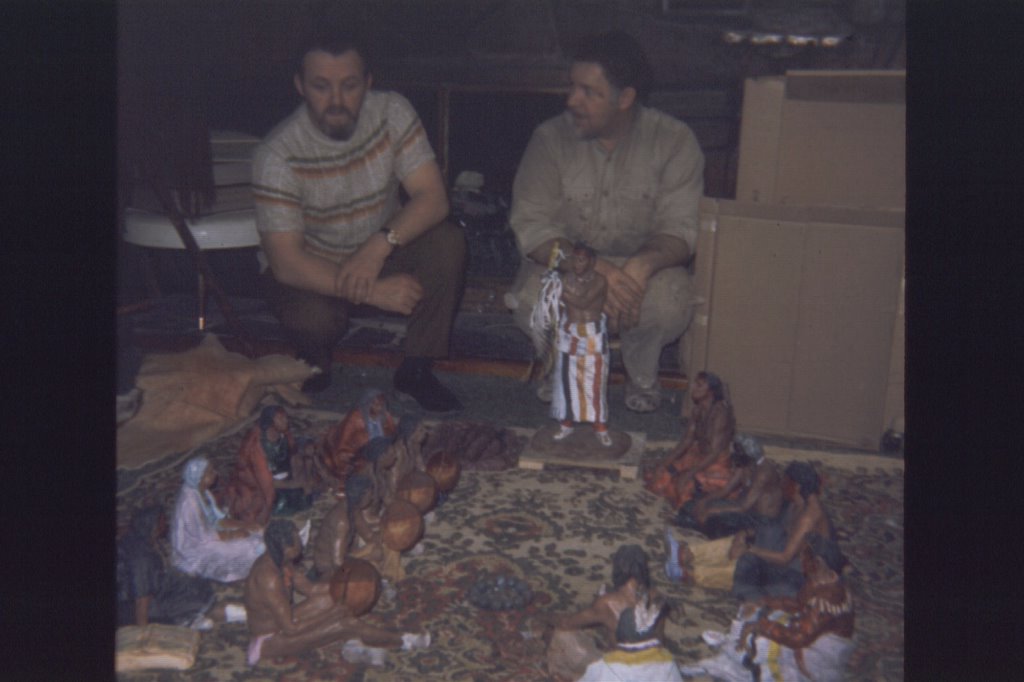
This photo shows John Hellson, expert on Medicine Bundles and other sacred Blackfoot materials, advising Bob Scriver about the figures who would become "The Opening of the Thunder Pipe Bundle." The Pipe Owner is directly in front of Bob Scriver and is a portrait of Charlie Reevis. Each of the figures is a portrait of the people who were actual members of the Bundle Keepers. There are only two living now: whoever it was who posed for the small boy and Joe Old Chief, who was one of the drummers.
Wednesday, February 01, 2006
Temporary Blogger Standdown
The blogger has had to regroup and take a few days of “stand-down” to retool. In simple terms I’ve just been diagnosed with Type II diabetes, which means a major change in habits and a huge jump in the attention that has to be paid to eating and exercising. I’m making big charts -- then revising them. I’m supposed to take daily blood pressures, twice-daily blood sugar readings, and a half-hour of walking or the equivalent. (What IS the equivalent to a half-hour of walking?) But it’s working. My blood sugar sank from 200 (very high) to 100 (tolerable) in 24 hours. It’s like cotton candy melting out of my brain. I feel better and I didn’t even realize I didn’t feel good.
Being my father’s daughter (my father believed the world could be saved by Popular Mechanics and self-help books), I had at hand some books to guide me. I’ll list them in case you need something similar. I got them from Hamilton remainders online, whose inventory changes all the time. Maybe there’s something new and better by now.
RESOURCES:
“THE GOOD NEWS EATING PLAN for Type II Diabetes” by Elaine Magee. John Wiley & Sons, 1998.
“THE GOOD CARB COOKBOOK: Secrets of Eating Low on the Glycemic Index” by Sandra Woodruff. Penguin Putnam, 2001.
“THE DIABETIC’S BRAND NAME FOOD EXCHANGE HANDBOOK” BY CLARA G. Schneider. Running Press, 1991.
Some time ago I read an article that claimed if a person who had gone slightly to seed in late middle-age or early old-age really got with the program, ten years could be restored to their health. All the years of not drinking/not smoking should count for something.
But there is nothing to be done about my posture from hunching over a keyboard all these years -- well, unless I got hip to podcasts!
Being my father’s daughter (my father believed the world could be saved by Popular Mechanics and self-help books), I had at hand some books to guide me. I’ll list them in case you need something similar. I got them from Hamilton remainders online, whose inventory changes all the time. Maybe there’s something new and better by now.
RESOURCES:
“THE GOOD NEWS EATING PLAN for Type II Diabetes” by Elaine Magee. John Wiley & Sons, 1998.
“THE GOOD CARB COOKBOOK: Secrets of Eating Low on the Glycemic Index” by Sandra Woodruff. Penguin Putnam, 2001.
“THE DIABETIC’S BRAND NAME FOOD EXCHANGE HANDBOOK” BY CLARA G. Schneider. Running Press, 1991.
Some time ago I read an article that claimed if a person who had gone slightly to seed in late middle-age or early old-age really got with the program, ten years could be restored to their health. All the years of not drinking/not smoking should count for something.
But there is nothing to be done about my posture from hunching over a keyboard all these years -- well, unless I got hip to podcasts!
Wednesday, January 25, 2006
NANOFICTION
1-25-06
The warm wind roared and pried and battered at the sides of the houses. Stovepipes ripped out of their sockets. Garbage cans rolled down the streets. Branches tore off trees and flailed at every obstacle. Some comforted themselves with the thought that their houses had survived previous storms. But what about themselves? This mental pounding.
The warm wind roared and pried and battered at the sides of the houses. Stovepipes ripped out of their sockets. Garbage cans rolled down the streets. Branches tore off trees and flailed at every obstacle. Some comforted themselves with the thought that their houses had survived previous storms. But what about themselves? This mental pounding.
Tuesday, January 24, 2006
Dan Connolly: The Cowboy Rode Off
From the Great Falls Tribune. (January 22, 2006)
Daniel Brian Connolly, 88, a rancher and horse trader from Starr School, died of natural causes Thursday at a Browning hospital.
Services were Monday at Little Flower Parish, with burial in Willow Creek Cemetery. Whitted Funeral Chapel of Cut Bank handled arrangements. Condolences may be sent to the family at www.whittedfuneralchapel.com.
Survivors include his wife of 43 years, Phyllis Connolly of Starr School; a daughter, Brenda (Jim) Johnston of White Sulpur Springs, sons Ron White, Jack Connolly and Kalvin Brian (Karen) Connolly, all of Browning. Seven grandchildren and nine great-grandchildren. he is also survived by two sisters, Nora Lukin and Ruby Horn, and brothers Charles, Victor, and Bud, all of the Browning area.
Dan was born February 9, 1917, in Browning to Brian and Ida (Johnson) Connolly and grew up in the Crown Butte/Meriwether area. He attended grade school at Blackfoot, Cut Bank John School and the Cut Bank Boarding School. He married Phyllis Horn in Fort MacLeod, Alberta, on August 17, 1962.
Dan was an active rancher and horse trader all his life. He enjoyed participating in rodeo, hunting, fishing, working with leather, cutting studs, branding colts, sharpening knives, berry hunting [in earlier days, when he could get up and down the hills, he picked them by the bucket], picnicking with family and friends, and story telling.
The family suggests memorials to the Circle of Life in Browning.
********
Dan Connolly was the kind of man that is usually portrayed in the movies by some long lean charismatic actor. Usually he’s supposed to be a loner who never really belongs anywhere, but that wasn’t the case with Dan. He was both Blackfeet Indian and horse-centered cowboy. (The split between sheepmen and cowmen was sociological in early days -- but once again Dan was inclusive, raising both sheep and cows. The split between cowmen and horsemen is different, though being Blackfeet has something to do with it. A matter of the heart.) One of his childhood friends testified that when they played “cowboys and Indians,” Dan was both, on horseback.
East of Browning and north of Highway 2 is a complex country full of ranches and buttes, mostly grazing land. Kids out that way grow up on horseback and often get an early start on rodeo. Descent, one of the famous bucking horses, grew up out there and so did his relative Playboy, who was Bob’s best posing horse and had the best gait of any of his horses, but bucked everyone off, including Bob.
Darrell Kipp grew up out that way in what some call “Del Bonita country” and others call “God’s Country” and remembers Dan as the “chief” though no one used that term. He wasn’t elected or certified by some professional body -- he just WAS the man who knew what to do and the man who could get it done. If you were about to undertake something big or risky, you’d be smart to drop by and ask Dan what he thought about it.
Once Bob and I and the grandkids were trying to haze our little remuda of five horses into a corral. They were frisky on new grass and not at all inclined to go in -- we were on foot. We ran and ran until we fell flat in the grass with exhaustion. About then Dan came riding up, his long legs almost wrapped around his horse. “You folks tryin’ to put them horses in that corral?” he asked. (It’s always good to ask -- maybe we’d just invented a new form of tag.)
“Yes, yes!” we cried in unison, and Dan put ‘em in there in about three minutes. Of course, the horses took one look at Dan and knew they’d better do what he wanted.
Darrell tells about a school out that way that confused all the school records from that early time. On paper sometimes kids went to Higgins School and sometimes to Connolly School. Turned out that the little one-room school was on skids and when there were more Higgins kids attending, the building was dragged over to the Higgins ranch. But if there were more Connollys, the building traveled back to their ranch. Dan said he went to Higgins school, but Charlie and Nora are sure there wasn’t a Higgins School until afer Dan had finished with school. The early school, which Nora and Dan attended, was known as Cut Bank John, after John Kipp rather than a Connolly. The school was held in the upstairs of the Kipp home, one of the few two story houses around, probably originally built as a rooming house in the years when Blackfoot town was the rail head and crews stayed over while the trains were turned around.
Dan had that wonderful characteristic of ranchers around here of teaching as they go through the day. Darrell says Dan taught them to always remove the bit from their horses’ mouths when they were letting them graze. “How would you like to eat with a spoon tied crosswise in your teeth?” he asked. In late years Dan made it a point to encourage the work of Piegan Institute, crossing the cafe to say a few words in the morning.
Herman Whitegrass at the funeral mass told about borrowing a stock rack from Dan for his pickup when he was hauling some horses. When he got back and went to take the rack out to return it, he picked up some wire cutters. He’d wired it in and thought he’d just cut the wire. Dan nudged him aside, produced pliers and carefully unwound all the wires. “Saves wire,” he said. But this man said he had the uncomfortable feeling that if he’d gone to unwind the wire, Dan would have said, “You’re wasting time!” and produced wire cutters.
Dan loved kids and instructed them as well. They were to pull their weight, keep quiet, and be polite. He didn’t care whose kids they were -- if one was rebellious, they got settled down. He loved horses but was unfinching about cutting, branding, and canning them when they weren’t good for anything else. During WWII his canner horses fed the French people.
Dan came by his knowledge, sense of propriety, and passion for horses through his middle name, Brian, which was for his father, “Briney.” The nickname was quite appropriate for such a salty character. It would be hard to find a more colorful reservation force. Sometimes on the Tribal Council and sometimes afflicting the Tribal Council, he prospered and therefore was the object of accusations and jealousy. Prosperity is a Connolly characteristic but they have no need to cut corners. Dan would go to a stock auction, sit and listen for a while, then -- while others were working their charts and pocket calculators, he’d make some figures on the back of his Copenhagen tin, bid, and come away with a better deal than anyone else.
There are variant spellings of the Irish-based name: Connolly, Connelly, and Conway. On the rez the three names get slid around a bit, misspelled or incorrectly corrected and there are family opinions (linked to their Irish genes) about which is proper. Conway is more a mistake of the ear, a totally different family. But no one mistakes Dan or Briney.
Darrell says Briney bought his cars new, but within a few months they looked as though they’d been driven over a cliff. Once as a kid Darrell was thumbing rides when Briney stopped in a big old Jeep truck of some sort. As he drove, the gear shift came out of its socket, but Briney just stuck it back in. He always had a little candy or a nickel for a kid.
At the end of the Catholic mass, Jim Johnston, Dan’s son-in-law, read the poem “A Cowboy Prayer” by Badger Clark. The poem was written in 1917, the year Dan was born. The eulogy was read by Mary Lynn Lukin, Dan’s niece, who has had an admirable career at Montana State University where she supported and guided students in the Advance By Choice Program. Another descendent named Moriah Kipp (her mother is Kathy Connolly Kipp) sang a cappela “Swing Low, Sweet Chariot,” unerringly in a ringing soprano voice. (She is a successful contestant in high school singing competitions and a good barrel racer.) Then the guitar partnership of Herman Whitegrass (nephew-in-law) and Gabe Grant sang, “And The Cowboy Rode Off,” a favorite of Ernie Pepion.
The wind had pounded on the land all night as though it were drumming. The snow has been gone for weeks and the hills swelled tan and rough with winter grass. Huge white clouds crowded over the mountains, revealing this edge and then that edge, and left a little snow. The horses were bunched in the low places and behind buildings with their rumps to the wind. This is God’s Country.
Daniel Brian Connolly, 88, a rancher and horse trader from Starr School, died of natural causes Thursday at a Browning hospital.
Services were Monday at Little Flower Parish, with burial in Willow Creek Cemetery. Whitted Funeral Chapel of Cut Bank handled arrangements. Condolences may be sent to the family at www.whittedfuneralchapel.com.
Survivors include his wife of 43 years, Phyllis Connolly of Starr School; a daughter, Brenda (Jim) Johnston of White Sulpur Springs, sons Ron White, Jack Connolly and Kalvin Brian (Karen) Connolly, all of Browning. Seven grandchildren and nine great-grandchildren. he is also survived by two sisters, Nora Lukin and Ruby Horn, and brothers Charles, Victor, and Bud, all of the Browning area.
Dan was born February 9, 1917, in Browning to Brian and Ida (Johnson) Connolly and grew up in the Crown Butte/Meriwether area. He attended grade school at Blackfoot, Cut Bank John School and the Cut Bank Boarding School. He married Phyllis Horn in Fort MacLeod, Alberta, on August 17, 1962.
Dan was an active rancher and horse trader all his life. He enjoyed participating in rodeo, hunting, fishing, working with leather, cutting studs, branding colts, sharpening knives, berry hunting [in earlier days, when he could get up and down the hills, he picked them by the bucket], picnicking with family and friends, and story telling.
The family suggests memorials to the Circle of Life in Browning.
********
Dan Connolly was the kind of man that is usually portrayed in the movies by some long lean charismatic actor. Usually he’s supposed to be a loner who never really belongs anywhere, but that wasn’t the case with Dan. He was both Blackfeet Indian and horse-centered cowboy. (The split between sheepmen and cowmen was sociological in early days -- but once again Dan was inclusive, raising both sheep and cows. The split between cowmen and horsemen is different, though being Blackfeet has something to do with it. A matter of the heart.) One of his childhood friends testified that when they played “cowboys and Indians,” Dan was both, on horseback.
East of Browning and north of Highway 2 is a complex country full of ranches and buttes, mostly grazing land. Kids out that way grow up on horseback and often get an early start on rodeo. Descent, one of the famous bucking horses, grew up out there and so did his relative Playboy, who was Bob’s best posing horse and had the best gait of any of his horses, but bucked everyone off, including Bob.
Darrell Kipp grew up out that way in what some call “Del Bonita country” and others call “God’s Country” and remembers Dan as the “chief” though no one used that term. He wasn’t elected or certified by some professional body -- he just WAS the man who knew what to do and the man who could get it done. If you were about to undertake something big or risky, you’d be smart to drop by and ask Dan what he thought about it.
Once Bob and I and the grandkids were trying to haze our little remuda of five horses into a corral. They were frisky on new grass and not at all inclined to go in -- we were on foot. We ran and ran until we fell flat in the grass with exhaustion. About then Dan came riding up, his long legs almost wrapped around his horse. “You folks tryin’ to put them horses in that corral?” he asked. (It’s always good to ask -- maybe we’d just invented a new form of tag.)
“Yes, yes!” we cried in unison, and Dan put ‘em in there in about three minutes. Of course, the horses took one look at Dan and knew they’d better do what he wanted.
Darrell tells about a school out that way that confused all the school records from that early time. On paper sometimes kids went to Higgins School and sometimes to Connolly School. Turned out that the little one-room school was on skids and when there were more Higgins kids attending, the building was dragged over to the Higgins ranch. But if there were more Connollys, the building traveled back to their ranch. Dan said he went to Higgins school, but Charlie and Nora are sure there wasn’t a Higgins School until afer Dan had finished with school. The early school, which Nora and Dan attended, was known as Cut Bank John, after John Kipp rather than a Connolly. The school was held in the upstairs of the Kipp home, one of the few two story houses around, probably originally built as a rooming house in the years when Blackfoot town was the rail head and crews stayed over while the trains were turned around.
Dan had that wonderful characteristic of ranchers around here of teaching as they go through the day. Darrell says Dan taught them to always remove the bit from their horses’ mouths when they were letting them graze. “How would you like to eat with a spoon tied crosswise in your teeth?” he asked. In late years Dan made it a point to encourage the work of Piegan Institute, crossing the cafe to say a few words in the morning.
Herman Whitegrass at the funeral mass told about borrowing a stock rack from Dan for his pickup when he was hauling some horses. When he got back and went to take the rack out to return it, he picked up some wire cutters. He’d wired it in and thought he’d just cut the wire. Dan nudged him aside, produced pliers and carefully unwound all the wires. “Saves wire,” he said. But this man said he had the uncomfortable feeling that if he’d gone to unwind the wire, Dan would have said, “You’re wasting time!” and produced wire cutters.
Dan loved kids and instructed them as well. They were to pull their weight, keep quiet, and be polite. He didn’t care whose kids they were -- if one was rebellious, they got settled down. He loved horses but was unfinching about cutting, branding, and canning them when they weren’t good for anything else. During WWII his canner horses fed the French people.
Dan came by his knowledge, sense of propriety, and passion for horses through his middle name, Brian, which was for his father, “Briney.” The nickname was quite appropriate for such a salty character. It would be hard to find a more colorful reservation force. Sometimes on the Tribal Council and sometimes afflicting the Tribal Council, he prospered and therefore was the object of accusations and jealousy. Prosperity is a Connolly characteristic but they have no need to cut corners. Dan would go to a stock auction, sit and listen for a while, then -- while others were working their charts and pocket calculators, he’d make some figures on the back of his Copenhagen tin, bid, and come away with a better deal than anyone else.
There are variant spellings of the Irish-based name: Connolly, Connelly, and Conway. On the rez the three names get slid around a bit, misspelled or incorrectly corrected and there are family opinions (linked to their Irish genes) about which is proper. Conway is more a mistake of the ear, a totally different family. But no one mistakes Dan or Briney.
Darrell says Briney bought his cars new, but within a few months they looked as though they’d been driven over a cliff. Once as a kid Darrell was thumbing rides when Briney stopped in a big old Jeep truck of some sort. As he drove, the gear shift came out of its socket, but Briney just stuck it back in. He always had a little candy or a nickel for a kid.
At the end of the Catholic mass, Jim Johnston, Dan’s son-in-law, read the poem “A Cowboy Prayer” by Badger Clark. The poem was written in 1917, the year Dan was born. The eulogy was read by Mary Lynn Lukin, Dan’s niece, who has had an admirable career at Montana State University where she supported and guided students in the Advance By Choice Program. Another descendent named Moriah Kipp (her mother is Kathy Connolly Kipp) sang a cappela “Swing Low, Sweet Chariot,” unerringly in a ringing soprano voice. (She is a successful contestant in high school singing competitions and a good barrel racer.) Then the guitar partnership of Herman Whitegrass (nephew-in-law) and Gabe Grant sang, “And The Cowboy Rode Off,” a favorite of Ernie Pepion.
The wind had pounded on the land all night as though it were drumming. The snow has been gone for weeks and the hills swelled tan and rough with winter grass. Huge white clouds crowded over the mountains, revealing this edge and then that edge, and left a little snow. The horses were bunched in the low places and behind buildings with their rumps to the wind. This is God’s Country.
NANOFICTION: True Story
The funeral mass was for a cowboy who was an Indian, the kind of person the movies try to capture. Born during WWI, he grew up on horseback close to the Canadian border. If there aren’t horses in heaven, he won’t stay there very long. Correction: he’ll sell some to God to improve the place.
Monday, January 23, 2006
NANOFICTION
“Curse you, Herman.” The rancher’s first-time heifer had been bred by a neighbor’s extra large bull that got over the fence. Now the calf could not be born without help -- and the heifer might not survive the ordeal. Rancher and cow strained and struggled.
“Damn you, Herman!” Herman was not the bull but the neighbor.
“Damn you, Herman!” Herman was not the bull but the neighbor.
Sunday, January 22, 2006
NANOFICTION
Cat was sleeping on top of the television set where it was warm. Natural history program came on. “Garumph!” from a frog. Cat opened one eye.
Lot of sonorous narration. Elephant trumpeted. Cat raised her head. Put it down.
Owl hooted. Cat went under the sofa. She recognized that one. Owl almost got her once.
Lot of sonorous narration. Elephant trumpeted. Cat raised her head. Put it down.
Owl hooted. Cat went under the sofa. She recognized that one. Owl almost got her once.
Saturday, January 21, 2006
NanoREALITY
Last week the buttercups in Montana's Bitterroot Valley were blooming. No one has heard of them ever blooming in January. Usually the little yellow six-petaled waxy flowers come in March.
But the newspaper says this is only the fifth warmest winter on record.
Prairie Mary
But the newspaper says this is only the fifth warmest winter on record.
Prairie Mary
Friday, January 20, 2006
NANOFICTION
Working late, the young lab tech peered closely at his Petri dish and asked, “What’s this fruitfly doing in my agar-agar?”
His co-worker looked. “The backstroke!” They cracked up.
The tech turned back to his work, caught a sleeve on the microscope and dropped the Petri dish. Smash. “There goes the hope of humanity!” Laughter.
His co-worker looked. “The backstroke!” They cracked up.
The tech turned back to his work, caught a sleeve on the microscope and dropped the Petri dish. Smash. “There goes the hope of humanity!” Laughter.
Thursday, January 19, 2006
NANOFICTION
While she washed dishes she sang Broadway musical songs. “I Love You, Porgy!” and “Poor Jud Is Dead.” Her husband heard and came to pick up the dish towel. It wasn’t the singing -- it was the happiness that attracted him. Had from the very beginning. She looked at him, winked, and began “Old Man River.”
Wednesday, January 18, 2006
NANOFICTION
“Gram? Gram, want some tea?”
Gram is watching ice skating competition on television. She remembers: her muscles sing, her spine flexes, her lungs breathe evenly, she flies on a silver edge. No one alive today has seen her skate. She gave away her trophies.
“Gram, come away from the television. You need to get more exercise.”
Gram is watching ice skating competition on television. She remembers: her muscles sing, her spine flexes, her lungs breathe evenly, she flies on a silver edge. No one alive today has seen her skate. She gave away her trophies.
“Gram, come away from the television. You need to get more exercise.”
Tuesday, January 17, 2006
NANOFICTION
The about-to-retire teacher took no nonsense off anyone. She went to confront the coach about his team’s bad grades.
The coach called the boys out from the lockerroom and they emerged half-dressed with bare chests and Spandex pants, crotches and thighs padded. They reeked of sexuality and health.
Unable to speak, she turned and left.
The coach called the boys out from the lockerroom and they emerged half-dressed with bare chests and Spandex pants, crotches and thighs padded. They reeked of sexuality and health.
Unable to speak, she turned and left.
Monday, January 16, 2006
NANOFICTION
First try: too boring. Second try: too sexy. Someone might take it personally. Third try: snarky. Fourth try: giving too much away. Fifth try: nice irony. Sixth try: now we’re cookin’.
Nanofiction: old dance, more dangerous when cyberized. Anyone might read it. So who is the audience? Will they think this is the real me?
Nanofiction: old dance, more dangerous when cyberized. Anyone might read it. So who is the audience? Will they think this is the real me?
Sunday, January 15, 2006
NANOFICTION
The mall opened early so senior citizens could walk for exercise in bad weather. Women walked -- men reverted to “standing on the corner watching all the girls go by.”
One woman sat down for a breather. A man sat next to her.
“Bother someone else!” she snapped. “I’m no pickup.”
He wept. “I’m so lonely.”
One woman sat down for a breather. A man sat next to her.
“Bother someone else!” she snapped. “I’m no pickup.”
He wept. “I’m so lonely.”
Saturday, January 14, 2006
NANOFICTION
The fact that her daughter was a military pilot in Iraq seemed unnatural.
When she went out to the compost, she saw in the swirly sky a bright line, unnaturally straight. It was like a line drawn by an angel’s finger.
She knew it was just a jet contrail, but was it also a sign?
When she went out to the compost, she saw in the swirly sky a bright line, unnaturally straight. It was like a line drawn by an angel’s finger.
She knew it was just a jet contrail, but was it also a sign?
Friday, January 13, 2006
NANOFICTION
Three queen-sized housewives procrastinated over coffee and cigarettes in the local cafe. The sleek town banker passed their table. “Gooood morning, little ladies!” he purred.
“Up yours, buddy,” muttered one rebel, blowing smoke. The others snickered.
At a nearby table the librarian, gracious and disciplined, overheard, but held her book higher to hide her smile.
“Up yours, buddy,” muttered one rebel, blowing smoke. The others snickered.
At a nearby table the librarian, gracious and disciplined, overheard, but held her book higher to hide her smile.
Thursday, January 12, 2006
NANOFICTION
The tough old rancher was told he had incurable macular
degeneration. He was seemingly not emotional, but told his wife that he was thinking about what to read for the last time before he went blind.
Later she came into the room and, seeing a book in his hands, asked what it was.
“’Goodbye, Moon.’”
degeneration. He was seemingly not emotional, but told his wife that he was thinking about what to read for the last time before he went blind.
Later she came into the room and, seeing a book in his hands, asked what it was.
“’Goodbye, Moon.’”
Wednesday, January 11, 2006
NANOFICTION
Saturday night and the whole small town was at a dance. A dignified old rancher looked around for a likely woman and spotted a retired schoolteacher.
“I don’t dance”
“Sure you do.” He pulled her out on the floor.
In a bit he returned her. “You don’t dance and you’re too drunk if you did!”
“I don’t dance”
“Sure you do.” He pulled her out on the floor.
In a bit he returned her. “You don’t dance and you’re too drunk if you did!”
Tuesday, January 10, 2006
MISTER DICK
According to Wikipedia, Ben Hur Lampman (November 27, 1886–March 2, 1954) was a U.S. newspaper editor, essayist, short story writer, and poet. He was a longtime editor of The Oregonian in Portland, Oregon, and he served as poet laureate of Oregon from 1951 until his death.
“He began publishing nature essays in The Oregonian. His stories and essays also appeared in national magazines such as the Saturday Evening Post. Some of his essays about life in Portland were collected in his 1942 book “At the End of the Car Line.” In 1943 he won an O. Henry Award for his short story "Blinker Was a Good Dog", which originally appeared in the Atlantic Monthly. Some of his papers and manuscripts are now in the collection of the library of the University of Oregon. He is buried in Lincoln Memorial Cemetery in Portland.”
This morning I couldn’t find my copy of “At the End of the Car Line,” which is essentailly the same as a “blook,” except that it’s a compilation of columns instead of a blog. The full title of the column was “The Little Old Lady at the End of the Streetcar Line.” When I say “LOL, that’s who I mean -- “little old lady” -- not “lots of laughter” or “lots of luck,” which are the more modern phrases. Lampman used his LOL as a ventriloquist’s puppet to speak the obvious truth that even an out-of-it and impaired person knows, mostly through life experience. She’s a wise little old lady in her rickety rocker on her overgrown porch.
But this blog is not about Ben Hur Lampman or his LOL, well-loved as they were. This is about an old man who lived in Browning across the main street (actually it was two highways on top of each other and only became the main street by default when the perpendicular and original main street withered) from the Scriver Museum of Montana Wildlife. His name was Mister Dick. He was a retired barber.
Mister Dick’s claim to fame was that when Ben Hur Lampman got married, Mr. Dick prepared him for the wedding. Lampman had been doing labor on the Canadian Plains before he returned to North Dakota and married Lena Sheldon, a New York City resident who had moved to the Dakotas to become a school teacher. Then his family moved to Oregon. Mr. Dick must have done his vital preparation in North Dakota about the time of WWI, maybe just before, in that Edwardian decade when people were optimistically seeking opportunity. The son of a small-town newspaper man marries a school ma’arm from back east. The roots of one classic Western paradigm.
Mister Dick loved to tell about his bathtub room in back of the barbershop and just how he carefully shaved Ben Hur with a straight razor, trimmed up his sideburns a bit, then “braced” his cheeks, dusted his neck, and pomaded his hair. “He was a fine sight,” declared Mister Dick who was evidently never married, himself. It was the high point of Mister Dick’s life as much as it was of Ben Hur Lampman’s.
Once when my mother, visiting Browning from Portland where BHL was quite famous when I was in what would be junior high today, came to the grocery store with me. I introduced her to Mister Dick where I knew she would be safely parked for a half hour. “You did that on purpose!” she accused. My defense was, “But think of the good it did to Mister Dick to find someone who actually knew who Ben Hur Lampman was!”
Mister Dick’s house was no more than a shanty with a shed attached. I rented a house next door to him and though it was modest, it was luxurious compared to that of Mister Dick, which was knocked together of unpainted boards. There were Moccasin Flat cabins that were more weather-tight and convenient. I was never inside but not sure there was running water or electricity. What I did know, from eyewitness accounts, was that there were clotheslines strung all over the single room and on them were pinned violin parts, for Mister Dick’s hobby was making violins. On rare occasions I could hear him scraping out a bit of music, but he never seemed to play publicly. Those who had been inside also claimed that he hoarded newspapers in stacks, so that a person had to sidle between them to cross the room.
But I saw Mister Dick often, because he took a daily walk towards the mountains no matter what the weather might be. To say he walked with a cane would be misleading. He used his cane as a baton, waving and even twirling it, though he never threw it in the air. He brandished it, he celebrated his walk with it. If it were cold, his other equipment was a long plaid wool scarf with ends that flew on the wind like pennants. No one was ever as joyfully alive as Mister Dick on a walk!
Kenny Hofland, also a barber, lived next door on the other side and I thought he might be some relation, but his attitude to the world was far more downbeat. He was a sceptic, a pessimist. Possibly this was because he never prepared a famous man for a wedding, a small memory but a jubilant one and maybe as good a high point as any for a life wherein the rememberer was never married.
When Mister Dick died, he was found standing up, propped up by all his accumulated debris of newsprint and musical instruments. I didn’t see him like that, but I imagine him on this last trip with his jaunty cane and billowing scarf, a sort of human sailboat with an even keel.
“He began publishing nature essays in The Oregonian. His stories and essays also appeared in national magazines such as the Saturday Evening Post. Some of his essays about life in Portland were collected in his 1942 book “At the End of the Car Line.” In 1943 he won an O. Henry Award for his short story "Blinker Was a Good Dog", which originally appeared in the Atlantic Monthly. Some of his papers and manuscripts are now in the collection of the library of the University of Oregon. He is buried in Lincoln Memorial Cemetery in Portland.”
This morning I couldn’t find my copy of “At the End of the Car Line,” which is essentailly the same as a “blook,” except that it’s a compilation of columns instead of a blog. The full title of the column was “The Little Old Lady at the End of the Streetcar Line.” When I say “LOL, that’s who I mean -- “little old lady” -- not “lots of laughter” or “lots of luck,” which are the more modern phrases. Lampman used his LOL as a ventriloquist’s puppet to speak the obvious truth that even an out-of-it and impaired person knows, mostly through life experience. She’s a wise little old lady in her rickety rocker on her overgrown porch.
But this blog is not about Ben Hur Lampman or his LOL, well-loved as they were. This is about an old man who lived in Browning across the main street (actually it was two highways on top of each other and only became the main street by default when the perpendicular and original main street withered) from the Scriver Museum of Montana Wildlife. His name was Mister Dick. He was a retired barber.
Mister Dick’s claim to fame was that when Ben Hur Lampman got married, Mr. Dick prepared him for the wedding. Lampman had been doing labor on the Canadian Plains before he returned to North Dakota and married Lena Sheldon, a New York City resident who had moved to the Dakotas to become a school teacher. Then his family moved to Oregon. Mr. Dick must have done his vital preparation in North Dakota about the time of WWI, maybe just before, in that Edwardian decade when people were optimistically seeking opportunity. The son of a small-town newspaper man marries a school ma’arm from back east. The roots of one classic Western paradigm.
Mister Dick loved to tell about his bathtub room in back of the barbershop and just how he carefully shaved Ben Hur with a straight razor, trimmed up his sideburns a bit, then “braced” his cheeks, dusted his neck, and pomaded his hair. “He was a fine sight,” declared Mister Dick who was evidently never married, himself. It was the high point of Mister Dick’s life as much as it was of Ben Hur Lampman’s.
Once when my mother, visiting Browning from Portland where BHL was quite famous when I was in what would be junior high today, came to the grocery store with me. I introduced her to Mister Dick where I knew she would be safely parked for a half hour. “You did that on purpose!” she accused. My defense was, “But think of the good it did to Mister Dick to find someone who actually knew who Ben Hur Lampman was!”
Mister Dick’s house was no more than a shanty with a shed attached. I rented a house next door to him and though it was modest, it was luxurious compared to that of Mister Dick, which was knocked together of unpainted boards. There were Moccasin Flat cabins that were more weather-tight and convenient. I was never inside but not sure there was running water or electricity. What I did know, from eyewitness accounts, was that there were clotheslines strung all over the single room and on them were pinned violin parts, for Mister Dick’s hobby was making violins. On rare occasions I could hear him scraping out a bit of music, but he never seemed to play publicly. Those who had been inside also claimed that he hoarded newspapers in stacks, so that a person had to sidle between them to cross the room.
But I saw Mister Dick often, because he took a daily walk towards the mountains no matter what the weather might be. To say he walked with a cane would be misleading. He used his cane as a baton, waving and even twirling it, though he never threw it in the air. He brandished it, he celebrated his walk with it. If it were cold, his other equipment was a long plaid wool scarf with ends that flew on the wind like pennants. No one was ever as joyfully alive as Mister Dick on a walk!
Kenny Hofland, also a barber, lived next door on the other side and I thought he might be some relation, but his attitude to the world was far more downbeat. He was a sceptic, a pessimist. Possibly this was because he never prepared a famous man for a wedding, a small memory but a jubilant one and maybe as good a high point as any for a life wherein the rememberer was never married.
When Mister Dick died, he was found standing up, propped up by all his accumulated debris of newsprint and musical instruments. I didn’t see him like that, but I imagine him on this last trip with his jaunty cane and billowing scarf, a sort of human sailboat with an even keel.
Nanofiction
1-10-06
The widowed farm wife’s old cat slept with her. One morning she woke to find he had died. The ground was frozen too hard to dig a grave under her favorite tree, so she wrapped the small body decently and sent it with the trash.
In spring that tree blew down and she was inconsolable.
The widowed farm wife’s old cat slept with her. One morning she woke to find he had died. The ground was frozen too hard to dig a grave under her favorite tree, so she wrapped the small body decently and sent it with the trash.
In spring that tree blew down and she was inconsolable.
Monday, January 09, 2006
Nanofiction 1-9-06
Two women, longtime friends, gossiped in a summer yard, shrieking with laughter, moaning with pain, and swearing with anger. They rocked in their wicker chairs, twitched at their flowered sundresses, and refreshed their lemonade.
The striped cat sat quietly overhead on the garage roof, paying as close attention as an opera lover. Finally it yawned.
The striped cat sat quietly overhead on the garage roof, paying as close attention as an opera lover. Finally it yawned.
Sunday, January 08, 2006
THOSE WHO WISH TO WRITE
One writes a blog without knowing who is out there. Some are trying to reach a farflung audience -- national, maybe -- or a particular layer of society, most commonly what is called the “chattering classes” -- meaning those who talk and write all the time, often about artistic or historic matters. Somehow the phrase always suggests India to me, I think because Chatterjee is an Indian word and partly because that country has an uncommonly large and capable members of that class.
But particularly on this blog (I also have two others), I imagine my audience to be in this geographical region. A subcategory, probably one quite a bit smaller, is those who have the same interests that I do -- which is what drives my choice of topics. I’m hoping that includes reservation people.
Those who wish to write -- or maybe those I wish would write -- are at the heart of that. When I started out with the Merry Scribber , I intended to provide a source of materials for teaching high school English. But what I’m finding is that I’m more likely to be read by the college student -- and on the reservation that means not late teenagers but early middle age -- say, forty. These people are now ready to write, if they only knew how to begin. At over sixty I feel just about ready to begin and knowledgeable about how to do it. The eighty year olds, except for those who have been writing all along, are beyond the physical labor of writing -- even handwriting, and much less the technicalities of keyboarding. So I’m going to another level, but in addition to the elementary exercises, which are often fun.
The other day I got a box and began gathering all my “how to write” books into it. I had to go get a second box. It’s time to confront these books, digest them and maybe dispense with them, but I think I’ll review them (on the Merry Scribbler blog) as I go. There’s not time (I don’t mean time in my day, but rather time in my LIFE) to reread them -- but I can note their style and method. They’ve become more talismans for success than real reference sources anyway.
One I know I will keep (among some others that I still use) is the most recently acquired. It arrived on Saturday, when the post office is closed except for the letter boxes, but the postmaster heard my voice and stepped out to hand it to me. (I TOLD you she was a peach!) “Narrative Design” by Madison Smartt Bell. I discussed the first chapter, “Unconscious Mind,” on Merry Scribbler 1-7-06.
Bell speaks of the right-brain as being the location of the subconscious, at least as we use it in pursuit of humanities: art, music, books. The point of his discussion was that writing workshops teach craft but NOT the right brain issues: how one gets access to what is stored there, what might happen if one does it too clumsily, and what to do with what you find. Most people, thanks to Freud who thought up this word and sensationalized it by positing that mostly it’s full of sex, will admit they have a subconscious but hugely overestimate how much control over it they really have -- even the people who drink and take drugs in attempts to evade it.
The image I always think of is the one in the first Star Wars episode where the main characters are trapped in a trash reservoir, full of what seem to be machinery parts half-submerged in water but also inhabited by predatory, tentacled, and probably carnivorous creatures we never see unless dragged under the surface by them. (The Blackfeet have had a vivid fear of being dragged under the water by monsters, some declining to learn to swim since struggles are hopeless against greater forces that want you to drown.)
The major component of that unconscious is one’s experience of acquiring and giving meaning to the sensorium of life, but that’s another blog. There’s also a lot to be learned from the actual brain machinery and cultural context.
Clinical Pastoral Education is a specialized program that educates aspiring ministers. Rather like boot camp, it is also meant to flush out the undesirable. In the context of a hospital, where all the patients are on their way out -- one way or another -- each student is pressed hard to reveal their unconscious and conscience. Each small group of students is in the care and under the scrutiny of a leader, who also belongs to a small group of leaders who are under the guidance and ethical restraints of their own leader, who is also in a small group -- and so on. These are little mini-congregations, not unlike writing classes or AA.
Learning to write, says Bell (quite memorably) is not just a matter of learning craftsmanship: punctuation, grammar, metaphor, and so on. When I was teaching in the Seventies, we were willing to discard all this stuff and drive our hands down into the mess of the mind to shake hands with the tentacles. Now we seem to have done an about-face and to almost actively suppress the news that there is something under the surface. It was just too damned scary.
Who wants to know what it’s like inside the mind of a suicide-bomber? That’s part of it. Anyway, not many people can express what they find -- the mere fact of the discovery seems enough.
And as the economic times thin out and become taut, how much anger, contempt, remorse, ecstacy, pride and ethical standard does one dare reveal? I mentioned CPE because it was originally designed for conventional, rather repressed, young men in a culture that believed in maintaining a front. If the CPE pressure necessary to get that sort of person out in the open is applied to someone like myself at forty, someone who has already seen much trauma and drama, the leader may be overwhelmed. And he was.
He said, “I don’t want to get old and pick up a novel by you to find myself splayed and excoriated.” He said that he’d imagined we’d be buddies and happy to share beer and pizza in some bar some day. Too bad.
A lot of whites who hope for access to the cultural subconscious of Indians also imagine they will someday share beer and pretzels as buddies. They have no idea of the rage, the indignation, the thirst for vengeance, the greed, and the bloody-mindedness of people with seething sub-consciousnesses -- at least when they’re over forty. This is why readers misunderstand Sherman Alexie, even Indians.
I don’t have much idea of what’s in the unconsciousnesses of the TV generation. They have the sense not to share with adults. I think they are quite invested in withholding, so that it’s hard to get them to write anything at all. They decline to be taught about themselves. Just give them the craftsmanship lessons, so they are correct enough to earn a living.
What really counts for a writer is the courage to extend enough tentacle from the depths to hold a pen or at least keyboard.
But particularly on this blog (I also have two others), I imagine my audience to be in this geographical region. A subcategory, probably one quite a bit smaller, is those who have the same interests that I do -- which is what drives my choice of topics. I’m hoping that includes reservation people.
Those who wish to write -- or maybe those I wish would write -- are at the heart of that. When I started out with the Merry Scribber , I intended to provide a source of materials for teaching high school English. But what I’m finding is that I’m more likely to be read by the college student -- and on the reservation that means not late teenagers but early middle age -- say, forty. These people are now ready to write, if they only knew how to begin. At over sixty I feel just about ready to begin and knowledgeable about how to do it. The eighty year olds, except for those who have been writing all along, are beyond the physical labor of writing -- even handwriting, and much less the technicalities of keyboarding. So I’m going to another level, but in addition to the elementary exercises, which are often fun.
The other day I got a box and began gathering all my “how to write” books into it. I had to go get a second box. It’s time to confront these books, digest them and maybe dispense with them, but I think I’ll review them (on the Merry Scribbler blog) as I go. There’s not time (I don’t mean time in my day, but rather time in my LIFE) to reread them -- but I can note their style and method. They’ve become more talismans for success than real reference sources anyway.
One I know I will keep (among some others that I still use) is the most recently acquired. It arrived on Saturday, when the post office is closed except for the letter boxes, but the postmaster heard my voice and stepped out to hand it to me. (I TOLD you she was a peach!) “Narrative Design” by Madison Smartt Bell. I discussed the first chapter, “Unconscious Mind,” on Merry Scribbler 1-7-06.
Bell speaks of the right-brain as being the location of the subconscious, at least as we use it in pursuit of humanities: art, music, books. The point of his discussion was that writing workshops teach craft but NOT the right brain issues: how one gets access to what is stored there, what might happen if one does it too clumsily, and what to do with what you find. Most people, thanks to Freud who thought up this word and sensationalized it by positing that mostly it’s full of sex, will admit they have a subconscious but hugely overestimate how much control over it they really have -- even the people who drink and take drugs in attempts to evade it.
The image I always think of is the one in the first Star Wars episode where the main characters are trapped in a trash reservoir, full of what seem to be machinery parts half-submerged in water but also inhabited by predatory, tentacled, and probably carnivorous creatures we never see unless dragged under the surface by them. (The Blackfeet have had a vivid fear of being dragged under the water by monsters, some declining to learn to swim since struggles are hopeless against greater forces that want you to drown.)
The major component of that unconscious is one’s experience of acquiring and giving meaning to the sensorium of life, but that’s another blog. There’s also a lot to be learned from the actual brain machinery and cultural context.
Clinical Pastoral Education is a specialized program that educates aspiring ministers. Rather like boot camp, it is also meant to flush out the undesirable. In the context of a hospital, where all the patients are on their way out -- one way or another -- each student is pressed hard to reveal their unconscious and conscience. Each small group of students is in the care and under the scrutiny of a leader, who also belongs to a small group of leaders who are under the guidance and ethical restraints of their own leader, who is also in a small group -- and so on. These are little mini-congregations, not unlike writing classes or AA.
Learning to write, says Bell (quite memorably) is not just a matter of learning craftsmanship: punctuation, grammar, metaphor, and so on. When I was teaching in the Seventies, we were willing to discard all this stuff and drive our hands down into the mess of the mind to shake hands with the tentacles. Now we seem to have done an about-face and to almost actively suppress the news that there is something under the surface. It was just too damned scary.
Who wants to know what it’s like inside the mind of a suicide-bomber? That’s part of it. Anyway, not many people can express what they find -- the mere fact of the discovery seems enough.
And as the economic times thin out and become taut, how much anger, contempt, remorse, ecstacy, pride and ethical standard does one dare reveal? I mentioned CPE because it was originally designed for conventional, rather repressed, young men in a culture that believed in maintaining a front. If the CPE pressure necessary to get that sort of person out in the open is applied to someone like myself at forty, someone who has already seen much trauma and drama, the leader may be overwhelmed. And he was.
He said, “I don’t want to get old and pick up a novel by you to find myself splayed and excoriated.” He said that he’d imagined we’d be buddies and happy to share beer and pizza in some bar some day. Too bad.
A lot of whites who hope for access to the cultural subconscious of Indians also imagine they will someday share beer and pretzels as buddies. They have no idea of the rage, the indignation, the thirst for vengeance, the greed, and the bloody-mindedness of people with seething sub-consciousnesses -- at least when they’re over forty. This is why readers misunderstand Sherman Alexie, even Indians.
I don’t have much idea of what’s in the unconsciousnesses of the TV generation. They have the sense not to share with adults. I think they are quite invested in withholding, so that it’s hard to get them to write anything at all. They decline to be taught about themselves. Just give them the craftsmanship lessons, so they are correct enough to earn a living.
What really counts for a writer is the courage to extend enough tentacle from the depths to hold a pen or at least keyboard.
Nanofiction
The old fisherman loved being out in his little house hunched over a hole when the ice was really thick. But he left his pickup parked on land and walked all the way out. “Why not drive?” people asked.
“I like to walk on the water -- like Jesus,” he said smiling. They shook their heads.
“I like to walk on the water -- like Jesus,” he said smiling. They shook their heads.
Saturday, January 07, 2006
Nano Novel 1/07/06
1/7/06
Snow cancelled school. The pretty young math teacher used the day for experimentation: face masks and hair treatments. She wore a ratty old robe.
Then the UPS man arrived with packages containing more potions. Still laughing that night, he told his wife the sight of that kid at the door made all the drift-busting worthwhile.
Snow cancelled school. The pretty young math teacher used the day for experimentation: face masks and hair treatments. She wore a ratty old robe.
Then the UPS man arrived with packages containing more potions. Still laughing that night, he told his wife the sight of that kid at the door made all the drift-busting worthwhile.
Subscribe to:
Posts (Atom)