Saturday, November 18, 2006

"GREY & GOLD"


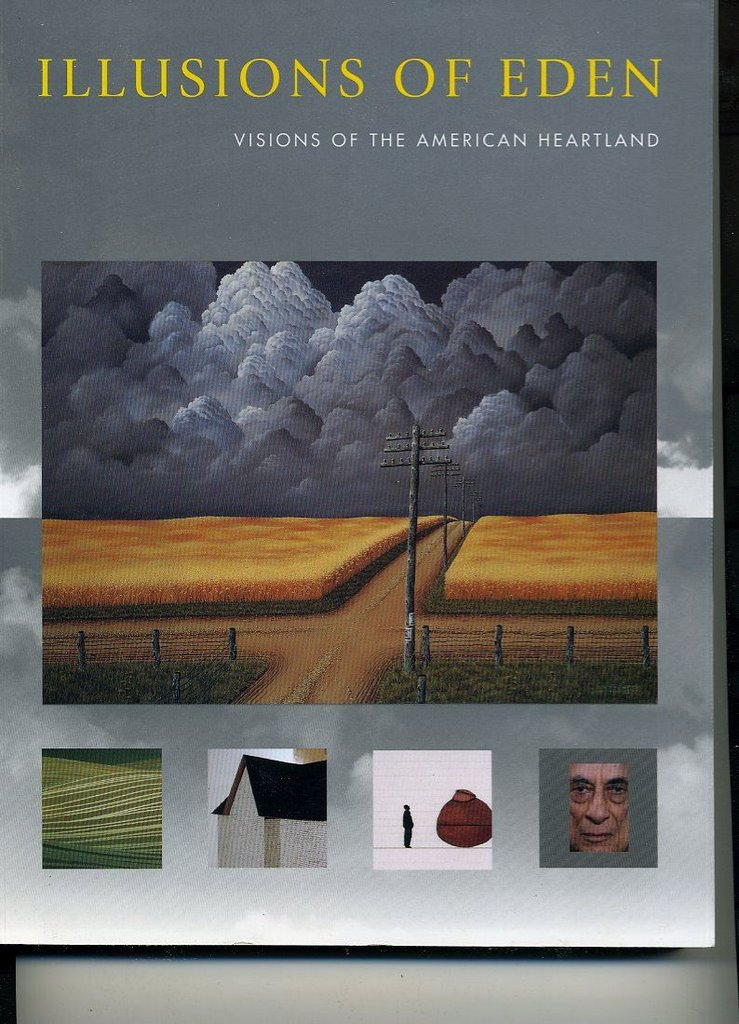
“GREY AND GOLD” 1942 by John Rogers Cox

A copy of this painting hung on our wall when I was growing up. It was an icon signifying my father’s boyhood in South Dakota. (My mother had her own, a photograph of sheep in the hills of Douglas County.) The book cover I’ve scanned here is called “Illusions of Eden, Visions of the American Heartland.” It’s actually a catalogue to accompany a show of art works and was sponsored by Phillip Morris. It’s in three languages: English, Hungarian, and German. I haven’t sat down to the read the book, but I did read the bio of Cox (1915-1990) and the information at AskArt.com, much of which is on the bulletin board section as messages from friends and former students. His work is considered to be “magic realism,” realer than real. His later years were spent in Washington State, in Wenatchee, though he was born in Indiana and taught in Chicago at the Art Institute for a long time. The example of his work on AskArt.com shows he detected a twisted and demonic side to the prairies as well as this orderly but foreboding landscape. Surrealists always seem to have a kind of horror-film side. Or is it the other way around?

This painting won the second medal in the “Artists for Victory” exhibition at the Metropolitan Museum of Art. Two years later the same painting received the “popular prize” in the exhibition, “Painting in the United States, 1944,” held at the Carnegie Institute in Pittsburgh. This painting now resides in the permanent collection of the Cleveland Museum of Art.

I don’t know whether my father knew all this stuff or what he made of it. His connection was just straight from the heart and my mother honored it. Over our fireplace was a “painting” (actually a print with a nice frame) that my parents bought together. I was present for the discussion of whether to buy it, but had no input. I was very small, but was impressed by their seriousness. A swan swims in a pond, looking very much like Laurelhurst Park, which I thought it was until I was grown up. It was to stand for their joy at living in Portland, Oregon, where we often picnicked in this park. My Aunt May and Uncle Doc also had a nice “painting” on their wall that looked very much like the prairie parkland of northern Canada. It was poplars in winter with snow and when the family gathered there, they would discuss whether the light was meant to be winter sun or moonlight. That signalled the beginning of the stories about Manitoba.

I tell all this as an illustration of how art weaves in and out of the lives of even fairly ordinary people -- without any discussion of modernity or political implications or ultimate value. My father’s art form was, of course, photography, which is why I have all these photos of houses to springboard essays off. My mother leaned a bit more to crafts but could do a respectable watercolor. My youngest brother has an MFA in metal-smithing, my other brother is also a decent landscape sketcher, and I dabble around when I have the inclination. My Aunt May filled her house with paintings. This gives me quite a different point of view from the new rocket-propelled art sales, which they say are fueled by hedge-fund millionaires. (See the latest “Vanity Fair” magazine.)

Instead of having a “picture window” out the front of my house so I could look in the “picture windows” of the house across the street (it has two), my picture window looks out the back and up a dirt alley with telephone poles alongside, just like “Grey and Gold” except that there are backyards instead of wheat. However, there is a wheat field at the end of the alley, which ends in a ridge that looks like the end of the earth, just like this painting. (A couple of miles beyond the ridge is the missile silo, aimed I know not where.) The cats spend much of their time on this windowsill since it faces east so it gets a lot of sun. They never tire of the view and neither do I. In fact, I get impatient if someone parks in the alley so that all I’m looking at is some RV’s rump.

We talk a lot in words about writing that has affected us, but art images can be powerful as novels, influencing choices, helping us interpret our environment and lives. Certainly “Grey and Gold” has caused me to see the world a certain way and to welcome the prairies, their electrical potential, their stored wealth. Part of my happiness in living here comes from this “magic realism.”

Friday, November 17, 2006

CULTURE, GOVERNMENT AND KITTYCATS

In the far past “culture mixing” has been local and mostly a product of shipping or packstring commerce: silk, sugar, slaves, spices, bananas and so on. Along came colonies, largely commerce-based at first (corporations), which shifted large numbers of white northern European people into “other” cultures as bosses. Then World Wars scattered people all to hell and gone over the face of the planet. Now we push ever farther into treacherous and unvisited corners, just to say we did it.

When people stay in one place for a long time, they develop meshed understandings of the place that amount to a culture: accepted ways of doing things with the resources at hand. Desert culture might be uncommonly focused on wells and herding. Fertile riparian places might be concerned with gardening and therefore the determining of “property” lines. These practices support religious concepts, economic means inform hierarchies, and order is kept by consensus as the oddballs drop out, are pushed out, or even are genetically extinguished.

All is well until someone different shows up and is able to make an impact or if the economics change, maybe due to weather or erosion or disease. Then there’s a scramble until a synthesis or at least a truce is achieved.

In the US today, we have a highly eclectic population except as they self-select in pockets by ethnic origin, economics (more and more), education, and so on. One cause is immigration, another is the shift from rural to city (rural used to be the baseline for everyone), another is the receding of two hugely unifying shared experiences (Depression and World Wars) that melded together the previous assortment of immigrants. The schism introduced in the Sixties and Seventies seems to lie latent within our society, with occasional flaring up of embers. Another fault line, which I blame on the media, is the barrier between parents and their young, who have been introduced to black ghetto culture through music, dialect and uppity persons. Even reservation kids who are lucky to get to Great Falls can talk Hip-Hop.

Culture just happens, mostly. Great Waves pass over us all. The media thinks it’s at least surfing on it, but I think the changes are more subtle and deep than any television or even literary expert can trace. Maybe most of all causes are economic, which always reduces in the end to environmental resources. Even our politics and certainly our movie culture is driven by economics: oil, sex, bling, and control to protect corporations.

Government is charged with regulation, both formal laws (short of the Constitution) and minor local regulations and everything in between. Regulation can try to restrain culture (no porn, no violence, no white collar crime, decent pay and working conditions, no monopolies) but also the culture tries to resist and do what it wants to though the mechanisms of voting. If worse comes to worst, there might be a riot.

Animals are caught in this struggle just as much as people are, but they have no say over it. Animal Control agencies are governmental, trying to keep order in communities, while Humane Societies depend upon the culture through the media. Somehow, in a time when people have forgotten about relating to cows and horses (except in the movies -- well, in the brief period when we all watched Westerns) but like to keep child-sized animals (cats and dogs) as signs of affluence and status or just to make family of a single person or a childless couple, we have managed to swap the status of pets and children. Some call this anthropomorphism, but I think it’s a little more specific than that.

Many people treat their pets as though they were children. Many people treat their children as though they were pets. The consequences are not very good for either category. An overfed little dog with a wardrobe is an aberration, but so is a child who is left to shift for his or her self, never receiving the transfer of human culture that is the function of parents. Schools themselves are no longer concerned with progress and civilization for the whole of humanity, but rather are told to make the children economically viable, as though they were race horses or milk cows. More, more, bigger, better. Make me proud of my child so I can buy one of those self-esteem bumper stickers.

The culture today has so sexualized every form of human intimacy that it’s only safe to be truly unguarded with one’s pets. A little too much fondness with one’s child and someone will knock on the door. (A little too much harshness with one’s pet and someone will knock on the door.) The kids want to escape anyway and run off with their peers. The pets might be willing to give up their peers in order to devote themselves to you. (If the pet doesn’t cooperate, you can always get rid of it in a way one can’t dump children.) Anyway, with both men and women working, nurturing careers instead of families, living in city apartments, not really willing to commit to lifelong relationships with another person, pets just make more sense.

Humane Societies have capitalized on the infantilization of pets in order to fund their work -- which is undoubtedly worthy work -- but it isn’t about the dignity of horses anymore. Their concentration has been on “adopting” all animals, maintaining the idea that euthanizing animals is as horrifying as euthanizing unwanted children, trying to capture all unowned cats and dogs so that none are “street animals,” encouraging the keeping of cats indoors at all times -- possibly declawed. Even “wild” animals are seen as very much like populations of people whose cultures are inscrutable. We read about elephants that weep and geese who “mate for life.” We giggle over bonobos who have such liberated sex lives.

Humans are animals but animals are not human. The culture has lost its grip on this, and the result is that governmental regulation -- Animal Control -- is hampered by a loss of social consensus, a constant barrage of bad publicity and lawsuits from the sentimental, and confusion in general when one culture says dogs are lovable children and another says dogs are to eat and another says one dog per household is plenty and another says dogs need their freedom to do their own thing and another says dogs are unclean, to be avoided at all costs.

I recommend several measures. First, animal control and humane societies must work together BUT paradoxically they probably cannot do this so long as they are the same entity. To the public and the media, animal control is the parent who is oppressive (but often inadequate when really needed) and humane societies are the children who are always good, always in need of money (and therefore can’t help demonizing animal control) and sometimes victims. Humane societies that contract to be Animal Control might not be able to do either very well.

Second, both entities need to get more sophisticated about culture, providing examples of successful ways to manage animals and Americanizing good animal care. (I would also recommend the uplifting of the American mutt as an exemplar of multi-culturalism!)

Third, the use of arbitration and mediation through boards in communities and neighborhoods is far more helpful than a full-scale court trial over a barking dog. Often bad dog ownership is part of a household collapse that already involves parole officer, public health officials, social workers, and so on. Local teams and panels help defuse the Big Bro image of government regulation. They’re far more work, especially at first, but in the end they CAN change the culture more than any judge could. Or any media outlet either.

Fourth, animals -- especially dogs -- have been a part of criminal and police action for a long time. There will continue to be a need for criminal prosecution and penalties for such situations as dogs that harm or even kill people, especially when they do so as agents of humans -- converted to deadly weapons. It would be the rare humane society that could cope with this. Likewise with emergency responses when people or animals ae in danger.

Fifth, animal regulation should be local as much as possible. Rules good for city dwellings are silly in small towns or rural countryside. Some suburban problems can be solved structurally: fences, a plumbing receptable for droppings, so on. High population of any animals -- including humans -- means more regulation. Economic inequity also needs to be addressed. Perhaps animal hoarding can be treated medically, but surely if the hoarders themselves had security and support, they would behave differently. They are rarely high-earning folks, often old and alcoholic.

This is only the beginning of the discussion. The culture changes -- the regulations pant along behind, trying to keep up. Burgwin used to push all the paperwork off his desk now and then, put his giant feet up there, and think. Think. Think. Figure it out.
Thursday, November 16, 2006

THE CATS MEOW

CATS MEOW

Recently two stories about cats were in the newspapers here and they provide a strange contrast in the way people interact with cats.

The first case is the more sensational and sad. An old man rented a trailer and lived in it a year with his cats. No one knows how many or why. He was “skint” as the English say, “broke” as the Yanks say, “impoverished” as the multisyllabic say, and stopped paying his rent. Therefore he was sent an eviction notice and left. But he didn’t take his cats with him -- just locked the door and left them in there with no way to escape.

The owner didn’t come to check for a month. In that time the cats increased to about thirty (it’s hard to count panicked cats), surviving with no food or water. Expert opinion was that they ate each other’s kittens. They also say the feces were six inches deep. The cats were sick, gaunt, inbred and freaked -- all were euthanized. There was no report on the owner. Everyone is mad at him.

The other story was quite different. It was about a program to spay and neuter cats, either pets in homes or captured feral cats or cats of ambiguous status. The idea was a day of sterilization with several veterinarians -- mostly women -- working in assembly line fashion. The photo showed volunteers, each sitting in front of a little pallet of blankets, each occupied by a cat recovering from anesthesia. Again, the volunteers were women who watched the cats for bad reactions while petting, reassuring and keeping them warm. It was easy to see ghosts of “Nurse Nightingales” hovering over victims of a catastrophe. (Sorry for the pun -- well, maybe not.) They were clearly tender, mothering women whose hearts went out to their “babies,” conked out with their tongues hanging sideways from their mouths, both appealing and comic.

First, let’s get the obvious out of the way: why wasn’t there a committee of women who went to investigate and help that feral old man? Because he would probably have fought and evaded them in the same way a feral cat would. The law won’t allow people to set livetraps for ornery old men. Anyway, what do you do with them after you’ve caught them? Cats can rustle their own grub if they can get outside. They can even solicit membership in a family. That old man will simply be found dead some day unless he can do the same.

No one’s child says, “Hey, Mom! This old human followed me home -- can I keep him?” Even if that happened, Mom wouldn’t say, “Well, don’t feed him or he’ll never go away.” She’d just call the cops. The two stories get at the difficulty our society has with the question of “what is human?” and “what is an animal?” What is the status of species -- ours and others -- and what relationship is there between the two. What are our obligations?

With animals the situation depends upon the concept of “owning.” That old man “owned” the cats and therefore ought to have limited their number to as many as he could take good care of. This is the premise of the laws that curb animal ownership. But no one “owned” the old man so no one offered him care. We don’t “own” humans, or at least in theory we haven’t since slavery was outlawed, but in truth the saying that one’s “soul” is owned by one’s employer or the government and the antique but persistent conviction that men own their children and wife are still there in terms of obligation and control. Needy people are considered the obligation of their families, even if you haven’t seen them for years.

As a society, we “own” our soldiers, don’t we? Aren’t we part of the same “family?” So what care of them are we taking? Damned little once their use is over. Amputees, the traumatized, are on the streets. But if we were to try to round them up and put them in institutions to be fed and sheltered, they’d fight. They fought for our freedom and most of them would no doubt fight for their own. Like cats.

As a society we are supposed to at least extend care to children, but one-fifth of our children live in poverty, some with parents trapped by economics as surely as that old man in a trailer, and some with parents deranged, never matured, or criminally violent. There isn’t enough money to help them, let alone volunteers to sit by their cots as guardian angels. Does this mean we shouldn’t sit guarding recovering cats? Absolutely NOT. It’s all of a piece -- the same continuum. Humane societies and investigating scientists have long known that we likely treat our human relatives in the same way that we treat our animals. Animal abuse is a good indicator of human abuse.

In the counseling community, people speak of “owning the problem.” Not people or animals -- the “problem.” It appears to me that there are two major components to this “owning” problem. The first is sheer numbers. Limiting populations is clearly important: we will extend care to individuals that we would never legislate for in great numbers. This small town watches out for our old men, even the prickly ones who have no relatives. We might not exactly hover over them, but if someone were in enough trouble even the other old men might intervene -- and have. In a city that might not happen.

Those who start wars should carefully consider -- among all the other costs not reckoned in advance -- the cost of veteran care, which the health industry had pounced upon with great glee. Think of the profit in all those expensive microchipped prosthetic arms and legs! But who will pay out enough money for people who can’t find a way to support themselves? Who will build enough of the right kind of housing for physically challenged people? How long will it take before we all succumb to “compassion fatigue?”

What answers are there? Affinity groups -- veterans taking care of veterans; cat-lovers taking care of cats. Clear legal standards for when intervention is justified and what sort of intervention it ought to be. Careful economic planning so people can afford shelter and pets. (Not necessarily charity.) Most of all, some careful and thorough thinking about what it means to be human on this planet. If we “own” this planet, shouldn’t we be attentive to it, responding to its needs?

Have we let ourselves by “owned” by corporations and politicians who have locked us in and left? Like poor people in New Orleans or starving children in predatory foster care or aging and damaged veterans on the streets?

There’s another component. Those women who took care of cats had a great time, made friends, built community, and went home feeling the glow. Taking care of each other feels great, and that’s hard-wired into being human. There's a reason why a cat's meow sounds like a human baby's cry.

Wednesday, November 15, 2006

EMIGRATION TO MANITOBA


The Strachan Homestead

By 1907 the Sam Strachans had built a more comfortable house than their claim shanties. The construction was “balloon framing” with a four-sided pyramid roof, which probably helped keep the square house rigid in the face of high winds. Many buildings around Valier with double-slant roofs have gradually converted to being parallelograms. Sometimes it is the gumbo ground, which expands when wet, then contracts as it dries, that distort a house unless it’s well-braced. None of my doors are square in their frames unless the weather is about the same as when they were hung.

After WWII many veterans built houses in stages, starting with the basement, where the family lived until there was money to put up the rest, but many prairie homes from that period had no basement or even cement foundations. The climate is so dry that one can often get away with building on railroad ties.

Balloon framing is a system of wood-frame construction, first used in the 19th century, in which the studs are continuous from the foundation sill to the top wall plate. Floor structures (one, two, or more) are hung from the studs. Balloon framing, which replaced post-and-beam construction, was made possible by the availability of structural lumber sawed to uniform sizes. A balloon frame, which is held together entirely by nails, could be erected faster than a post-and-beam frame, with the use of less-skilled labor; and the end result was stronger and more apt to be square and plumb. Balloon frames have one serious drawback: unless firestops are installed at the level of every floor, the stud spaces form what are essentially chimneys from cellar to attic, greatly accelerating the spread of fire.

In spite of the many fires these prairie houses still abound in small towns and modest farms. There are a number of them in Valier, with the same characteristic “lean-to” shed-style addition to a side and the small dormer window for light in the attic so it could be used for sleeping, or for cooling ventilation in summer. The SSS house had a nice big window in the front. The top of it probably tilted for air or maybe one couldn't buy a sheet of glass big enough for the entire opening. If one manages the shades and windows properly, one can keep even a small house on the baking prairie a little more comfortable. Ideally, there would have been a porch across the front. These houses could be bought as kits with the wood pre-cut to spare labor and waste. If the family had stayed, maybe they would have built a porch. There are few porches in Valier, though there are a growing number of decks.

In 1919 the family went far north to Swan River, Manitoba. For some reason the Strachans remodeled the barn before they left, making the roof “hipped” like a mansard. Maybe it was a condition of the sale of the farm.

Why did they leave? I have a fascinating book, “The Timetable of History, Horizonal Linkage of People and Events,” that reveals 1919 as both tragic and hopeful. WWI had just ended and the League of Nations was forming. (Beulah was a little nervous about being partly German in the post-war bitter times.) Sir Wilfred Laurier had just become the first French Canadian premier. I suspect this could only encourage a massive surge of French immigration to Canada, which the country would welcome and guide to their empty prairies with liberal homesteading policies. At the same time the population of the prairie small towns had just been reduced by 10% in the world flu pandemic and war veterans everywhere were badly damaged by the use of poison gas. Europe was laden with the bones of the dead. In the US prohibition had just begun. (Beulah Stachan was a strong WCTU supporter, I think because of a brother lost to alcoholism.) Thinkers and artists were releasing a lot of pent-up energy in what is now called “modernity.”

The American prairie weather had taken a turn towards drought, crop prices were low, the government was less interested in subsidies, and probably the railroad had some good deals for emigrants. In a sense the Strachans were staying in the same ecosystem, since they were moving north through the ancient drainage created by the melting of the glaciers and, before that, the uplifting of the Rockies which bent the continent like a piece of paper and drained the EXTREMELY ancient inland sea into the Gulf of Mexico.

On the personal scale, May Alice, who was twelve at the time of the move and defined herself as shy (though I suspect it had as much to do with emotional attachment and fear of loss as with being bashful), impressed it upon her adult children how traumatic that move was for her, not least because they got to Swan River, Manitoba, just as a plague of equine encephalitis killed their horses. In extreme old age (she lived to be over ninety) the last of her memories to fly away were those of the horses. She deeply loved them. She often spoke of my father, her big brother protector.

My father, eighteen, was rarin’ to go. These were his college years coming up -- at least once they got the family economics stabilized again -- and most of his lifelong ideas came from the thinkers of this period.

Moving to Manitoba meant that for a while the family would not own their own house.

Tuesday, November 14, 2006

SOUTH DAKOTA HOMESTEAD


My paternal grandfather, Samuel S. Strachan, and my paternal grandmother, Beulah Swan Finney, separately proved up homesteads near Faulkton, South Dakota. Their families already lived nearby. When they married in 1901, they dragged their two tar-paper shacks together, ran another strip of tar-paper around the middle, and began their own family. The first baby, Samuel Archibald was born prematurely on 23 July, 1902, and died on 30 July, 1902. Beulah blamed herself because she had been so lonely for company that she’d accepted a jolting ride into town -- which she thought brought the baby -- but that might not have been the cause at all. (She may have had the baby alone while Sam raced for the doctor or maybe Sam made the delivery, then went for the doctor.) The little mite was kept alive those few days in a shoebox lined with cotton on the open door of the oven to her woodstove. For the rest of her life Beulah noted his birthday in her journal but never talked about the tragedy.

My father, Bruce, and the next child, Glenn, were born here, or it may be that they simply were brought to this home as infants. It seems likely that Beulah took the precaution of going to town well in advance of the births and stayed with family to wait.

Both of the couple were teachers. Sam was the County Superintendent of Education. In the Scots style, they valued education and culture above almost everything else. In old age they could reel off poetry by the hour. Their idea of a fine gift was a book, a fountain pen, or new eyeglasses. Beulah did have some nice things, notably bone china kept in a china cabinet. Once there was an unexpected earthquake that pitched the china cabinet over onto its face. Beulah went to the front doorstep, sat on the threshold (it must have been summer), put her apron over her head and wept for an hour. Then she never said another word about it.

In addition to putting their houses together, the couple now had two teams of horses. One day Sam decided to use Beulah’s team, but he considered them lazy and spoiled, so he touched them up up with the buggy whip. Beulah happened to glance out the window just in time to see him do that. Storming out, she snatched the whip out of his hand, exclaiming, “You’ll not whip MY horses, Sam Strachan!”

Homesteading in this time and place is vividly described in “Land of the Burnt Thigh,” which is about two resourceful sisters, unsuited to the task except for their exceptional will-power.

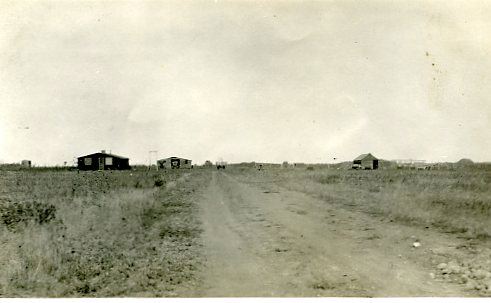
Rather than feeling this childhood home was embarrassing or difficult, my father loved it as most of us love the place where we first come to consciousness and was overjoyed to visit it in the early Fifties with his own three children, though it was in miserable shape. (I’m the oldest, the girl in the photo.) It had been a cowshed for a long time, but there were still shreds of the original tarpaper and he was able to find the place on one of the outbuildings where he’d shot at what he thought was an interloper in the middle of the night. It wasn’t, but he was pleased to think that he could rise decisively to the challenge even though he was a kid.

Monday, November 13, 2006

PRAIRIE PALACES


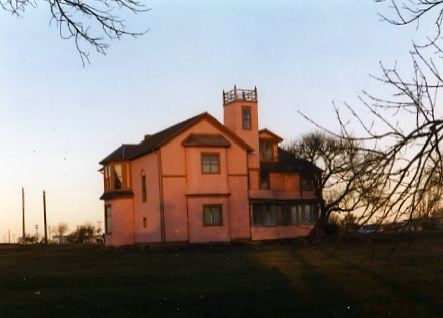
THE PICKLER HOUSE: THE “PINK PALACE”

Among the humble homesteads of the prairie, there occasionally develops an exceptionally big or fancy house belonging to some particularly prosperous and outstanding citizen. There is none in Valier because the Conrad brother (two developed this area as partners) who was interested in such things ended up in Kalispell. The mansion he built there is maintained for tours and has been in movies. It’s probably worth seeing “Heaven’s Gate” just to see the house, which provided the setting for the cattlemen’s meeting. The daughter of that Conrad used to slip out onto the upstairs mezzanine (in the movie the space where Kristofferson plays billiards) so that she could watch her father’s Indian friends gathered in the half-light around the fireplace in the big hall. They told stories and in old age she remembered seeing their eyes gleam with firelight and memory.

The Kohrs’ ranch in Deer Lodge is another remarkable place, complete with the surrounding outbuildings and fields -- even a ghost who mysteriously rumples the beds. And the most fabulous of them all, in my opinion, is the “chateau” at Medora, North Dakota, a ranch house built by a French Marquis. It’s not as big, but FAR more elegant. Still, these exceptional places are kind of a problem. No one wants to disperse them and their sometimes quite precious contents, but what seems as first to be a valuable museum will, as time passes, be overwhelmed by ever more modern fabulous overreaching. Sometimes the mansions are in places where there simply isn’t the population density or traffic to support them with admissions. And yet the neighbors will fight to save them, feeling that it is a matter of reflected glory.

The following is from a brochure:

“The John and Alice Pickler home ...is a prairie Victorian home featuring 20 rooms in three stories. Construction began in 1882 when Major Pickler, a Civil War veteran, built his claim shanty on his pre-emption... There was no architect for the constructiion of this prairie mansion, which was built in stages and completed by 1894.

“The first part of the house comprised the present dining room alcove (re: cozy corner) and part of the attached master bedroom... The kitchen and front parlor were added in 1883-84 with a secret room under the kitchen, separate from the rest of the basement. It is entered through a trap door in the kitchen closet...

“The library and music room on the south side of the main floor are part of a two-story hotel building moved from the ghost town of LaFoon in about 1890. When the railroad by-passed LaFoon, the county seat, in favor of Faulkton, most of the buildings “took wheels” and moved here. The library is the largest room in the house, 30 X 30, featuring a large arch and window ...a book alcove, a...stained glass window and fireplace....It contained one of the largest and finest libraries in the state at the turn of the century with more than 2,500 volumes still on the shelves.

“The most striking woodwork is in the music room. Pre-cut wood panels could not be purchased at the time so a carpenter, Archibald Mitchell Strachan, was hired to fashion the fir panels in the room and staircase. He lived with the family the winter of 1893-94 completing the project. [His pay was a team of horses.]

“When the house was completed, local artist Charles T. Greener selected a color in 1894 between a salmon and coral and it has remained this “pinkish” color and hence the sometimes name “The Pink Castle."

“A large lamp always hung in the tower of this home in the early days to guide the traveler to a place of shelter. The flag always flew from the tower, showing the family’s patriotic sentiments.”

John Alfred Pickler was a midwesterner who entered the Civil War at age 18, rose to the rank of Captain in the Third Iowa Cavalry and then was given command of the 138th Regiment of the United States Colored Infantry, and made a Major. He became a lawyer and then a Republican member of the US House of Representatives. He was a charter member of the Free and Accepted Masons and the Methodist Episcopalian church. His life might have made a better movie than "Heaven's Gate!"

The explanation the brochure suggests for the “secret basement” is Indian attacks and severe weather, but the Sioux of the area had been put on reservations since 1850, which was part of the reason this area could be homesteaded. I strongly suspect that given his command of the US Colored Infantry Regiment, the house may have been a stop on the Underground Railroad and the tower a beacon for them. I don’t know how long the need persisted after the Civil War. It could also have been a hiding place for something like liquor, but his wife was a force in the WCTU, as a good Methodist would be.

No Strachan except Archibald ever lived in this house, but because of his work there the family was quite imprinted with the place, particularly the library. Luckily, none of the family was ever inspired to paint their house pink.

Sunday, November 12, 2006

ARCHIBALD'S HOUSE

This posting may not be of much interest to the general public as they are part of a series about houses that will justify the name "Prairie Mary." They are family houses -- at first my ancestors, then my birth and growing-up house, and then the whole sequence of places I've lived until now.


*
About the turn of the century (1900?) Archibald Strachan came from Kilmarnock, Scotland, with his wife, two daughters (Jean and Jessie) and one son, Samuel. In the United States a fourth son, Thomas, was born. Archibald had the idea that he wanted to homestead on the prairie, to be a man of the land. He was a fine carpenter and was leaving a comfortable life, but he had Jeffersonian ideas about what was important. In Scotland he would probably never own land. He settled in Faulkton, South Dakota.

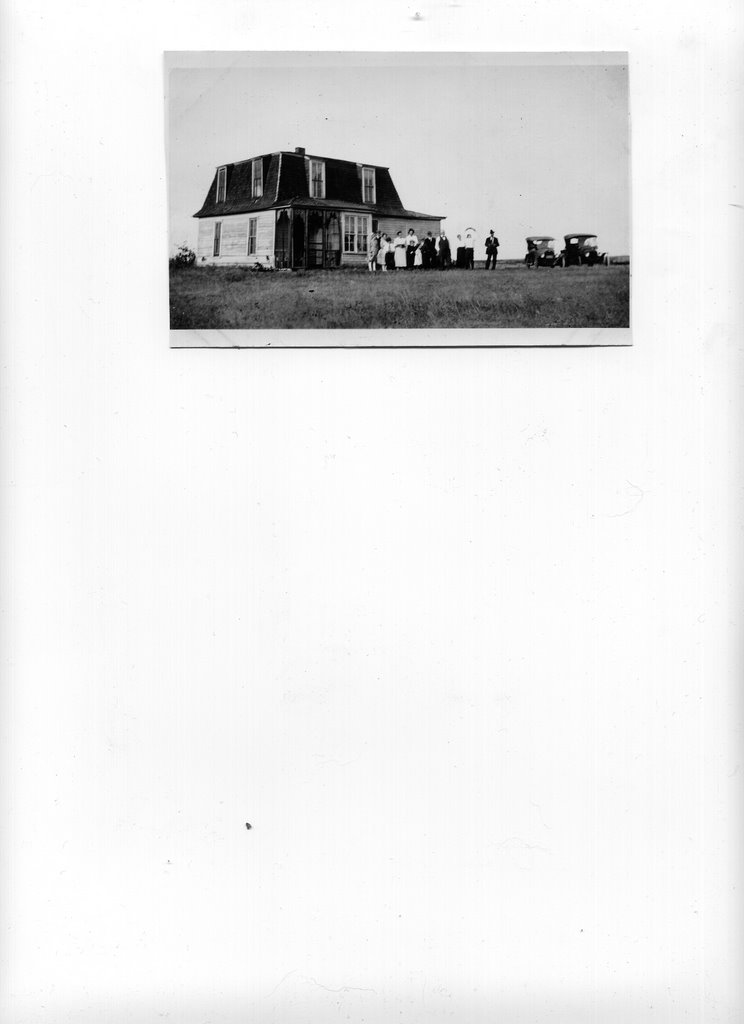
When in the summer of 2002 Gene Strachan (younger son of Thomas) arrived in Valier, Montana, to look at the family albums my father (oldest son of Samuel) had kept, this was the photo he most wanted to see. He remembered this house, but it was so atypical he couldn’t quite come to terms with the memory. I've certainly never seen one like it. He said it was a terrible house for cold in winter with all those windows and before modern insulated glass. Archibald must have been a man who loved light. There appears to be only one masonry chimney in the middle of the house but we don’t know what kind of stove or furnace it vents.

Neither is there any way to tell how the space inside was divided, but I’m betting that it was like my Valier house: four rooms up and four rooms down (except that I have no “up.”) It’s unclear whether there is indoor plumbing or electricity. I see neither wires nor outhouses. No woodpile. No trees.

When Sam and Beulah Strachan and their four teenaged children decided to leave Faulkton in order to homestead in Canada, they stopped at this house to tell it goodbye. Note the “bumpout” with windows on the front, which created a small porch screened and decorated with jigsaw Victorian trim. The house is not quite so well-maintained as I would guess it was when Archibald was young. I’m not even sure any of the Strachans were living there when this photo was taken.

Archibald later made a name for himself when he was hired to do wood paneling and other trim inside the "Pickler House," which counted as a mansion in those days. Not only did Archibald do the woodwork, but also he had made all his own tools. The house is quite famous. Google will bring it up. Archibald became miserably cranky in his last years, possibly due to strokes as that seems to be a family pattern. He had been living with the Sam Strachans, but had to be asked to leave. He died in a single-room-occupancy hotel in Minneapolis. Sam went to collect the body and bring it back to Faulkton for burial, though Sam's family was in Canada by then. It may have been Sam's share of Archibald's estate that helped the Sam Strachans to move to Oregon.


SAMUEL STRACHAN was born in Nova Scotia (18??) and Married Jessie Mitchell.

SAMUEL'S CHILDREN:
Archibald Mitchell Strachan
Annie Strachan
Thomas Strachan (died in a train wreck in Australia)
George Strachan
Jessie Strachan married an Ingram
John Strachan
Maggie Strachan married Peter Monie

Archibald Mitchell Strachan (b. June 17, 1850 in Stevenson, Scotland -- d. June 6, 1926 in Minneapolis, MN)
MARRIED July 25, 1873, in Kilmarnock, Scotland
Catharine Welsh (b. Jan 10, 1852, in Kilmarnock, Scotland -- d. Oct. 1918 in Purcell, Oklahoma) (Her father was Thomas Welsh, her mother was Jeannie Gillis)
THEIR CHILDREN:
Samuel S. Strachan (He was given no middle name and chose the middle initial "S.")
Jean Gillis Strachan
Jessie Mitchell Strachan
Thomas Welch Strachan

Friday, November 10, 2006

GEORGE WASHINGTON

Part of our national -- or maybe it’s a world's -- or maybe an English-speaking world's -- conversation about leadership lately has been taking a look back at first leaders, like Elizabeth I and Elizabeth II, and like George Washington, whose image needed a good refurbishing and reburnishing.

http://www.npr.org/templates/story/story.php?storyId=6388351 This URL is for an NPR story about three recently commissioned portraits of George Washington in wax, using CSI technology to reconstruct what was a tall, athletic, blue-eyed red-head who rode a horse with style. It’s worth reading the whole story. The three portraits cost a million dollars and reveal that in his youth George looked maybe quite a lot like Liam Neeson. He was said to be a wonderful ballroom dancer but a really bad conversationalist. He just didn’t say anything. Maybe it was his teeth which were notoriously terrible. Maybe he just didn’t talk until there was something to say. They say he didn’t like to be casually touched either. He was simply a self-contained man. The most unexpected revelation is that the fashion when he was young was to put boys in corsets, so that he stood and sat on a horse with shoulders sloping back and his stomach slightly stuck out. That posture lasted through his life.

From the very beginning of the United States, the people of the new nation yearned for a big bronze monumental statue of their first president, as was traditional in Europe, but in those days sculpture technology was focussed on Italian marble and you couldn’t make a free-standing heroic-sized horse in marble because its legs would break. (Marble is more fragile than is fortunate.) Houdon was brought from France to make bust portraits of the founders, and his portrait of George was helpful to the CSI crew.

The sculptor Greenough was in Italy and made a seated Washington. In the Greco-Roman conceit of the time, Greenough made his Washington a mock Caesar wearing a toga and making a grand gesture with his index finger. American critics, strictly groundlings, said he was pointing to where he left his clothes. At great effort and expense, the carved marble was bought to its assigned spot but it was too big to go through the door. The door frame was ripped off and the statue struggled in and centered. Then the floor began to creak and sag. A crew quickly ran to the basement to shore it up, then puffed back upstairs to move the statue out onto the sidewalk where it remained for a good long time.

One of the first sculptors to manage a bronze monument of Washington was Henry Kirke Brown. This url will take you to a description and photo, plus the information that after the attack on the World Trade Towers, this statue in New York City became a rallying point for grieving people. He is portrayed giving a benediction:
http://www.nycgovparks.org/sub_your_park/historical_signs/hs_historical_sign.php?id=12322

In time there were a half-dozen equestrian bronze monuments of Washington. But the statue of the man that I like the best -- perhaps the one most in character -- is one that Francis Morrone put me onto. It’s by Henry Shrady (1871-1922), one of those many skillful sculptors who have been neglected by history. Mostly Shrady’s famous for his “Grand Memorial” honoring General Grant, which took him almost two decades because of its extent and complexity. Also he was excellent at animals, heroic or parlor-sized, and is known for “The Empty Saddle,” a horse grazing alone in cavalry gear. His bronzes sometimes show up among “Western sculpture.” It was “The Empty Saddle” that prompted a member of a committee sponsoring a competition for a statue of Washington on horseback for Valley Forge to invite Shrady to compete -- and Shrady won.

In George W. Bush’s Oval Office, clearly seen during many photo ops, is a Remington sculpture of a bronc buster -- the horse rearing. An uncontrolled rearing horse is not a good thing and I’d make more of it except that same bronze has been there through the administrations of many presidents and we’re in conciliation mode.

What I’d rather see in that office is the Shrady portrait of George Washington at Valley Forge. Sombre, dignified, shrouded in cloak, Washington sits his horse easily and what a horse it is! Beautiful, controlled, and powerful. All four feet on the ground. I hope the picture of it will transfer to my blog for Veteran’s Day. Can’t we take up a collection to buy a casting for the Oval Office?

Thursday, November 09, 2006

WHEN PIGS FLY

When a truck hauling pigs to slaughter crashed on a freeway, I was happy to be out of animal control and not have to try to cope with the problem. Dead, maimed and freaked-out pigs among traffic is not anything anyone could prepare for. Another story in the newspaper was about a HUGE pig that had had to be shot after escaping and running amok on a freeway. It took a backhoe to load it back into its truck.

Among the very first animal control laws were those to control pigs in the Boston colonies. The general rule of thumb with domestic animals is that pigs must be fenced IN (because it takes a very strong fence to keep them there), horses and cows must be fenced OUT (in the open range states), and sheep and goats must be accompanied by a herder and flagged out -- that is, not a fence but a signal that the herder should obey. Sheep need a herder to prevent predators and goats need a herder because it’s pretty hard to fence goats at all. These rules just grew and formed themselves around the nature of each species. Enforcement might range from neighbor protests to gunfire to a lawsuit for crop damage.

We learn as little kids about which species are “domestic” and which are “wild,” and then maybe as older folks we think about “feral.” (Animals once domestic that have gone wild.) But in general people are not very sophisticated about such categories and there are not enough of them to exactly fit the realities. Pigs are a good example. There are domestic AND wild pig species. There are feral pigs and since pot-bellied pigs there have been pet pigs. We eat them, pet them, teach them tricks, neglect them, make stories around them, turn them loose to go wild, manage them like range animals, treat them as industrial units, and use them as experimental subjects -- they can cross just about every category boundary we have without overly upsetting anyone. That there are still places on the planet where dog and cat meat or dog and cat skins are accepted parts of commerce horrifies many people. This is a huge violation of American taboos so that urban myths constantly circulate about pets bought from shelters for food. “It’s a giveaway when they begin to feel a puppy’s ribs and remark that they seem nice and fat!”

But pigs are attractive as food except in places where they are pariah animals who clean the streets by eating scraps, excrement, even animal carcasses and dead people. Dogs can serve this purpose, too, so they can share a taboo, the perception that they are unclean -- to be avoided even in terms of contact. The taboo on pigs, right there in the Bible, is thought to be due to their physiological similarity to humans which means they can pass diseases to humans. Or some have suggested that it takes a lot of water resources to keep pigs cool enough (the real purpose of the traditional muddy pig sty) and that in warm places where water is scarce, they are far too much of a luxury -- leading to the hogging of resources.

On the other end of the spectrum, Americans don’t like the idea of eating horses. In fact, if we treated horses the way we treat pigs, everyone would be upset. We romanticize wild horses and burroes, but not wild pigs or goats which are enormously destructive to wildlife. It was evidently a “wild pig” that recently pooped in the spinach, killing people with e.coli infections, though it may have been that he was only a “wild pig” at parties.

While I was an animal control officer, we never did have to deal with pigs though we were sort of prepared, since the shelter was built on the original county “poor farm” and had the pig barns nearby. I was delighted to find an article about how to make pigs go where they were wanted. The two main techniques were to pick up their rear trotters, converting them into a kind of wheelbarrow which could be steered around, or to put a bucket over their heads and back them up, using their attempts to get their heads back out to power them along. Someone on the staff -- maybe it was Oswald -- knew how to herd pigs through chutes by using a square of light plywood, which the pigs intepreted as a wall. Also, it helps to protect your legs from pig tusks.

Like any animals, even a rhino, baby pigs are cute and appealing, especially when they are pink and have a clever voice-over, like Babe. They are indeed as smart as Wilbur, Charlotte the Spider’s friend. Pot-bellied pigs seem to bond with people strongly enough to justify bringing them into the house (not an Indonesian hut but a Western-style house). When the craze hit Portland, one man who kept a sort of farm-in-the-city in his fenced yard, added a pig to his little flock of chickens. We had to invent a permit that split the difference between the fears of some neighbors and the assurances of the owner. But pot-bellied pigs can be winningly small or big as any pig. Where do you draw the line?

Pig poop, even composted, is close enough to human excrement to be objectionable for soil amendment in the city, but no one ever tried it in Portland. I don’t think there was a law against it. I bought some by mistake here in Montana and had to use it on the borders farthest from the house.

What I’m getting at is that knowing the species of an animal doesn’t really tell a person much. We are used to conventional representations and make our laws to fit them, but there are always exceptions that crop up. The best laws have escape clauses. Animal control officers who can use good judgment, sometimes even resorting to a blind eye, permit systems based on realities, laws that suit the community standards rather than philosophical ideals, and complaint and court systems that use both common sense and democratic standards -- all these make animal control effective.

On further thought, I do remember a pig case in Portland. There is a huge “wild” park that is technically within the city limits. In the Seventies, before street people began to build hooches in there -- taking urban crime in with them -- an old black lady who lived up the street from my mother had recognized an opportunity. Down south where she came from, one turned out pigs in the spring into the oak forest to forage for themselves. In the fall one rounded them up and sold them for a tidy profit. So she turned 300 pigs loose in Forest Park.

As I recall, we thought about the political ramifications, scolded her, gave her a time limit for getting them out, and hoped we wouldn’t get anymore complaints, since we had no desire to mount a pig roundup. But it sure did keep street people out of the forest. Maybe the issue should be rethought.

Wednesday, November 08, 2006

Schadenfreude

While the hypocrite evangelist whose name begins with H. and whose attacks on gays finally were so offensive to his own “call boy” that the latter turned him in (or “out”), Martin Marty in his regular email essay, “Sightings,” cautioned us against enjoying it too much. I’m sure the advice applies to the whole political shift that some of us are so relieved to see.

The idea that in a Democracy “the majority wins” has not been examined enough, in my opinion. For one thing, it’s an Old Testament idea left over from tribal warfare. The New Testament is concerned with the protection of the minority, a much neglected concept unless there a way to make money out of some program for them.

Someone suggested on the radio that political parties in this country have been “genderized,” which is to say that Repubs are from Mars (warriors, tough, male, red) and Dems are from Venus (conciliators, weak, female, blue). This justifies the domination of Dems by Repubs in the minds of some locals, because to them that’s the way every set of categories boils down: winners vs. losers with women, Dems, nerds, geeks, and other non-athletic types being the automatic losers.

I remember subbing in the Valier High School library when in came a boy who had just gotten a paper back with a bad grade on it. “I KNEW Mr. Suchandsuch was gay!” he proclaimed.

“What? Do you know the definition of gay?” I asked, Mr. Suchandsuch being a family man.

“Of course I do. It means weak, incompetent, someone who doesn’t matter.” He didn’t say “girly man.” I couldn’t convince him that gay meant homosexual and that many gays are big strong tough men. He’d seen “Brokeback Mountain” and didn’t know what the fuss was about. Both of them were incompetent sheepherders -- that was all. This seems to be a widespread opinion in this neck of the prairie, at least in that age group. In his mind this information simply entitled him to ignore, discredit and attack any gay/weak/girly/ineffective person as a way of improving the species and removing obstacles from the path of the deserving big tough achievers. (There is some evidence that this point of view can be traced to athletic coaches.)

Needless to say, these guys are Repubs. What are they going to do about this major shift, which is not just a paradigm shift but more like a tectonic plate earthquake? Who will make sure they get their subsidies? Smart Dems -- and Tester really is smart -- will not pound them into the ground. Let Burns go quietly back to Missouri, which is where he came from and where they say retirement is very pleasant (good weather) and quiet. Rehberg and Rove are already emphasizing how skillful they are at being bi-political.

So much energy and expectation has piled up that this may be a bit like a dam bursting and the first test of Nancy Pelosi will be managing it in a constructive way. For instance, one military man pointed out that even if the troops were ordered out of Iraq tomorrow, it would take them a year to pack and transport everything that’s supposed to come back to this country -- that’s not counting the people.

I stopped this to listen to Bush’s news conference. Goodbye, Rumsfeld.

Somewhere long ago I read some Machiavellian advice that I think came from the Asian world. The gist of it was that if you want your opponent to withdraw without rancor and revenge (remember the computer sabotage the last time there was a turnover?), don’t block the exit. Maybe he WAS kicked to the curb with good cause, but don’t make him look bad to his mother while he’s lying stunned in the gutter.

Some think that WWII happened in large part because at the end of WWI, Germany was told “winner takes all” and humiliated. Maybe the US should do a little thinking about the way they treated Native Americans in defeat. (I notice Bush says one of the things he wants to get done before he leaves office is “this Indian thing,” by which I suppose he means returning the money the government has misused over the last century and a half.)

The environment here on the high prairie is pretty unforgiving. An economic miscalculation or even a driving blooper can be punished by death. This should make us humble and willing to help each other. It’s going to be very hard on the pride of the Repubs who have relied on Burns to save them. I notice a quick little series of lawsuits withdrawn, etc. I personally am glad Judge Buyske lost. Many continental shifts will be out of sight, but a lot of people will be adjusting in ways that never become public, little tremors.

But I hope I never have to hear Bush’s joke about measuring drapes in the Congressional offices again. In fact, I think they ought to accept the drapes already there -- red or blue -- in the interest of economy. Use the energy and money for bigger things.

Tuesday, November 07, 2006

SELECTED SHORTS

There’s a lot of miscellaneous stuff wandering around my virtual desktop, so I’ll just post it and get it out of the way even though none of them has quite fermented/gestated into a complete posting.

I read quite a bit about brain research and the genome, partly because I have so many family members with brain damage (husband, brother, cousin, father) and other relatives struggling with problems that may have genetic roots.

This below comes from a blog called “Gene Expression” and a regular poster called “Coffee Mug.” The photo won’t travel, given my technical skill, but it’s at:
(http://www.gnxp.com/blog/2006/11/place-and-plasticity-two-views-on.php) The piece is about the hippocampus and the photo shows a seahorse alongside a real dissected hippocampus from a brain -- the resemblance is very clear. Below is the concluding paragraph of the piece:

“Exploration of the hippocampus' abilities continues. I have not scratched the surface even in this mega-post. The theories of the hippocampus as a memory storage device and a cognitive map are not mutually exclusive and may turn out to be one and the same. I came to an interest in the hippocampus via a more philosophical route: considering the role of memory in the definition of the self and such, but there are plenty of noble non-navel-gazing reasons to delve deep into this structure as well. The hippocampus shows signs of damage and deterioration early on in Alzheimer's disease and other forms of dementia, and the same recurrent excitatory connectivity so useful for memory storage may also provide the substrate for the electrical storms underlying epilepsy. I hope you now have some more of the conceptual framework necessary for reading and evaluating new hippocampus articles, and we can talk about it some more when good studies come out. Now make like a hippocampectomized rat and get lost!”

I’m also coming at an interest in the hippocampus through the issue of identity, but in two ways. First, the identities of these close and loved people changed subtly but so definitely that it was impossible to continue in relationship with them. Was this a failure of faithfulness? (In sickness or in health...) If another person is unrecognizable in terms of responses, even though they smell, taste, feel the same, are they even the same person?

Second, for a long time my rule has been to turn all questions of others onto myself. When I was a child and made declarations, people would say, “Oh, you’ll change. You’ll grow out of that.” So I have been determined to stay the same -- but how do I remember who I was? Aren’t I as likely as the next person to “forget” what’s inconvenient ? This is one of the appeals and uses of writing for me -- write down the evidence, then go back later to check the record.

The hippocampus also has a lot to do with the sorting and reassorting of memories done during sleep, probably causing dreams. Towards morning when I get a little chilled and rise through sleep enough to remember dreams, I often have what I call “snow dreams.” This morning I had the electric mattress warmer turned up high -- high enough that the cat left -- and instead of the usual dream about being at an insufficiently heated conference center, I dreamt about being in a room with a fireplace -- wonderful polished wood mantel filled with weathered discarded boards that were only burning in the middle. I think it had something to do with finding the website of Daniel Harper (www.danielharper.org) who is a UU minister in New Bedford. (Remember the Curtis Room, Dan?) I was reading about various UU issues and about Meadville/Lombard which is up to its usual tricks. So now, which is UUism -- the mantel or the burning wood?

Since Darrell told me about his Blackfeet Uncle (sort of like a Dutch Uncle, maybe), I’ve been making up pithy bits of advice to tell a young ‘un. Like: “If your pickup breaks down on the way home from Great Falls with the groceries in the back, eat the ice cream but don’t open the beer.” I was still in this mood when I got to Pro-Lube in Great Falls yesterday. They always want to vacuum the inside of the cab and I don’t want them to, but the Montana ethic is to always keep your pickup Very Clean. (The carwash in Valier is exempted from the ban on using water frivolously.) In the past I’ve asked them not to vacuum and they just did it anyway. So this time I told the young man, “Listen, I’m a drug dealer and I don’t want you to vacuum in my cab because the marijuana seeds collect on the floor and when I really need the money, I gather them up and sell them.” He laughed, looked at me sideways, and when he thought I wasn’t looking he checked the floor -- but he did NOT vacuum it! Do people trust illegal people to be more honest?

Yesterday the November winds were really ripping and the sky was torn in every direction. Great gray blankets of wooly clouds were hanging low and out to the horizon, but they were ripped and rolled, tumbled and twitched, so that bright blue sky shone through and sometimes there were even sudden bursts of white light. The ground has no snow again, which is why the clouds are dark underneath, and the Rockies are only patched with white. The windmills by Great Falls were turning in sync when I went by. They don’t strike me as ugly. They’re white and oddly sedate.

I suppose the day of an election ought to be breathless, held in suspense, but maybe this wild tumult is more appropriate to these times and our national predicaments. I had to leave several positions on my ballot empty since there were NO people I could vote for. I joked that it would save energy if I just had one big vote: “All incumbents out.” For weeks pollsters have been calling me and I’ve hung up without speaking. Now they’re having their revenge. Every time I settle down for a nap or a good long read, they call me and there’s no one on the line.

Daniel Harper and my new friend Sharon (SBpoet.com) are both participating in NaNoWriMo. Sharon took photos of the group that gathered to write their novels together (possibly at the Leaf & Bean in Missoula or is it Butterfly Something?). All sweet chix, sitting there with thousand dollar laptops in front of them (plus caffeinated beverages), and I’ll bet you ten dollars they were all writing about love. Riding, writing, those hippocampi through the sea of memory. Mermaids.

REPRISE

One of the other major subjects Darrell Kipp and I pondered the other day was Blackfoot music and Bruno Nettl, who first came here to study it in the 1960’s. He had a fabulous set of reel-to-reel recordings of Blackfoot songs taken back in the times of the first anthropologists: George Bird Grinnell recorded 40 songs in 1897, McClintock collected 51 songs in 1898, Clark Wissler collected 200 songs in 1903-4, and so on. Because of this, Nettl could compare early versions of a specific song with later versions -- which showed that they didn’t change much.

In fact, there is usually a strong pattern which is “the way” an Indian song is sung. The drummers sit around the big bass drum, then they softly and steadily beat the rim, then they get more intense, then the leader sings the theme, a second leader repeats, and by that time the group is singing in unison, but not necessarily in time to the drum! Nettl suggests a 2:3 relationship. There is set of repetitions and drumming may stop during some phrases of singing. Part of the reason I like “Pow-wow Songs for Kids” by the Blacklodge Singers, is that the words are English so a person can follow the repetitions more easily.

Nettl said that when he did this study, no one much was using flute or anything stringed. But it struck me that when I subbed at the Nitzipuwahsin Real-Speak School, the kids were learning guitar. No one said, “Now there will be guitar class.” Instead the teacher showed up and some kids had already been practising softly in preparation. Clearly they loved it. They clustered in a corner with high concentration.

Funerals here are always accompanied by country music on guitars. When Bob Scriver was teaching music, he started everyone in the low grades on little plastic flutes and he said they just took to it naturally. There’s not a problem with European music. (I’m writing a story about an Indian man who plays concertoes on a grand piano and am a bit surprised that people find this unlikely. I’ve been a Browning Indian home that contained a grand piano.)

Back to the point: Bruno Nettl thought one day, “We do all this research on the reservation -- why don’t we give something back to them!” This is the point of enlightenment that so many of the researchers who visit here never reach. They seem to feel that Indians are like little lab mice -- they would never think of turning the results of their studies over to the mice.

And, of course, lots of people do give things back and those precious documents or artifacts are lost, neglected, sold, or stashed without even examination. But that’s what Piegan Institute is able to prevent. They looked at this big box of reel-to-reel tapes and thought, “We’ve got to find a machine that will play this stuff.” (Of course, the tapes themselves were re-recorded from wax cylinders.) It took a while to find an old reel-to-reel machine, but as soon as they did they sat down to listen. Then, as they began to accumulate people with some technical expertise, the tapes were put on DVD’s. Darrell began to play them in the background while he worked, occasionally recognizing words, which he couldn’t have done before the Immersion Program started.

But still, they were interesting, but what did they mean? In the end, one needs a particular kind of person, who turned out to be Shirlee Crowshoe who speaks Blackfoot as her first language. These days she is listening to the DVD’s on the computer and transcribing what the people say among themselves in their own language while Bruno was there asking for songs and then asking “funny questions” about the songs.

In the 1960’s Bruno had a pretty good idea what the men were saying but probably was a little less clear what the kibitzing women were telling the men. Sometimes they’re joking so much that Shirlee gets to laughing. Mostly there were two concerns: one was to protect the Sacredness of the songs by leaving off a phrase, maybe at the end, so it wouldn’t have to be accompanied by the proper ceremony it belonged to. (This is much like filming a Catholic mass -- the priest will leave his hat off to prevent himself from being in “sacred” mode.) The other concern was to come up with as many songs as possible because they were being paid by the song. They really needed the money. These were old people living in log cabins on Moccasin Flats where the broken windows might be mended by a rag stuffed into the hole in the glass and heat came from a wood stove.

They had no idea that in the twenty-first century the technology and the motivation would be there for these recordings to be studied -- not by high-powered professors from back East, but by their own people with some sophistication and sympathy for both worlds. This work cuts against the bitter post-colonial doctrine that depends upon rejection of all white modes and records. Grinnell, McClintock and Wissler did their best to capture the sounds, never knowing there would be a Bruno Nettl, but in faith that it was important. Likewise, Nettl recorded and then returned the songs never knowing that Darrell Kipp and Shirlee Crowshoe would welcome them like returned children. The first recorders could never do this empowering work of today, but today’s workers could never do this without those old recordings. It’s a synergy.

Sunday, November 05, 2006

DOES THE END JUSTIFY THE MEANS?

One of the first cracks in my hero-worship of my first Unitarian minister came when he said something that led me to ask, “Then are you saying the end justifies the means?”

“Yes.”

This has always been a critical moral question and -- too often, I fear -- using dubious means has corrupted the action to the point of changing the end. I mean, if a person lies, cheats, steals, and etc. to get to be the president on grounds that then he or she will be in a position to make vital changes to save the world, will they even remember what the changes are? What they’re supposed to save?

I haven’t put this directly to Darrell Kipp, but we were talking along these same lines the other day. He was telling about conferences of nonprofits, organized to do good, who are now so massive and self-regarding that they crush their own ability to do good. Several important Indians with outstanding achievements were invited to a recent event but so many people who considered themselves MORE important had insisted on having time, that in order to make room for them the Indians were put on a panel together at the end of the day, reduced to a category.

He was saying that probably half of the people at the conferences he’s attended recently were well-dressed, attractive women between twenty and fifty who were clearly “on the make” -- while the rest were grassroots people, ordinary small-town, low-rent folks driven to do some good: food banks, credit counseling, housing. I’ve been suggesting for some time that when one goes to environmental roundtables the activists are often the tweedy, verbal, summer back-packers who suggest college professors and spend all their time tweaking agreements and regulations that no one else understands. Phyllis has sent me a publication by an organization called “Animal People,” who publish the budgets and incomes of humane societies (millions) and their directors (hundreds of thousands). They normally post these figures on their websites but the sites get hacked. I’ll blog more about this later.

Now I’m told that the Unitarian Universalist Association is advertising in the usual media ways to make the denomination grow. (The current president is an old advertising exec -- people are afraid to point out that he’s black or that he’s from Washington, D.C.) So what is the UUA point of salesmanship, their “means” argument? Religious freedom, which is the classic gathering point? No. Gay rights. I expect this is the result of some kind of survey to discover who is looking for a denomination, not a principled consensus. It’s “sexy” and media-worthy.

Darrell and I have been reflecting on the children of the Boomers, who were the children of the WWII generation. Because their parents had hard times, the Boomers were raised “easy” -- very little hardship in their lives, an expanding economy, the programs of the War on Poverty (as opposed to War on Terrorism), welcoming colleges, and so on. They didn’t have to learn how to tough it out, scrimp through a budget, or accept a rather lesser lot in life than they might have originally imagined. (The lesser lot being the great hardship of dorm life or work/study.) At the same time it was the Boomers who were the idealists, the ones who wanted to change the world, the ones Darrell remembers thronging to Billings to see JFK, Jr. and glory in his ideas. (As contrasted with Bush’s recent visit where the people must be filtered.) They were the hippies.

Now their kids totally reject traditional college life. They say their parents are square: NPR is dumb, nature trails are boring, symphonies are fossilized, “art” is corny, opera/dance/theatre are-you-kidding? and even the director of the gay and lesbian coalition in Montana has had to resign for lack of funds. Funding everywhere is thinning out. Maybe this is related to the changes we’re seeing in the nonprofit world: the professionalization and the bureaucratization of NGO’s, whether supposedly rebuilding Iraq or supposedly feeding the poor. A huge percentage off the tops of their budgets go to the staff. The Boomers’ kids know this. Part of the judgment of “square” comes from cynicism rather than awareness of newer and better ways. They’re saying, “All means are corrupt.” And -- I think -- to protect themselves from despair, add, “It’s not a worthwhile goal anyway. Nobody really cares about all this old moldy liberal do-gooders stuff. Just have a good day while you can, man!”

But the despair creeps in anyway. Darrell says that Father Ed, at Church of the Little Flower in Browning, said -- uncharacteristically, since he is not one to talk about himself -- “I came here with such wonderful ideas about what could be accomplished. And all I’ve done has been to bury young people.” Drugs, drink, fast driving, violence, “media meth” mainlining shock and risk... On a national level how do we expect anyone to turn around global warming, the death of the oceans, steadily increasing atmospheric pollution, crazed dictators with atomic bombs, and -- hell -- meteors striking the planet Earth? And who cares anyway? We’re just another kind of animal waiting to become extinct. Why deny yourself?

A strong tie between DRK (Darrell) and MHS (me) is our conviction that the pen is mightier than the sword, even if it’s a virtual fantasy sword on Gameboy. Ideas rule. Ideas rock. The best way to defeat a bad idea is with a good idea. The best way to forge a good idea is to collaborate with a community that simply will not let any among them get away with substituting means for Ends, will not let any among them forget the End or change the End to something else because corrupt means have damaged their vision. That’s what the college years used to be about. That’s why we wanted the high school kids to go to college. I thought that’s what churches were about.

If they aren’t, let’s get busy and figure out what can replace them. It’s Sunday. I can’t help preaching. Guess I won't bother to apologize since this is not a comfortably salaried pulpit on which I and my family are dependent. This is a great means, this blog thing.

Saturday, November 04, 2006

ADVICE FROM UNCLES

Darrell Kipp stopped by on his way home from a flying trip to St. Louis to tie up loose ends on the Lewis & Clark Bicentennial. In the past when asked to fly over early in the morning, participate in events, and fly back in the evening, he went through Valier too late at night to stop. But in the last week or so Darrell, his wife and myself have all had birthdays in our sixties. As we age, things have to change a bit, so this time Darrell insisted he needed more time to adjust on that end and when he landed in Great Falls he stayed overnight, arriving here just as I was backing out to go do the laundry in Shelby. I would have left earlier except that for a while the sewer project meant I couldn’t get out -- which now seems very fortunate.

We had a few hours to talk and Darrell was tired enough to let down his guard a little more than usual. Aside from plotting and analyzing what’s going on, I love to play Boswell to Darrell’s Johnson and always jump on an opportunity to question him, especially about the early years. What I want to know most of all is how he made the transition out of the failure paradigm that traps so many people here, including three of his brothers. My entering premise was that kids here fail in school and engage in other self-destructive behavior because they WANT TO. They see no percentage, no attraction, in success. So what made him different? What made him want to succeed?

This time his answer was mentoring. (Sometimes it’s slightly different.) We had been talking about the early split between full-bloods, who stoically withdrew to wait for the end, and the half-blood boys, esp. the ones with white fathers who had connections, pushed their boys into their family businesses, and provided other means for success. (Not the girls.) Darrell is full-blood but he said that when he was a boy, his uncle (on his father’s side) would say to him occasionally, “Get that chair and bring it over here.”

The two of them would sit facing each other so they could have a serious, intense, one-on-one talk about life. (The uncle was a WWII veteran.) “These are things you need to know to protect yourself,” he would say. The emphasis was on protecting oneself. This is what you should do if you are completely broke somewhere you don’t know anyone; or in a bar when a brawl starts; or someone wants to fight you personally; or you’ve made a woman very angry. None of the advice was censored or dumbed down for a little boy. The uncle said, "This is what it's like to be in bed with a woman." It was hard-won man-knowledge from the wider world. This is how to act around blacks; this is how to protect yourself in a big city or while hitch-hiking.

I’ve heard Darrell give graduation talks and I realize this is the source of those talks. He tells graduates to always be nice to women because they will remember that and help you later, to rat-hole $500 so you’ll have enough money to get out of town if you have to, to never get into a hole too small to get out of. Things to do to protect yourself. They always listen closely. These are not the shiny lies and half-truths they are usually told.

When Darrell went off to college in Billings, somewhat bolstered by the faith his English teacher had in him, he flunked every single class he took. In those days anyone who graduated from a Montana high school was automatically admitted to college and somehow his tuition was paid. He didn’t know he would have to pay for room and board, but work/study and grants took care of that. He learned that he could petition to keep his enrollment and subsidies and so he did and they always granted him permission to stay.

"Why did you want to stay?" I asked. So many of the kids go to college, even in Montana, and can’t bear to be away from familiar friends and places for as long as a month. They come back before there is a time to recover from homesickness. (I figure six weeks is about what it takes -- I'm convinced it's physiological.)

Darrell said, “Are you kidding? I thought the dorm was the height of luxury! I only had to share my room with one other person, a guy from New Jersey who I thought was Mafia, and once he got over thinking I might scalp him in his sleep, we became best friends right up to the present. I thought cafeteria food was wonderful and I could have as much as I wanted. My dorm was assigned all the Indians, East Coasters, handicapped, Butte and Anaconda characters and we meshed into a community. The talk was great -- constant banter and quips -- in every accent and from every point of view. I loved those guys. I didn’t want to leave them.”

Even now, whenever Darrell turns to talk about utopias, he wants to create a little village of those good friends, or at least people like them. But now kids think it’s low-class to have to live in a dorm. They think cafeteria food is beneath them. (As Darrell says, they don’t know that modern cafeterias include salad bars, Mexican food, burgers and fries, and pizza.) The Indian kids in those days didn’t clump up, but rather distributed themselves among the others. They didn’t pair off except for events but Darrell, because he was dependable, good-looking, and earnest, was sometimes asked to be an escort for banquets or dances where smart, ambitious Indian women wanted to appear. The friendships he formed with those “pals,” as he calls them, have turned out to connect him to some pretty high places when he needs a little help for a program or a student.

More than that, when he went to petition the dean, the man he talked to was Ben Surwill, a big handsome Polish man who had made his fortune back east and came looking for a small community where he could do some good and have some fun. He liked Darrell and put his feet on the European immigrant’s path: hard work, education, and good company. Because he took Darrell along as a sidekick -- also entrusted with the duty of getting the Dean home if he were drinking and a fight looked imminent -- he sent Darrell to a Billings tailor for a fine suit and a nice sports jacket. (I know of Unitarian ministers who operate this way.) This was one of the big secrets: Darrell accepted -- at least to some degree -- the ethos of the first and second generation immigrants who built the infrastructure of the state.

Sometimes I wonder whether the post-modern deconstructive approach to Native American issues hasn’t done as much mischief as good. Much of their jargon is unintelligible to both Darrell and I. The rage that goes with it gets in the way of forming contacts and community. Their strategy for protecting themselves seems to be to eliminate all opposition or criticism. Anyway, I think maybe the wave of it is mostly ebbing.

I can imagine someone’s Mexican uncle (or maybe aunt) saying (and I should really say this is Spanish), “Child, bring that chair over here,” and sitting down with their four knees together to explain, “This is how you must protect yourself! Go to school! Learn all you can. Make amigoes wherever you go!”

You know what? Some of those uncles and aunts will have learned this stuff in the Middle East battles. Of course, others didn’t live to bring back what they learned.

Friday, November 03, 2006

BEST AND BRIGHTEST

During my last year of seminary (1981-82) I typed half-time for a living at the U of Chicago Law School. The U of C is pretty much an elitist school, but the Law School is arguably the elitest and most formidable section of it. (They themselves could argue that well.) This evening I was reading a review by Cass Sunstein, one of the professors, who always arrived in the building so desperate to get to his computer and record what he’d thought in transit that his office looked as though a major crime had been committed and the room ransacked. It would have been easy to hide a good-sized body under the papers and books. Tonight the idea of Googling some of these people came to me. In those days we only had computer word-processors for professors, with a few that secretaries had to reserve in advance and use in a small sound-proof room with windows so the world could see we were not playing “Asteroids.” (The profs did.) Google is a game they would have relished even more.

Cass Sunstein, according to Google, is still there at U. of C. but his website won’t come up tonight. The review I was reading was of “Our Undemocratic Constitution: Where the Constitution Goes Wrong (and How We the People Can Correct It” by Sanford Levinson. Excellent review. But don’t ask Anton Scalia if he agrees with it. (Levinson argues for term limits on Supreme Court Justices.) I used to deliver his mail and sometimes rode the elevator beside him, fully aware that everyone knew he was destined for the Supreme Court. He tried not to be smug about it, with little success. That was, I’m shocked to realize, more than twenty-five years ago.

Two other Google results shocked me. The first was Monte Dube, who was nothing if not hip and bold: beard, longish hair, plaid shirt. My specific assignment was to type for the Bigelow Fellows, of which he was one. In those days we typed on a typewriter and used Whiteout or Corrasable paper. Dube and Berg, who was much more uptight, demanded that their letters never have any corrections, which one could detect by holding the letter up to the light. (There were two female “Fellows” and they pretty much did their own typing.) I could never pick Monte Dube out of a lineup now: baldish, clean-shaven. Is that a bespoke suit? He’s in law specializing in the health industry. I’d bet it IS tailored. And are those DIMPLES??

The other was Norval Morris, an Australian who was studying when and how the insanity plea should work. To give him something concrete to write about, he invented some “lost” stories by George Orwell, writing them in so convincing a manner that no one questioned their formidable style. One, I remember, was a man who shot his wife to death while dreaming of something else. It was the tropics and he was feverish... Truly, they were like novels until Morris turned to the legal argument and REALLY made your head spin with the issues he raised.

He insisted on cone coffee, which in those days one made in a big pyrex Chemex hourglass with a wooden collar, and I had a wrestling match to make it properly. (U of C lawyers were major coffee snobs and there was a little shop that sold cappacinos beyond anything I’ve ever had since. Foam to dream of.) Also, I could never quite get the knack of sitting in the modern chairs in his office and almost sprawled on the floor several times. I couldn’t decide whether he thought I was endearingly awkward or a great menacing cow.

The stories, which were convincingly “found” by one of Morris’ friends, raised quite a furor and I never could quite figure out whether this was a bad thing that would get the professor fired or whether it was a wonderful conspiracy that would become a legend. I guess he just liked ambiguity. I remember some important magazine calling to insist that I deliver him a message as soon as possible. He was playing tennis behind my lodgings, so I called him over to the fence and pushed the note through to him. He said, “You’re enjoying all this, aren’t you?” I was, but I wasn’t sure whether that was good or bad. The shock is that he’s gone now -- died two years ago.

Jim White had a double appointment with English and Law. His secretary was Sharon Mikulich, who had a huge crush on Sting and loved “Guns and Roses.” First I’d ever heard of them. (Sharon has 22 Google entries because of her work on behalf of labor and because of marathon traveling!) She considered me reliable, so if she needed help, I typed White’s manuscripts, which I loved to do because they were about rhetoric and always excellent. White and I had several conversations about Norman Maclean and he was the one who told me that Maclean seemed to be in mental trouble and that people were wondering about alcoholism. Of course, it was Alzheimers and Maclean knew it was, couldn’t quite figure out what to do about it. Can anyone?

But the funniest story was about Franklin E. Zimring, a California script-writers' kid who somehow blundered into this totally unsuitable context and was stressing out. His back kept going into spasm, people said it was psychosomatic (probably), he made a great fuss, I thought he really was being treated so badly that I wept, and somehow he decided that I’d fallen in love with him. (Who wouldn’t? Smart, handsome, connected, dyslexic -- and proud of it all.) I left Chicago at the end of the academic year. (I was a little short on my transcript to actually graduate, but they agreed to let me pick up the last class or so in Montana -- Chicago was clearly an unsuitable context for ME, too!) Zimring organized (or rather the head of the secretarial division organized at his request) a farewell luncheon with him, me and the head of the secretaries, a charming and gracious lady who also bought me a necklace at the Oriental Institute -- at Zimring’s request. It had the Code of Hammarabi on it. I thought it was a classy thing to do. I mean, what if I’d REALLY been in love with him?

Tonight Zimring’s page at the School of Law, University of California, Berkeley, (his proper milieu) has a photo of him looking a bit like Jim Harrison. Maybe a little bit like a character from “Guys and Dolls.” He writes about kids and capital punishment, always defending the little guy. Well, maybe I’m still a little in love with him. He gets interviewed on NPR now and then.

You must understand that I came to this extraordinary collection of Big Brains straight from the doggy streets of Portland and had five years of experience with neighborhood animal cases. The person who appreciated this was the Viennese Hans Zeisel, who was a friend of Konrad Lorenz. I’d read Lorenz, so we could talk about him. Zeisel was also a director of the Bulletin of Atomic Scientists, which runs the Doomsday Clock and I remember that one day they advanced it closer to midnight. He was very upset, but I don’t remember what the specific cause was. It was as though in his mind it had stopped being a symbol, so that moving that hand was to him something actual and personal.

What I learned from all this was how little separation there is between ordinary folks and people of great privilege and honor. They were so far beyond me intellectually that I didn’t need to feel compared, even in terms of the youngsters. Sharon, who was a secretary then and remains a secretary, has probably had as much impact on the world as any of the professors. I sure hope that somewhere in there she got to meet Sting.

Thursday, November 02, 2006

GOING POSTAL

In Valier we don’t have mail delivery door-to-door, but go down to the post office to pick it up. We voted to keep it this way because it’s a good chance to run into neighbors. This morning there was quite a group of us, so I got to tell my sewer story. The post master, at the moment a woman named Lorraine, says she’s like a “bartender with stamps.” We had an illustration this morning when one of the older guys in town, a widowed contractor who in his time could build a house single-handed, asked mournfully if anyone could fix a zipper for him. She sent him to the Quilt Shop, where there are good machines and clever hands. It’s in the back of the Conoco station. I didn’t find it for the first few years I was here.

The person I am always most pleased to see at the post office is Corky, whose dad helped us build the Scriver Bighorn Foundry in Browning 45 years ago and who was once my student. What I never quite registered was just how smart he really was, though the math teacher picked up on it -- at one point Corky wanted to be a math teacher, too. It didn’t happen. Instead Corky has had one of those fix-everything lives, doing what came to hand. A few years ago he had a brain aneurysm which was repaired by emergency surgery, leaving him just as smart and funny as he ever was but causing him to have perpetual pain and an occasional internal lightning strike like a taser hit that doubles him up. His mail included books on tape -- authors like John McPhee, who also likes to know how everything works.

I’ve never had the contempt for working men (and now sometimes women, though they are political enough to escape criticism) that many people mostly keep hidden. But I think it’s real and I think it hurts us all to have a shortage of guys who can do plumbing, electric stuff, water and sewer -- jobs that take logic, strength, tools and a willingness to crawl under houses. When I bought this house, part of my motivation was to learn how to do this myself -- at least a little bit -- and I did crawl under there a few days ago to disconnect my hose bib.

I love big hairy men who can really do stuff. Maybe it’s because my folks grew up on farms. My dad used to show us how he could burn the red hair off his arms with a blowtorch. My brothers and I would sit on the basement steps, all agog, while he fixed things. Then there were the foundry years with Bob when we sweated from heat and exertion. I was the only woman, but I was kept humble by the knowledge that one of the workers who was doing the same thing I was had flunked out of my English class. (No, not Corky -- he was a little kid then.) I mean, if he could do the same work as me, why couldn’t I teach him English?

Today my U of Chicago Alumni mag came and on the cover is a guy who could easily be my father from the looks of him: red-headed, beefy, freckled, dressed in ball cap and baggy jeans. (He’s twenty years younger than me.) Kevin Murphy, a PhD ‘86 economist, a “genius” according to the MacArthur Foundation, is said to be a brilliant economist but he hates to write (oh, oh -- not ENTIRELY like me). What he really likes is fine carpentry. Of course, he’s a professor with a huge classload because he likes that, too. He likes to think “with” people.

In the years of this past century must of our population has left rural life and I would propose that in the process we lost much knowledge that came from doing things, handling materials, learning tools and strategies. Someone was recently praised as a woodsman because he could make a willow whistle. Heck, my mom made good willow whistles. I’ve been looking at horse and rider sculptures and thinking how much we’ve lost in terms of knowing horse breeds, being able to read horse language, internalizing the feeling of a big, muscled, and yet obedient (mostly) animal under us. When we look at equestrian statues nowadays, we lose much of the information once plain to everyone: what kind of man would ride this horse, what this horse thinks of its rider, what sort of work this horse is meant to do.

So I was telling Corky about the trench in front of my house so deep the shovel guy needed a ladder and he told me about one part where the sewer is twelve feet down. Jack Smith came in sporting an elegant Spanish round-crowned hat this morning. (He runs a mountain man gallery -- http://www.medicineriver.com/lame_bear.htm -- in case you need a pure white buckskin wedding dress with authentic Indian details.) He said the slip liners were trying to do something in the trench using a solvent that made him, quietly sitting at his desk, suddenly feel like Saturday on a happy night. His demonstration was vivid.

I live here for the competence, the gusto, the stories. But when I go to the post office, what I pick up is stuff like the U of Chicago Magazine so I can read about economics and the Argonne National Laboratory. That there is an article about Susan M Bielstein’s book “Permissions, a Survival Guide: Blunt Talk about Art as Intellectual Property” (U of Chicago, 2006). It would be pure gravy except that it is information I really need.

Before there was the Internet, there was the Post Office, which comes equipped with a community and a “bartender with stamps.” And you know who else came in? The librarian!

Wednesday, November 01, 2006

MAAAAARK TWAAAAAIIINNN

This morning at 8:30 AM the village guys and the sewer liners began to get organized. At 9AM the steamshovel (well, actually they call it an “excavator” now, but it’s still two stories tall and looks like a dinosaur) hit the pavement hard with with its shovel -- BAM! This little house jumped on its foundation, the two cats jumped in the air, and I jumped, too, even though I was watching the monster teeth bite down. After that there were no cats around. I don’t know whether they went out to the back garage or dove into the closet to hide. I myself dutifully abstained from using any drains, depending on the camping toilet I bought just in case.

All day the guys out there in their Carhartts and knit caps measured and dug and marked both sewer caps and snow with pale blue spray paint (Della Robbia Blue -- well, more Wedgewood). The international code for sewer pipe is this sky blue. I don’t know what the color for water pipe is. Hot pink? Gas might be yellow. AS the day went on the cats became more confident.

After the big machines -- one is REALLY big and the other is pretty big -- broke through the street surface and carefully pulled out dirt, going down as deep as a man is tall, guys got in there with shovels to do the delicate last bit of exhumation. They had instruments that could tell them when they were getting close. When the sewer pipe was uncovered, it looked like an old bone.

The streets in this village were laid out a hundred years ago to accommodate horse teams and wagons turning around, so there’s plenty of room for big machinery, trenches, two lanes of passage and even parking. I think most people on the block found someplace else to be -- there are four houses on the other side, one with small children, and three houses on this side plus the Baptist church. Through all the crashing and grinding, the church bells went on bonging out the hours and hymns with their usual gusto. The trench went between two of the row of boulevard trees, cutting roots.

Strange sounds and terrible smells (more chemical than excremental) rose into my bathroom. Crackers went to see what the noise was, encountered the smells and backed out slowly with her fur standing up in a ridge.

I thought they would have the trenches closed by evening, but it’s seven “post meridian” and the news has ended. It's dark. I went out for the dozenth time in my carpet slippers and double fleece shirts to see whether I could pee in my own pot tonight. “Give us ten more minutes,” said the fellow feeding cable into the manhole. Someone in the front of the lit truck was operating machinery while the fellow with the cable watched the video screen and told him: “Four feet! Three feet! This is it!” I asked if he ever sang out, “Maaaarrrk Twaaaaaiiin.” He recognized the joke and laughed. Then I sang him a bit of Belafonte, “one foot, two foot...” but he’s too young for that. I had to do something to keep warm. It’s sinking down to eight tonight and I hadn’t planned to walk that far up the block. But it was fascinating -- a familiar sight made new by man-deep square holes and tall dirt piles.

The two excavators are parked to block the open trenches. There are traffic cones, ladders put sideways, big dayglo warning signs (the kind that are fabric that unfolds), but not many lights. I miss those old round stinking oilpots that used to mark highway work -- flickering smoky yellow flames. After WWII it seemed as though they were everywhere my family went on trips. Recently I saw that a person could buy them from a catalog for one’s patio. Nowadays serious highway crews use flashers on yellow plastic sawhorses, but I don’t see any out there. We’re a cautious community and Halloween was LAST night, so it will probably be all right.

“Four feet, three feet, that’s IT!” And the video camera shows a little cutting tool turning on its side and biting into the liner. The cutter barely fits inside the liner, which is marked where the hole ought to be. If it works, I can take a shower tonight. And wash the dishes. The big guy with the pink face said he would come and tell me. “It was a long day,” he said and took another pinch of Copenhagen. Tomorrow’s temp is supposed to rise above freezing.

The gibbous moon is gauzy, so there must be vapor in the air. Snow has withdrawn from the path I carelessly shoveled and is compacted where it wasn’t shoveled. I should be able to drive without having to throw some old tires in the back of the pickup to help with traction, but I think I’ll throw them in anyway after I take out to the dump the last of the leaves and the old busted combustion lawnmower the last owner of this place left behind. I had fantasies about getting it fixed, but nothing like thinking about sewers to get one’s mind focussed on reality.

I’ll dream tonight about the rosy-faced young man out there in the dark, talking to an unseen person inside the truck, standing in the only light on the street, watching a tiny video screen and paying out his cable with all the seriousness of Mark Twain on a paddlewheeler, keeping the boat in the channel. “Just give us another ten minutes or so!” he says cheerfully. He’s coming up on a twelve hour day. He won’t have trouble sleeping.