Saturday, May 04, 2013

MY TAKE ON DEMISEXUALITY


At last a sexual category I can identify with!  DEMISEXUAL.   Like all the other categories, someone just made up the word so they get to define it.  They say,  “A demisexual is a person who does not experience sexual attraction unless they form a strong emotional connection with someone. . .  When a demisexual is emotionally connected to someone else (whether the feelings are romantic love or deep friendship), the demisexual experiences sexual attraction and desire, but only towards the specific partner or partners.
. . . “Demisexuals are not choosing to abstain; they simply lack sexual attraction until a close relationship is formed.”
I don’t know what this theorist would make of the pattern in which a person has had a deep, physical, complete relationship with someone that can never be duplicated again, often because of never being that young again.  It does discourage more relationships that don’t seem likely to ever duplicate that intensity.  I don’t think that’s demisexuality.  Also, getting a little buzz out of someone who is reminiscent of that first love is not demisexuality.  

I really don’t like the word very much, but it does usefully distinguish between two stages of intimate relationship, and I’m grateful that the “primary” one is the one given attention, that the physical is secondary.  I confess that I’m lacking in the capacity for instant desire.   I mean, I might note approval of a big handsome hairy powerful man, but that would be no reason to hop into bed with him, no guarantee of having any affection for each other.  If I did progress to the point of real intimacy, it would rip me apart when it ended.  Which is another good reason not to get involved again.

But I’m grateful that now I have a label and a “letter” to claim:  LGBTXD.  Until now I was merely an X.   I’m also pleased that there are more points identified on the continuum that is sexual desire, not even mentioning gender identification, because surely a person could be LGBT and D at the same time and surely whether one thinks of oneself as male or female has little to do with it.  One can have emotional connection of considerable intensity and depth with a child, a very old person, a disabled person.  It wouldn’t even have to be in words: it could be in terms of music or art.  D’s, as I understand them, could easily accommodate an epistolary relationship based on the exchange of letters or even a relationship with someone who is dead but who left a written record that may trigger a strong emotional connection.  Our society completely ignores this.  Victorians did not, but they had many occasions to be connected only by letters.

An intense connection in terms of emotion and thinking, which is quite common in an academic setting but certainly not confined to it, can be innocently public.  The delight and intensity of it can please people nearby.  People referring to overheard dialogue with my close friends along these lines have called us “the two philosophers,” not the two lovers.  I haven’t experienced many others wanting to butt in or feeling jealous about it.  But when we came into the same space, I could see the other person light up and feel myself become incandescent at the connection.   I get a little rush from spotting their name in my email.  There is none of the dominance or exclusiveness or ownership that gets into physical sexual relationships, maybe because these talking friendships aren’t a basis of economic dependence or governed by the laws that are necessary when children or property ownership are involved.

The only “problem” with being a D is that no one has figured out how to commodify it, unless you count old-fashioned romance novels -- as contrasted with the contemporary bodice-rippers about hook-up culture where you go straight to bed and then get to know each other.  People conflate sex and love so much that it’s hard to describe a love that isn’t physical, much less orgasmic.  You can pay for sex, but not for Demisexuality.  It happens at a deep level, below consciousness, in “felt” concepts rather than words.  Part of it is the product of prior experiences and part of it is a matter of something sought, something yearned for, a kind of meshing.

Adults having explicit sex with children is problematic, partly because it is forced, partly because it is often physically damaging due to the mismatch of size and strength, and because it requires emotional capacity that can be exceeded or distorted.  It rewires the brain in ways that may be crippling for the rest of life, dropping out necessary steps of development.  It can’t help being one-sided -- but there are exceptions.  I don’t know whether this might be true of D-sexuality that has not become physical.

In fact, I don’t know enough about how D-sexuality (being technically A-sexual until a deep emotional and intellectual connection is already established) eventually becomes overt physical sex.  Is it at a point of crossover to kissing and embracing?  Or must there be full-on fucking to change from demi- to full?  What if one wants to move to the physical and the other doesn’t?  That might apply to an adult relating to a child.  Is it a failure if the friendship just stays a friendship?  Why would it be?

Demisexuality is often a matter of long-distance relationships -- in the past on paper and now via electronics -- that CAN translate into a desire to make real body contact.  Again, if one person feels a strong emotional and intellectual connection and the other is only after some fucking, the asymmetry renders it immoral.  So I would add the requirement of emotional/intellectual equality to any legitimate demisexuality.

That means people need to be really developed in terms of their brain and heart life; children are not likely to handle such a relationship without some risk being involved, not least the grief of an ending.  The adult or dominant half of the relationship must take responsibility for that.

Most people might guess that a relationship based on the exchange of ideas or even shared affinities would be dry and formal.  But I’ve had ecstatic conversations -- even in writing -- about theatre or art.  Ideas can be deliriously Dionysian and if we recognized that more clearly, people would demand more education.  But it’s still not necessarily some kind of foreplay for going to bed.  It can be complete in itself and it can persist without the two people even being in proximity.  It’s not fantasies about lust;  it’s something real happening in the mind.  

The product will not be children but maybe a book, a symphony or a painting.  Even more likely, and closer to my experience, it might be progress in a cause, a new way of seeing, a genuine cultural advance.  Such rewards are not needed as justification for a relationship that exists for itself, as its own reward, which is a wonderful thing -- I sometimes worry that it is getting lost.

Friday, May 03, 2013

WHAT YOU GET IS WHAT YOU SEE

This post considers two movies about Native Americans interacting with whites.  The first one is “Wind River,” (2000, PG)  “The 1854 Wyoming historical drama is based on Tom Shell's adaptation of the true life memoirs of Pony Express rider Nick Wilson.”  “It would be an appropriate film to show as part of the fourth grade curriculum in California schools.”  (Dr. Brad Bryant, IMDB reviewer)

The second one is “The New World” (2005, PG-13) about the Jamestown Colony and the legendary story of Pocahontas.  Now this ill-fated colony has been returned to the news because of the newly discovered proof of cannibalism in the "starving time" of 1609–1610.  Only 61 of the 500 colonists survived the period.   The eaten person was a fourteen-year-old English girl of good family who had died earlier and was dug up to be butchered.  

Historians were not surprised.  They had already read shocking stuff.  “During these first years of the colony, many of the people lived in cavelike holes dug into the ground, and in the winter of 1609-1610, they were  ″...driven through insufferable hunger to eat those things which nature most abhorred, the flesh and excrements of man as well of our own nation as of an Indian, digged by some out of his grave after he had laid buried there days and wholly devoured him; others, envying the better state of body of any whom hunger has not yet so much wasted as their own, lay wait and threatened to kill and eat them; one among them slew his wife as she slept in his bosom, cut her in pieces, salted her and fed upon her till he had clean devoured all parts saving her head...″  

“Wind River” is PG and “The New World” is PG-13 because it is “sexy,” I guess.  The latter is unsuitable for many grownups, as it will challenge their ideas of the founding of the United States, the nature of indigenous people, and the real moral core of English gentry, even though the movie spares them any scenes of cannibalism or shit-eating.  Tom Shell, who directed “Wind River” appears to be a “utility director,” while Terence Malick, who conceived, wrote and directed “The New World,” is widely considered a genius.  “Wind River” is a kind of “utility movie,” where expectations are fulfilled and the standard marks are hit without any particular challenge.  To most people, this is what movies are supposed to be.  They like the fight scenes.  There are some great stunt horseback fighters in this film.

“The New World” is a philosophical treatise in images: what IS the nature of human beings, what is our moral obligation to those who are different and so on.  Malick uses the script only as a guide to accumulate a lot of images which he edits into a more direct way of conveying “felt concepts.”  In that sense, I’m with him.  I write with words, he writes with film clips.  I revise, he revises.  We both have fancy educations, his far more advanced than mine.  We like the meta-story.

It’s interesting that there is a pool of NA actors and since now the whole “truth and authenticity” thing has become so literal, they are the only possible casting choices for some movies.  But in “Wind River” both Russell Means and Wes Studi are cast against their natural personalities.  Means is a violent and self-important man playing a wise old chief.  Studi plays a war-like rebel but is actually a thoughtful and generous person.  Studi is in both films.  He was particularly invested in learning the original language in “The New World.”  He is a growing man with a broadening awareness. 


Both films have an element that must trouble the pedophile-phobes.  The actress who plays Pocahontas, Q'orianka Kilcher, was twelve when cast and fourteen when the movie was shot.  We pretend kids this age are not sexual and, in fact, relations with them are unlawful, but historically a woman this age would be considered adult, just not a free-range person -- very much confined and supervised, not because of her age but because of her gender.  Studi said he worried a little about Kilcher but she was “tough, very tough,” and her mother shadowed her.  In real life the mother/daughter team are politically active worldwide for autochthonous issues.  Q’orianka had a tribal Peruvian father but was raised in Hawaii by her mother.  I thought of Obama.  In the movie she is freedom and delight “personified,” exactly that which the Eden-seekers expected to find in the land but couldn’t see.

Blake Heron plays a little older adolescent when he sort of semi-voluntarily gets trafficked into a boy-man relationship with a middle-aged Indian (actually a Californian with an hispanic name, A. Martinez, who’s been acting since 1968).  If you look at it that way, the older man tying the boy onto a horse and then cutting away the pants from his crotch when the friction of riding rubs the inside of his thighs painfully bloody . . .  well, you see what you’re looking for, don’t you?  Wes Studi’s character claims he wants to buy the boy to ransom back to whites, but is that all there is to it?  Martinez supposedly captures the boy to replace sons who died.  Both of the “mothers” in the story are idealized. 

In some ways “Wind River” is more revealing than “The New World,” because “Wind River” is so unconscious, as we say.  Malick is fully aware of longings, sexual and otherwise, and human vulnerability to grotesque darkness.  Shell is just sticking to the script, which is meant to present a family story in a family way, but sometimes is transparent to the underlying history which -- true or not -- potentially has the same elements.  Isn’t the teenaged rebellion of the boy against his older brother both sexual and Oedipal, in the absence of the father?

There are several specifically NA movies about to break into publicity.  Arnaud Desplechin, a French auteur admirer of Truffault, is about to release “Jimmy P: Psychotherapy of a Plains Indian.”  This is based on a book I’ve had for a long time:  “Reality and Dream” by George Devereaux.  I bought it from the Hyde Park Powell’s when I was in seminary, thinking that the author as well as the analysand was Blackfeet, since Devereaux is a common local name.  As it turns out, Devereaux was the analyst.  He cleverly disguised the analysand by using his tribal name.  As it happens, that’s also a familiar name around here.  The part will be played by Benicio del Toro, who is Puerto Rican with Spanish citizenship.  But the ground of analysis is both reality and dream, identity and deception, mix and match.

“Reality and dream” is a pretty good category for any movie that’s supposed to have Indians in it, whether or not they are played by “real” Indians.  I suppose that “reality and dream” might be a description of any movie with humans in it, whether or not played by “real humans”, whatever those are.


PS:
http://winterinthebloodfilm.com  seems to be about finished.  Lovely website to visit.

Thursday, May 02, 2013

"GUUJAW AND THE REAWAKENING OF THE HAIDA NATION" By Ian Gill


So many of us long for a special place, sometimes once know and lost and sometimes only envisioned and occasionally literary.  A land loved by many is called “Earthsea,” the homeland envisioned by Ursula LeGuin.  Fewer know that this is a real place called by geographers “Queen Charlotte Islands.”  Which always makes me think of the dessert.

My mother told me I was conceived in a thunderstorm on one of those islands.  She and my father had gone to visit a family that included the woman my father almost married.  Neither my father nor my mother had red hair, but I did.  My mother claimed it had something to do with that red-headed woman on the island, either that thoughts of her strayed into my father’s mind or that my mother seized the copper hair from her -- or both.  Sci-fi is just a way of talking within given parameters about a reality so it becomes a story but sometimes the world creates parameters that allow the same thing.  They are always slightly menacing, like that small dark knot in the corner that haunts Jed in “The Wizard of Earthsea.”

The Queen Charlottes include the Haida Gwaa which is the main location of the Haida people.  What you need to know about this collection of islands along the British Columbia coast is at first geological:  These islands were once roughly where Hawaii is now, but were moved along on the tectonic plates until they bumped up against North America.  They are connected by contiguity and origin to rhyming islands near Japan and they are rich in copper piped to the surface by volcanic action because they are part of the Ring of Fire that subduction zone that shakes the land violently now and then.  There is a deposit of argyllite, a soft flat black kind of stone good for carving and polishing.  (The Sioux use red argyllite for their pipe bowls.)

But beyond everything else there is cedar.  As buffalo are to the Blackfeet, cedar is to the Haida.  Some would say salmon was a better icon, but others would classify a salmon as a forest animal: they are conceived in the cold streams coming down from the mountains that were pushed up by the tectonic plate action, the mountains that scrape water out of the clouds.  The salmon grow in gravelly headwaters first, then go on their long journey around the sea and back as though someone had slipped them a copy of Joe Campbell’s mythology.  Where there is water, there is life, connected.

The huge cedar trunks, hollowed out with fire and adzes, made possible ocean-going “canoes” so that the Haida were kings of the sea, ranging far and far, Vikings of the Pacific.  They lived in board houses made of split cedar and carved beams and their harbor villages were marked by carved totem poles that told the stories of families in terms of animals: frogs and thunderbirds and otter.  If you didn’t mind rain and smoke, and enjoyed seafood, the life was a rich and comfortable one.  Then came smallpox.

And then came the timber companies and then came poverty.  It’s an old story.  But the awakening came, partly through artists like Bill Reid and Gary Edenshaw, and eventually created a man called Guujaaw, previously Gary Edenshaw.  It means Drum.  Of course, there’s a book -- how else would I know?  “All That We Say is Ours:  Guujaaw and the Reawakening of the Haida Nation,” by Ian Gill. The “Aquarian Age” called to the indigenous people of the Queen Charlotte Islands, renaming them Haida Gwaii, “Islands of the People”, Xaaydlaga Gawaayaay, “Islands at the Boundary of the World”.  Reid is famous for his giant carving of Raven calling the People out of their origin in a clamshell.  Now Guujaaw, carver/storyteller/dancer/actor/singer/politician -- acting as Raven in a proper mask -- set about prying the People out of the mindset of the Euros, which was intent on cutting every old growth tree they could.  To do such a prying thing, first you have to think of it.  Guujaaw, in the traditional human way of talking late at night with the likeminded, began to think of things the rest of us are still only gradually realizing.


First, they thought of meeting Canada as equals, not as dependent victims.  To counter British law based on the granting of authority to a king, they raised Haida law based on the self-evident ecology of the land.  (A shift from Creator to Creation.)  To add the endorsement of “first users” which is a traditional element when dealing with land and water, they went into the forest and found ancient evidence of cedar-based occupation: trees that had been modified by ancient people, logs that had been cut but left for some reason, boxes and house foundations.  Always the places were haunted by the ghostly totem poles, so mystically portrayed by Emily Carr and now standing in front of museums.  Part of Guujaaw’s preparation was going to the secret places marked by the poles and by the bleached bones of the People in order to bury them before the souvenir hunters found the skulls for mantel ornaments.  He slept there and their spirits came to him.

The friends sat late at night with maps and drew lines.  Euros understand drawn boundaries.  When the laws of the cedar were developing, the Haida realized that timber brokers and politicians only planned for tomorrow -- get elected, make the profit, and get the hell out.  So they developed a time-line based on the life span of a cedar -- about a thousand years until maturity, much longer until natural death -- inhabited by the lifespans of the totems.  They worked out the intervals of birth and death and showed that the land could only be sustained by this ecology.  Otherwise the government was looking at a cliff: big money soon -- eventually nothing but rocks and seabird guano.  Reality forced a paradigm shift.  The Haida were ready: in the interval tribal women had attended law school and could elegantly address the courts in their own Haida language.

Call it “post-colonial” if you like.  The Brit Empire reconvened transformed, indigenous peoples united to resist the German/British monarchy-based systems, reaching back to pre-discovery days for their identity.  Now the Australian and New Zealand aboriginals, the Japanese Ainu, the tribes on the southern parts of the American continent, began to talk to each other.  The idea is not to choose between two binaries, but to find either a balance or a blend that saves the land because that IS the way to save human lives.  

The arts are always a major part. http://www.bruceruddell.com/?page_id=49   This is a clip of “The Spirit of the Haida Gwaii Oratorio” that Ian Gill describes in his last chapter.  You are hearing it because of the new level of cyber-networking on the planet now -- if we can keep it out of the hands of the government and predatory corporations.

What follows is a little poem by Jenny Nelson, mother of two of Guujaaw’s children. (I do believe I have seen an ancient movie of this scene.)   Then a video cartoon that is described as “Haida Manga.”

Kjusta
for Naanii Ida

The canoe came,
Long-prowed and slim-paddled it came;
slipping through still water,
and the bear danced.

The bear danced in the prow
bringing the princess in.

Old women cleaned chitons by the fire.
Drank strong coffee.
Made good pan bread
Told the stories.

Children moved
in and out
of the women's circle.

Until the boat came in.

Then faces painted,
Dancers robed
Drums sounded,
Songs sung,
And the bear danced the princess in.


Haida Manga:  The power of the hummingbird.

Wednesday, May 01, 2013

AIDS FROM THE OUTSIDE


Though I do not have HIV-AIDS and am not at risk because: I am 74, sex is only a dim memory, I don’t use IV drugs, I don’t work in a lab or a hospital, and the pool of carriers in Montana is pretty small.  In spite of all this I spend quite a bit of time thinking about the problem for one over-riding reason:  it’s interesting.  Diseases are always interesting because they connect to so many dimensions of being human.  Here’s a list of things I ponder:

1.  How is HIV like smallpox?  In some cases smallpox was deliberately spread to the Native population, but for the most part the disease spread quickly with deadly but convenient consequences for white Euros, because the Natives had no immunity.  Whites caught it, some of them knew to be vaccinated, and most survived.  But Indians did not.  Jefferson had Lewis’ expedition carry the vaccine and offer it, but for the most part the NA people didn’t understand the concept.  A natural susceptibility combined with the demonization of a whole people, so that when they died, they were not mourned, nor were white Euro people very aware of their suffering.

2.  The timing is crucial.  Gay people had just begun to assert their humanity and to flower into a kind of SF climax culture based on freedom, the arts, and unconstrained sexuality.  Just as it was beginning to resolve into something permanent, the AIDS epidemic struck.  There were two results:  one was demonization again, so that Gay and AIDS were conflated in the public mind and AIDS was seen as the natural punishment, supernatural.  The other was the response of the HIV survivors as they nursed and buried their lovers and friends.  Horror was mixed with compassion and intimacy.  Their openly acknowledged love for each other meant organizing to care for each other.  What had been sex deepened into something more, but terrifying.

3.  In fact, HIV is not particularly linked to circumstances: any class, gender or education-level can catch this virus through blood exposure.  The IV drug route has not been as publicized as the anal sex route (which is not confined to one gender) or mother/child contagion.  But educated, prosperous, well-placed gays often want to avoid all stigma and they can afford the drugs to keep HIV contained.  They are NOT interested in the plight of sex workers or trafficked children.  The younger ones have NOT gone through that massive lesson enforced by the deaths of a generation of gays.  These young men want marriage, children, prosperity and to be priests -- they don’t want barriers.  Or any limitations at all.

4.  Third world (including the internal ghettos and reservations or whatever) HIV people are caught in a tangle of diseases enforced by stigma.  HIV is just one more disease among TB, Hep C, malaria, and ordinary infection, exposure, malnutrition, and violence.  They constitute a reservoir of contagion that strangely has a magnetic attraction for two opposite types of people:  those who like to flirt with danger -- partly because of what some call “low self-esteem” and others call a death wish -- and those who are do-gooders.  (The dynamics of “doing good” are mostly outside this discussion.)

5.  Those who try to improve the world are again of two types:  hands-on who plunge into the streets and soup kitchens, going one-on-one; and those who try to understand the social structures and economics that enforce ghettos and poverty.  The first kind tends to burn out (or to remain, but so hardened by experience that they are hostile to the people they originally came to help) and the second kind gets bought out.  This latter is a kind of mission drift:  the fund-raising activities and the world-class conferences eat up their lives until they replace the original problem.

6.  This second dynamic is entwined with government in the same way as corporations, because NGO’s that become consumed by producing papers and attending seminars ARE corporations.  They become self-perpetuating economies that put the money into salaries, travel, and theories rather than field workers, localness, and practice.  The result is that they become so separated from the actual problem that they are little more than advertising agencies.  There’s no more research, no more insight.

7.  Which brings us to the Big Pharma vultures who use all these dynamics on an international scale for profit.  They offer false cures, useless testing, double standards, overpricing, and a host of other strategies that they pretend are medical when they are actual economic profiteering.

8.  And governments find this all very useful.  Buying necessary meds for Third World Countries at reduced prices, they tolerate high prices for their own citizens.  Offering or withdrawing support for meds is an excellent way to control other countries.  Maybe better than predator drones.  Letting people die is much more covert than killing people.

9.  Even Third World countries cannot afford to simply let the infected die.  The most contagious state of infection comes BEFORE they know they are infected.  Stigma is so high that they have every reason to conceal their status.  Two commodities are in high demand in poverty cultures:  sex and secrets.  Together they are explosive even without disease.

10.  If the number of people on the planet declines in the long run, that may be a good thing.  But in times as short as generations, it means the hollowing of nations, diminishing institutional and financial resources, and the loss of cultural order and hope.  Humans who live long enough to reproduce but not long enough to raise their children are not producing human beings because humans are as much culture as flesh.  A child without protection and support becomes, as the popular metaphor would have it, a zombie, staggering along, craving identity and meaning.  Or a vampire, living off the vitality of others.

Native Americans have been rebuilding their cultures and rehumanizing their children for a hundred years now.  For fifty years I’ve been close enough to watch.  It’s an emotional rollercoaster, but deeply absorbing -- more at the heart of humanness than most religion.  In the end and in addition, I also think about HIV-AIDS because of friendships with people I cherish: those who have died of it, those who live with it, those who are gay but not infected, and even a few street kids or memories of them.  

But all this stuff is social dynamics.  The scientific angle is even more absorbing.  The genome, epigenetics, histones and methylization, heredity winding its way through identity, and identity like a flame dancing through the cells.  They say that the silver side of war is the advance in technology and medicine.  When AIDS is figured out, it will be like a searchlight going on.  A true game-changer. 


Tuesday, April 30, 2013

"THE EPIGENETICS REVOLUTION" by Nessa Carey


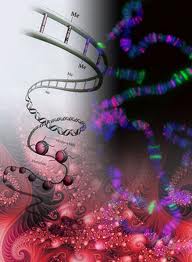
Epigenetics are barely recognized as a new field, greatly expanding the number of questions we have about human bodies and how they work.   The research is tentative, complex, hard to assimilate.  The human genome becomes easier to “read” daily, but it is a only the basic manuscript.  Epigenetics are the annotations, the blue pencil remarks that indicate both additions and deletions: they can make all the difference.

One kind of annotations is the histones that are like the spindle or spine that the genes are wrapped around to make their helix, a kind of spiral, and they can make that helix -- sort of like the wire binding on a notebook -- tighter or looser, which can make the genes able to get their message out more easily or with more difficulty, as though the tighter the binding, the harder to turn the pages.

Another kind is methylization, a little molecule that says NOT.  It turns genes off.  (I’m now running into this term everywhere.)  It doesn’t remove a gene -- just shuts it down.  But then there’s another little molecule that adds to the methyl molecule and that says “TIS, TOO!” and turns it back on.

When the two-sided zipper that creates a new person by unzipping, then rezipping with someone else’s opposite zipper side, the father’s side loses all the methyl attachments -- all the notes are removed.  But some are guarded somehow.  And the mother’s notes are now applied to the father’s zip, with new results.

Environmental circumstances can write new methyl notes or wind the histones tighter or looser, and these can persist up to three generations or beyond.  It appears that my weight struggles may be related to my grandfather’s poor nutrition in Scotland at the turn of the 19th century.  This particular sequence affects females rather than males, for some reason.  The genes of each half of the zipper are marked with little tags that say whether they came from the sperm or the ovum, and they interact as well, so they can footnote methylization. 

Over a decade or so, ten per cent of a person’s epigenetics may change as they grow, move to a new environment, change practices.  There are drugs and strategies that will turn these epigenetics off and on, add and subtract, but the genes themselves are hard to alter.  In fact, one of the functions of the epigenetics is to guard the genes and repair them if they get broken.  It is the patterns that count more than the individual genes -- if 3, 5, 8, and 14 are off, the results will be different from 3, 5, 6, and 24 being off.

Early childhood abuse can alter at least two molecular pathways that create epigenes, one through the adrenals excreting cortisol -- I suspect also through direct damage to the adrenals since a favorite kind of abuse is a beating on the back right over the adrenals, which are on/above the kidneys -- and the other through the hippocampus which is the result of existing in a hostile social environment.  The research for this is done on a little mouse that is put into a cage with a big mean ugly hostile mouse.  Like a bad step-dad.  Or an abusive school situation where bullying is tolerated.  No doubt sexual abuse has its own pathways, but they are not in the book I’m reading.

This book is by Nessa Carey, an English scientist.  The title is “The Epigenetics Revolution” with the sub-title of “How Modern Biology is Rewriting Our Understanding of Genetics, Disease and Inheritance.”  There are many little side trails, one of which is about cancer.  Cancer drugs and HIV drugs have a good deal of overlap, and some of them work in similar ways -- adding or subtracting these small epigenetic elements.  The epigenetic approach works better on cancers of the blood, possibly because the “annotations” can penetrate into the script of the liquid genome more easily than they can get into the solid masses of other kinds of cancer.  Several kinds of epigene-triggered cancer affect T cells, which are part of the HIV puzzle.  The idea is that epigenetics confuse the cancer protection systems (cancer is a phenomenon of the broken genome control of the cell but may be a complex system of this-turned-off and that-turned-on) and that every virus is code, just like the genome.  In fact, there are several epigenetic phenomena either woven into the actual genome or showing up attached to it some way that are believed to have originated as viruses.

It’s almost scary that the parallel to computer code is so apt.  Punctuation in the wrong place, a stutter, a copy-and-paste in the wrong place, and the person is crippled to some degree.   The links don’t work anymore.  There’s an “upstream/downstream” which means that there are triggers, just as there are in software.  if you miss passing the trigger, the performance of the code changes.  

These are quite apart from mutations, which means actual genes added, changed or subtracted, which are far more permanent changes than epigenetic tags.  Red hair, blue eyes, and so on are gene mutations.  No one knows whether it might be possible to turn the gene for alcoholism off or maybe even turn PART of it off, in case the rest of that gene (which can be very long and full of code) is some kind of genius we don’t want to lose.  There is a notion of which gene it is that causes addiction to opiates, but no real plan for how to turn it off.  The same for amphetamines.

A new generation that thinks about human behavior problems in code instead of the persisting parent generations that have hung onto behavior-modification through reward and punishment might change our whole society.  We hope.  But maybe it would be worse.  What if genes could be methylated or not at will, maybe by plugging the whole genome into a computer system programmed to “heal” what is missing or what is overactive?  Who would decide what to put in or take out?  And then there is the constant problem presented by who gets access to such a treatment -- the rich, probably, and more likely in the developed world, which creates a moral problem.  Often risky strategies for fighting disease are tried out on people who have arrived at their last resort, which makes results hard to interpret, or on people no one cares about, like prison inmates -- which is a whole different moral problem.

The book constantly brings up the difficulties presented by things like Big Pharma and the problem of how to get meds into people (pills, IV, implant, maybe technically across the brain barrier, or through steady dedication to protocol).  We struggle on, “methylating” with alcohol or pot, rebooting with a nap or a long walk, maybe even reprogramming.  But increasingly we realize how complex this is, how woven together we are, how much everything changes all the time.  How much the culture “methylates” us.  This account of mine is indubitably at least partly wrong and certainly only a start of my understanding.  But this limitation is also true -- on quite a different scale -- in terms of the major scientists working on this stuff.  This book was published at the beginning of 2013.  It’s probably already out of date.  But the vocabulary is useful.

Monday, April 29, 2013

"OPPOSITIONAL DEFIANCE DISORDER" pt. 3


“Oppositional defiance disorder” gets more hits than anything else I write about, even religion or sex.  We clearly need more thinking about it.  This time I’m starting from the idea that defiance is not a “disorder” but rather an addiction.  It is at its core an arousal addiction, which means the substance doesn’t come from street drugs nor from prescribed pharmaceuticals, but rather from the person’s own body’s ability to create drugs.  Some of these are:

dopamine (pleasure)
adrenaline (anxiety, energy) 
oxytocin (love, jealousy, maternity) 
serotonin (mood stability)
endorphins (mild euphoria)

They can be triggered by thoughts, by events, by personal interactions, by art, by music and by risk.  They can also be triggered by violence, sex, thoughts of suicide, pain, cruelty, and urban roof-top parcours.   And defiance, which is courting danger.  I know the feeling.  The more powerful the person or force one is defying, the greater the high.  Remember when kids were daring each other to lie down on the yellow line on a busy street?  You know how many play chicken on the railroad?  Gambling, of course, is notoriously addictive.  Oh, the risk!  The rush!

Defiance is an addiction.  (The “oppositional” adjective is not needed.)  On the series “Homeland” the main spies, Carrie and Saul, both express addiction.  Carrie says she used to play chicken on the railroad and always won.  Neither will follow orders.  Neither will ever give up.

The basic process seems to be arousal, defined as heightened internal chemical states, which we generally interpret as emotions, that somehow crave repetition -- more, more, more.  I do not understand “cold blooded” emotionless risk, unless it is entirely driven by rational drive towards some advantage: money, status, control.  This discussion won’t touch that context.

The “problem” is that “this ‘addictive’ response is the underlying biological component that drives the dysfunctional behavior patterns of compulsive gamblers, shopaholics, sex addicts, and others who seek intensity as a means of self-soothing distraction.”  Like combat soldiers, surgeons, ballet dancers, artists, mountain climbers, etc.   That is, I’m saying that addiction in the sense of focused and constant preoccupation with a practice is what creates skill and mastery and is not a problem.  A person with a gambling addiction could become a helluva poker player and who would object?  It’s the dysfunctional behavior that either interferes with relationships or is illegal that creates the problem.  It may be that as we all live closer and closer together with more and more legal and regulation requirements, we are simply moving more behavior into the category of “dysfunctional.”

But if a person wants to change or is forced into counseling by the law, social workers and counselors likely use several strategies.  One is to form a group of peers who can support each other and discuss how to reach better control and why.  Another is to write out “boundary” contracts, voluntary agreement not to do whatever it is after negotiating with the counselor: basically operating off the morality of the counselor.  Maybe the least appealing treatment is prescribing drugs to counteract the “kick” from defiance.  The job of the social worker is to get compliance, to establish control, to be the one who knows.

“Oppositional Defiance Anonymous” programs do not exist as far as I know.  Defiance might be a conditioned reflex, might be self-protective, might be the product of fear, or might give the same chemical surges as other forbidden behavior.  The person who is defiant may not be doing it consciously at all.  Can one be addicted to defiance?  Why not?  But a written boundary contract as a remediation could not work because it would only present another opportunity to be defiant! 

There’s an old joke about a lecturer giving a talk at a women’s college.  He looked out and saw that some of the women were knitting.  He didn’t like that and quipped that knitting was a displacement of masturbation.  A woman looked up from her yarn and needles to say, “When I knit, I knit.  When I masturbate, I masturbate.”  In other words, she was not unconscious and knew the reasons for what she did.  In this case perhaps not wasting time while waiting for the lecturer to say something useful.  She was not susceptible to being shamed and knew what was appropriate, which the lecturer did not.  So which one was defiant?  Which one got the emotional surge?   

Can masturbation be displaced to knitting?  Can addictions be displaced?  To what would defiance be displaced?  Can a therapist join a client in a larger defiance, say against society’s misunderstanding?  What if the defiance were justified either in relationships where someone stood up against abuse -- the child refusing parental rape, the wife refusing to tolerate neglect, the colony refusing to accept imperial domination, the Chinese man standing in front of the invading tank?

Isn’t terrorism an oppositional defiance?

The most obvious first consideration when dealing with a defiant individual has got to address the reason for the defiance.  Otherwise we are only blaming the victim.  The point of the man who has turned informant in “Homeland” is that he sees good reasons to oppose his own country, like the use of bombs on schoolchildren.  The story turns the focus from his inner life -- which has been manipulated -- to larger patterns, in search of solidarity from the audience.  (Plot lines are always manipulations of the audience to generate emotional surges in them.)  

Justified defiance, allying with others in sympathy and solidarity, is an engine of historical evolution, like rebellion against empires.  Unjustified defiance with no outlet, no goal, no community, verges on evil, is certainly corrosive, and will probably cause the destruction of the defiant one.  Maybe a lot of people.

Must addictions escalate?  If the basic process is arousal, then it may find expression in  
intense fantasy, including conspiracy theories
urges, like rape or violence 
rituals, maybe shaped by religion like burning crosses 
and other behaviors 
as means of dissociating from or otherwise coping with internal and external life stressors, emotional pain, and uncomfortable feelings.  The nature of the behaviors defines the level of criminality and destruction. 

I’m reacting in part to a blog:  http://blogs.psychcentral.com/sex/2012/11/neurochemistry-escalation-and-the-process-addictions/  I don’t agree with everything Weiss says.  The issue I was looking for was escalation.  Is it inevitable?  Clearly it is common.  Often it is stopped only by repentance after doing grievous damage to someone valued.  One clear escalation would be moving from the internally triggered emotional substances to street drugs.  There is also a phenomenon of expansion and elaboration:  planning, anticipating, considering strategy, preparing materials, teasing and afterwards boasting, hinting.  Weiss calls this -- he says as the addicted do -- “being in the bubble.”  Clearly Tamerlane the Terrorist was “in the bubble” for quite a while.

Shame and guilt are also powerful generators of internal chemicals.  The problem is the same as that for trying to control someone defiant -- the attempt to cure through these emotions simply feeds the addiction.    Can appeal to reason make a difference?   Or can one begin to supply a new set of prompts to the defiant one, evoking a different set of chemicals?  The feelings of safety, being loved, being successful, accomplishing goals set by oneself, achieving “flow” -- all these things can be provided instead of punishment, confinement, stigmatizing, criminalizing.  When the person learns to find them for himself, there can be rejoicing, a classic high.

Sunday, April 28, 2013

RELIGION AND SCIENCE FICTION


One of my earliest sci-fi moments was putting a question to the pretentious stuffed-shirt of a Presbyterian minister who was trying to browbeat my little 8th grade group (all girls) into being good church members.  I asked -- and I was quite serious about the question and quite blind to what the effect would be on the minister --  “Did Jesus die for whatever humanoids live on other planets and, if He did, was it necessary for Him to be crucified and if those humanoids had four arms, would those people wear asterisks on chains instead of crosses?”

Well . . . he never liked me even before I asked my question.  But it was clear that sci-fi and religion had a mixed and rather emotional relationship.  I have an anthology that was published in 1982, the year I left seminary to start ministry.  It’s just a little paperback called “Perpetual Light” that was edited by Alan Ryan, but the collection uses either traditional religious stories or concepts as springboards for sci-fi that’s not on the hard science end of a long continuum.  There’s a pretty blonde feathered angel on the cover.  The VERY first sci-fi I read was my father’s H.G. Wells’ short stories, often a tougher sort of speculation.  The first complete novel was “The Red Planet Mars.”  Robert Heinlein remained important for me and I’m sure he was for George Lucas as well, but I suspect that Lucas never made the connection I did between “The Martian Chronicles” and the Blackfeet nation.  My Blackfeet friend says “A Stranger in a Strange Land” is the story of his life.

Two short stories have remained with me for more than fifty years, though I don’t know who wrote them.  Both were based on classic Greek mythology-religion.  In one story a space sailor went to a planetary brothel where the female intimacy-provider was wearing a big turban.  Settled in a small private room, she unwound her turban, revealing not snakes but worms and not ordinary worms.  They were electric, slithery with the gel used for a sonograms.  They were long and there were a LOT of them.  The sailor was enveloped in ecstasy beyond anything he had ever known.  Finally emptied, the sailor was absorbed by the tentacles into the Medusa.

The other story was about a beloved woman, a dancer, whose body died.  Scientists kept her brain alive and gave her a new body made of golden bangles, cleverly shaped  in rings which fitted together in sequence and reproduced the woman’s shape.  They were held together by magnetic forces.  Eurydice could dance more beautifully than ever before, glinting as she moved.  I forget what equivalent to “looking back” this futuristic Orpheus couldn’t resist, but somehow her brain, her identity source, died.  Maybe the music stopped.  The golden rings showered to the floor, scattered and chiming.

The best science fiction mixes “hard science” with human truths, like the series of stories about the children who survived an alien spaceship crash.  They appeared to be human, but could fly and read minds.  Far from being recognized as “above average,” they were resented -- maybe the way science nerds are in high school -- and had to work out strategies for sticking together.  Prejudice is not always against the stupid or ugly.  Sometimes a person can be too good.  

Or there is another beloved scifi story that comes from the Old Testament fantasies about what an angel might be like.  An old lady is washing the dishes and glancing at her backyard through the window over the sink.  With no warning, straight down out of the sky, an angel crashes, the traditional bare young man with wings.  She rushes out to help him, carrying a mug of warm milk she had made for herself.  Impulsively, she holds up his head and gets him to sip it.  This brings the life back into the angel and he is soon well enough to fly off.  Then she realizes that touching him had brought a kind of radioactive force into her that has healed her rheumatism.

The metaphors go back and forth: sometimes the idea is the mythical Ouroboros, the snake with its tail in its mouth, and sometimes it’s the benzene ring.  There are levels:  science hardware builds the computer, software science writes the programs and algorithms, and the human wetware yearns to go beyond -- tries to capture the unknown, even the unsuspected, maybe by writing stories.  The hard science is intriguing: I recall an essay describing the metabolism of green blood, copper-based, that worked on methane instead of oxygen.  I can’t remember the particulars, just that it was so detailed and possible.  But then the implications:  could a red-blooded human love a green-blooded alien?

The answer to the asterisk vs. cross question is that sentient beings draw meaning from their material culture according to their perceptual means and the issues that concern them.  Crucifixion was specific to the Romans, a penalty imposed on hundreds of people so that the early Christians understood that Jesus was given a common death, to diminish Him, since He dared to rouse the rabble.  On this planet the matrix of vertebrate evolution has been tetrapods -- though the “pods” might be fins or wings -- therefore, a cross.  On another planet there might indeed be people with four arms, but they might not have necks, so nothing to hang jewelry from.  Maybe no impulse to self-adorn anyway.

http://en.wikipedia.org/wiki/List_of_religious_ideas_in_science_fiction  is an interesting summary revealing that either all sci-fi or the maker of the list is focused on ideas from a Judeo-Christian context, though they may be reinterpreted.  Not Islamic or Buddhist stories. 


http://en.wikipedia.org/wiki/Category:Religion_in_science_fiction makes a list of stories that include religions.  So far most of the writing I know about is either trying to explain miracles scientifically or depicting an invented institutional religious system.  Few, if any, writers have enough theological or comparative religion background to get below descriptions of material culture or moral systems, but that’s not always a problem.  I remember one tale about a planet that was mostly sea so that the sentient beings that had developed were like our earthly seals except that they were all empathic.  Every individual had full awareness of what was in the mind of every other individual, no matter how distant on the the planet they might be.  As it turns out, there was a pretty dark side to what would seem like a major advantage -- and this was written before the Internet was invented.  Now we’re living out that story.

A new scientific realm is barely opening now: neurofunction in the brain and body.  It has become clear that a lot of what we know is in the muscles and gut, and in the subconscious parts of the mind, but possibly traced and understood through acute technological monitoring.  First came the explanation of how we are conscious, then how we feel we are a “self,” and then an awareness of how much thought is “under” words -- far more than Freud ever suspected.  A human being appears to be a process, like a fire, running on oxygen, never the same from one minute to the next, but unwilling to see things in a new way because it does not know how.  Our work is cut out for us.


Saturday, April 27, 2013

MOVIE HEROES

“The Far Pavilions” is a strange movie to watch right now.  It was a book published in 1978 (the year I started seminary) about events almost a hundred years earlier on the northern border of India, at the same time James Willard Schultz came to Montana and fell in love with a Native American woman.  In the 1870’s -- while Americans were populating the prairie --  the British were fighting in Afghanistan to maintain the Empire.  The fighting was cavalry and cannons, nothing like our present weird mix of predator drones and isolated outposts as portrayed in “Restrepo.” http://www.youtube.com/watch?v=-DjqR6OucBc

The latter, taking place roughly in the same high mountains, was a recent documentary, showing a small outpost of men high up in the mountains where  people live on the edge of existence.  The two dimensions that have remained through time are the difficulty of communicating across what is not just a language but a world view and the mystery of why soldiers were up there "conquering" villagers anyway.  “The Far Pavilions” are an imaginary place in the high mountains of Afghanistan.  The idea of the movie’s conclusion is that living there would be a kind of Shangri-La where lovers from different contexts could live happily.  The reality shown in “Restrepo” is no such thing. 

Around the world we’re still wrestling with the problem of people marrying across social barriers, except that now they’re often gender-based.  “The Far Pavilions” has a gay tone sort of threading around subliminally, but when one princess declares a love for the other princess so deep that she will stay and die for her “sister” rather than leave with her lover (how could anyone leave Ben Cross?), we are clearly meant to understand that is a good, beautiful and pure thing.  It's just a sahib marrying a half-caste that is forbidden.  Rumer Godden loved the book.  (Godden’s book “The River” and its movie incarnation directed by Jean Renoir are heart-key scriptures for me.)  "The Far Pavilions" was meant to be in the style of “The Jewel in the Crown,” and indeed both films were successful.  Mollie M. Kaye was a petite blonde married to a General who spoke Pashtun.  She knew what she was writing about.  www.mmkaye.com

These movies about the Empire in India (and the same in Africa) are as archetypal as “Star Wars.”  Long rueful films proceeding at a stately pace, savoring the pomp and ceremony without any interpretation -- they offer no alternatives to Empire even as they hint at coming disaster.   "The Far Pavilions" is really a boy’s movie with beautifully painted elephants, balky camels, and those strange narrow long-legged horses with curly ears.  There’s a sassy prince in most of the story and lots of boys roaming around in the background.  The love story is passionate enough, but the real story is the camaraderie among men.  Honor!  It is the highest goal to die in defense of what you believe!  Old-fashioned.  Though Restrepo, the soldier for whom the documentary was named, presumably died for honor, too.

“The Far Pavilions” I watched by streaming on Netflix, but parallel I’m watching “Homeland” on discs.  It’s a woman’s movie: spying, figuring, maneuvering, never able to leave well-enough alone and always confronted by men out for themselves: dishonest, tricky, trying to take control, be the alpha dog.  It’s not about war but the aftermath of war in Iraq and all the tangled loyalties.  Contemporary.  Sleeping with the enemy.  Neither main character is quite sane.  Being half-breeds would be a mild problem compared to the split identities of these two, one bipolar and the other an Irish redhead.  The glamour of the military is now plainly only an illusion.  

Recently I've also watched “Crossing Over” (2009), an Indie film weaving several stories together, all of them about people trying to become naturalized citizens of the United States.   This border is the northern edge of Mexico.   Now the “military” are internal police, the immigration service trying to keep them out.  The idealization of patriotism and willingness to die is in the ordinary little people now. A sort of confusion of prosperity with personal salvation drives these stories.  

Harrison Ford (AKA Han Solo) has the umbrella story which is the simplest: a woman who walks up from Mexico with her young son, but is deported.  The other vignettes are ripped from the headlines: an idealistic Bangladeshi girl who defends freedom of speech a little too intensely, a wannabe movie actress from Australia who becomes a victim of her sexy appearance, a young Korean who gets pulled into a gang, a young British man who pretends to be Jewish and is helped by a wise rabbi.  These are LA-based stories so naturally the Village Voice hated them, sneering at the “lurid” stories while using obscene language to show how hip New Yorkers are.  (Someone ought to do a movie about the bicoastal cultures hating each other.)  “Crossing Over” is written, directed and produced by Wayne Kramer who is from South Africa where they know a thing or two about empires.  

The movie wasn’t the right kind of cynical for the politically correct and the critics, even those lesser than the Manhattan caliphs, hated the film.  I don’t think their dislike was based on cynicism about the naturalizing ceremony in which a lady judge gives a very a nice sermon.  I doubt that any critic knew these kinds of lives in real life.  It was released in the shadow of 9/11 and I was watching it in the aftermath of the Boston Marathon bombing.  That has made a difference.

Maybe the difference is recognizing that the Empire, ANY Empire, triggers desperate behaviors both by holding their citizenship up as though it were access to Shangri-La and yet at the same time enforcing borders with bureaucracy and military-style raids.  It is a fabulous Eden!  But you can’t come!  Such a situation is a magnet for crime, corruption, and a million tiny tragedies that add up eventually to hatred of the nation, coming both from outside and from inside.  We know examples of this system clear back to the 12th century.  Like the Crusades it’s a system based on us-against-them and wanting to take possession of them.  So maybe the bottom line is what is addressed in “Homeland,” the psychotic confusion between the two categories (us v. them) and the desperate need for a new way of looking at nations and religions, entitlements and means that overwhelm the ends.  We have internalized so many “third world ghettos” that national boundaries to keep undesirables out seem redundant.  They are already in our prisons.

We know about “Star Wars,” the Empire striking back, but we need to think more about “Star Trek” and it’s basic principles of respect for other cultures.  I haven’t seen the newer versions of "Star Trek", but I think I should.  In fact, I’m finding a need to revisit the whole oeuvre of science fiction.  The past seems to offer more negative solutions than new ideas, so maybe visiting the future will work a little better.   I’m eager to see Ben Cross as Mr. Spock’s father. 


 This insight is from Carl Pettit.  http://goodmenproject.com/featured-content/the-good-life-conspiracy-man/  “It’s only under the cover of a seemingly inexhaustible supply of astute, crazy and almost always contradictory conspiracy theories that the actions and misdeeds of the less-than-benevolent among us can be hidden in plain sight.”  

Often we figure the conspiracy is fomented by the government itself.  Pettit suggests “Which makes me wonder how the same group of folks who’ve botched disaster relief, entire economies, military occupations and the day to day governance and protection of common citizens (guns laws, health care, immigration) could carry out conspiracy after successful conspiracy throughout the annals of history.”  Today we expect Obama to be Mr. Spock.  He tries, baby, he sure tries.  

(I’m picking up Pettit at http://goodmenproject.com/ where you can read about men who are heroes or NOT, in their own words.)