From the NY Times Book Review:
LOGORREA by Adrian C. Louis (Tri-quarterly/Northwestern University, cloth $39.95; paper, $14.95)
Review by Joel Brouwer
With his customary mordant humor and beery weltschmerz, Louis writes in his new collection about lousy jobs undertaken to make ends meet, the perilous pleasures of alcohol, lost loves still pined for and loves far better forgotten, humanity’s twin addictions to money and brutality, and, most poignantly, the “dark, violent red land” of America’s Indian Country; in particular the Pine Ridge Reservation in South Dakota where Louis lived and worked for many years as a newspaper editor and teacher. Louis’s conversational style and salty language can bring Charles Bukowski to mind, but Louis is less prone to self-pity, and his indignation feels more righteous: “We cannot tell you why we spent/ a lifetime crawling when we had wings that were strong,/supremely brown, and so holy.” Relatively new themes for Louis in this collection are the skulking approach of old age, and ever-sharper jabs at academia, portrayed here as a kind of intellectual rez where Louis has reluctantly taken refuge from poverty. Louis sometimes seems to strain to make his poems sound fancy, calling his television a “cabled machine of thoughtlessness” and writing that after a poetry reading “the congregation adjourned to a local gin mill,” when he simply means the audience went to a bar. I don’t know why Louis thinks such rococo locutions are necessary, since his greatest strength as a writer is his point-blank bluntness, on particularly forceful display in the poems here about a loved one with Alzheimer’s: “Two of your toes have curled/into claws -- two of your fingers/ did until they chopped them off./ God forgive me for okaying that.” In fierce and clear lines like these, Lous burns away all traces of mendacity and cant and shows us a scalded world made purer through his vision.
***********
Adrian Louis is the author of the novel “Skins” which became a particularly powerful movie, not least because the Native American actors were able to embody the mix of sodden brutality and tender love that is characteristic of Louis’ work, as well as the love of language smashed up against the inability to finally convey the “Indian experience.” This vision (and it’s not so invented -- just read the police reports in any rez newspaper.) is an intense kind of Native American literature, read openly by college whites and covertly by middle class Indians.
It’s interesting that Charles Bukowski so often is invoked as a bridge between rough white experience and rough red experience. He’s not a type who catches my interest, but I have good friends who find him somehow liberating. Maybe it’s because he breaks up the idea that only Indians are drunks who sleep in the weeds by submitting frankly his own life. (There has been recent “chatter” here and there about the three movies based on his life, most notably probably “Ironweed.”) For more gently raised folks, there are two surprises in such stories: the first is that anyone can survive such a life and the second that the survivors are often intelligent, charming, and moral.
Brouwer values the blunt, simple terms -- “We cannot tell you why we spent a lifetime crawling when we had wings that were strong, supremely brown, and so holy.” (Check out the paintings of Tom Gilleon at timberlinestudios.com to see those brown winged warriors embodied -- a striking convergence.)
Brouwer complains about “cabled machine of thoughtlessness” for a television and “the congregation/adjourned to a local gin mill”, but I think it’s because he doesn’t imagine them in the mouth of the actor Graham Greene, thrown away as multi-syllabic sarcasm at the pretentiousness of such matters as TV and poetry readings.
As for the incredibly painful lines at the end about Louis’ wife’s Alzheimer’s, they are indeed “scalded” free of mendacity. He has written before about her sinking away into that darkness and already made it clear that he will care for her body, still here though her mind has left, with the total devotion one often sees in Indian families, no matter how grotesque that care may become. No question of parking her someplace and forgetting her.
As for academia, how can one NOT be indignant about institutions so pretentious and multi-syllabic, but so helpless when it comes to equipping anyone at all with wings of any color. In the end I guess the poets and artists must save us, just as they always have.
Friday, December 08, 2006


Wednesday, December 06, 2006
ONE AT A TIME: A WEEK IN AN AMERICAN ANIMAL SHELTER
One at a Time: A Week in an American Animal Shelter by Diane Leigh and Marilee Geyer was not what I expected at all. I thought it would be more about the organizing and mechanics of a shelter, but instead it was about a concept: for a week these two veteran shelter employees would take a photo of each cat or dog and write about each. Since more than three hundred animals came in, they had to be edited down to fewer, but the proportions of captured strays, released animals, and their fates would be kept the same. Very simple idea. The photos are also simple, mostly faces, all in black and white: curious, eager, inert, amused.
Each animal gets a name, each animal gets a story -- either true from a former owner or invented for an animal with an unknown past. These are not simple stories, but they are as thoughtfully informed as two very experienced people can make them. They speak of the dark side of popular breeds (puppy mills form to feed popular breeds that inbreed the animals into deformity), the weird vanity of surgery on dog ears, the enlightened practice of handling communities of feral cats, the policy of NEVER adopting out ANY pit bulls, and other subtle matters most people never think about because they don’t even know they are issues.This is not global warming. It’s happening on your block.
The book was sponsored by PETsMART Charities, a nice tax write-off for them, but still a good thing for them to have done and the reason the tax write-offs are there in the first place. In spite of its simplicity, it’s a far a more sophisticated book than most of the pet lit.
I have only one complaint and it’s not a fair one. So many people get interested in animal issues through shelters, because that’s where the animals are and they love the animals. Primary teachers even bring their classes to see the animals in the shelter -- not thinking about fingers poked through cyclone fence to be bitten or pass germs. But a shelter is not a humane society and a shelter is not an animal control program. It’s very possible to have a humane society without any shelter at all, simply by not impounding animals.
Animal control MUST either run a shelter or contract with a body that runs a shelter, and if they’re smart, they’ll make sure it’s a decent one, but animal control does its work on the streets. A shelter is not a “doggie jail.” It’s simply a place to keep animals safe until they can go where they belong.
Animal control programs that are run by sheriffs or police are hampered by not having expertise in bricks and mortar or the handling of captured animals. And county commissioners or mayors are most likely to target shelters as money pits and hotspots than any other part of the program. It’s concrete (maybe literally), it’s there where people can see it and criticize it for being too plush or too harsh, and it’s vulnerable to all kinds of problems from plugged sewers to moldy dog food, to say nothing of attacks from “animal terrorists” or jokers thinking it would be fun to let all the animals out or criminals after the killing drugs.
Shelter employees and an amazing number of informed and dedicated volunteers have revolutionized much of the way that shelters are run. Some look more like children’s hospitals. These particular shelter attendants speak of a “journal” kept in the break room where people can let off steam or record a prayer or ask a question. It’s an excellent way to cushion compassion fatigue.
But in the end many animals still have to be killed. This will always be true. Life is tragic, but there’s no sense is heaping on the injustice and stupidity.
Here’s the payoff paragraph which redeems my complaint:
“Ultimately, though, we need to transcend sheltering and the current shelter system in this country. The shelter system, as it exists today, and has existed for decades, has as one of its primary functions the processing of living beings -- either by recycling them to new homes or destroying them, but disposing of them somehow and relieving people and communities of their responsibility for them. It is a tangible sign of our society’s deep disconnection from other beings so profound and damaging that we could legitimately categorize it as a sickness.”
This is not a different issue from people themselves living on streets (1,000 on the beach in Hawaii) or being recycled through prisons.
(ISBN 0-9728387-0-8)
Each animal gets a name, each animal gets a story -- either true from a former owner or invented for an animal with an unknown past. These are not simple stories, but they are as thoughtfully informed as two very experienced people can make them. They speak of the dark side of popular breeds (puppy mills form to feed popular breeds that inbreed the animals into deformity), the weird vanity of surgery on dog ears, the enlightened practice of handling communities of feral cats, the policy of NEVER adopting out ANY pit bulls, and other subtle matters most people never think about because they don’t even know they are issues.This is not global warming. It’s happening on your block.
The book was sponsored by PETsMART Charities, a nice tax write-off for them, but still a good thing for them to have done and the reason the tax write-offs are there in the first place. In spite of its simplicity, it’s a far a more sophisticated book than most of the pet lit.
I have only one complaint and it’s not a fair one. So many people get interested in animal issues through shelters, because that’s where the animals are and they love the animals. Primary teachers even bring their classes to see the animals in the shelter -- not thinking about fingers poked through cyclone fence to be bitten or pass germs. But a shelter is not a humane society and a shelter is not an animal control program. It’s very possible to have a humane society without any shelter at all, simply by not impounding animals.
Animal control MUST either run a shelter or contract with a body that runs a shelter, and if they’re smart, they’ll make sure it’s a decent one, but animal control does its work on the streets. A shelter is not a “doggie jail.” It’s simply a place to keep animals safe until they can go where they belong.
Animal control programs that are run by sheriffs or police are hampered by not having expertise in bricks and mortar or the handling of captured animals. And county commissioners or mayors are most likely to target shelters as money pits and hotspots than any other part of the program. It’s concrete (maybe literally), it’s there where people can see it and criticize it for being too plush or too harsh, and it’s vulnerable to all kinds of problems from plugged sewers to moldy dog food, to say nothing of attacks from “animal terrorists” or jokers thinking it would be fun to let all the animals out or criminals after the killing drugs.
Shelter employees and an amazing number of informed and dedicated volunteers have revolutionized much of the way that shelters are run. Some look more like children’s hospitals. These particular shelter attendants speak of a “journal” kept in the break room where people can let off steam or record a prayer or ask a question. It’s an excellent way to cushion compassion fatigue.
But in the end many animals still have to be killed. This will always be true. Life is tragic, but there’s no sense is heaping on the injustice and stupidity.
Here’s the payoff paragraph which redeems my complaint:
“Ultimately, though, we need to transcend sheltering and the current shelter system in this country. The shelter system, as it exists today, and has existed for decades, has as one of its primary functions the processing of living beings -- either by recycling them to new homes or destroying them, but disposing of them somehow and relieving people and communities of their responsibility for them. It is a tangible sign of our society’s deep disconnection from other beings so profound and damaging that we could legitimately categorize it as a sickness.”
This is not a different issue from people themselves living on streets (1,000 on the beach in Hawaii) or being recycled through prisons.
(ISBN 0-9728387-0-8)
Monday, December 04, 2006
A CHRISTMAS MEDITATION
I’ve been sorting books, even bought a little dust mask so I could get serious about it instead of just sneezing. The ceremony below fell out of one of the books. I wrote it for Christmas 1983, the second year of the Unitarian Universalist Montana Ministry during which I was a circuit-rider around the state.
This is an example of using poetry to claim back the universality of a specific and particular tradition which conflates the theological birth of Jesus the Christ with the many global festivals of the Solstice. This other way, choosing and exploring an aspect of human experience, avoids the jumble of throwing a lot of ritual elements from assorted places into a big slumgullion of festivity. I was reading a lot of Thomas Moore and James Hillman at the time, but was also influenced by Kathy Fuson, my classmate at Meadville, who used the alchemy metaphor.
THE VESSEL OF LIFE
INTRODUCTION
Over twenty years ago [since this was 1984, add 22 more years!] about this time of year, I was spending my first winter in Montana, up in Browning where the high prairie meets the Rockies. One night, unable to sleep long after everyone had been in bed for hours, I walked out under the stars. I was young and restless and looking for a life path.
It had snowed -- and blown -- and snowed again, with a few brief Chinook winds in between, until now there was a padding over the land of several feet with a crust on top strong enough to walk across. I went toward the mountains into the large open space that in summer is the Indian Days tipi campground. Only the tips of a few wild rosebushes broke the undulating white. There was no moon; it was a starlit night. City lights were weak and few back then and didn’t carry outside of town.
Under the high galaxies of stars, I walked across the crust and felt that deeply religious sensation of losing one’s boundaries and dissolving into the universe, but there was no warm, comforting, oceanic lulling as there sometimes is. Instead I was aware of the immeasurable frozen surging implacability of those distant whorls of light and my infinite tinyness in the midst of them. It was the classical religious experience called the Mysterium Tremendum and Fascinans. I didn’t want to turn away -- in site of the despair and pain of knowing my own insignificance and lack of boundaries. I wanted to find some way to understand, for to understand is to participate.
Today for understanding I choose the Jungian metaphor of the vessel. For Jungians this refers to a special kind of vessel, the alchemist’s crucible, used to refine the cruder elements into gold. The crucible must have special capacities: it must protect what it holds from what is outside the desired event: the impurities and irrelevancies that could spoil the results. And it must prevent the escape of the elements from the time and place of the transformation, for if they dissipate into the surrounding air, then the reaction one is trying to cause cannot happen.
The crucible must be strong enough to contain elements that are molten, volatile, even explosive -- and yet it must not be so rigid and confining that the fire is snuffed and the expansion that is necessary cannot take place.
In the years I lived in Browning, I grew to know a lot about crucibles because I was a foundry hand in the Scriver Bighorn Foundry from its very beginning in an old coal shed. Very few moments are intense or as filled with potential as the firing of a bronze-melting crucible, mixing air and fuel until a green tornado of flame whirls over the furnace.
To the Jungians human life is just as full of intense moments. Much of the problem of how to develop these into growth and insight instead of leaden waste and destruction is answered by the art of developing proper vessels for our internal tornadoes of flame so we may create our own inner gold.
Christmas is such a vessel. Metaphor, festival, reunion, tradition -- it offers a place and a time for reactions to happen, transformations of people, not all bright and happy. Christmas can be a time of darkness, a need for hope, a time of suspense, with considerable potential for depression and disappointment.
Our fellowship is a vessel. We form for each other a psychic embrace for warmth, support, new relationship -- and yet the potential exists for snuffing out, turning away, deepened loneliness.
Such great importance demands that we give it attention. We want to be skillful alchemists, providing the right vessel for our love and enabling the creation of new life. For this is a time for kindling, opening up, blossoming in the most world-shaking way.
It came upon a midnight clear,
That glorious song of old,
From angels bending near the earth
To touch their harps of gold;
“Peace on the earth, good will to all
From heaven’s all gracious King.”
The world in solemn stillness lay
To hear the angels sing.
THE HOME
No vessel is so important to human life as the home, and none is so closely linked to Christmas in our culture. Christmas is a time to go home, to be received into the bosom of the family, to share wonderful secrets with those who have loved you and known you for a long time. A home is in large part a family.
But also, home is a PLACE that is deeply known. It may be a house or a series of houses. It may be town or ranch or a certain spot along a river. But it is a place deepy linked with hopes and fears, a place that has received dreams, a scene etched forever in all its smells, sounds, tastes, textures and temperatures so that it cannot be lost. In difficult times we dream of these places: our old creaky beds, patterns on the wallpaper, a special possession, wind in the eaves, the noises of traffic.
And at Christmas we decorate our homes, we share symbols, we invite others into our homes to feel our intimacy and caring. We look for those who may have been turned away from the Inn and try to find them a place to at least make a camp.
O little town of Bethlehem, how still we see thee lie!
Above thy deep and dreamless sleep the silent stars go by:
Yet in thy dark streets shineth the everlasting light;
The hopes and fears of all the years are met in thee tonight.
THE EMBRACE
No vessel is so precious as that of the embrace of a loved one’s arms. It is there that our deepest transformations take place, held against the hearts of those who love us best, whether parent, lover or child. For them our privacy is breached, but safely. Perhaps some other person who respects our necessary boundaries is nevertheless allowed to ignore them and come into our deepest being.
No vessel can be so confining as an embrace meant to be a restraint. Nothing can be so destructive as the someone who comes into our hearts through deception, abusing their access to the midst of our secrecy.
And yet, not to open the crucible of our selves into the embrace of another is to prevent the real growth that can lead us into the future, a whole new vision of what life can be.
At Christmas our hearts must be strengthened and purified. Our openings to the world must be newly innocent, for only in this way can the truly sacred be made part of us.
I’ll be home for Christmas.
You can count on me.
Please have snow and mistletoe
And presents on the tree.
Christmas Eve will find me
Where the love light gleams.
I’ll be home for Christmas,
If only in my dreams.
THE CRADLE/MANGER
A manger is a strange vessel to convert into a cradle, rather like using a bowl for a bed. For a manger (the very word means “to eat”) is something to hold what is consumed and a cradle is something to hold what is protected, reserved. The paradox continues to deepen.
To be born is to begin to die; to exist is to be consumed; for to embalm real existence is to be dead anyway. The baby to be nurtured is put into a place that holds sustenance, because a baby IS sustenance and as we nourish ourselves with the hope the newborn carry, the baby itself is nourished. The paradox is in fact a reciprocity and we are stupid to believe that to take nourishment into ourselves is to destroy it. For if we are nourished, then we grow and are reborn ourselves and have far greater capacity to nourish and accept and protect all that is newborn in the world.
A strange generosity to allow a birth in a stable and offer a manger for a cradle, and yet the vessel is exactly right. The process is -- after all -- one of transformation. We are not starting with gold, but making gold from what is ordinary and crude as straw.
Away in a manger, no crib for his bed,
The little Lord Jesus lay down his sweet head.
The stars in the sky looked down where he lay
The little Lord Jesus asleep on the hay.
THE MOMENT
The most abstract of vessels, a moment of time can hold enough meaning to last lifetimes. Christianity is an historical religion, based on the transcendent moment that exists both in real history and in the most unreal kind of poetry, so that it has an intensity and an unfolding meaning that renders categories of real and unreal irrelevant.
In our own lives are just such moments. Sometimes they are at Christmas and we make special preparations so that they maybe called to us at Christmas, but they cannot be forced and will arrive in their own time. A moment is the most transparent kind of vessel, the most dependent on risk and self-forgetfulness. It comes to gently enfold us when we are most open to possibility and most willing to give up our own definition of reality.
The special kind of transformation a moment holds is a new reality, a new insight and participation in what we think we know. But it requires courage and sacrifice, because we will never be able to go back. Again, it is a giving away that is met by a reciprocal generosity in growth and deepening. It is access to a deep well of Eternity.
The first Noel the shepherds did say
Was to certain poor shepherds
In fields as they lay.
In fields where they lay keeping their sheep
On a cold winter’s night that was so deep.
Noel, Noel, Noel, Noel,
Born is the King of Israel.
THE WOMB
And when we are exposed to the whistling and icy wind of Eternity, we most long for our first vessel, the womb, where we folded upon ourself comfortably in the protection of our mother’s life-processes, the homely work of pumping blood and digesting food. We may have come to resent the confinement, but never again will we be so effortlessly supported and fed.
Some of us become very good at reconstructing wombs, with water beds and down comforters and headphones that pipe us music. And it is a legitimate need, for sometimes all of us must be as infants and take a rest from all the striving. Sometimes growth happens quietly without our noticing while we think we’re only dreaming, or just indulging ourselves.
We mustn’t forget gentleness and quiet and the vessel that allows us to recollect ourselves into serenity and peace. For we can have confidence that if the womb is well-chosen, it will at the proper time begin to be too small and we will be pushed back into the world without much effort unless we resist.
The point of a good alchemist’s vessel is to keep the process happening, to allow the withdrawal but also to make the rebirth necessary, when it is time -- neither too soon nor too late.
Joy to the world! The Lord is come!
Let earth receive her king!
Let every heart prepare him room,
And heaven and nature sing; and heaven and nature sing.
And heaven, and heaven and nature sing.
Joy to the world! The Savior reigns!
Let us our songs employ;
While fields and floods, rocks, hills and plains
Repeat the sounding joy, repeat the sounding joy;
Repeat, repeat the sounding joy!
THE PLANET
We have come to understand that the earth is a blue-and-white vessel of life that allows an amazing, intricate, crucial series of processes to interweave in a way that supports and confines the continuing transformation that is human beings. Our understanding of this vessel is growing, along with our realization that if it is broken, we are spilled into destruction along with it.
The pressure mounts among us. Whether it ends in an exploding darkness that means death, or in a creative transformation that means golden life, it will at least continue to change, forcing us to change along with it.
At Christmas we speak of peace, an element that eludes all the alchemists at times. Yet peace itself is a vessel, just as Christmas is a vessel.
At Christmas we feel the need to make our own hearts and lives into vessels of peace. The key to doing that is in homely ingredients: a cookie, a phone call, a Christmas card, a moment of listening, a quick hug, a starry night, a fleeting memory, a whiff of nutmeg, a snatch of melody.
Let your heart be a kitchen, making warmth and food. Let your heart be a bed, making safety and rest. Let your heart be a cradle, an embrace, and this planet will be a home for us all, a vessel of life gleaming in the starry darkness of eternal sky.
Silent night! Holy night!
All is calm, all is bright
Round yon virgin mother and child.
Holy infant so tender and mild,
Sleep in heavenly peace! Sleep in heavenly peace.
This is an example of using poetry to claim back the universality of a specific and particular tradition which conflates the theological birth of Jesus the Christ with the many global festivals of the Solstice. This other way, choosing and exploring an aspect of human experience, avoids the jumble of throwing a lot of ritual elements from assorted places into a big slumgullion of festivity. I was reading a lot of Thomas Moore and James Hillman at the time, but was also influenced by Kathy Fuson, my classmate at Meadville, who used the alchemy metaphor.
THE VESSEL OF LIFE
INTRODUCTION
Over twenty years ago [since this was 1984, add 22 more years!] about this time of year, I was spending my first winter in Montana, up in Browning where the high prairie meets the Rockies. One night, unable to sleep long after everyone had been in bed for hours, I walked out under the stars. I was young and restless and looking for a life path.
It had snowed -- and blown -- and snowed again, with a few brief Chinook winds in between, until now there was a padding over the land of several feet with a crust on top strong enough to walk across. I went toward the mountains into the large open space that in summer is the Indian Days tipi campground. Only the tips of a few wild rosebushes broke the undulating white. There was no moon; it was a starlit night. City lights were weak and few back then and didn’t carry outside of town.
Under the high galaxies of stars, I walked across the crust and felt that deeply religious sensation of losing one’s boundaries and dissolving into the universe, but there was no warm, comforting, oceanic lulling as there sometimes is. Instead I was aware of the immeasurable frozen surging implacability of those distant whorls of light and my infinite tinyness in the midst of them. It was the classical religious experience called the Mysterium Tremendum and Fascinans. I didn’t want to turn away -- in site of the despair and pain of knowing my own insignificance and lack of boundaries. I wanted to find some way to understand, for to understand is to participate.
Today for understanding I choose the Jungian metaphor of the vessel. For Jungians this refers to a special kind of vessel, the alchemist’s crucible, used to refine the cruder elements into gold. The crucible must have special capacities: it must protect what it holds from what is outside the desired event: the impurities and irrelevancies that could spoil the results. And it must prevent the escape of the elements from the time and place of the transformation, for if they dissipate into the surrounding air, then the reaction one is trying to cause cannot happen.
The crucible must be strong enough to contain elements that are molten, volatile, even explosive -- and yet it must not be so rigid and confining that the fire is snuffed and the expansion that is necessary cannot take place.
In the years I lived in Browning, I grew to know a lot about crucibles because I was a foundry hand in the Scriver Bighorn Foundry from its very beginning in an old coal shed. Very few moments are intense or as filled with potential as the firing of a bronze-melting crucible, mixing air and fuel until a green tornado of flame whirls over the furnace.
To the Jungians human life is just as full of intense moments. Much of the problem of how to develop these into growth and insight instead of leaden waste and destruction is answered by the art of developing proper vessels for our internal tornadoes of flame so we may create our own inner gold.
Christmas is such a vessel. Metaphor, festival, reunion, tradition -- it offers a place and a time for reactions to happen, transformations of people, not all bright and happy. Christmas can be a time of darkness, a need for hope, a time of suspense, with considerable potential for depression and disappointment.
Our fellowship is a vessel. We form for each other a psychic embrace for warmth, support, new relationship -- and yet the potential exists for snuffing out, turning away, deepened loneliness.
Such great importance demands that we give it attention. We want to be skillful alchemists, providing the right vessel for our love and enabling the creation of new life. For this is a time for kindling, opening up, blossoming in the most world-shaking way.
It came upon a midnight clear,
That glorious song of old,
From angels bending near the earth
To touch their harps of gold;
“Peace on the earth, good will to all
From heaven’s all gracious King.”
The world in solemn stillness lay
To hear the angels sing.
THE HOME
No vessel is so important to human life as the home, and none is so closely linked to Christmas in our culture. Christmas is a time to go home, to be received into the bosom of the family, to share wonderful secrets with those who have loved you and known you for a long time. A home is in large part a family.
But also, home is a PLACE that is deeply known. It may be a house or a series of houses. It may be town or ranch or a certain spot along a river. But it is a place deepy linked with hopes and fears, a place that has received dreams, a scene etched forever in all its smells, sounds, tastes, textures and temperatures so that it cannot be lost. In difficult times we dream of these places: our old creaky beds, patterns on the wallpaper, a special possession, wind in the eaves, the noises of traffic.
And at Christmas we decorate our homes, we share symbols, we invite others into our homes to feel our intimacy and caring. We look for those who may have been turned away from the Inn and try to find them a place to at least make a camp.
O little town of Bethlehem, how still we see thee lie!
Above thy deep and dreamless sleep the silent stars go by:
Yet in thy dark streets shineth the everlasting light;
The hopes and fears of all the years are met in thee tonight.
THE EMBRACE
No vessel is so precious as that of the embrace of a loved one’s arms. It is there that our deepest transformations take place, held against the hearts of those who love us best, whether parent, lover or child. For them our privacy is breached, but safely. Perhaps some other person who respects our necessary boundaries is nevertheless allowed to ignore them and come into our deepest being.
No vessel can be so confining as an embrace meant to be a restraint. Nothing can be so destructive as the someone who comes into our hearts through deception, abusing their access to the midst of our secrecy.
And yet, not to open the crucible of our selves into the embrace of another is to prevent the real growth that can lead us into the future, a whole new vision of what life can be.
At Christmas our hearts must be strengthened and purified. Our openings to the world must be newly innocent, for only in this way can the truly sacred be made part of us.
I’ll be home for Christmas.
You can count on me.
Please have snow and mistletoe
And presents on the tree.
Christmas Eve will find me
Where the love light gleams.
I’ll be home for Christmas,
If only in my dreams.
THE CRADLE/MANGER
A manger is a strange vessel to convert into a cradle, rather like using a bowl for a bed. For a manger (the very word means “to eat”) is something to hold what is consumed and a cradle is something to hold what is protected, reserved. The paradox continues to deepen.
To be born is to begin to die; to exist is to be consumed; for to embalm real existence is to be dead anyway. The baby to be nurtured is put into a place that holds sustenance, because a baby IS sustenance and as we nourish ourselves with the hope the newborn carry, the baby itself is nourished. The paradox is in fact a reciprocity and we are stupid to believe that to take nourishment into ourselves is to destroy it. For if we are nourished, then we grow and are reborn ourselves and have far greater capacity to nourish and accept and protect all that is newborn in the world.
A strange generosity to allow a birth in a stable and offer a manger for a cradle, and yet the vessel is exactly right. The process is -- after all -- one of transformation. We are not starting with gold, but making gold from what is ordinary and crude as straw.
Away in a manger, no crib for his bed,
The little Lord Jesus lay down his sweet head.
The stars in the sky looked down where he lay
The little Lord Jesus asleep on the hay.
THE MOMENT
The most abstract of vessels, a moment of time can hold enough meaning to last lifetimes. Christianity is an historical religion, based on the transcendent moment that exists both in real history and in the most unreal kind of poetry, so that it has an intensity and an unfolding meaning that renders categories of real and unreal irrelevant.
In our own lives are just such moments. Sometimes they are at Christmas and we make special preparations so that they maybe called to us at Christmas, but they cannot be forced and will arrive in their own time. A moment is the most transparent kind of vessel, the most dependent on risk and self-forgetfulness. It comes to gently enfold us when we are most open to possibility and most willing to give up our own definition of reality.
The special kind of transformation a moment holds is a new reality, a new insight and participation in what we think we know. But it requires courage and sacrifice, because we will never be able to go back. Again, it is a giving away that is met by a reciprocal generosity in growth and deepening. It is access to a deep well of Eternity.
The first Noel the shepherds did say
Was to certain poor shepherds
In fields as they lay.
In fields where they lay keeping their sheep
On a cold winter’s night that was so deep.
Noel, Noel, Noel, Noel,
Born is the King of Israel.
THE WOMB
And when we are exposed to the whistling and icy wind of Eternity, we most long for our first vessel, the womb, where we folded upon ourself comfortably in the protection of our mother’s life-processes, the homely work of pumping blood and digesting food. We may have come to resent the confinement, but never again will we be so effortlessly supported and fed.
Some of us become very good at reconstructing wombs, with water beds and down comforters and headphones that pipe us music. And it is a legitimate need, for sometimes all of us must be as infants and take a rest from all the striving. Sometimes growth happens quietly without our noticing while we think we’re only dreaming, or just indulging ourselves.
We mustn’t forget gentleness and quiet and the vessel that allows us to recollect ourselves into serenity and peace. For we can have confidence that if the womb is well-chosen, it will at the proper time begin to be too small and we will be pushed back into the world without much effort unless we resist.
The point of a good alchemist’s vessel is to keep the process happening, to allow the withdrawal but also to make the rebirth necessary, when it is time -- neither too soon nor too late.
Joy to the world! The Lord is come!
Let earth receive her king!
Let every heart prepare him room,
And heaven and nature sing; and heaven and nature sing.
And heaven, and heaven and nature sing.
Joy to the world! The Savior reigns!
Let us our songs employ;
While fields and floods, rocks, hills and plains
Repeat the sounding joy, repeat the sounding joy;
Repeat, repeat the sounding joy!
THE PLANET
We have come to understand that the earth is a blue-and-white vessel of life that allows an amazing, intricate, crucial series of processes to interweave in a way that supports and confines the continuing transformation that is human beings. Our understanding of this vessel is growing, along with our realization that if it is broken, we are spilled into destruction along with it.
The pressure mounts among us. Whether it ends in an exploding darkness that means death, or in a creative transformation that means golden life, it will at least continue to change, forcing us to change along with it.
At Christmas we speak of peace, an element that eludes all the alchemists at times. Yet peace itself is a vessel, just as Christmas is a vessel.
At Christmas we feel the need to make our own hearts and lives into vessels of peace. The key to doing that is in homely ingredients: a cookie, a phone call, a Christmas card, a moment of listening, a quick hug, a starry night, a fleeting memory, a whiff of nutmeg, a snatch of melody.
Let your heart be a kitchen, making warmth and food. Let your heart be a bed, making safety and rest. Let your heart be a cradle, an embrace, and this planet will be a home for us all, a vessel of life gleaming in the starry darkness of eternal sky.
Silent night! Holy night!
All is calm, all is bright
Round yon virgin mother and child.
Holy infant so tender and mild,
Sleep in heavenly peace! Sleep in heavenly peace.
Sunday, December 03, 2006
DOGGIE DEATH ANGELS
http://www.wvec.com/news/local/stories/wvec_local_061705_peta_court.1b0c99cf.html
Check out the above story. Think they were framed? Think they are psychotic or sociopathic? Think someone is paying them to do this in order to make PETA look bad? Could be.
The Great Falls Tribune has printed a story claiming that PETA wants jail time for the old man who rented a trailer for he and his four cats which, by the time he was evicted and left the cats behind, had increased to thirty cats -- desperate, starving and filthy. It occurred to me that the old man himself might be grateful to be put in a shelter, even one so rigid as a prison, if it were clean and he were fed. What little twist of mind makes these “humane” folks so intolerant of human animals?
Among the packet of materials Phyllis Johanson sent me from Portland, where we used to both work for sanity and compassion, was a ghastly story about a video of a man butchering a springer spaniel (an exceptionally soft and eager sort of dog) -- maybe to eat. A canine snuff film. Then later came an even worse story about the slaughterer having done this heinous thing because he was paid by someone who wanted to use the video to raise money for “humane purposes” (the principal beneficiary of the generosity being himself). He was presenting an atrocity as something he would prevent, secretly knowing that he was the person responsible for it happening.
We are a society very accustomed to death, suffering, and starvation inflicted on both innocent animals and innocent people and just as accustomed to appeals for funds to help both. Let’s just look at animals. ANIMAL PEOPLE (www.animalpeoplenews.org) estimates there are about 6,700 animal charities and agencies (undefined) in this country. Most have no oversight except their own boards. This organization publishes an annual “Animal People Watchdog Report on 121 Animal Protection Charities” which shows the generous salaries of the non-governmental CEO’s and the huge proportion of their society incomes that is used for offices and more fundraising. They also monitor shelters in terms of killing: how many, what methods, etc., and note cases of interest, programs, and quite a bit of other detail. This group is headquartered on Whidbey Island, in liberal la-la land where ideals are high and not entirely practical. This is the same territory that gave rise to the PETA-like PAWS. On the other hand, if Animal People are at all accurate in what they report, they are serving transparency well.
But this is part of a cultural phenomenon that affects more than animals. A twisted sort of psychosis seems to be creeping into our whole society, partly through the media -- both as news reports and as fiction. “Death Angels” slip through nursing homes with syringes, killers of abortionists insist on the forced pregnancy of every woman who conceives, poisoners contaminate both illegal drugs and those on the shelves of drugstores, and we calmly watch African genocide on television at suppertime. In the aftermath of the poisoning of a Putin enemy, the means of death are discussed in great detail. At the same time interviewers wonder whether to let people know what they are. Listeners might want to know for their own use if their lives becomes so intolerable that they must self-destruct or maybe as a means of undetectably removing troublesome others. Then there are the cases of mothers who kill their children because “God” demands it. Was all this here before, and we just didn’t notice it? Was it censored?
When one combines this preoccupation of accepting death as a solution with the ever expanding knowledge of government lists of who is a “security risk” (notably eco-terrorists, humane society-terrorists, Native American troublemakers, uppity women...) the potential is more than just horrifying. Using our fears as justification, we are targeted by those we expect to protect us. If we and our animals are all to be “micro-chipped” and put on a value-based “security risk” list, are we far from numbers on our arms and death camps? Yet a Great Falls Tribune survey found that three-fourths of respondents thought the list (which already exists) was a good idea.
I remember vividly that at Heart Butte the superintendent kept a list of ten kids he wanted to remove as trouble-makers -- he did it, too. As well as removing any teacher who gave him trouble. The problem was that it was his methods that caused the trouble, so that every kid or teacher he removed was soon replaced by another just as opposed to him. The voters have suggested that this is George W. Bush’s problem, too.
Partly I blame the fascination of fearful death on the tedious boringness of life in carrels and at checkout counters. Thinking about death, even our own, gives a little adrenaline kick. So we are eager to learn all about the Unabomber gluing misleading footsoles onto his shoes and OJ “not” killing his wife.
Then there’s the power in being able to inflict suffering and death on what no one cares about: out-of-it street drunks, prostitutes (esp. ugly ones), and stray animals. In primary school I had a classmate who was killing cats. It was hushed up and he was spirited out of there -- I’ve always wondered what happened to him. His existence was denied; the possibility of anyone doing such a thing was denied. It was as though he were the body of someone from outer space that we shouldn’t know about. We were not told not to kill cats -- (we were not told not to put beans up our noses either) so we wondered: how did he do it? What exactly? How many cats? Where did he get them? Somehow he turned into a kind of Batman villain in our minds -- unreal, exaggerated, not just a small boy who was screwed up.
I’ve been watching BBC “Mystery” series crime stories. “Prime Suspect,” “Cracker,” “Touching Evil” and “Wire in the Blood.” The detectives are portrayed as usefully deranged, near-criminal enough to act as Charon going between the land of the living and the land of the dead. The trouble is how attractive they are, how uncertain about what is this side and what is that side. Usually produced by the underside of British life in this century, the better writers are Irish. In the old cultures of the world such people were shamans, wizards, sorcerers. People knew they were dangerous, as likely to turn on you as not.
On “Touching Evil,” the male character with the piercing eyes and the bullet-pierced forehead (Robson Green), says, “I’m losing the line. I can’t trust myself.” His partner (Nicola Walker) says, “Then trust me. I know what’s right. I’ll guide us both.” Big claim.
PETA is making that claim -- trying to force their judgment onto the society at large. I don’t think their claim is valid and I don’t think they are up to it. Circling back to the original news story, I think they are leading vulnerable people right into the River Styx.
Check out the above story. Think they were framed? Think they are psychotic or sociopathic? Think someone is paying them to do this in order to make PETA look bad? Could be.
The Great Falls Tribune has printed a story claiming that PETA wants jail time for the old man who rented a trailer for he and his four cats which, by the time he was evicted and left the cats behind, had increased to thirty cats -- desperate, starving and filthy. It occurred to me that the old man himself might be grateful to be put in a shelter, even one so rigid as a prison, if it were clean and he were fed. What little twist of mind makes these “humane” folks so intolerant of human animals?
Among the packet of materials Phyllis Johanson sent me from Portland, where we used to both work for sanity and compassion, was a ghastly story about a video of a man butchering a springer spaniel (an exceptionally soft and eager sort of dog) -- maybe to eat. A canine snuff film. Then later came an even worse story about the slaughterer having done this heinous thing because he was paid by someone who wanted to use the video to raise money for “humane purposes” (the principal beneficiary of the generosity being himself). He was presenting an atrocity as something he would prevent, secretly knowing that he was the person responsible for it happening.
We are a society very accustomed to death, suffering, and starvation inflicted on both innocent animals and innocent people and just as accustomed to appeals for funds to help both. Let’s just look at animals. ANIMAL PEOPLE (www.animalpeoplenews.org) estimates there are about 6,700 animal charities and agencies (undefined) in this country. Most have no oversight except their own boards. This organization publishes an annual “Animal People Watchdog Report on 121 Animal Protection Charities” which shows the generous salaries of the non-governmental CEO’s and the huge proportion of their society incomes that is used for offices and more fundraising. They also monitor shelters in terms of killing: how many, what methods, etc., and note cases of interest, programs, and quite a bit of other detail. This group is headquartered on Whidbey Island, in liberal la-la land where ideals are high and not entirely practical. This is the same territory that gave rise to the PETA-like PAWS. On the other hand, if Animal People are at all accurate in what they report, they are serving transparency well.
But this is part of a cultural phenomenon that affects more than animals. A twisted sort of psychosis seems to be creeping into our whole society, partly through the media -- both as news reports and as fiction. “Death Angels” slip through nursing homes with syringes, killers of abortionists insist on the forced pregnancy of every woman who conceives, poisoners contaminate both illegal drugs and those on the shelves of drugstores, and we calmly watch African genocide on television at suppertime. In the aftermath of the poisoning of a Putin enemy, the means of death are discussed in great detail. At the same time interviewers wonder whether to let people know what they are. Listeners might want to know for their own use if their lives becomes so intolerable that they must self-destruct or maybe as a means of undetectably removing troublesome others. Then there are the cases of mothers who kill their children because “God” demands it. Was all this here before, and we just didn’t notice it? Was it censored?
When one combines this preoccupation of accepting death as a solution with the ever expanding knowledge of government lists of who is a “security risk” (notably eco-terrorists, humane society-terrorists, Native American troublemakers, uppity women...) the potential is more than just horrifying. Using our fears as justification, we are targeted by those we expect to protect us. If we and our animals are all to be “micro-chipped” and put on a value-based “security risk” list, are we far from numbers on our arms and death camps? Yet a Great Falls Tribune survey found that three-fourths of respondents thought the list (which already exists) was a good idea.
I remember vividly that at Heart Butte the superintendent kept a list of ten kids he wanted to remove as trouble-makers -- he did it, too. As well as removing any teacher who gave him trouble. The problem was that it was his methods that caused the trouble, so that every kid or teacher he removed was soon replaced by another just as opposed to him. The voters have suggested that this is George W. Bush’s problem, too.
Partly I blame the fascination of fearful death on the tedious boringness of life in carrels and at checkout counters. Thinking about death, even our own, gives a little adrenaline kick. So we are eager to learn all about the Unabomber gluing misleading footsoles onto his shoes and OJ “not” killing his wife.
Then there’s the power in being able to inflict suffering and death on what no one cares about: out-of-it street drunks, prostitutes (esp. ugly ones), and stray animals. In primary school I had a classmate who was killing cats. It was hushed up and he was spirited out of there -- I’ve always wondered what happened to him. His existence was denied; the possibility of anyone doing such a thing was denied. It was as though he were the body of someone from outer space that we shouldn’t know about. We were not told not to kill cats -- (we were not told not to put beans up our noses either) so we wondered: how did he do it? What exactly? How many cats? Where did he get them? Somehow he turned into a kind of Batman villain in our minds -- unreal, exaggerated, not just a small boy who was screwed up.
I’ve been watching BBC “Mystery” series crime stories. “Prime Suspect,” “Cracker,” “Touching Evil” and “Wire in the Blood.” The detectives are portrayed as usefully deranged, near-criminal enough to act as Charon going between the land of the living and the land of the dead. The trouble is how attractive they are, how uncertain about what is this side and what is that side. Usually produced by the underside of British life in this century, the better writers are Irish. In the old cultures of the world such people were shamans, wizards, sorcerers. People knew they were dangerous, as likely to turn on you as not.
On “Touching Evil,” the male character with the piercing eyes and the bullet-pierced forehead (Robson Green), says, “I’m losing the line. I can’t trust myself.” His partner (Nicola Walker) says, “Then trust me. I know what’s right. I’ll guide us both.” Big claim.
PETA is making that claim -- trying to force their judgment onto the society at large. I don’t think their claim is valid and I don’t think they are up to it. Circling back to the original news story, I think they are leading vulnerable people right into the River Styx.
TWELVE BLACKFEET STORIES by Mary Scriver

NOT YOUR USUAL MYTHS AND LEGENDS!!
Dogwoman (1742 - 1766)
An old woman protests that dogs were good enough for the ancestors -- who needs horses?
Eats Alone (1767 - 1791)
A chief has everything but confidence in the Sacred.
Two Medicine (1792 - 1821)
A young two-spirited man falls in love with a little blonde priest, thinking he is also a man in a dress.
Horse Healer (1821 - 1841)
A woman warrior is captured and taken over the Continental Divide.
Horizon (1843 - 1859)
An exploring Indian goes back East and is mistaken for an insane person.
Eclipse (1860 - 1882)
A priest and a doctor puzzle over what to do with an old dead woman.
Whiteout (1883 - 1900)
An abusive wolfer is killed by his woman and her niece.
Cutnose Woman (1901 - 1924)
A woman unjustly punished for being unfaithful finds happiness unexpectedly.
Gay Paree (1924 - 1953)
Three Blackfeet soldiers, very different from each other, accidentally meet in Paris at the end of WWII.
Basketball Warrior (1953 - 1969)
A young athlete goes off to fight at Wounded Knee but never makes it.
Sweetgrass Hills (1969 - 1991)
A young man takes his Vision Quest in the Sweetgrass Hills, not knowing a rancher’s daughter is nearby.
The Sun Comes Up (1992 - now)
A female Blackfeet Fish & Game warden picks up a Blackfeet man (who has never seen the reservation) plus the bones of the ancestors so that both can come home.
ORDER ONLINE FROM:
http://www.lulu.com/content/393261
POWELLS, AMAZON, AND SO ON.
OR NOW in bookstores:
ISBN 978-1-84728-453-2
“Mary Scriver is an unruly fireball of writing talent -- full of horsepower, information, soul, brains, and juice.” MICHAEL B.
Friday, December 01, 2006
"The Nativity Story" in Tinsel Town
Reviewers of “The Nativity Story” are complaining that the story is too ordinary and boring, and that there are no surprises in the Biblically authentic tale, which shows that though the reviewers may be in sync with the zowie/blango/geewhiz/catastrophic/skin-em-alive aesthetic of the movie public (most of whom are in junior high), they are lousy theologians when it comes to the Immanent, which always arises quietly from the Ordinary. Here’s an imagined conversation between two “Holywood” moguls trying to produce the Nativity Story in a way that would make money:
X: Well, first of all, I want a blonde Mary, like a beautiful Swede!
Y: You can’t have that. The politics are impossible. She’s got to be from the Mediterranean.
X: What about an albino bedouin or Israeli?
Y: No, no. Be serious. We need someone really old to be Joseph. How about Peter O’Toole? We already know he can ride a camel.
X. Maybe. But the script has him walking alongside a donkey that’s carrying Mary.
Y. Could it be a talking donkey, like Mister Ed?
X. That’s already been done. Now, about the Immaculate Conception: I’ve got it all figured out. They say that in medieval times the theory was that she was inseminated through her ear by a Holy Dove, so we have her go to the oasis, take off her headgear to splash her face with water -- sort of symbolic baptism -- and then this bird comes down and attaches to her ear.
Y: That’s total nonsense. No actress will stand for it. It would just look like a version of Hitchcock’s “The Birds.” The conventional thing is for a shaft of light to hit her face.
X: Sounds more like Jove to me. But okay. All right. Now, we can’t have a whole flotilla of sperm paying tag in this girl -- God would just have one big sperm, right?
Y: Have you been watching that Woody Allen tape again?
X: And it would glow, right? Maybe smile -- a little like a dolphin. And the ovum would welcome it with open arms -- can the ovum have pale hair?
Y: Ovums don’t have arms or hair either one. You’re nuts. You’ve been watching the science channels too much.
X: Yeah, I did see it there, only just an ordinary ovum. They’re pink, you know, so the sperms must be blue for boys.
Y: (Groans.)
X: So I’ve seen these new photos of whatchacallums in the womb -- zygotes, that’s it. The Messiah Zygote. Might be a catchy title. In the photos they’re all glowing, so we have this flash of light at the moment of conception, then this glowing zygote with maybe a teeny-tiny crown floating over its head. I have this great idea: we could have Mary’s belly glow, lit from within. Great visual! The couple travels across the desert in the night with Mary’s belly glowing so they don’t have to use a lantern!
Y: (Dubiously) Would it be glowing red? That might be too much like Rudolph the Red-Nosed Reindeer.
X: Trust me. I know just who can do the effect. Battery pack in the pregnancy prosthesis ought to do it. Then we cut to the three Kings.
Y: That’s better.
X: So to bring it up to date we have one Jewish King, one Islamic King and one Christian King.
Y: You can’t have a Christian King. There are no Christians until after Easter.
X: Well, then wannabe Christians or proto-Christians or something. And instead of coming on camels, we have a little political nuance here: one’s riding a donkey, one’s riding an elephant, and... what shall we do about the third?
Y: I dunno. Remember one of the Kings is traditionally black.
X: I thought we’d save that for the sheepherders and make them a singing group, like “The Sheepherders” -- do you think they ought to be female? That stuff they sing has a lot of high notes in it.
Y: Well...it's the angels who sing. We can do product placement for the gifts the Kings bring. Stick to precious objects, but... why not a Gameboy?
X: And then here’s the best part of all. Instead of a boring old star, when the Kings get to Bethlehem, there’s a fireworks display -- the sky is full of explosions.
Y: (Muttering) Just like modern times.
X: Then -- this is the best part -- a laser beam writes on the moon, “Happy Birthday, Baby Jesus!” Smokin’ !! Let’s DO it!
Y: I'll go call Mel.
X: What if he turns us down? Maybe we should put in a realistic birth with a lot of suffering and blood.
Y: Do Scientologists do Christmas? Tom is running a studio now...
X: Well, first of all, I want a blonde Mary, like a beautiful Swede!
Y: You can’t have that. The politics are impossible. She’s got to be from the Mediterranean.
X: What about an albino bedouin or Israeli?
Y: No, no. Be serious. We need someone really old to be Joseph. How about Peter O’Toole? We already know he can ride a camel.
X. Maybe. But the script has him walking alongside a donkey that’s carrying Mary.
Y. Could it be a talking donkey, like Mister Ed?
X. That’s already been done. Now, about the Immaculate Conception: I’ve got it all figured out. They say that in medieval times the theory was that she was inseminated through her ear by a Holy Dove, so we have her go to the oasis, take off her headgear to splash her face with water -- sort of symbolic baptism -- and then this bird comes down and attaches to her ear.
Y: That’s total nonsense. No actress will stand for it. It would just look like a version of Hitchcock’s “The Birds.” The conventional thing is for a shaft of light to hit her face.
X: Sounds more like Jove to me. But okay. All right. Now, we can’t have a whole flotilla of sperm paying tag in this girl -- God would just have one big sperm, right?
Y: Have you been watching that Woody Allen tape again?
X: And it would glow, right? Maybe smile -- a little like a dolphin. And the ovum would welcome it with open arms -- can the ovum have pale hair?
Y: Ovums don’t have arms or hair either one. You’re nuts. You’ve been watching the science channels too much.
X: Yeah, I did see it there, only just an ordinary ovum. They’re pink, you know, so the sperms must be blue for boys.
Y: (Groans.)
X: So I’ve seen these new photos of whatchacallums in the womb -- zygotes, that’s it. The Messiah Zygote. Might be a catchy title. In the photos they’re all glowing, so we have this flash of light at the moment of conception, then this glowing zygote with maybe a teeny-tiny crown floating over its head. I have this great idea: we could have Mary’s belly glow, lit from within. Great visual! The couple travels across the desert in the night with Mary’s belly glowing so they don’t have to use a lantern!
Y: (Dubiously) Would it be glowing red? That might be too much like Rudolph the Red-Nosed Reindeer.
X: Trust me. I know just who can do the effect. Battery pack in the pregnancy prosthesis ought to do it. Then we cut to the three Kings.
Y: That’s better.
X: So to bring it up to date we have one Jewish King, one Islamic King and one Christian King.
Y: You can’t have a Christian King. There are no Christians until after Easter.
X: Well, then wannabe Christians or proto-Christians or something. And instead of coming on camels, we have a little political nuance here: one’s riding a donkey, one’s riding an elephant, and... what shall we do about the third?
Y: I dunno. Remember one of the Kings is traditionally black.
X: I thought we’d save that for the sheepherders and make them a singing group, like “The Sheepherders” -- do you think they ought to be female? That stuff they sing has a lot of high notes in it.
Y: Well...it's the angels who sing. We can do product placement for the gifts the Kings bring. Stick to precious objects, but... why not a Gameboy?
X: And then here’s the best part of all. Instead of a boring old star, when the Kings get to Bethlehem, there’s a fireworks display -- the sky is full of explosions.
Y: (Muttering) Just like modern times.
X: Then -- this is the best part -- a laser beam writes on the moon, “Happy Birthday, Baby Jesus!” Smokin’ !! Let’s DO it!
Y: I'll go call Mel.
X: What if he turns us down? Maybe we should put in a realistic birth with a lot of suffering and blood.
Y: Do Scientologists do Christmas? Tom is running a studio now...
Wednesday, November 29, 2006
A CASUAL LIST OF BOOKS ABOUT HOUSES & PLACES
Amato, Joseph A., Rethinking Home: A Case for Writing Local History. (Berkeley, CA: U of California Press, 2002. ISBN 0-520-23293-3)
Bachelard, Gaston, The Poetics of Space. (Boston: Beacon Press, 1969. ISBN 0-8070-6439-4 pb)
Bachelard, Gaston, The Poetics of Reverie. (Boston: Beacon Press, 1969 ISBN 0-8070-6413-0)
Bogart, Barbara Allen, In Place: Stories of Landscape & Identity from the American West. Glendo WY: High Plains Press, 1995) ISBN 0-931271-27-4
Fiffer, Sharon Sloan and Fiffer, Steve, editors. Home: American Writers Remember Rooms of their Own. (NY: Random House, 1995. ISBN 0-679-44206--5)
Gallagher, Winifred. The Power of Place: How Our Surroundings Shape Our Thoughts, Emotions and Actions. (New York: HarperCollins, 1993. ISBN 0-06-097602-0 pb)
Goodrich, Charles. The Practice of Home: Biography of a House. (Guilford, Conn.: The Lyons Press, 2004. ISBN 1-59228-416-7)
Greene, Elaine. Thoughts of Home: Reflections on Families, Houses, and Homelands. (New York: Hearst Books, 1995. ISBN 0-688-16988-0 pb)
Hiss, Tony, The Experience of Place: A New Way of Looking At and Dealing with Our Radically Changing Cities and Countryside. (New York: Random House (Vintage Books), 1990. ISBN 0-679-73594-1)
Kemmis, Daniel. Community and the Politics of Place. (Norman, OK: U of Oklahoma Press, 1990. ISBN 0-8061-2227-7)
Nisbett, Richard E., The Geography of Thought: How Asians and Westerners Think Differently... and Why. (New York: Free Press, 2003. ISBN 0-7432-5535-6 pb)
Pearlman, Mickey, A Place Called Home: Twenty Writing Women Remember. (NY: St. Martins Press, 1996. ISBN 0-312-12793-6)
Pollan, Michael, A Place of My Own: The Education of an Amateur Builder. (NY: Random House, 1997. ISBN 0-679-41532-7)
Rybczynski, Witold, City Life: Urban Expectations in a New World. (New York: Scribner, 1995. ISBN 0-684-81302-5)
Tuan, Yi-Fu, Topophilia: A Study of Environmental Perception, Attitudes, and Values. (New York: Prentice-Hall Inc., 1974. ISBN 0-13-925230-4 pb)
Tuan, Yi-Fu, Space and Place: The Perspective of Experience. (Minneapolis: University of Minnesota, 1977. ISBN 0-8166-0884-9 pb)
I notice that sometimes when I mention a book, people assume I'm recommending it. But this is not always the case. I haven't even read all the books above. Some of them (Yi-Fu Tuan, Rybczynski, Bachelard, Kemmis) are highly respected and certainly OUGHT to be recommended, but for different reasons. Kemmis is a practical and humanistic politician considering human community. Bachelard is a French philosopher writing poetry as much as reality. Tuan is a pseudonym for a respected professor. But Elaine Green simply edits a series of House Beautiful columns by various folks. (Not that they aren't intriguing!)
Feel free to add your own choices to the comments.
Bachelard, Gaston, The Poetics of Space. (Boston: Beacon Press, 1969. ISBN 0-8070-6439-4 pb)
Bachelard, Gaston, The Poetics of Reverie. (Boston: Beacon Press, 1969 ISBN 0-8070-6413-0)
Bogart, Barbara Allen, In Place: Stories of Landscape & Identity from the American West. Glendo WY: High Plains Press, 1995) ISBN 0-931271-27-4
Fiffer, Sharon Sloan and Fiffer, Steve, editors. Home: American Writers Remember Rooms of their Own. (NY: Random House, 1995. ISBN 0-679-44206--5)
Gallagher, Winifred. The Power of Place: How Our Surroundings Shape Our Thoughts, Emotions and Actions. (New York: HarperCollins, 1993. ISBN 0-06-097602-0 pb)
Goodrich, Charles. The Practice of Home: Biography of a House. (Guilford, Conn.: The Lyons Press, 2004. ISBN 1-59228-416-7)
Greene, Elaine. Thoughts of Home: Reflections on Families, Houses, and Homelands. (New York: Hearst Books, 1995. ISBN 0-688-16988-0 pb)
Hiss, Tony, The Experience of Place: A New Way of Looking At and Dealing with Our Radically Changing Cities and Countryside. (New York: Random House (Vintage Books), 1990. ISBN 0-679-73594-1)
Kemmis, Daniel. Community and the Politics of Place. (Norman, OK: U of Oklahoma Press, 1990. ISBN 0-8061-2227-7)
Nisbett, Richard E., The Geography of Thought: How Asians and Westerners Think Differently... and Why. (New York: Free Press, 2003. ISBN 0-7432-5535-6 pb)
Pearlman, Mickey, A Place Called Home: Twenty Writing Women Remember. (NY: St. Martins Press, 1996. ISBN 0-312-12793-6)
Pollan, Michael, A Place of My Own: The Education of an Amateur Builder. (NY: Random House, 1997. ISBN 0-679-41532-7)
Rybczynski, Witold, City Life: Urban Expectations in a New World. (New York: Scribner, 1995. ISBN 0-684-81302-5)
Tuan, Yi-Fu, Topophilia: A Study of Environmental Perception, Attitudes, and Values. (New York: Prentice-Hall Inc., 1974. ISBN 0-13-925230-4 pb)
Tuan, Yi-Fu, Space and Place: The Perspective of Experience. (Minneapolis: University of Minnesota, 1977. ISBN 0-8166-0884-9 pb)
I notice that sometimes when I mention a book, people assume I'm recommending it. But this is not always the case. I haven't even read all the books above. Some of them (Yi-Fu Tuan, Rybczynski, Bachelard, Kemmis) are highly respected and certainly OUGHT to be recommended, but for different reasons. Kemmis is a practical and humanistic politician considering human community. Bachelard is a French philosopher writing poetry as much as reality. Tuan is a pseudonym for a respected professor. But Elaine Green simply edits a series of House Beautiful columns by various folks. (Not that they aren't intriguing!)
Feel free to add your own choices to the comments.
POLAR DUST BUNNIES
It has been so cold here that I’ve resorted to heating the cat food in the microwave so they’ll eat it. (How warm? To the temperature of mouse blood!) I’ve been so hunched over to keep warm, that my shoulders ache. And that’s with an electric laprobe, two layers of fleece, and long underwear. This old house leaks little knife-edges of chill when the temp goes below zero. But today we’re up to eight above and headed for the twenties tomorrow.
That wasn’t the biggest problem: my internet provider had what they called an “issue” with “authentication” for several days. Since when did the cyber community begin to pick up psychotherapy talk? Anyway, I was left adrift for a while and had to resort to filing, which was a rather psychotherapeutic occupation in itself. What do I REALLY want to keep? Where are the boundaries? What is the core issue in this file? Why am I doing this anyway?
Self-publishing is going slowly. Some friends claim they are buying dozens of books -- not knowing that I can see at my Lulu website every sale made and so I know they’re fantasizing. But when I search my name or the title of the book it comes up everywhere. It’s on Amazon, Powell’s, etc. even as a “used” book. How can it be used? It’s Print On Demand -- unless someone bought copies to resell. But I’d know that -- I can account for every sale so far. Quarterly, one is supposed to be sent one’s profit and the third quarter check (Aug, Sept, Oct) was supposed to come in November so I’m sitting here like a little bird with its mouth open, beseeching for a worm. Tomorrow is the last day of November.
One childhood friend, who has not bought a book and does not read my blogs, and yet protests that she thinks I’m a fabulous writer and so on, became so angry -- when I boasted about getting a thousand hits a week on my main blog and expressed some worry about starting a literary career at 67 -- that she told me off. I think she wrote me off because she was afraid that I might write her off -- self-fulfilling prophesy. You can’t fire me -- I quit. So, if I DO have a literary career, how many friends will it cost me?
Indigo agrees to highlight self-published Canadians
JAMES ADAMS
From Wednesday's Globe and Mail
The Globe and Mail
Toronto — Canada's largest retail book chain, Indigo Books & Music, has agreed to carry a selection of books by self-published Canadian authors, provided those books are packaged by iUniverse, the Nebraska-based affiliate of U.S. super-retailer Barnes & Noble.
Participating authors will have to process their books through iUniverse's Premier Plus system which, for a $1,349 fee, gets a writer an editorial evaluation of his or her manuscript, custom cover and book design, a "marketing tool kit" and other services. Copies of the books will be published on an on-demand basis, with the author paying for the print run, the fee being based on a discount of the book's retail price.
There's a selection process for all titles and those chosen will be displayed in "high-traffic areas" of Chapters, Indigo and Coles stores "for at least 60 days -- longer if the book keeps selling."
This strikes me as a sort of hybrid (i.e. half-assed) approach to coping with the new technology/old venues. Lulu.com is much less expensive for just printing and listing ($100 for an ISBN and Amazon, et al) but if one took advantage of the adjunct offers for design, publicity, marketing kits, and so on, it would be pretty easy to spend that much. Probably the most expensive part of this would be the editorial evaluation, but how does one know whether it is worth anything? Back in 1961 I was stung by Famous Writers, which was all encouragement until one was signed up for an expensive course with an airtight contract -- then an instructor’s assault began that was pretty hard to withstand for a person just starting out. The idea was to install writer’s block so you didn’t send any more assignments -- just checks. It worked, well, “famously.” Until the law caught up with them.
The “best” part of the above Canadian arrangement is the display deal, if they actually carry through. The most insidious part is “the author paying for the print run.” Don’t have to do that at Lulu.com unless you’re going to buy a bunch of your own books and sell them from under your arm at a conference or something.
I predict a lot more blundering and experiments before we settle into a new pattern. The headache of it is that one must commit to strategy without knowing whether it will ever amount to anything more than... well, dust bunnies.
That wasn’t the biggest problem: my internet provider had what they called an “issue” with “authentication” for several days. Since when did the cyber community begin to pick up psychotherapy talk? Anyway, I was left adrift for a while and had to resort to filing, which was a rather psychotherapeutic occupation in itself. What do I REALLY want to keep? Where are the boundaries? What is the core issue in this file? Why am I doing this anyway?
Self-publishing is going slowly. Some friends claim they are buying dozens of books -- not knowing that I can see at my Lulu website every sale made and so I know they’re fantasizing. But when I search my name or the title of the book it comes up everywhere. It’s on Amazon, Powell’s, etc. even as a “used” book. How can it be used? It’s Print On Demand -- unless someone bought copies to resell. But I’d know that -- I can account for every sale so far. Quarterly, one is supposed to be sent one’s profit and the third quarter check (Aug, Sept, Oct) was supposed to come in November so I’m sitting here like a little bird with its mouth open, beseeching for a worm. Tomorrow is the last day of November.
One childhood friend, who has not bought a book and does not read my blogs, and yet protests that she thinks I’m a fabulous writer and so on, became so angry -- when I boasted about getting a thousand hits a week on my main blog and expressed some worry about starting a literary career at 67 -- that she told me off. I think she wrote me off because she was afraid that I might write her off -- self-fulfilling prophesy. You can’t fire me -- I quit. So, if I DO have a literary career, how many friends will it cost me?
Indigo agrees to highlight self-published Canadians
JAMES ADAMS
From Wednesday's Globe and Mail
The Globe and Mail
Toronto — Canada's largest retail book chain, Indigo Books & Music, has agreed to carry a selection of books by self-published Canadian authors, provided those books are packaged by iUniverse, the Nebraska-based affiliate of U.S. super-retailer Barnes & Noble.
Participating authors will have to process their books through iUniverse's Premier Plus system which, for a $1,349 fee, gets a writer an editorial evaluation of his or her manuscript, custom cover and book design, a "marketing tool kit" and other services. Copies of the books will be published on an on-demand basis, with the author paying for the print run, the fee being based on a discount of the book's retail price.
There's a selection process for all titles and those chosen will be displayed in "high-traffic areas" of Chapters, Indigo and Coles stores "for at least 60 days -- longer if the book keeps selling."
This strikes me as a sort of hybrid (i.e. half-assed) approach to coping with the new technology/old venues. Lulu.com is much less expensive for just printing and listing ($100 for an ISBN and Amazon, et al) but if one took advantage of the adjunct offers for design, publicity, marketing kits, and so on, it would be pretty easy to spend that much. Probably the most expensive part of this would be the editorial evaluation, but how does one know whether it is worth anything? Back in 1961 I was stung by Famous Writers, which was all encouragement until one was signed up for an expensive course with an airtight contract -- then an instructor’s assault began that was pretty hard to withstand for a person just starting out. The idea was to install writer’s block so you didn’t send any more assignments -- just checks. It worked, well, “famously.” Until the law caught up with them.
The “best” part of the above Canadian arrangement is the display deal, if they actually carry through. The most insidious part is “the author paying for the print run.” Don’t have to do that at Lulu.com unless you’re going to buy a bunch of your own books and sell them from under your arm at a conference or something.
I predict a lot more blundering and experiments before we settle into a new pattern. The headache of it is that one must commit to strategy without knowing whether it will ever amount to anything more than... well, dust bunnies.
Saturday, November 25, 2006
"Neanderthals, Bandits & Farmers"
When I was in seminary, Steve Beall was always trying to develop a “theology of pastoralism” from the Tom McGuane book, “The Bushwacked Piano.” I never really understood what he was up to, but I began my own topological theology from Tillich/Eliade to the effect that there is a “horizontal” dimension (the earthly), and a “vertical” dimension (to the other-worldly, whether heavenly or satanic). This is a spatial assignment suprisingly widespread in various religious systems, some of which actualize the symbolic by climbing down into a hole (or Kiva) or by hiking to the top of a prominence (on a vision quest).
Then I organized the rest around the “home” (center) and the “wilderness” (as far out as you can get). Of course, you can make metaphorical hay out of this all along. The center (axis mundi: turning point of the world) is always where you are -- narcissistic but true. What choice do you have? Generally I got a bit confused when I went to working out the meaning of pastures, gardens, fields, and so on.
So I was pleased with my most recent remainder investment, a book called “Neanderthals, Bandits and Farmers: How Agriculture Really Began” by Colin Tudge. It’s an endearing 5” by 7.5” hardback, 52 pp., the dust jacket split top from bottom: emerald on top, purple on bottom. Considering that I’ve been putting lots of time and effort into capturing the actual worlds of my prairie ancestors (some fields, a lot more wilderness than now) and have been reading about the reconsideration of neanderthals in terms of both the skull of a little girl and the genomic patterns of their protein, this little book is really more of a book “marker” for ideas.
Written in 1998, there are no really new ideas in it. It’s an essay in the purest sense, essaying to reconsider a lot of old ideas in the light of then-new research. Gradually, the idea dawns that converting from hunting (pax Paul Shepherd) to agriculture was not a simple matter of progress nor was it quite the curse depicted in the Bible when the people were driven out of Eden and beset by the Flood -- but nearly. Climate study was confirming that indeed there was a mighty and unprecedented flood, more than just the melting of the glaciers. In fact, a climate shift that melted the ice caps in a few decades, raised the ocean by many feet, drowned the easily cultivated lands of what is now Iraq, forcing them to reinvent agriculture in tougher places. It could happen again, and not just in New Orleans. (A recent competition for a vision of Manhattan in the future took into consideration the possibility of it looking like Venice.)
A parallel body of theory was that human beings, through overpopulation and clever technology (the atl-atl), killed off whole species of animals -- just as we are doing today. Between Cain and Abel, we have changed the Earth and we continue to do it -- though we wonder, like Paul in the New Testament, “Why do I do what I would not?” So this little booklet is worth pondering.
Tudge’s idea is that people went to agriculture gradually, in several ways and stages, an insight which I appreciate:
1. Horticulture (from the Latin hortus meaning garden): “growing food plants intensively, initially on an individual basis.” So, one of the ways one can find the ancient camps of the Blackfeet along the paths they followed is to look for clusters of plants they liked and evidently took along to put where they would be convenient. Sarvisberries, sweetgrass, tobacco. Years ago I read an account of someone walking through the South American jungle with a “medicine man,” who watched for certain herbs and flowers, stopping to dig them up and transfer them closer to the village where he lived.
Second category is “arable farming” which entails breaking the soil, removing all pre-existing plants, and planting something new. Seeds, potatoes. Storable foods in enough quantity to support a city, which spares some people from "sweaty faced" toil so they can think but enslaves the plowman and his ox.
Tudge’s third phase is pastoralism -- animal keeping but not in the nomadic way. Most people would put it first, not third, seeing it as “more primitive” somehow. Doesn’t it go: “hunting, herding, fencing?” But Tudge is after another new idea from research: the management of grazing animals through the use of fire to move them around and to renew the grass. Another Blackfeet skill.
In some ways Tudge is only summing small paradigm shifts (if there IS such a thing -- maybe I should just call it “reframing the evidence”) that have begun to add up to something far more momentuous and world-shifting: how we came to be us and how we must save ourselves. Quite a religious subject: “what must we do to be saved?”
His answer is shocking: We must be lazier. He points out that in hunting cultures, the hunters -- like lions, or horseback Blackfeet -- mostly sleep and groom. They can catch enough meat for pleasant enough lives for most of them: the quick, the clever and the community-based. The others die. But in an industrious, hustling, production-based society, there is enough to encourage more and more people who do less and less that isn't just busyness. The few must feed the many. (What is it now, 2% of the people are farmers?)
I won’t go farther. This is Thanksgiving weekend. Thank you, farmers.
Then I organized the rest around the “home” (center) and the “wilderness” (as far out as you can get). Of course, you can make metaphorical hay out of this all along. The center (axis mundi: turning point of the world) is always where you are -- narcissistic but true. What choice do you have? Generally I got a bit confused when I went to working out the meaning of pastures, gardens, fields, and so on.
So I was pleased with my most recent remainder investment, a book called “Neanderthals, Bandits and Farmers: How Agriculture Really Began” by Colin Tudge. It’s an endearing 5” by 7.5” hardback, 52 pp., the dust jacket split top from bottom: emerald on top, purple on bottom. Considering that I’ve been putting lots of time and effort into capturing the actual worlds of my prairie ancestors (some fields, a lot more wilderness than now) and have been reading about the reconsideration of neanderthals in terms of both the skull of a little girl and the genomic patterns of their protein, this little book is really more of a book “marker” for ideas.
Written in 1998, there are no really new ideas in it. It’s an essay in the purest sense, essaying to reconsider a lot of old ideas in the light of then-new research. Gradually, the idea dawns that converting from hunting (pax Paul Shepherd) to agriculture was not a simple matter of progress nor was it quite the curse depicted in the Bible when the people were driven out of Eden and beset by the Flood -- but nearly. Climate study was confirming that indeed there was a mighty and unprecedented flood, more than just the melting of the glaciers. In fact, a climate shift that melted the ice caps in a few decades, raised the ocean by many feet, drowned the easily cultivated lands of what is now Iraq, forcing them to reinvent agriculture in tougher places. It could happen again, and not just in New Orleans. (A recent competition for a vision of Manhattan in the future took into consideration the possibility of it looking like Venice.)
A parallel body of theory was that human beings, through overpopulation and clever technology (the atl-atl), killed off whole species of animals -- just as we are doing today. Between Cain and Abel, we have changed the Earth and we continue to do it -- though we wonder, like Paul in the New Testament, “Why do I do what I would not?” So this little booklet is worth pondering.
Tudge’s idea is that people went to agriculture gradually, in several ways and stages, an insight which I appreciate:
1. Horticulture (from the Latin hortus meaning garden): “growing food plants intensively, initially on an individual basis.” So, one of the ways one can find the ancient camps of the Blackfeet along the paths they followed is to look for clusters of plants they liked and evidently took along to put where they would be convenient. Sarvisberries, sweetgrass, tobacco. Years ago I read an account of someone walking through the South American jungle with a “medicine man,” who watched for certain herbs and flowers, stopping to dig them up and transfer them closer to the village where he lived.
Second category is “arable farming” which entails breaking the soil, removing all pre-existing plants, and planting something new. Seeds, potatoes. Storable foods in enough quantity to support a city, which spares some people from "sweaty faced" toil so they can think but enslaves the plowman and his ox.
Tudge’s third phase is pastoralism -- animal keeping but not in the nomadic way. Most people would put it first, not third, seeing it as “more primitive” somehow. Doesn’t it go: “hunting, herding, fencing?” But Tudge is after another new idea from research: the management of grazing animals through the use of fire to move them around and to renew the grass. Another Blackfeet skill.
In some ways Tudge is only summing small paradigm shifts (if there IS such a thing -- maybe I should just call it “reframing the evidence”) that have begun to add up to something far more momentuous and world-shifting: how we came to be us and how we must save ourselves. Quite a religious subject: “what must we do to be saved?”
His answer is shocking: We must be lazier. He points out that in hunting cultures, the hunters -- like lions, or horseback Blackfeet -- mostly sleep and groom. They can catch enough meat for pleasant enough lives for most of them: the quick, the clever and the community-based. The others die. But in an industrious, hustling, production-based society, there is enough to encourage more and more people who do less and less that isn't just busyness. The few must feed the many. (What is it now, 2% of the people are farmers?)
I won’t go farther. This is Thanksgiving weekend. Thank you, farmers.
Friday, November 24, 2006
SEVERE COLD
There are two kinds of little old ladies in Valier: the kind who dreads wind and the kind who dreads cold. (Of course, we all dread ice underfoot and the threat of broken hips.) Hardly anyone dislikes neither and many people of every age and gender dislike both. Personally, I don’t mind wind, but I’ve come to hate extreme cold. I’m not talkin’ zero -- I’m talkin’ SUBzero. The kind of cold that leaves white coin dots on your cheekbones and makes your fingers numb.
When I was young I hardly cared and zipped around with no jacket (for short distances) and bedroom slippers for sprints to the foundry or shop. (Of course, they were often Bob’s bedroom slippers, which his mother bought for him. Substantial wool objects with a zipper up the front and a hard sole.) Out to the woodpile, no prob. Rarely any gloves either. The Sixties were the era of the mini-skirt and a couple of the senior girls froze their thighs. No one could decide whether that was reckless, brave, or maybe (ahem) erotic. “Oh, let me rub your limbs, dear! Warm you up!”
My best winter footware in those days was felt liners inside four-buckle galoshes, which I never buckled because I liked to go clashing and jingling along through the deep snow we used to have in those days. Old-time Indian cowboys would stop me on the street and make me buckle up, lest I fall flat on my face when the buckles caught on each other. In those days they neither loved nor hated white people -- they just tried to take care of everyone.
Today it was zero when I got up at 6AM and the ground was bare. After I read the paper and went back to sleep, I re-woke at 9AM and knew by the light -- muted and matte white -- that there was snow. Now -- late afternoon -- the temp is up to ten above and the sky has cleared so that the light has changed again. Now it’s bright, striped gold and blue. Just now I went out to sweep my sidewalks -- in my slippers, no gloves. Not that cold if one keeps moving.
Everything is very still, so that even this very dry light snow is staying balanced on the twigs. It’s easy to swish the snow-dust off the sidewalk, which is cold enough these days that it stays dry. The only problem is where people have stepped, crushing the snow into a felty cake that wants to resist the bristles. Someone insists on walking down my sidewalk, no matter what state it’s in. There’s only one other residence -- Loretta next door -- and she goes in and out the alley, ignoring her sidewalk in front. The rest of the block is mostly the Baptist church which clears the walks for Sunday only.
Alongside the house, where I swept earlier, some of the dry snow has already sublimated, been absorbed into the even drier air. The humidity in the house, where I’ve been washing dishes and boiling things, is 30%. Our precipitation, which was far above normal early in the year, has fallen to “trace.” Doorknobs don’t sting with a static discharge because this is an old-fashioned house with rugs instead of carpets and no electrically propelled heat.
My furnace is under the floor and works by convection. It’s great to stand on, except that the “modern” grille over the top is fairly fragile and costs $400. The directions say not to install it in a doorway, but that’s exactly where it is, so traffic beats it up. I try to remember to leap over it and guests following me through the house take my example, so we look like sheep or goats, imitating the leader.
The thing I dread the most about the cold is not the cold itself -- thanks to fleece, down, and electric bedding, I can cope pretty well. It’s the money. The cost of natural gas, piped, is supposed to be less this year than last, but my heat bill is double or triple in winter. The gas company was released from regulation a few years ago which has turned out to be a HUGE mistake. An international corporation from Australia is trying to buy it at the moment. I’m sure they’re not looking for a nonprofit investment.
In another of those “help the poor and the old” gestures that only use those categories to subsidize international corporations, one can apply for help with heating costs. I’ve applied for three years straight and been turned down each time, even though the people in the office helped me with the application and assured me that I qualified. This year the application form is much longer and includes the demand that one permit access to all records: financial, medical, employment, assistance, and so on -- plus the entire year’s bank statements.
There is an assurance of confidentially. I’ve learned from bitter experience that nothing NOTHING on the county level is ever confidential. Or impartial. The demonstrations and scandal over Bob Scriver’s sale of his artifact collection was propelled by the “confidential” list of the values (a MILLION DOLLARS!!! CANUBELIEVEIT???) that the white local insurance businessman maliciously leaked to NA political opportunists. He thought it was funny to see Bob, the “Indian lover,” attacked like that.
The most profound cold comes in the night. The house begins to pop and creak. Both cats want under the covers and as close as they can get. Usually it has cleared and stars stab the blackness. Aurora Borealis may wave her veils, but who can stand out there to watch? Our porch lights are less alluring but more reassuring, although if it gets cold enough the lightbulb in my “jam jar” fixture explodes.
When it’s so cold, little old ladies can’t sleep and prowl from one window to another. They might read or turn the radio on low. I don’t need to worry about an electricity blackout shutting down my heat, but others do. The people with hot water heat are at most risk. Who might be out there in the cold? Is that a dog howling? When the county snowplows can be heard far away, grinding and scraping, it’s time to sleep. Now they’ll watch for trouble.
When I was young I hardly cared and zipped around with no jacket (for short distances) and bedroom slippers for sprints to the foundry or shop. (Of course, they were often Bob’s bedroom slippers, which his mother bought for him. Substantial wool objects with a zipper up the front and a hard sole.) Out to the woodpile, no prob. Rarely any gloves either. The Sixties were the era of the mini-skirt and a couple of the senior girls froze their thighs. No one could decide whether that was reckless, brave, or maybe (ahem) erotic. “Oh, let me rub your limbs, dear! Warm you up!”
My best winter footware in those days was felt liners inside four-buckle galoshes, which I never buckled because I liked to go clashing and jingling along through the deep snow we used to have in those days. Old-time Indian cowboys would stop me on the street and make me buckle up, lest I fall flat on my face when the buckles caught on each other. In those days they neither loved nor hated white people -- they just tried to take care of everyone.
Today it was zero when I got up at 6AM and the ground was bare. After I read the paper and went back to sleep, I re-woke at 9AM and knew by the light -- muted and matte white -- that there was snow. Now -- late afternoon -- the temp is up to ten above and the sky has cleared so that the light has changed again. Now it’s bright, striped gold and blue. Just now I went out to sweep my sidewalks -- in my slippers, no gloves. Not that cold if one keeps moving.
Everything is very still, so that even this very dry light snow is staying balanced on the twigs. It’s easy to swish the snow-dust off the sidewalk, which is cold enough these days that it stays dry. The only problem is where people have stepped, crushing the snow into a felty cake that wants to resist the bristles. Someone insists on walking down my sidewalk, no matter what state it’s in. There’s only one other residence -- Loretta next door -- and she goes in and out the alley, ignoring her sidewalk in front. The rest of the block is mostly the Baptist church which clears the walks for Sunday only.
Alongside the house, where I swept earlier, some of the dry snow has already sublimated, been absorbed into the even drier air. The humidity in the house, where I’ve been washing dishes and boiling things, is 30%. Our precipitation, which was far above normal early in the year, has fallen to “trace.” Doorknobs don’t sting with a static discharge because this is an old-fashioned house with rugs instead of carpets and no electrically propelled heat.
My furnace is under the floor and works by convection. It’s great to stand on, except that the “modern” grille over the top is fairly fragile and costs $400. The directions say not to install it in a doorway, but that’s exactly where it is, so traffic beats it up. I try to remember to leap over it and guests following me through the house take my example, so we look like sheep or goats, imitating the leader.
The thing I dread the most about the cold is not the cold itself -- thanks to fleece, down, and electric bedding, I can cope pretty well. It’s the money. The cost of natural gas, piped, is supposed to be less this year than last, but my heat bill is double or triple in winter. The gas company was released from regulation a few years ago which has turned out to be a HUGE mistake. An international corporation from Australia is trying to buy it at the moment. I’m sure they’re not looking for a nonprofit investment.
In another of those “help the poor and the old” gestures that only use those categories to subsidize international corporations, one can apply for help with heating costs. I’ve applied for three years straight and been turned down each time, even though the people in the office helped me with the application and assured me that I qualified. This year the application form is much longer and includes the demand that one permit access to all records: financial, medical, employment, assistance, and so on -- plus the entire year’s bank statements.
There is an assurance of confidentially. I’ve learned from bitter experience that nothing NOTHING on the county level is ever confidential. Or impartial. The demonstrations and scandal over Bob Scriver’s sale of his artifact collection was propelled by the “confidential” list of the values (a MILLION DOLLARS!!! CANUBELIEVEIT???) that the white local insurance businessman maliciously leaked to NA political opportunists. He thought it was funny to see Bob, the “Indian lover,” attacked like that.
The most profound cold comes in the night. The house begins to pop and creak. Both cats want under the covers and as close as they can get. Usually it has cleared and stars stab the blackness. Aurora Borealis may wave her veils, but who can stand out there to watch? Our porch lights are less alluring but more reassuring, although if it gets cold enough the lightbulb in my “jam jar” fixture explodes.
When it’s so cold, little old ladies can’t sleep and prowl from one window to another. They might read or turn the radio on low. I don’t need to worry about an electricity blackout shutting down my heat, but others do. The people with hot water heat are at most risk. Who might be out there in the cold? Is that a dog howling? When the county snowplows can be heard far away, grinding and scraping, it’s time to sleep. Now they’ll watch for trouble.
Thursday, November 23, 2006
BRANDON, MANITOBA
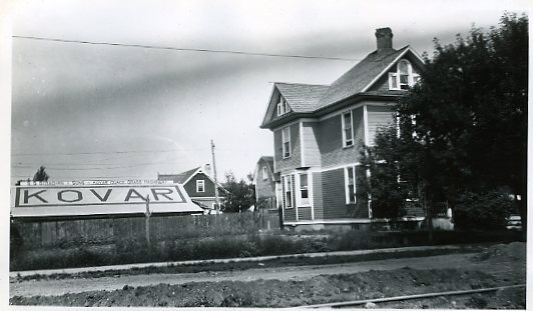

Thanks to the Kovar machinery, the Sam Strachans were at their most prosperous and optimistic point. Then came a 25% tariff on the machinery and the decision to move to Oregon. In the meantime, the Brandon house with the Kovar warehouse behind it was as comfortable as they had ever been. The address was 724 10th Street. There was a “sacred fireplace” that became the new anchor point for ceremonial photographs, and even a “sacred staircase.” The house would be an excellent location for several graduations and a double wedding as the children reached maturity.
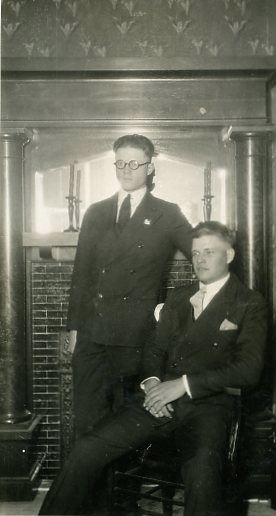
Seth and Glenn were formally posed in fall, 1927, just before they left for “flying school” in Marshall, Missouri, in preparation for the acquisition of a small airplane for Kovar business. Seth began his lifework as a pilot in this way.

May is posed in her graduation splendor in June, 1928, dressed almost like a bride with a bouquet on her arm. (She earned a Certificate in Domestic Science from Manitoba Agricultural College.) In those days the fashion was white stockings with white satin shoes -- just as in the Seventies the fashion was black stockings with black patent leather shoes. The fireplace itself appears to be of glazed brick with a fancy enameled grill over the opening, probably intended for coal rather than wood. It seems quite English to my eye. The area above the mantel shows a built-in mirror. Two candlesticks adorn the actual mantel -- at least one can’t see the mantel clock. Maybe it stayed with its bookcase from the previous houses or maybe it just doesn’t show. There is an elaborate columned carpentry surround framing the whole fireplace area. The chair in both photos seems to be an unremarkable wooden chair, borrowed from someplace else. Other photos show the hearth as rubble! Broken rocks and possibly brick. This suggests that the original hearth -- marble? -- was removed for some reason and the pieces were a stopgap.

The stairway is very nice: carved wood, gracefully designed. A radiator shows, meaning that this house has a furnace or boiler which probably means a basement. This, along with a lack of easy chairs for reading near the fire, might suggest that the fireplace wasn’t really used for heat. This would be an excellent stairway for a bride to descend -- or two brides since the Strachan wedding was double. (Unusually good-looking couples, I might add! The brides dressed as May did for graduation except for veils gathered into little upside-down sugar bowls on top of their heads.) I suspect that the frieze at the top of the wall and the window shade were left by the former owner. Also the quite remarkable art nouveau wallpaper in the main room! I wish I knew the colors. I'm guessing turquoise, plum, orange!
The family was quite proud of the fact that this house had belonged to Martha Ostensko, the author of “Wild Geese,” published in 1925 and a great hit. Slyly dedicated to her father, the story is about a prairie patriach in territory more like Minitonas, who in his drive to succeed ruled his family too harshly. There is a terrible prairie fire arising from Caleb’s greed. The passage below comes late in the book after the fire. Lind is the school teacher who boards with the family.
“The first hoar frost came, and Lind woke one morning to find the earth covered with white, powdered glass. The sun took its glitter within a few minutes, but the land was not the same after it had gone. It seemed to have left a shadow over the stubble and over the short brown grass of the pastures to the west, and over the black corpses of the trees that had been ravished by the fire. The days that followed were as full of mellow radiance as those that had gone before, the wind was as soft and the sky as intimate a blue, but there was some change in the mood of the earth.
“Then Lind heard the honking of the first wild goose, high overhead. On a night that was cold with moonlight she heard it, a full, clear trumpeting, in a sky that was vacant of clouds. The wild geese were passing over -- passing over the haunts of man in their remote seeking toward the swamps of the south. They marked the beginning and the end of the period of growth. Next year they would fill the sky with their cold, lonely clamor at sowing time, and again when the earth would have closed in upon itself after yielding its growth.”

In 1996 a movie called “After the Harvest” was made for Canadian television, based on this novel.

Sam Shepard played the patriarch, but he was nothing like Sam Strachan, nor were his children like the trapped siblings in the story. Still, especially in Brandon, there was a sense of them trying their wings, looking to the south. Probably the exception was Elsie, who grew up in Brandon. When she married Glenn, she may have felt that the future of the family would be securely and prosperously in Brandon. In fact, she became a poet and would eventually have her work published in The Saturday Evening Post and Arizona Highways. Most of her adult life would be in Southern California, but she had no inkling of that yet.
Murdock McLean, called “Doc,” met the Strachan sons in Winnipeg at MAC and then their sister May. After a year back home in Reston, Ontario, on his father’s substantial farm -- big house with stone foundation, even bigger and always expanding barn, and a family to match with a patriarch a bit more like Caleb -- he decided to throw in with the Strachans in Brandon. He and May, along with Glenn and Elsie, formed a foursome. In old age, the two widows called each other late at night when rates were low to share their lives and memories, still close as school girls.
In fall of 1929 Bruce, graduated in Winnipeg, left for Oregon State College to get an advanced degree in “scientific agriculture.” Sam and Beulah, facing the economic future of Kovar, bought a house in Portland. May and Doc soon joined them. Glenn and Elsie stayed in Brandon in hopes that Kovar would somehow recover or at least survive. Elsie ran a little beauty parlor in an upstairs bedroom.
You know what happened next: economic depression like a prairie fire: so harsh and widespread that people across the continent died of starvation and suicide. Sam went up to Brandon to help close out the business and move the remains to Portland.
Wednesday, November 22, 2006
HUMANIACS AS TERRORISTS
House Passes 'Terrorism' Act Against Animal Activists
by Megan Tady
© 2006 The NewStandard
Wednesday, November 15, 2006 -- Monday afternoon, the US House of Representatives passed a bill that reclassifies unlawful animal-rights tactics as terrorism under certain conditions, even if they are non-violent.... the bill will classify civil disobedience actions -- such as blockades, property destruction, trespassing, and the freeing of captive animals -- as terrorism... enhance penalties against activists who "interfere" with animal enterprises by destroying property or engaging in behavior that appears "threatening." It even includes perceived threats to companies that work with animal enterprises and takes into account resulting profit losses.”
In other words, Oprah as terrorist. No more civil trials -- straight to criminal law. Not just “spitting on the sidewalk” but hard-core, locked-up-in-Guantanomo terrorism. It was easy to see this one coming.
There are several elements to this development. One is the meat industry, which wants no attention to its de-beaked chickens crammed into gym-baskets, it’s e-coli-spreading slaughter practices and feedlots, its illegal employees scalded and slashed by lousy work conditions, and so on. Another is the high-minded medical research community and its specially bred and expensive white mice and rats with “knockout” genetics, monkeys confined and infected because that’s the only way to find out about human diseases if they won’t let you do such things to humans, or cats literally wired for sex and violence in the name of understanding those potent human forces. The fur industry -- of course. So far growing plants are not included as victims of cruelty, but that food industry is also intent on eliminating public interference with its more dubious practices like not providing latrines for workers in the fields.
In short, 9/ll worked so well as a political ploy for Bush, was such an argument for power and secrecy, that entire industries have decided to follow suit. In the past when attempts have been made to regulate such organizations, they have depended on simple passive resistance: making things unavailable, stonewalling, conforming to the law only when inspectors were present, blocking the funding of enough inspectors to enforce the regulations. It’s all worked pretty well, a kind of board game of approach and avoidance.
But this is different. There is a edge in this approach, a determination to skewer the individual, to intimidate anyone who tries to take on the status quo by punishing him or her as “other.” At the very least, ecoterrorists will need a lot of money for lawyers. At the most they may simply disappear into “rendition,” confinement in a country with low standards about torture and no habeas corpus.
True enough that setting fire to laboratories, liberating mink from “ranches,” setting loose millions of dollars of mice and destroying the experiments they support, are bad things to do and often come from people who are neither thoughtful nor helpful. They meant to be provocative and look what they provoked! But defining them as “terrorists” ups the ante enough to attract the truly nutso. Do we want people blowing themselves up in local animal shelters?
In the last wave of extravagant superrich industries, the 1900’s Age of Gold, which many writers are beginning to compare to right now in terms of growing wealth disparity, there was violence against workers, sabotage against factories, riots and assassinations enough to dislocate public order. Is this what we’re moving towards?
Many humane workers think that they’re trying to make everyone be gentle pacifists who never kill any animals anywhere. They never consider overgrazing, belligerent deer in towns, vicious animals, or anything else that interferes with their vision of life as naturally an Eden: a zipless, prelubricated, eternal childhood Land of Sunshine. Instead, their harassment of government and corporate bodies has irritated the latter enough for this kind of out-of- proportion overkill.
I understand the irritation. When I was doing animal control, there were always individuals who locked onto us as evil monsters, used sunshine laws to demand time-consuming and expensive compilations of records, got on talk shows to whip up emotion over incomplete versions of lamentable cases, and generally hounded us into plugging our ears. But they weren’t terrorists. And a few of them had good sense -- they could become valued allies and friends. Still, there was always a rough edge of law enforcement that muttered, “Those women need a good ...” you know. Only a short step from there to rape, which can hardly be separated from violent assault. If they’re “only” terrorists...
No newspaper has discussed this federal law. I see no articles in magazines about it. Journalism believes that animal stuff is for children. All that tiresome stuff -- so hard to sort out. So...well, icky.
They tell me -- and I guess I believe it -- that in France there is no law against cruelty on grounds of being inhumane. Rather it is illegal to offend the sensibilities of others through cruelty. In this country, we don’t care much about sensibilities. The great overriding consideration is the profit margin. It is increasingly illegal -- to the point of being considered terrorism -- to interfere with anyone’s profit margin. Crimes against the dollar are crimes against the State.
by Megan Tady
© 2006 The NewStandard
Wednesday, November 15, 2006 -- Monday afternoon, the US House of Representatives passed a bill that reclassifies unlawful animal-rights tactics as terrorism under certain conditions, even if they are non-violent.... the bill will classify civil disobedience actions -- such as blockades, property destruction, trespassing, and the freeing of captive animals -- as terrorism... enhance penalties against activists who "interfere" with animal enterprises by destroying property or engaging in behavior that appears "threatening." It even includes perceived threats to companies that work with animal enterprises and takes into account resulting profit losses.”
In other words, Oprah as terrorist. No more civil trials -- straight to criminal law. Not just “spitting on the sidewalk” but hard-core, locked-up-in-Guantanomo terrorism. It was easy to see this one coming.
There are several elements to this development. One is the meat industry, which wants no attention to its de-beaked chickens crammed into gym-baskets, it’s e-coli-spreading slaughter practices and feedlots, its illegal employees scalded and slashed by lousy work conditions, and so on. Another is the high-minded medical research community and its specially bred and expensive white mice and rats with “knockout” genetics, monkeys confined and infected because that’s the only way to find out about human diseases if they won’t let you do such things to humans, or cats literally wired for sex and violence in the name of understanding those potent human forces. The fur industry -- of course. So far growing plants are not included as victims of cruelty, but that food industry is also intent on eliminating public interference with its more dubious practices like not providing latrines for workers in the fields.
In short, 9/ll worked so well as a political ploy for Bush, was such an argument for power and secrecy, that entire industries have decided to follow suit. In the past when attempts have been made to regulate such organizations, they have depended on simple passive resistance: making things unavailable, stonewalling, conforming to the law only when inspectors were present, blocking the funding of enough inspectors to enforce the regulations. It’s all worked pretty well, a kind of board game of approach and avoidance.
But this is different. There is a edge in this approach, a determination to skewer the individual, to intimidate anyone who tries to take on the status quo by punishing him or her as “other.” At the very least, ecoterrorists will need a lot of money for lawyers. At the most they may simply disappear into “rendition,” confinement in a country with low standards about torture and no habeas corpus.
True enough that setting fire to laboratories, liberating mink from “ranches,” setting loose millions of dollars of mice and destroying the experiments they support, are bad things to do and often come from people who are neither thoughtful nor helpful. They meant to be provocative and look what they provoked! But defining them as “terrorists” ups the ante enough to attract the truly nutso. Do we want people blowing themselves up in local animal shelters?
In the last wave of extravagant superrich industries, the 1900’s Age of Gold, which many writers are beginning to compare to right now in terms of growing wealth disparity, there was violence against workers, sabotage against factories, riots and assassinations enough to dislocate public order. Is this what we’re moving towards?
Many humane workers think that they’re trying to make everyone be gentle pacifists who never kill any animals anywhere. They never consider overgrazing, belligerent deer in towns, vicious animals, or anything else that interferes with their vision of life as naturally an Eden: a zipless, prelubricated, eternal childhood Land of Sunshine. Instead, their harassment of government and corporate bodies has irritated the latter enough for this kind of out-of- proportion overkill.
I understand the irritation. When I was doing animal control, there were always individuals who locked onto us as evil monsters, used sunshine laws to demand time-consuming and expensive compilations of records, got on talk shows to whip up emotion over incomplete versions of lamentable cases, and generally hounded us into plugging our ears. But they weren’t terrorists. And a few of them had good sense -- they could become valued allies and friends. Still, there was always a rough edge of law enforcement that muttered, “Those women need a good ...” you know. Only a short step from there to rape, which can hardly be separated from violent assault. If they’re “only” terrorists...
No newspaper has discussed this federal law. I see no articles in magazines about it. Journalism believes that animal stuff is for children. All that tiresome stuff -- so hard to sort out. So...well, icky.
They tell me -- and I guess I believe it -- that in France there is no law against cruelty on grounds of being inhumane. Rather it is illegal to offend the sensibilities of others through cruelty. In this country, we don’t care much about sensibilities. The great overriding consideration is the profit margin. It is increasingly illegal -- to the point of being considered terrorism -- to interfere with anyone’s profit margin. Crimes against the dollar are crimes against the State.
Tuesday, November 21, 2006
A TRIP IN THE RANGER
For a while there, it appeared that the Sam Strachan family would make their fortune from crabgrass -- the elimination of it. Well, the attempted elimination of it. In fact, they were about to leave farming and become manufacturers, working as the agents of the Kovar Kultivator Kompany. The great success was a harrow designed for the pesky long-rooted quack grass. “Dry and die” was the motto of the horsedrawn machine that pulled them out of the ground so the sun could get at them.
From the Internet:
Crabgrass is a common weed that almost everyone knows. (The "great philosopher" Pogo said, "Work is the crabgrass in life."). {The Latin name, Digitaria, alludes to the finger-like spayed out ends.] Digitaria were introduced from Eurasia and are widespread throughout the United States. Crabgrass is found in turfgrasses (mostly smooth crabgrass) and in ornamental landscapes (primarily large crabgrass). Large crabgrass is also found in orchards, vineyards, and other agricultural areas. Crabgrass also has many other names including crowfoot grass and summer grass.
It was 1926 and the Sam Strachans had been married for twenty-five years. Sam built his own homemade version of an RV, a home on wheels they called “The Ranger,” and they set off to explore the Continent. Strachans never paid much attention to the 49th parallel, though it gave them trouble through tariffs at the border on their Kovar Kultivators. The tariffs would end the business but not yet. (If the tariffs hadn’t put Kovar out of business in Canada, the soon-to-come invention of herbicides would have anyway.)
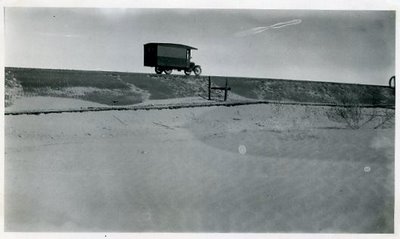
After many adventures getting to Portland, that Christmas the couple lived in the Ranger on a parking lot across from the Congregational Church. Of course it rained the whole time, which Beulah, used to the high and dry prairie, thought was wonderful. She hung a bucket to the eaves and collected soft water for hand laundry. The two of them walked down to the waterfront where there were still sailing ships and they went to stage shows. In the daytime they separately patronized the YWCA and YMCA. Each of them kept journals which I’ve typed out and distributed around the family. It was quite like a second honeymoon, although they were so enmeshed and had been for so long, that there was no need for such an interval to restore their relationship. They just needed time away from the frontier prairie.
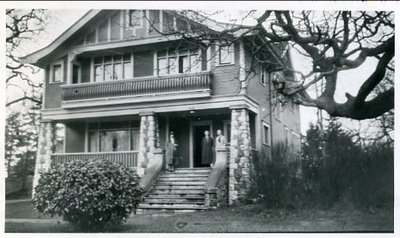
There were several stops to make through the Strachan diasphora. One was to Sam’s cousin, George Ramsey Jr., (the son of Sam’s mother’s sister Mary Welch who married George Ramsey Sr.), thriving in Victoria, B.C. (I have no b&d dates for these folks. The Welch girls were born and raised in Scotland in the last half of the 19th century.) Across the street from the very substantial Ramsey house was another, and looming over it was Craigdarroch Castle. Sam took a photo from the top floor of the Ramsey house. It didn’t look like the little pink Pickler mansion.
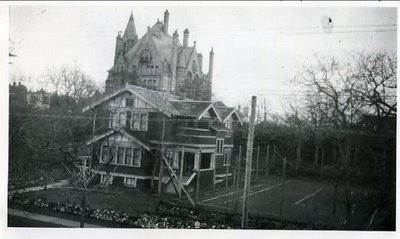
Cousin Will Harcus, son (or husband?) of Jean Ramsey daughter of Mary Welch Ramsey lived in Everett in a rather less palatial house.
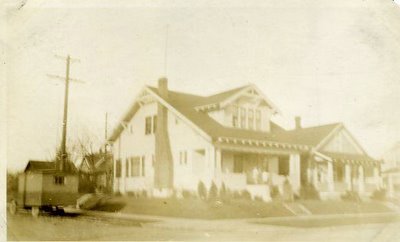
A South Dakota neighbor, Will Jackman, also had a pleasant house nearby.

The Sam Strachan’s appear to have kept up their relationships with the homestead neighbors as much as they did with their genetic diasphora. Which are stronger: bonds of blood or bonds of shared experiences? Best is when the two are entwined. Which draws people closer together, hardship or good fortune? Hard to tell. Maybe hardship.
Having taken a good look at the Pacific Northwest, the travelers swung down to Purcell, Oklahoma, where Sam’s mother and her sisters and Sam’s sister Jeannie (1877-1957) -- a second wife to the widowed Harmon Archer (1869 - 1942) -- were living. Sam’s mother, Catherine Welsh Strachan (b.1852), was buried there in 1918 and Sam had taken his father Archibald’s body (b. 1850) to her side in 1926. Matt Robertson (1880 -1967), a cousin who is in this photo and who referred to Archibald as “Uncle Archie,” had a story about Uncle Archie’s small brother, whose leg had to be amputated for some reason. After a while, when the boy had recovered somewhat, he asked when his new leg would begin to grow back. An optimist, that boy! I have no idea what his first name was or what eventually happened to him.
Matt, who was a lawyer and probably could have been a writer, said that on the Welsh side the family was descended from John Knox, the great Scotch reformer, through his second wife. Matt said he was of the 11th generation but couldn’t prove it. Also, he claimed as ancestors King Robert the Bruce of Scotland and William Wallace, the Scots hero of the 12th Century. Jane Welsh, wife of Thomas Carlyle, and Jane Welsh, wife of Alexander Hamilton, were also claimed. There is a long story about John Brown Gillis and his children, which I won’t include here.
Harmon Archer’s house is also quite romantic, with gingerbread on the eaves, a square tower with a not-quite spire, and unique windows. The family often spoke of the “round window.” Note the amenity of the screen porch at the rear. The front porch, concrete, is rather Greek with its curves and columns. I believe Jeannie Archer lived here all her life after marrying in 1907, so that means she was in residence for fifty years. Her sister Jessie stayed in South Dakota -- quite a different life.

Beulah and Sam returned to the far north, encouraged by the success of others and with renewed confidence that there was still time to succeed themselves. They would make several other swings around the continent, to Ottawa, New England, and to Alberta. Even a visit back to South Dakota. They had escaped John Knox and his dour Scots devotion to duty.
From the Internet:
Crabgrass is a common weed that almost everyone knows. (The "great philosopher" Pogo said, "Work is the crabgrass in life."). {The Latin name, Digitaria, alludes to the finger-like spayed out ends.] Digitaria were introduced from Eurasia and are widespread throughout the United States. Crabgrass is found in turfgrasses (mostly smooth crabgrass) and in ornamental landscapes (primarily large crabgrass). Large crabgrass is also found in orchards, vineyards, and other agricultural areas. Crabgrass also has many other names including crowfoot grass and summer grass.
It was 1926 and the Sam Strachans had been married for twenty-five years. Sam built his own homemade version of an RV, a home on wheels they called “The Ranger,” and they set off to explore the Continent. Strachans never paid much attention to the 49th parallel, though it gave them trouble through tariffs at the border on their Kovar Kultivators. The tariffs would end the business but not yet. (If the tariffs hadn’t put Kovar out of business in Canada, the soon-to-come invention of herbicides would have anyway.)

After many adventures getting to Portland, that Christmas the couple lived in the Ranger on a parking lot across from the Congregational Church. Of course it rained the whole time, which Beulah, used to the high and dry prairie, thought was wonderful. She hung a bucket to the eaves and collected soft water for hand laundry. The two of them walked down to the waterfront where there were still sailing ships and they went to stage shows. In the daytime they separately patronized the YWCA and YMCA. Each of them kept journals which I’ve typed out and distributed around the family. It was quite like a second honeymoon, although they were so enmeshed and had been for so long, that there was no need for such an interval to restore their relationship. They just needed time away from the frontier prairie.

There were several stops to make through the Strachan diasphora. One was to Sam’s cousin, George Ramsey Jr., (the son of Sam’s mother’s sister Mary Welch who married George Ramsey Sr.), thriving in Victoria, B.C. (I have no b&d dates for these folks. The Welch girls were born and raised in Scotland in the last half of the 19th century.) Across the street from the very substantial Ramsey house was another, and looming over it was Craigdarroch Castle. Sam took a photo from the top floor of the Ramsey house. It didn’t look like the little pink Pickler mansion.
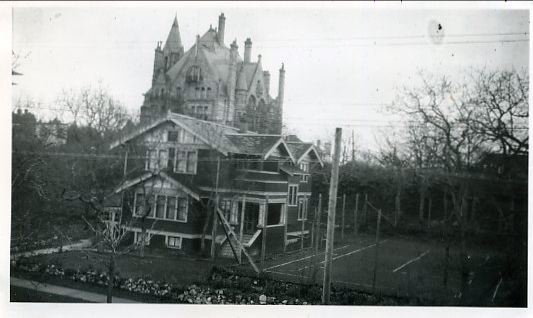
Cousin Will Harcus, son (or husband?) of Jean Ramsey daughter of Mary Welch Ramsey lived in Everett in a rather less palatial house.
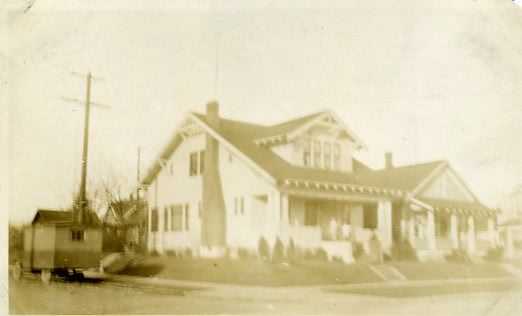
A South Dakota neighbor, Will Jackman, also had a pleasant house nearby.
The Sam Strachan’s appear to have kept up their relationships with the homestead neighbors as much as they did with their genetic diasphora. Which are stronger: bonds of blood or bonds of shared experiences? Best is when the two are entwined. Which draws people closer together, hardship or good fortune? Hard to tell. Maybe hardship.
Having taken a good look at the Pacific Northwest, the travelers swung down to Purcell, Oklahoma, where Sam’s mother and her sisters and Sam’s sister Jeannie (1877-1957) -- a second wife to the widowed Harmon Archer (1869 - 1942) -- were living. Sam’s mother, Catherine Welsh Strachan (b.1852), was buried there in 1918 and Sam had taken his father Archibald’s body (b. 1850) to her side in 1926. Matt Robertson (1880 -1967), a cousin who is in this photo and who referred to Archibald as “Uncle Archie,” had a story about Uncle Archie’s small brother, whose leg had to be amputated for some reason. After a while, when the boy had recovered somewhat, he asked when his new leg would begin to grow back. An optimist, that boy! I have no idea what his first name was or what eventually happened to him.
Matt, who was a lawyer and probably could have been a writer, said that on the Welsh side the family was descended from John Knox, the great Scotch reformer, through his second wife. Matt said he was of the 11th generation but couldn’t prove it. Also, he claimed as ancestors King Robert the Bruce of Scotland and William Wallace, the Scots hero of the 12th Century. Jane Welsh, wife of Thomas Carlyle, and Jane Welsh, wife of Alexander Hamilton, were also claimed. There is a long story about John Brown Gillis and his children, which I won’t include here.
Harmon Archer’s house is also quite romantic, with gingerbread on the eaves, a square tower with a not-quite spire, and unique windows. The family often spoke of the “round window.” Note the amenity of the screen porch at the rear. The front porch, concrete, is rather Greek with its curves and columns. I believe Jeannie Archer lived here all her life after marrying in 1907, so that means she was in residence for fifty years. Her sister Jessie stayed in South Dakota -- quite a different life.

Beulah and Sam returned to the far north, encouraged by the success of others and with renewed confidence that there was still time to succeed themselves. They would make several other swings around the continent, to Ottawa, New England, and to Alberta. Even a visit back to South Dakota. They had escaped John Knox and his dour Scots devotion to duty.
Monday, November 20, 2006
MANITOBA AGRICULTURAL COLLEGE
From the Internet:
Manitoba Agricultural College
After 1905 the agricultural education movement on the prairies was strengthened when the province of Manitoba established the Manitoba Agricultural College.
It might be argued that the objectives of the College had less to do with teaching students how to farm as then with equipping those who already knew how to farm with the scientific and management tools to make them better farmers. The College offered a core curriculum of coures in horticulture and field husbandry, agricultural engineering, animal husbandry, and natural history. In addition to these practically oriented courses, programmes were offered in the fields of agricultural economics, accounting and farm management, courses which reflected the increasing professionalization of farming.
Alongside the faculties that taught farming practises, MAC offered course in Household Sciences and Home Economics. This home economics division offered courses in foods and nutrition, clothing and textiles, physiology and hygiene and institutional management to women, and reflected a growing professionalization of the domestic sphere in rural society.
In addition to being a centre of teaching, the College was a centre of research and experimentation. College agronomists conducted research into agricultural techniques, inventing and improving machinery, determining the optimal methods for weed and insect control, tillage and ploughing, and crop rotation.
The College was also a primary instrument of agricultural education beyond its own classrooms and laboratories, and it counted among its objectives to bring news of agricultural developments to the attention of established farmers. The College sponsored field experiments and demonstration crops on private farms. It conducted extension courses, lecture series and practical demonstrations at which farmers could learn more about soil and moisture conservation, traction engineering, seed cleaning, and other aspects of modern farming. Between 1912 and 1914, these educational programmes took to the rails, as the College co-operated with the Agricultural Extension Services to send two Better Farming Trains across the province.

Since in Minitonas in 1924 the Strachans were raising row crops (onions, potatoes, raspberries) with horse-drawn machinery (the kind on which one sits, holding reins) and living in modest houses, Bruce must have been in a state of shock for the first months at Manitoba Agricultural College in Winnipeg. Huge blocky buildings sitting in straight lines south of Winnipeg were so new there was neither lawn nor landscaping. The campus looks rather Soviet. The first thing he did was go to the top of each building and take a photo of the other buildings from the top. The first impulse of most folks would be to stand before the entrance and take a photo looking up at the building, but I don’t see a single photo like that. Bruce was a freshman at age 23, evidently preferring to look at the larger layout -- and perhaps to keep some distance.

But the phenomenon of the Edenic, protected, inside over-against the monolithic, stony, forbidding outside is present at its most extreme in the horticulture building with its greenhouses. Inside is lush and blooming summer, nothing like the subzero of outdoors. The seduction of such a sheltered place cannot be overestimated.
In 1925 Glenn also attends college here and thus is able to photograph his big brother Bruce at the top of the 100 foot CKY radio tower while the latter photographs the campus from his perch. At the end of the first term, Bruce averages 82% and Glenn averages 84%. These scores are the highest in their respective classes. The next highest scores are several points lower. Despite their literal high-jinks, they work hard.
I don’t know whether they were atypically older or whether this was a common phenomenon in that setting, but I do believe they were proud, nearly to the point of arrogance. What kept the lid on them was a strong near-communist sense of social responsibility and political obligation to others. They had a keen sense of community and neighborhood, for the excellent reason of having saved each other over the years. This was the Roaring Twenties, sure enough, (probably rather muffled in Winnipeg, though even today that city has an avant garde edge), but there was also an element like the Sixties -- an appetite for experiment and a Peace Corps-like drive to reform and develop. My father was enthralled by people like Bertrand Russell and Margaret Sanger, but his idealism was not theoretical so much as it was practical. Rodale, the organic gardener, was in there with Freud. The prairie Strachans knew what hard times were like.
Traveling home on the train from school, my father’s resources had been reduced to 26 cents. Combining his knowledge of nutrition with a desire for value, he spent the money on a big bag of redskin peanuts to eat on the long trip. Throughout his life he kept a little cache of redskin peanuts as a buffer against starvation. I do the same.
Manitoba Agricultural College
After 1905 the agricultural education movement on the prairies was strengthened when the province of Manitoba established the Manitoba Agricultural College.
It might be argued that the objectives of the College had less to do with teaching students how to farm as then with equipping those who already knew how to farm with the scientific and management tools to make them better farmers. The College offered a core curriculum of coures in horticulture and field husbandry, agricultural engineering, animal husbandry, and natural history. In addition to these practically oriented courses, programmes were offered in the fields of agricultural economics, accounting and farm management, courses which reflected the increasing professionalization of farming.
Alongside the faculties that taught farming practises, MAC offered course in Household Sciences and Home Economics. This home economics division offered courses in foods and nutrition, clothing and textiles, physiology and hygiene and institutional management to women, and reflected a growing professionalization of the domestic sphere in rural society.
In addition to being a centre of teaching, the College was a centre of research and experimentation. College agronomists conducted research into agricultural techniques, inventing and improving machinery, determining the optimal methods for weed and insect control, tillage and ploughing, and crop rotation.
The College was also a primary instrument of agricultural education beyond its own classrooms and laboratories, and it counted among its objectives to bring news of agricultural developments to the attention of established farmers. The College sponsored field experiments and demonstration crops on private farms. It conducted extension courses, lecture series and practical demonstrations at which farmers could learn more about soil and moisture conservation, traction engineering, seed cleaning, and other aspects of modern farming. Between 1912 and 1914, these educational programmes took to the rails, as the College co-operated with the Agricultural Extension Services to send two Better Farming Trains across the province.

Since in Minitonas in 1924 the Strachans were raising row crops (onions, potatoes, raspberries) with horse-drawn machinery (the kind on which one sits, holding reins) and living in modest houses, Bruce must have been in a state of shock for the first months at Manitoba Agricultural College in Winnipeg. Huge blocky buildings sitting in straight lines south of Winnipeg were so new there was neither lawn nor landscaping. The campus looks rather Soviet. The first thing he did was go to the top of each building and take a photo of the other buildings from the top. The first impulse of most folks would be to stand before the entrance and take a photo looking up at the building, but I don’t see a single photo like that. Bruce was a freshman at age 23, evidently preferring to look at the larger layout -- and perhaps to keep some distance.
But the phenomenon of the Edenic, protected, inside over-against the monolithic, stony, forbidding outside is present at its most extreme in the horticulture building with its greenhouses. Inside is lush and blooming summer, nothing like the subzero of outdoors. The seduction of such a sheltered place cannot be overestimated.


In 1925 Glenn also attends college here and thus is able to photograph his big brother Bruce at the top of the 100 foot CKY radio tower while the latter photographs the campus from his perch. At the end of the first term, Bruce averages 82% and Glenn averages 84%. These scores are the highest in their respective classes. The next highest scores are several points lower. Despite their literal high-jinks, they work hard.
I don’t know whether they were atypically older or whether this was a common phenomenon in that setting, but I do believe they were proud, nearly to the point of arrogance. What kept the lid on them was a strong near-communist sense of social responsibility and political obligation to others. They had a keen sense of community and neighborhood, for the excellent reason of having saved each other over the years. This was the Roaring Twenties, sure enough, (probably rather muffled in Winnipeg, though even today that city has an avant garde edge), but there was also an element like the Sixties -- an appetite for experiment and a Peace Corps-like drive to reform and develop. My father was enthralled by people like Bertrand Russell and Margaret Sanger, but his idealism was not theoretical so much as it was practical. Rodale, the organic gardener, was in there with Freud. The prairie Strachans knew what hard times were like.
Traveling home on the train from school, my father’s resources had been reduced to 26 cents. Combining his knowledge of nutrition with a desire for value, he spent the money on a big bag of redskin peanuts to eat on the long trip. Throughout his life he kept a little cache of redskin peanuts as a buffer against starvation. I do the same.
Sunday, November 19, 2006
MANITOBA HOME
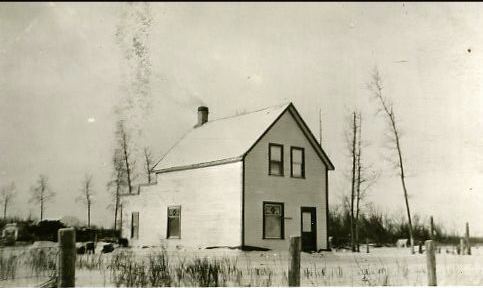
This farmhouse is in West Favelle, Minitonas, Manitoba. My father’s caption says, “Winter comes in October.” The date is October, 1919. This is not prairie, but rather scrubby brush that shelters bears and moose. The first winter, when money was short, they subsisted largely on canned moose.
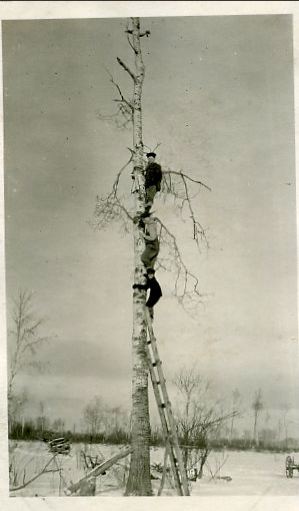
The bears, like the Strachans, climbed the poplars. The Strachans, unlike the bears, climbed each other, the house, and whatever else there was. Growing up on the horizontal, they were fascinated by the vertical. This caption says, “Looking at the claw marks after a bear climbed this tree.” They did a bit of logging and a photo of a wagon-load of logs notes that the biggest log they cut was 27” across.
This house is taller than the South Dakota house and the added-on shed has a stepped roof (or edge) instead of slanted. The chimney is at the shed end of the house, so maybe the kitchen is in the shed, sharing the chimney with a heating stove in the front. Note the stained glass embellishment on the upper parts of the windows. (I’m impressed that in English movies the houses always have lots of stained glass, so maybe it’s an English predeliction.) Again there’s no porch.
Winter here was very hard. My father remembered it as a constant round of carrying out ashes and clinkers to put on the paths to sheds and outhouses and then carrying in more coal. There are always coal deposits on the high prairie if you know where to look. Even in the mild climate of Portland, OR, he would not give up the coal furnace, even after it became impossible to buy coal. (Finally my mother had the furnace removed while he was out of town.)

Even far to the north indoors was snug and safe. The result of having four nearly-grown children in a house this size was that things were a tiny bit crowded. In this house most photos were taken against this bookshelf with the mantel clock at the top, which I take to be a substitute because they are heating with a stove rather than an inefficient fireplace. Still, this family considered writing as important as fire. The mantel clock continued on to May’s household eventually, and the Bruce Strachan’s also had a plainer one which wasn’t sold until my mother died in 1999. The clock in this photo has a bronze portrait of a seated woman at the top, wearing Greek draped clothing. Probably she is meant to represent “Wisdom,” though I think I was once told she was “Minerva,” approximately the same thing. The books in the shelves look to be bound reports rather than popular books: the size of typing paper, but slim.
Mircea Eliade and other writers have pointed out that what the family values often becomes a kind of household altar: a piano, a staircase, a big window, a fine painting. In this house it’s pretty clear that classical time and books are the sacred objects. One photo after another is taken with this book case as background. (The camera case is hanging to the far right next to the calendar. I remember it from my own childhood. It was a bellows camera that made "post card" photos.) Of course, part of the reason is that this is an available-light time-exposure, so the windows need to be behind the camera or the result will only be silhouettes.
The sibs are probably doing homework -- May actually typing! But the caption says, “The family holds court.” That’s just a way of saying everyone is there and attentive, but it does look rather as though Bruce is the judge, sitting up high, May is the court stenographer and the two boys -- well, are they culprits or lawyers? Maybe they combine and swap the roles. They were in cahoots quite a lot.
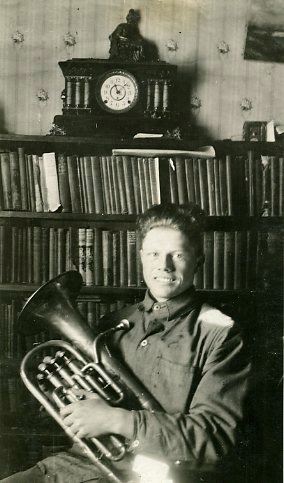
Here’s Glenn with his horn, seated in front of the domestic altar. One can see the goddess and the sacred texts -- not quite the titles on the spines. Or maybe you have sharper eyes than mine.
The Strachan families that resulted from these sibs did tend to be self-contained and to feel that they were special, just by being Strachans. They were literate, they all worked hard on the farm, they saw nothing but progress ahead. No one had a clue that the youngest boy, Seth, with his love of heights, would end up as a bomber and transport pilot (B52's and B59's) in World War II, though they had admired the barnstormers in their little canvas and bamboo flying machines when they visited South Dakota prairie after WWI.

This photo actually begins a different essay, about touring the West in a homemade RV, probably funded by the estate of Archibald. I'm unsure whether this is the back of the same house, improved with a second chimney and porch, or simply another house. There are many hints about economic problems: good crops lead to low prices, you know.
Saturday, November 18, 2006
"GREY & GOLD"
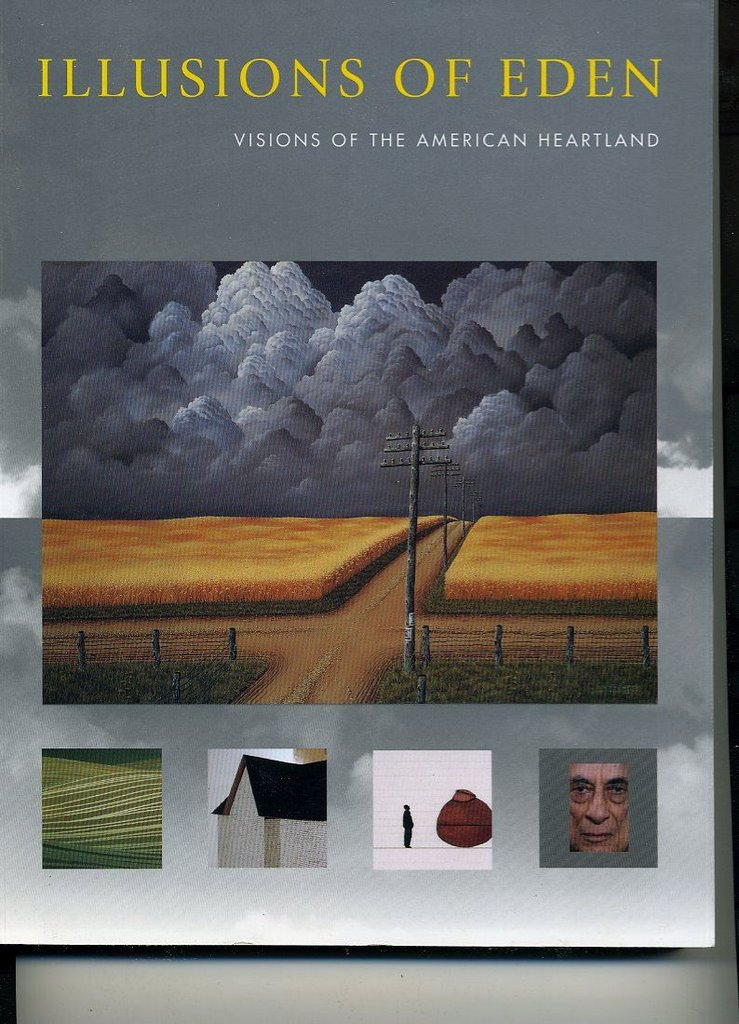
“GREY AND GOLD” 1942 by John Rogers Cox
A copy of this painting hung on our wall when I was growing up. It was an icon signifying my father’s boyhood in South Dakota. (My mother had her own, a photograph of sheep in the hills of Douglas County.) The book cover I’ve scanned here is called “Illusions of Eden, Visions of the American Heartland.” It’s actually a catalogue to accompany a show of art works and was sponsored by Phillip Morris. It’s in three languages: English, Hungarian, and German. I haven’t sat down to the read the book, but I did read the bio of Cox (1915-1990) and the information at AskArt.com, much of which is on the bulletin board section as messages from friends and former students. His work is considered to be “magic realism,” realer than real. His later years were spent in Washington State, in Wenatchee, though he was born in Indiana and taught in Chicago at the Art Institute for a long time. The example of his work on AskArt.com shows he detected a twisted and demonic side to the prairies as well as this orderly but foreboding landscape. Surrealists always seem to have a kind of horror-film side. Or is it the other way around?
This painting won the second medal in the “Artists for Victory” exhibition at the Metropolitan Museum of Art. Two years later the same painting received the “popular prize” in the exhibition, “Painting in the United States, 1944,” held at the Carnegie Institute in Pittsburgh. This painting now resides in the permanent collection of the Cleveland Museum of Art.
I don’t know whether my father knew all this stuff or what he made of it. His connection was just straight from the heart and my mother honored it. Over our fireplace was a “painting” (actually a print with a nice frame) that my parents bought together. I was present for the discussion of whether to buy it, but had no input. I was very small, but was impressed by their seriousness. A swan swims in a pond, looking very much like Laurelhurst Park, which I thought it was until I was grown up. It was to stand for their joy at living in Portland, Oregon, where we often picnicked in this park. My Aunt May and Uncle Doc also had a nice “painting” on their wall that looked very much like the prairie parkland of northern Canada. It was poplars in winter with snow and when the family gathered there, they would discuss whether the light was meant to be winter sun or moonlight. That signalled the beginning of the stories about Manitoba.
I tell all this as an illustration of how art weaves in and out of the lives of even fairly ordinary people -- without any discussion of modernity or political implications or ultimate value. My father’s art form was, of course, photography, which is why I have all these photos of houses to springboard essays off. My mother leaned a bit more to crafts but could do a respectable watercolor. My youngest brother has an MFA in metal-smithing, my other brother is also a decent landscape sketcher, and I dabble around when I have the inclination. My Aunt May filled her house with paintings. This gives me quite a different point of view from the new rocket-propelled art sales, which they say are fueled by hedge-fund millionaires. (See the latest “Vanity Fair” magazine.)
Instead of having a “picture window” out the front of my house so I could look in the “picture windows” of the house across the street (it has two), my picture window looks out the back and up a dirt alley with telephone poles alongside, just like “Grey and Gold” except that there are backyards instead of wheat. However, there is a wheat field at the end of the alley, which ends in a ridge that looks like the end of the earth, just like this painting. (A couple of miles beyond the ridge is the missile silo, aimed I know not where.) The cats spend much of their time on this windowsill since it faces east so it gets a lot of sun. They never tire of the view and neither do I. In fact, I get impatient if someone parks in the alley so that all I’m looking at is some RV’s rump.
We talk a lot in words about writing that has affected us, but art images can be powerful as novels, influencing choices, helping us interpret our environment and lives. Certainly “Grey and Gold” has caused me to see the world a certain way and to welcome the prairies, their electrical potential, their stored wealth. Part of my happiness in living here comes from this “magic realism.”
Subscribe to:
Posts (Atom)