
Bob working on a commissioned portrait of the Mayre brothers.
These are the results of the March in Montana auction website.
http://buy.marchinmontana.com/March-In-Montana-2016_as40962_p7?ps=50 The link is to the screen that shows what was recently offered in the private gallery auction and what the art sold for. This is their self-description: “With over 150 years of collective knowledge and a history of record-breaking sales experience of fine art and collectibles, Manitou Galleries of Cheyenne and Santa Fe and The Coeur d’Alene Art Auction of Idaho produce “March In Montana Fine Art & Collectibles Auction”. This annual event is held in conjunction with the other events in Great Falls surrounding and honoring Charles M. Russell’s birthday. “
My memory traces http://www.manitougalleries.com/exhibitions back to Kalispell, Montana, and Van Kirke Nelson’s Glacier Gallery. Beginning in the Sixties there was a little circle of dealers in the area. Before that was Trailside Galleries, then in Idaho which was the home base for Dick Flood who vacuumed the landscape for any Charlie Russell remnants or anything that looked a lot like a Charlie Russell. This meant both paintings and sculpture. It did not mean women or Indians.
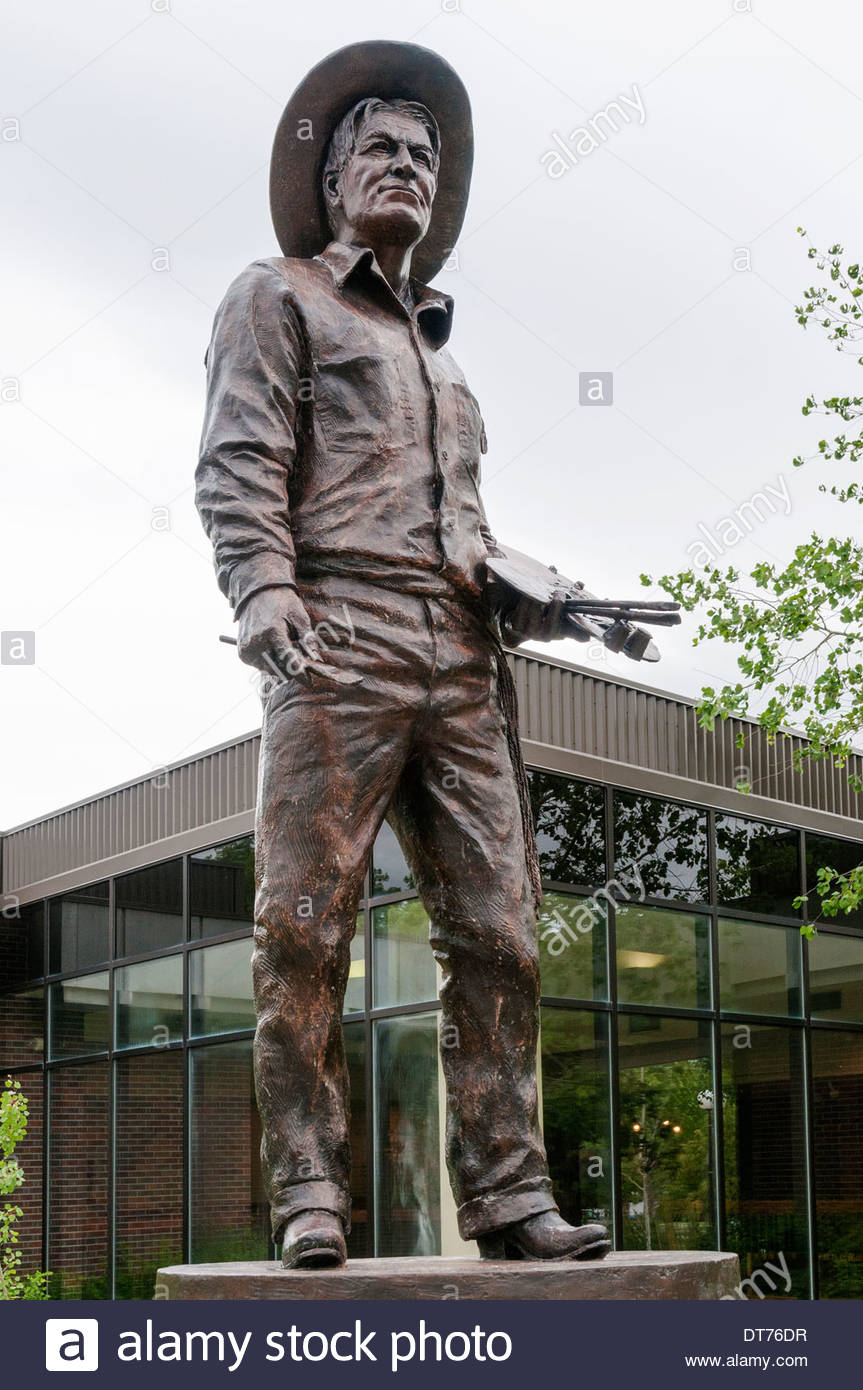
Scriver portrait of Charlie Russell.
Lucky for dealers, there was a LOT of material that had been produced in the 20th century about the 19th century. Basically, these “wheeler/dealers” filled warehouses and did a little dealing out of the trunk of cars, but Nelson always wanted an auction for sales and finally found a partner in Norma Ashby, energizer of the Ad Club in Great Falls. Anchoring the concept in Charlie Russell, homeboy, they scheduled the event around his birthday.
Eventually, partly by moving to the SW where prosperous customers abounded, the galleries caught fire and thrived, but much of their clientele and “story” remained anchored in Montana. Cowboy Artists of America were a source of oxygen based in the SW and also some major museums like the Cowboy Hall of Fame and the Buffalo Bill Historical Center.
This little circle from Kalispell wormed into Montana culture through the Montana Historical Society in Helena and the CM Russell Museum in Great Falls, until when Bob Scriver died in 1999, the two institutions were locked in rivalry over which got his estate. With the help of Ross Cannon, who fastened on Bob’s fourth wife (I was the third.) the bronzes finally went to the Montana Historical Society.

Monumental version of "Symbol of the Pros" in the backyard of the Montana Historical Society.
Bob’s bronzes can be grouped. The very earliest tourist items, little animals made of hydrocal and shaped for use as lamps or ashtrays, show up on eBay.

The Blackfeet narrative pieces are in the custody of the Fort Benton cluster of historical re-creations and are well served in a fine gallery display. An internal sub-group is Bob’s finest work, meant to be a monumental series for the Blackfeet in the oil years. They include "No More Buffalo" and "Transition." The horse-and-rider pairs that were begun around 1960 as a set of five, were the first to be cast in bronze. The Linderman rodeo series developed out of a portrait of Bill Linderman for what was then the Cowboy Hall of Fame. The big set of events was a major sale to the Calgary Stampede complex.

His personal work, portraits and a small set of religious themes related to the death of his daughter, have never circulated to auctions. There are always animals, but he never went on safari to Africa. There are thousands of sculptures of various kinds and importance out there in the hands of customers.
The Blackfeet narrative pieces are in the custody of the Fort Benton cluster of historical re-creations and are well served in a fine gallery display. An internal sub-group is Bob’s finest work, meant to be a monumental series for the Blackfeet in the oil years. They include "No More Buffalo" and "Transition." The horse-and-rider pairs that were begun around 1960 as a set of five, were the first to be cast in bronze. The Linderman rodeo series developed out of a portrait of Bill Linderman for what was then the Cowboy Hall of Fame. The big set of events was a major sale to the Calgary Stampede complex.
His personal work, portraits and a small set of religious themes related to the death of his daughter, have never circulated to auctions. There are always animals, but he never went on safari to Africa. There are thousands of sculptures of various kinds and importance out there in the hands of customers.
Bob’s works in general rarely go through auction, which are dealers’ events rather than coming directly from the artists. Bob did not much use dealers and despised some of them. This particular auction was selling estates of major collectors, and therefore made some major pieces available from Bob’s Rodeo Series. Those pieces tended to reach their estimated value. In general, this specific auction was under-achieving with most pieces selling for half or even a third of their expected prices. Whether that constitutes a “burst bubble” is anyone’s guess.

"Castle Rock, Green River, Wyoming"
Over at the primary auction, the one specifically organized for the Russell Museum, a Thomas Moran painting, “Castle Rock, Green River, Wyoming” sold for $3.6 million dollars. Last year the highest price at that auction was $1.5 million for CM Russell’s “For Supremacy.” I suspect the jump is related to a shift in culture from the resource exploitation version of the West (cowboys and Indians) to the near-mysticism of recent environmentalism which appeals to the new monied classes.
Following is from the March in Montana website. I’ve bolded the titles, followed them with the number of the casting and the specified limit number of castings. Photos of the pieces are in the online catalog. The second small number is the premium for the auction.
Bob Scriver (1914-1999)(CA). Winter King 81/110 Bob Scriver 1956
Est: 2,000 to 3,000
Sold for 1,700 +357
Bob Scriver (1914-1999)(CA). No Meat 12/30 1973
800 - 1,200
Sold for 600 + 126
Bob Scriver (1914-1999)(CA). Not For Glory. 21" x 34" x 26" bronze from the Rodeo Series. Inscribed: -2- © BOB SCRIVER 1971. Bighorn Foundry. Provenance: Ex- Archie Miller collection, Collection of Dr. Delwin & Karen Bokelman, PA & pictured in their book Precious Dreams, page 58.
Est: 15,000 - 20,000
Sold for 10,000 + 2100
Bob Scriver (1914-1999)(CA). Headin' For A Wreck. 18" x 28" x 43" bronze from the Rodeo Series. Inscribed: © BOB SCRIVER 1968 -6-
Powell Bronze Foundry. Provenance: Ex- Archie Miller collection, Collection of Dr. Delwin & Karen Bokelman, PA., & pictured in their book Precious Dreams, page 63.
Est. 6,000 - 8,000
Sold for 8,000 + 1680
Bob Scriver (1914-1999). Too Late for the Hawken. 23" x 30" x 24" bronze. Inscribed: "Too Late For The Hawken" 34/50, Arrowhead Bronze Foundry Mark.
Est 6,000 - 8,000
7,000 + 1470 8470

Bob Scriver (1914-1999)(CA). Herd Bull. 19" x 28" x 12" bronze. Inscribed: 5/110 © BOB SCRIVER 1959. Provenance: Ex- Archie Miller collection, Collection of Dr. Delwin & Karen Bokelman, PA.
Est. 7,000 - 9,000
Sold for 8,500+1785
Bob Scriver (1914-1999). Moving On. 14" x 8" x 35" bronze. Inscribed: "Moving On" © Bob Scriver 1995, 3/50.
Est 6,000 - 8,000
5,000 + 1,050
Bob Scriver (1914-1999). A Hard Way to Get Off. 15 ¾" x 10" x 19" bronze. Inscribed: "A Hard Way to Get Off" 22/150 © Bob Scriver, 1981.
Est. 3,000 - 5,000
Sold for 4500 + 945

Bob Scriver (1914-1999). Tail Stander. 24" x 15" x 10" bronze. Inscribed: "Tail Stander" © Bob Scriver, 1981, 22/150.
Es. 3,000 -5,000
3,500 + 735
Bob Scriver (1914-1999)(CA). Piegan Brave. 11" x 11" x 5" bronze. Inscribed: "Piegan Brave" © Bob Scriver 1974, 2/35, JHM Classic Bronze.`
Est. 2,000 - 2,500
1,700 + 357
Bob Scriver (1914-1999). When Hunters Meet. 15" x 24" x 13" bronze on swivel base. Inscribed: When Hunters Meet, 38/100, Bob Scriver, 1993.
Est. 4,000 - 6,000
4,000 + 840
Bob Scriver (1914-1999). The Golden Dragon. 9" x 7 ½" x 11 ½" bronze. Inscribed: 29/30 © Bob Scriver, 1973 "The Golden Dragon".
Est. 2,000 - 3,000
1,900 +399
Bob Scriver (1914-1999)(CA). The Warrior. 13" x 8" x 15" bronze. Inscribed: "The Warrior" © Bob Scriver, 1995, 33/50.
1,500 - 2,500
900 + 189
Bob Scriver (1914-1999). Calf in the Way. 21 ½" x 16 ½" x 16" bronze. Inscribed: "Calf in the Way", © Bob Scriver, 22/150, 1981.
Est. 2,500 - 3,500
2,500 +525
I include Gordon Monroe on this list because he worked closely with Bob Scriver. He is an enrolled Blackfeet Indian and Googling will reveal more information.

Gordon Monroe (Late 20th century). A Ride of Courage. 20 ½" x 9 ½" x 17" bronze. Inscribed: "A Ride of Courage" 24/50 © '83, Gordon Monroe.
Est. 3,000 - 4,000
1,600 + 336
I am not an art dealer. Questions appropriate for that role should be directed to Jerry Gorowski in Great Falls He is qualified, certified, and a veteran of this history.
Home (406) 452-6771 *Cell (406) 868-1372
Home (406) 452-6771 *Cell (406) 868-1372
Website: openrangeart.com
I maintain a blog where I post information that comes my way. scriverart.blogspot.com. I’ve written a memoir/biography available at any bookstore like Amazon. “Bronze Inside and Out” by Mary Scriver, published by the University of Calgary Press.


