Showing posts with label burning man. Show all posts

Saturday, August 22, 2015

THE WORLD IS ON FIRE


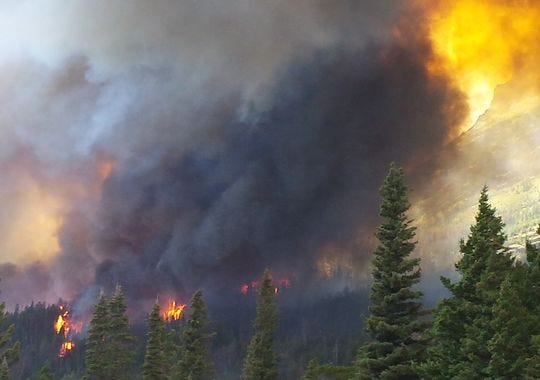
REYNOLDS CREEK FIRE

The real challenge to “Western” (Abramic) religion did not come through theology influenced by math or morality. It was the mountains that did it. That’s a metonymy (using a part to stand for a whole) a metonymy that is not just partial but also a shift in focus that led to an obsession with control and dominance, the prioritizing of logic and adversarial reasoning (legal), the use of written language rather than spoken language, and the drawing of boundaries superimposed on natural phenomena.

The bold raw confrontation with nature which is presented where I live on the eastern slope of the Rocky Mountains challenges all that. Unless it is screened by an aesthetic attitude (“Oh, how beautiful!”) or an itch to summit, it reduces human efforts like settlements and their crops down to dots on a landscape that includes vast sky.

The study of geology began the empowerment of sciences that previously had been reduced to Just-So stories. More even than human experience in awe of the mighty forces of what turned out to be plate tectonics, the evidence of fossils, sedimentation, and earthquakes told us the world was a totality of evolving, constantly displacing, interactional events that reduced us to incidental, even if we named an aeon after ourselves, the anthropocene that claims to have profoundly altered the planet. You think a huge algae bloom, a few degrees of warming, or even an asteroid impact is “profound”? It only is to ourselves and other life forms, and not to all of the latter. The planet has existed through far more challenges. But we won’t.

Survivors of the Twisp fire deaths.

At the moment we here are confronting not the burning bush of the Bible, but the burning mountain. It’s not the flames, it’s the smoke that brings the message. A fire whirl, a cyclone of flames, is very impressive, but not so ominous as smoke. At least last evening that’s the way it seemed. I parked at the western edge of town for a while to watch the progress of a great dark murk of a sky-wide cloud, mostly smoke, moving onto the prairie, an accumulation of what they tell us was the smoke from the Twisp fires that killed four firefighters, added to the Glacier-area fires.

Often at sundown whatever clouds there are will lift up over the mountain ridge line and let the setting sun shoot through. If I’m reading in my front room, it will suddenly be in my eyes, coming level through my west windows. Last night that strip of clear sky was pale blue satin with just a faint hint of the mountains. After dark that clarity would increase in a great curve we call a Chinook Arch and a cold wind would shake us hard for an hour or so. Since my house hunkers among trees, that means occasional smacking blows from dead limbs falling. There are a lot of them this year because of the harsh winter.

These are phenomena, experiences, which can then be explored and calibrated and compared by rationality, measurements, graphs and comparisons. We were having an “average” fire season: 2,364 fires burned 243,168 acres. (Starting June 1 and referring to a region that includes Idaho and Montana.) In 2012 those numbers were 3,433 burning 1.5 million acres — that’s the record. Now we appear to be approaching those numbers.

Undefined or addressed are things like mosaic fires, nothing to do with Moses, but wandering combustion that takes patterns through the forest according to local subtleties like dampness or density, reacting differently through old burns than through new growth.

Fires are named for their locations and as small fires kindle and then merge, the names capriciously make them seem like more or different when they are contiguous. Almost as capricious are the names of places, which might be indigenous or more likely some local nickname that got onto a map, often based on stigmatized people (because they stand out) or repetitions of nature (Willow Creek, Deer Creek, Sweetgrass Hills), but what the heck is a “twisp”?
Beetle-killed trees.

There are still beetle-killed stands. Depending on maturity and altitude, some of this mosaic burn will regrow easily because the seeds are there. The worst is fire so hot that it removes even duff and peat. Of course, the beetles die, too.

Australians know a lot, since their continent has been founded on cyclical sweeps of conflagration shaping vegetation and a climate that is largely dry heat. It does not rain often. In some places, never. Can you call it a drought if it’s always like that? For the displaced English, that rainy place, there was a lot to learn. It was hard to accept wild fire.

Science tells us that we are creatures of oxygen, which was only a feature of the planetary air after zillions of years of vegetation using up carbon dioxide, thus creating a poisonous (to some) atmosphere based on oxygen, a volatile element that became the basis of our cell-life, a quiet combustion supported by our red blood cells that carry it through our bodies once our lung alveoli have taken oxygen from the atmosphere to the core of our bodies so the blood system can carry it through the liquid vessels of our flesh.

Some say "The Thing" is an AIDS parable, but there are several versions.  
Arness was the "Thing" in the first one, 1951.

Recently in films there have been a lot of images of fire, like people on fire. One of the early attempts to make this real-seeming was filmed in Cut Bank. James Arness in an asbestos suit was supposed to be “the Thing” from outer space. (Fire was supposedly the only thing that would kill it.) He was actually on fire. Now there is a computer program that makes things seem engulfed. The Cinematheque and Smash Street Boys love it and soon their vids showed flaming skateboards and bicycles.

What is this attraction? "The Burning Man, “a weeklong communal art installation event in which participants arrive with everything they need to survive for the duration” attracted nearly 66,000 people last year.


Spring-boarding off the Celtic “pagan” ceremony of scapegoating one person to protect the rest, this tangle of events is experience-based, pre-theological. This year it was Stinking Biting Bugs that plagued them. “Where did they come from?” asked everyone. Probably from THEM, the attenders. And the bugs, several species, would be impossible to confine to a wicker cage for burning. When humans get hypnotized by One Big Thing, they forget the power of a zillion little things. God is a swarm.

That is, one’s deity is always drawn from human experience, maybe one’s own and maybe that of a tribe. I was talking to a Methodist minister, casually, and said something about God as an abstract concept, maybe.  You know, like "the Force."  He was aghast and blurted, “If I thought God wasn’t a loving person, just like a human being, I would die.”

He IS going to die, but it has nothing to do with the nature of God. It has nothing to do with human beings either. It is embedded in the nature of life, the experience of life, that it is both holocaust and breath. When the smoke is too thick, no one knows what the fire is doing and it’s impossible to go into the air to survey it or suppress it. But then comes the wind and everything changes. As for your death, the bugs will take care of that.

This morning in Glacier National Park

Tuesday, February 04, 2014

OUTSTRETCHED ARMS


When I was in junior high and taking instruction about how to be a good Presbyterian but also just reading science-fiction beginning with Heinlein’s “The Red Planet Mars” which eventually morphed into “Star Wars,” I began thinking about the symbolism of the human body.  For instance, I asked the long-suffering and self-important Rev. J. Arthur Stevenson whether Jesus died for everyone.  Oh, yes.  (He was accustomed to that question.)  Then I asked whether he died for “people” on other planets.  Pause.  Um, yes.  Well, then, if the people on that planet had evolved to have four arms, would they not be wearing crosses around their necks but rather something like an asterisk?  End of the lesson.


I felt confirmed when the new math became popular and someone suggested that our calculations are “base ten” because we have ten fingers.  (I have cousins who are vulnerable to a mutation that causes extra or fewer fingers or toes.)  I’ve never found a really powerful discussion of bilateralism: the whole thing of having two sides, roughly the same until you get to internal organs where there is only one heart, one liver, but two lungs.  Is this the source of our insistence on dividing everything into two sides, usually opposed or at least alternative?
  

The image of the man with arms outstretched shows up everywhere.  It’s not quite the same with legs together as it is with legs apart, which latter makes it somehow more sexual, more humanistic in terms of having power, capable of making a wheel or even a snow angel.  In fact, most often the man (almost always a man) suggests suffering, like the prisoner at Abu Ghraib made to stand on a box, hooded, with his outstretched arms attached to electrodes, convinced that if he dropped his arms he would be electrocuted.


The crucified man is, of course, claimed by Christianity, which makes that man into a god immobilized and dying for the sake of human beings.  A scapegoat.  This method of killing people was favored by the Romans as economical (you can recycle crosses) and forcing public notice -- no secret prison torture for them.  They did it right out in the open.  In fact, some historians now point out that sometimes there were mass crucifixions, hundreds of crosses.  I’m haunted by an artist’s rendering of that, crucifixions like soldiers’ cemetery tombstones,  all in orderly rows, probably counted and recorded on paper like all the other bookkeeping, so that it could be sent by runner back to the Emperor.  The image above is meant to show crucifixions along a road where people had to pass.

A cross is a rigid order imposed on a body that moves, pulses, dances, changing shape.  It denies the reality of a living individual.  The victim dies by shock and denial of breath since the rib cage is immobilized by being stretched against gravity.


Conventionally we make scarecrows in the same shape but in this case the cross is inside, a skeleton covered by the semblance of a man or at least his clothes, possibly rounded out by stuffing with straw.  My brother and a few friends made a garden once and since they were all arty types and, anyway, didn’t want to have to dig a hole for an upright, they made two scarecrows, a man and a woman down on their hands and knees as though pulling weeds.  Not only did the crows stay away, the strategy also caught their midnight vegetable thief, who tripped and fell over the backs of the surrogates and made enough noise to be noticed.  Nevertheless, the scarecrow man who stands upright is often imagined as asking to get down, as though he were being punished.  In “The Wizard of Oz” he is depicted as the rhetorical “straw man” who turns out to be empty, a vulnerable and brainless creature aspiring beyond his capacity.  Or what he THINKS is his capacity.

There’s another figure, again a European figure, which is the Immolated Man, the man made of sticks, the Wicker Man meant to be burned, who is sometimes seen as Guy Fawkes, the Catholic rebel who was caught guarding a hoard of gunpowder in hopes of exploding James I in England.  Most recently the mask of Fawkes is seen everywhere on the faces of rebels and his pyre showed up in a recent Sherlock Holmes PBS plot as the near-fate of poor Dear Doctor Watson.  


If you look at the video at http://ronaldlgrimes.twohornedbull.ca about the Santa Fe spring festival  (this website is is well-worth looking at for any reason, as Ronald Grimes is a master “ritologist”) you’ll see an effigy that is made to scream and move as it burns.  (Those Spanish speakers always take things a step over the top.)  Some interpret this as the death of Death itself.   It is “the burning of Zozobra, also known as "Old Man Gloom", a 50 ft/15.2m tall marionette that symbolizes the hardships and despair of the past year.”  Fireworks may be embedded.  Sure beats groundhogs!

In a sort of culture duality, some want to drive their consciousness straight into the heart of the worst darkness, the torture, the dissolution, and the Evil.  Others wish to make everything light and sweet.  If those latter persist too much, then -- we believe -- the dark negative stuff is forced down into the unconscious where it will ferment, compress and become a peat that fuels the worst of atrocities.  This will create the figure of the Dark Dancing Man -- goat-footed Satan.  At least this is the structure of the three Abrahamic religions with borrowed content from the European vegetation cults.


So how to turn this into something positive that still not treacle?  I see one that’s really spectacular: the Flying Man or Diving Man, free from gravity but not needing wings either, able to hold out his arms and lift off into the sky.  Superpowered men who can help us. http://www.google.com/hostednews/afp/article/ALeqM5g0-BZRwK84UAu27XKm3m1sBMzfUg?docId=2347faab-e1b4-4c21-8c1f-753dee50101c  Recognize this one?

Next is the Blessing Man, like the huge statue of Jesus in Buenos Aires.  And then there is the Sheltering Man or the Embracing Man who holds out arms to children, animals and birds, like St. Francis or even Pope Francis I.  Recently there was an event where the gentle symbolism that good man favored was ripped apart by the real world, the survival world.  He could have used a good biologist at that point.  An ecologist would have been even better.  Because St. Peter’s square is always full of tourists, and tourists eat, scattering bits that are good for pigeons, the predatory birds have learned where to lunch as well, preferring their food warm and bloody.  


Francis and the little children sent out pretty doves, and the cameras recorded the massacre.  The darkness broke through.  http://www.youtube.com/results?search_query=Pope%20francis%20doves&sm=3  One was in the form of the classic black crow and the other was a gray gull.  Easy to weave a LOT of theology out of that.  Their desperate ballet is quite beautiful in an abstract way.  That strife is exactly what we love and reward in our movies and books.  One of the Niebuhr brothers (I forget which of the two famous theologians) used to say that God admonished us to be as gentle as doves and wise as serpents, but we always get it backwards: gentle as serpents and wise as doves.


There’s a third bird, a parrot.  When the Pope was blessing babies, a male stripper offered his green parrot, which Francis -- true to his namesake -- took on his finger and blessed, his face full of delight.  So consider the parrot, the green of the planet, able to say blessings itself, willing to sit in conversation, and VEGETARIAN.  http://www.youtube.com/watch?v=uBqVKv4aZoc   Also possibly endangered.  But it still beats a turkey.