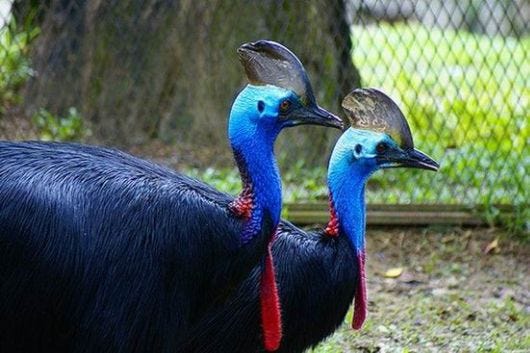
Showing posts with label cassowaries. Show all posts

Tuesday, July 05, 2016

CASSOWARIES AND THE MALE BURDEN


(Reprint from Tuesday, June 03, 2008 Prairiemary.blogspot.com)
This is a relatively informal account of a very serious ceremony. I adopt the tone in part because it deals with SUCH serious forces in life, which are often best handled with a bit of humor, but make no mistake: this is “ultimate” stuff in the Tillichian sense. The Umeda are (or were) a small group living in New Guinea in one of those very marginal places where humans can survive only with hard work and good luck. They get to believing in all sorts of talismans and symbols that help them “do what has to be done,” and it was only by living with the people for a while that Alfred Gell, a rather classical sort of Brit anthropologist, was able to dope out what things really meant.

Alfred Gell
He says: “Ida is a public non-verbal spectacle, whose meaning is also public and non-verbal, and is not given separate existence in the exegetical homilies of ‘ritual specialists’ or ‘doctors’ — of whom there were none in Umeda. Informants were neither willing nor able, in my experience to translate a non-verbal exegesis, beyond the provision of a bare name, details of the status of the role (senior, junior, comic, terrible, etc.) and of its ‘properties’ (masks, body-paint, dance-style, etc.) Both Gell and I greatly admire Victor Turner’s work.
“This general lack of indigenous exegesis does not rule out the possibility of an analysis however; Turner himself stresses all along the native exegesis is not the ‘whole truth’ about the meaning of symbols. In this account of Ida I myself will be concentrating on what Turner calls the ‘positional’ meaning of ritual symbols; that is, on the role of a particular symbol within the context of the rite as a whole, seen, as it were, from ‘outside via an ‘observer’s construct.’ Furthermore, I will be looking at the rite in the context of Umeda social structure and cosmology.”
So, to perform an Ida, first you need a village and then you need that village to be in a deep jungle valley where the sky is never visible, there is very little to eat, and the success of the village depends on the diligence and responsibility of the adult males, who are seen as “cassowaries” who are the opposite of a responsible mature man — the freedom and solitude of the fierce bird is something they earn in old age when they can retire to a little shelter built in the jungle. The main part of their lives is about the hard work of clearing gardens, cutting sago palms (without metal in the old days) and pounding the sago pith into a kind of flour (a pretty suggestive mortar-and-pestle act) which is washed to take the poison out of it so it can be reconstituted into a sort of jelly that looks a lot like semen. It takes a married couple to successfully do this enough to support a family.

When men are young, they wear a gourd over their penis, in part because they think of semen as a kind of “milk” or sago jelly: a food to conserve. They call the sago jelly “jis” — a little echo there. The drive towards sex becomes a drive towards feeding. As men age and become preoccupied with the gardens, they tend to leave their gourds off. The gourd worn by cassowary dancers in the Ida is bigger than usual and the dancing causes it to bounce, striking against a belt with hard seeds fixed to it so that a rhythm is created, a dancing percussion.
Gell was a bit puzzled because the costumes, which consist of paint, the gourds, and a “mask” which is sort of like a frame held over the head, a kind of bell or upside down basket shape with the man inside as the clapper. It doesn’t look much like a cassowary. The men could easily make a costume out of actual cassowary plumes and be much more convincing. But it DID make the men look like palm trees, the trees their mothers planted when they were born, the trees that were considered so much a part of them that they could “commit suicide” by killing their tree. Maybe this was too deep to safely express.
Then one day Gell was in the deep jungle cutting down trees with the men when they felled a hollow tree and out crawled a creature that looked like an independent penis, a skin-colored writhing worm that came out of the hollow and went into the bush while the men turned away in dismay as though it were a taboo and unbelievable creature. Indeed, it was Freudian enough to shake Gell! But then it came to him: the so-called Cassowary mask was really a version of this penis (maleness) housed in a tree. The man in the mask was really this creature, a penis of independent motives, like the man’s own penis in its hollow gourd. (The creature was actually a kind of blind worm or slow worm, which is not really a worm. The ones at Google Image don’t look particularly penile, but they're not necessarily from New Guinea where creatures are often unique. 
The crucial center of any persisting culture is food/sex, to keep the existing people alive and reproducing themselves. In such a marginal place, these two responsibilities weigh heavily. An Ida, in an intensely poetic way, says things that should not be said, lets destructive emotions find some kind of release.
The actual Ida consists of a sequence of dancing that lasts for more than a day and a night, inside a long time-frame of about nine months. (Does that catch your eye?) Each “part” is assigned to a different group so that everyone has something to do. They are age-grouped: little kids together, bigger kids together, in the same sequence as growing up. For relief, there are clowns who make everyone laugh and ogres who make everyone shiver and shriek. (Have I noted that it’s Rose Festival in my original home town? Interesting to compare with an Ida. Or, failing that, to compare with Christmas or Easter, each with its Cassowary (old man or rabbit) and cluster of events.)
There are two points that are almost frankly — but not admittedly — connected to male ejaculation. One is supposed to guarantee the fertility of the sago: a pot of boiling sago is provided at dawn and the sago dancers jump over the fire, then plunge their fists into the gruel, burning themselves painfully. (They don’t say that it is torture to guarantee the courage of grown men, not unlike Sun Lodge skewering.) The other is supposed to encourage the fertility of the jungle itself, where the sago palms grow, and it consists of dancing archers who finally shoot their arrows into the trees.
Sago Palms
Men in Umeda culture never hold hands, but when they are cassowaries, they occasionally do. There are always two cassowaries who dance wildly and aggressively so that it takes enormous strength and determination to get through the Ida. Taking the role is a huge honor, a pay-off for struggling through all the steps from toddler to aging family man.
There’s much more in Gell’s book: “Metamorphosis of the Cassowaries: Umeda Society, Language and Ritual.” It’s out of print but can be found occasionally on used book websites or in academic libraries.

Monday, May 25, 2015

MY BROTHER, MY CASSOWARY

Honey-hunters in New Guinea welcoming a new "man"

Humans are meant to live in cooperating groups of fewer than a hundred people and did that for so many millennia and epochs that our bodies and brains have been shaped into what works for that context.  And yet the group and the individual are both constrained by the ecology of their existence.  Early peoples who lived on grassy plains organized themselves differently than those who lived where there was forest because they were hunter/gatherers and different strategies worked if the prey were different.  Fishermen were quite different from buffalo hunters.

Lately there has been a lot of reflection about the change made possible by agriculture and domestication, which meant that people didn’t have to travel around to find food, esp. in places with seasons, and also meant that they could store grain.  But now the energy that went into moving around had to be devoted to walls for defense or a kind of military specialization for raiding other group’s bins.

In the original basic group, the people knew each other and their skills and temperaments.  Specializing was results-oriented: the best hunter was the go-to guy for bringing in some meat; the best weaver of baskets was the chief of baskets.  But staying in one place caused other kinds of sorting that created what in a flock of chickens is called “pecking order,” meaning who can dominate which others, beak to beak.  One big alpha chicken can peck all the others, while some poor little moulting poultry is on the receiving end of every other bird’s ire.  This is the origin of stigma, based mostly on appearance.  Of course, it’s a loop because the hen that got the most food was the biggest and glossiest. The upshot is that the Big Pecker makes the most new chickens and the little limpies get weeded out.  Until the terms of success change -- maybe the climate or maybe the intervention of humans.

A much more subtle version of both these forces -- skill and appearance -- also shape human communities.  Soon a village begins to sort itself out into best families and those who can be pushed around.  Parallel, the original naively spiritual folks (the ones who loved the dawn, the ones with empathy) begin to form institutions, often around promises of success embodied in sacrifice (bribes).  In the fiercer and more primitive places, the sacrifice might be human, a loser.  Or an enemy.  
Pyraethi: a version of priesthood that suggests the flaming chalice.

In the villages who are prosperous enough that not everyone has to go into the fields or arm-up for fights, a class of people might develop who seem to know more, to be charismatically and then later institutionally entitled to think their way to a priest-like status.  Maybe when writing develops, they are the keepers of the book (er, scroll) or the ones who pray on behalf of all the others.  Of course, it’s good to have an impressive building for them and natural for people to gather -- maybe to engage them with arguments, ask for their help with the gods, or share some kind of experience led by them.  This is so natural it feels like the only way to understand religion.

There are few places on the planet that have not been settled to some degree by humans, but there are edges where they can barely survive.  It is never by being independent individuals and yet it is, because if someone hadn’t been pushed out or cranky enough to want territory of his or her own, the place would never have had founders.  One of those nearly impossible places is the New Guinea Highlands where tectonic drift has pushed the land into high sharp ridges and deep narrow valleys, so separating the people that those whose village are on one ridge, barely know the people on the next ridge, and keep their morale up by aggressively hollering insults across the difficult-to-cross valleys.  The Umeda are one of the most isolated tribes, which made them attractive to an anthropologist who lived with them for a while and tried to psychoanalyze their felt concepts about the world.
Umeda world view

Everything was food, exertion, and children.  The staple food was the pulp of the sago palm which is poisonous unless it is washed and pounded for a long time: hours.  This is done with a big section of wood pounding the starch in a sort of canoe.  The Umeda do not miss that the action of mortar and pestle are like the sex act.  Nor do they discount the apparent similarity of breast milk, semen, and ready-to-eat sago mush.  They wear gourds over their penises, not out of modesty but to make sure no semen escapes.  When it dries into powder, they sprinkle it on food as a condiment.  They think that ejaculate feeds babies before they are born, so the men increase their efforts when a woman is pregnant.

The rest of the menu is yams grown in small clearances, fenced to keep out the elusive pigs (walking feasts), and whatever living protein is in small creatures like fish, lizards and insects.  Some tribes are cannibals.  But the king of the jungle is the cassowary, huge bird we now conceptualize as descendants of dinosaurs, and a very convincing bit of evidence they are.  Very hard to hunt, they live as solitary animals in the highlands, a state that is appealing to old men who have spent their lives in hard labor and combat.  A man too old to work will go into the jungle and built a little hut where he spends his time meditating and dozing.  People bring him food and might even say he was a cassowary.

"Felt meaning” ceremonies were hard to perceive at first. These ceremonies are strung out through a whole year but climax at about nine months, the period of a human pregnancy.  At the intense liturgical time of eventfulness, song and dance prevail, but the dances are separated according to age classes indicated by animal metaphor masks: very large, scary, and heavy.  For men, the periods of ceremonial dance are ordeals.   Women dance in place, defining the circle of the dance arena, and the male children stay in mobs, like flocks of birds or schools of fish, rushing in and out.

At the very end of the days of exertion, there is a solemn climax that is said to be two cassowaries, two old men who hold hands while dancing.  They are considered to be brothers.  The anthropologist, who is the only solitary human present in the village, interpreted all this in terms of the child rearing pattern for boys.  Babies are carried in a net on the mother’s back until they are toddlers.  Then girls stay around the village near their mothers, but the boys are carried on their father’s shoulders, on-lookers at the times the men sit together considering plans or walking through the jungle to look for animals or signs of sneaking enemies.

Papa and his boy

When the next boy comes, the father puts the older son down and takes up the younger one.  If there have been girls in a row, then the de-shouldered dethronement will be harder because the riding son has assumed an entitlement.  When the set-down boys see each other, they form a group and begin to imitate what they learned from fathers by mock-hunting small creatures, sometimes with success.  They get better and better at it until they begin to hunt with the men, and pretty soon are old enough to be pressed into marriage, which means swidden clearing and sago palm pounding.  The transitions between stages are psychologically painful, as they mean going from comfortable dependence to a scary and perhaps starving status.

To the anthropologist (who has been accused of projecting his own issues), the key to the cassowary dance is the reconciliation in old age between the two resentful brothers.  One of his clues was that the villages were encircled with palm trees, each -- planted at the birth of the boy -- was considered the birth tree of a specific man.  The men and their trees were so closely connected that if a man’s tree were cut down, he would be very sick and maybe die.  The two dancers in cassowary masks didn’t look at all like cassowaries; they looked like the palm trees.

There’s a lot more to the story, but this particular ceremony says nothing about God or Gods, is not linked to a specific historical event, is not verbal, and comes directly out of the lifeway forced by the ecology.  Is this religion?  Not if you think “religion” has to have a book, a bell, an altar, a priest, a building, a candle, a lot of rules.  This is the human substrate of felt meaning out of which formal religions develop.  The key is always survival, that of the tribe (the group) and that of the anthropologist’s career (the individual).  


The book I'm drawing on here is called "The Metamorphosis of the Cassowary" by Andrew Gell.