Showing posts with label fur trade. Show all posts

Sunday, January 22, 2017

"FRONTIER," the streaming series


When I was in Saskatoon, even though I had roots in Manitoba, I wanted to really know about where I was, so I dashed out to buy books written by Sask writers and was careful to watch CBC and listen to Canadian radio.  Those were the days of Peter Zosky, a golden era.  I found a TV series called “The Campbells” about early days Canadian settlers, sort of Laura Ingalls Wilder up North.  Then I would say to the locals,  “Did you see on ‘The Campbells’ where such-and-such happened?”  And they’d give me this pitying look.  

They never watched it.  They were subscribing to American cable so they could keep up with the murders and sex scandals.  To them that was reality, the action, where things happened.  ‘Campbells' was hopelessly square and lame.  Sort of Walt Disney gruel with trees.  They thought it defined them as second-best, dull.  A weak version of Davy Crockett.

So now comes “Frontier,” a Canadian series.  Six episodes this season.
This is the trailer, but YouTube will take you along from that point to other stories and interviews.

If the story follows across the continent, they’ll come just north of me at a time when there was no boundary between countries, just the pushing edge of the Hudson’s Bay Company.  The eastern edge pulled in Iroquois trappers, who later came West, and across both oceans there were outposts:  Samoans and Hawaiians in the Pacific and Brits and Irish roaming the Atlantic.  

“Capitalism in North America” is one of the themes at a time when the exploitation of the high frontier continent was based on furs.  We know about this here.  In fact, Bob Scriver was a fur-buyer.  Our dog slept on a stack of stretched-round flat beaver hides and I was used to the smell of mink skins drying on wooden scabbards whittled from shingles.  PETA be damned.  We knew the families who did the hunting and trapping — they had to as survival and their families had done the same for millennia.  Now many of them have office jobs.

It’s just that the Blackfeet were buffalo-based and had little to do with HBCo because there were no buffalo over there at James Bay.  The Blackfeet disliked canoes, being soaked all the time, and eating what they considered “nothing food” like deer or big birds.  But they would go east to trade for metal.  On what is now the Canadian side of the high prairie, adventurers from Europe came long before Lewis and Clark.  In that strange folded-back way of a round world, there were also people from around the Pacific, including Europeans who had figured out how to get around the various horns of continents.  

So Momoa is not the first Hawaiian fur trader.  His tribe in the story is Cree/Metis.  The wise chieftain is female this time, Tantoo Cardinal.  She wears a fabulous feather cape, not the Hawaiian hummingbird shimmery kind, but a rich earth-colored and moving scrim of feathers.  Tantoo is one of the most enduring and skillful of the indigenous actors nourished by Canadian respect for theatre.  Most of them are aging, even gone, but Tantoo is a figure of wisdom that transcends film roles and supports personal activism.

https://www.youtube.com/watch?v=Zm3p8vUdKyE  This is an interview with Momoa, who looks and acts like Conan in movies but surprisingly grew up in small town Iowa, actually Madison County.  He was born in Hawaii (yes, like Obama) and has a good fraction of indigenous blood from various places, like for instance the brutal British Isles.  He’s just learning about Canada, and is one of the few actors who are not Canadian.

In interviews he’s not a lot more talkative than his fabulous character on “Game of Thrones.”  So far he’s not riding horses.  (Not a lot of grazing in those woods.)  But he says he loved the script because it was brutal, violent, bloody, very dark, defiant, and far on the edges where he could lurk mysteriously.  The Canadians will love it.  At last they’re not gray ladies, but up there with the gladiators, though they wear quite a lot of fur since the climate is not Italian.

As side remarks about the costumes, in one of these shows-about-shows there is a “breakdown artist” whose job is to distress, stain, scrape or whatever the costumes and other materials.  They use wire brushes, acid, various pigments, and it’s actually rather dangerous because of the corrosion and force.  Ace Powell’s son, David, did quite a lot of that work, but had to stop because it affected his lungs.  We’re long past the Maidenform bras; now the corsets make boobies pop out the top like rising bread.  I spotted a lot of contemporary off-the-rack leather jackets, but they aren’t obvious.  One of the secrets of survival for the actors was built-in electrical heat, battery-operated.  They said you could buy that off-the-rock, too.  

Living as I do next to the Blackfeet Rez and acknowledging as I do the enormous progress and growing sophistication of the people here, who include a lot of Cree and Metis and are not confined as a tribe to either Canada or the States, I never feel any particular allegiance to the political categories of Montana as a State of America.  Rather, my understanding of the terrain is ecological, both sensuously and philosophically.  I mean, the long horizon and the rippling grass have meaning to me, as well as the ways of living on this high prairie cut through by rivers and swept by blizzard.

I loved Momoa saying that the weather out on the northern Atlantic coast was what in Iowa he had considered a cyclone.  That is, he said, it was “surreal” (his word) when the big blows came ashore in winter full of heavy snow and desperate temps, only to completely vanish in a few days — no trace, only sunshine and songbirds.  We just lived through a sequence like that right here.


This world of “Frontier” that is so much about capitalism in North America is crucially relevant to the prairie today.  “Fur” is no longer the focus — now it’s minerals, fuel, and industrial grain/meat.  The dynamics of murder, corruption, sacrifice of the weak and small, and now — since we are overrunning our ecologies — destruction of the great global commons of sky and sea, all continue on and threaten to wipe away all our troublesome mammal greeds and passions.  This is a chance to watch the entry of European savagery into a new continent, which turns out to be old enough to fight back with equal force and relentlessness.

Monday, May 05, 2014

"THE FAR-OFF WILD LAND: The Upper Missouri Letters of Andrew Dawson"


This is Tom Dawson, Andrew's son.  
The coonskin cap was out of the artist's trunk of special effects.  
He never wore such a cap.

Andrew Dawson (1820-1872) is not on Wikipedia.  Lucky him!  Known as the last “King of the High Missouri,” he was a key fur trader and an excellent example of Jim Webb’s tall, red-headed Scots who built this nation.  What I knew about him until this excellent biography was mostly about his son, Tom, who married Isabel Clarke and settled in East Glacier on the Blackfeet Reservation.  Someone needs to follow up on the idea that the east slope of the Rockies since Lewis and Clark has been settled in large part by “Celtic” whites with their love of a challenge and determination to make things work.  Their style, which was resistant to top-down governance and appreciative of wilderness, meshed well with the pre-existing Blackfeet world, even as it helped to destroy it.  Tom and Isabel's adopted daughter, Helen, was known to the granddaughter of John Clarke the woodcarver as "Aunt Helen."  Helen Edkins is still well-remembered by living people.  (She is not the same as Helen Clarke who also lived there and is buried there.)  This is a "local" story.

Here is the live webcam going into East Glacier from the East.  The bridge is a new rebuild.

First, I want to make a bit of a time-line as I find that this high east slope area is so much later in development than either the East or the Pacific Coast that I lose the relationships among them.  The dates are mostly based on “This Far-Off Wild Land: The Upper Missouri Letters of Andrew Dawson,” by Lesley Wischmann and Andrew Erskine Dawson.  Wischman is also the author of “Frontier Diplomats”, the story of Alexander Culbertson and his Blackfeet wife, Natawista.  Culbertson was the immediate predecessor and guide of Dawson.  Andrew Erskine Dawson, the collateral great-nephew, had his ancestor’s letters, which make up half of this book.  These Scots had been educated and because Dawson valued his family so much, he wrote many letters.  And because the family valued Dawson, they saved them.

Grace Scott Dawson 1794-1859
Dawson's beloved mother

1804-1806  The Lewis and Clark expedition.  Several Blackfeet boys killed by the expedition.
1808   John Jacob Astor founds the American Fur Company.
1820  Dawson is born in Dalkeith, Scotland, seven miles from Edinburgh.
1822  Ramsay Crooks establishes the St. Louis office of the AFC.  Ownership shifts from man to man and from good fortune to setbacks -- then good luck again.
1835  Crow siege of Fort McKenzie under Culbertson, which the latter ended with conciliation in spite of his own blood-thirsty crew.
1839  Culbertson sends Malcolm Clarke to be in charge of Fort Benton when he's not there.
1840  Back in Scotland, the young Dawson qualifies as a professional accountant but doesn’t “stick” and becomes unemployed.  What he really wanted to be was an ornithologist and he was an admirer of Audubon.  His embarrassed family pressed him to find a place in the world that would yield an income. 
1842  Andrew Potts, owner of the Edinburgh bookstore where Dawson often hung out, had gone to the American frontier, so his brother, still in Scotland, vouched for Dawson by writing to Kenneth McKenzie, a fur trader. Just then Andrew Potts was killed at Fort McKenzie, commanded by Alexander Culbertson.  It was a mistaken murder, but led to a deliberate and murderous retaliation that prevented safe dealing with the Blackfeet.
1844  Dawson arrives from Scotland.  At about the same time Chardon and Harvey arranged a revenge at Fort McKenzie that made trade with Blackfeet impossible for years.
1847  Dawson reaches the upper Missouri.  Part of his preparation was learning to ride a horse.
1847 - 1854  Dawson is at Fort Berthold and Fort Clark, located near the Mandan, Hidatsa, Arikara complex that had been a major trading hub but had been nearly wiped out by a smallpox epidemic in 1837.  The settlement was vulnerable to the steamboat passengers and crew who were vectors for deadly diseases.
1851  Marriage to the widow of a friend, Josette Garreau Desautel, because of the deathbed wishes of the friend.  He was also looking out for Jerry Potts because of friendship with his father.
1852  Birth of an outside-marriage child, Andrew, as well as his son James with "Kuta", as Josette was called (As well as "Mary.")  Their daughter was named Grace.
1854  Dawson moves to Fort Benton as the new factor.   This is the same year as another incident when hungry tribes were gathered to wait for their late commodities near Fort Laramie.  They killed and ate a lame cow belonging to a wagon train, which kicked up another dangerous fracas.
Clarke is very angry at being passed over and soon quits the company.    Dawson is popular and as a surrogate agent becomes involved in Indian allotments and gold strikes.  He helps to develop the Mullan Road that breached the Rockies before Isaac Stevens showed the railroad how to cross through Marias Pass.  In this period the steamboats were finally able to get as far as Fort Benton.  In short, he's a success.
1855  The Blackfeet treaty (Lame Bull)
1858  Rising in the night without a light, Dawson falls through the open trap door that leads to the space under the floor and breaks his back.  He survives but is crippled.  Heavy drinking was probably involved both before as a cause and after as a pain-killer.
1859  Thomas Erkine Dawson, Sr. is born.  His mother is Pipe Woman or Mary Fisher, Dawson's second wife.
1861- 1865  The American Civil War
1864  The upper Missouri fur trade essentially ends when Dawson retires back to Scotland.  This is the year that the Montana Territory was defined and legalized.
1870  Baker Massacre (which has several names) in retaliation for the murder of Malcolm Clarke, which was evidently due to old grudges from his Fort Benton days.  At the time of his killing he was living on a ranch near Helena.  It was a mistaken attack that killed friendly people.
1872  Death of Dawson back in Scotland.
1876  Battle of the Little Bighorn/Battle of the Greasy Grass
1885  The end of the buffalo
1889  Montana becomes a state.
1890  The Wounded Knee massacre

This fort has been reconstructed and part of it is an art gallery displaying the work of Bob Scriver.

The dynamics of Dawson's promotion to the head of the Fort Benton trading post are intriguing. Culbertson made the decision, but he had earlier sponsored Malcolm Clarke and had sometimes left him in charge of the Fort.  From Clarke's point of view, he had been doing this job for fifteen years and expected promotion.  Probably it was his temperament that disqualified him.  In a few years it provoked his murder, which triggered the "Baker Massacre."

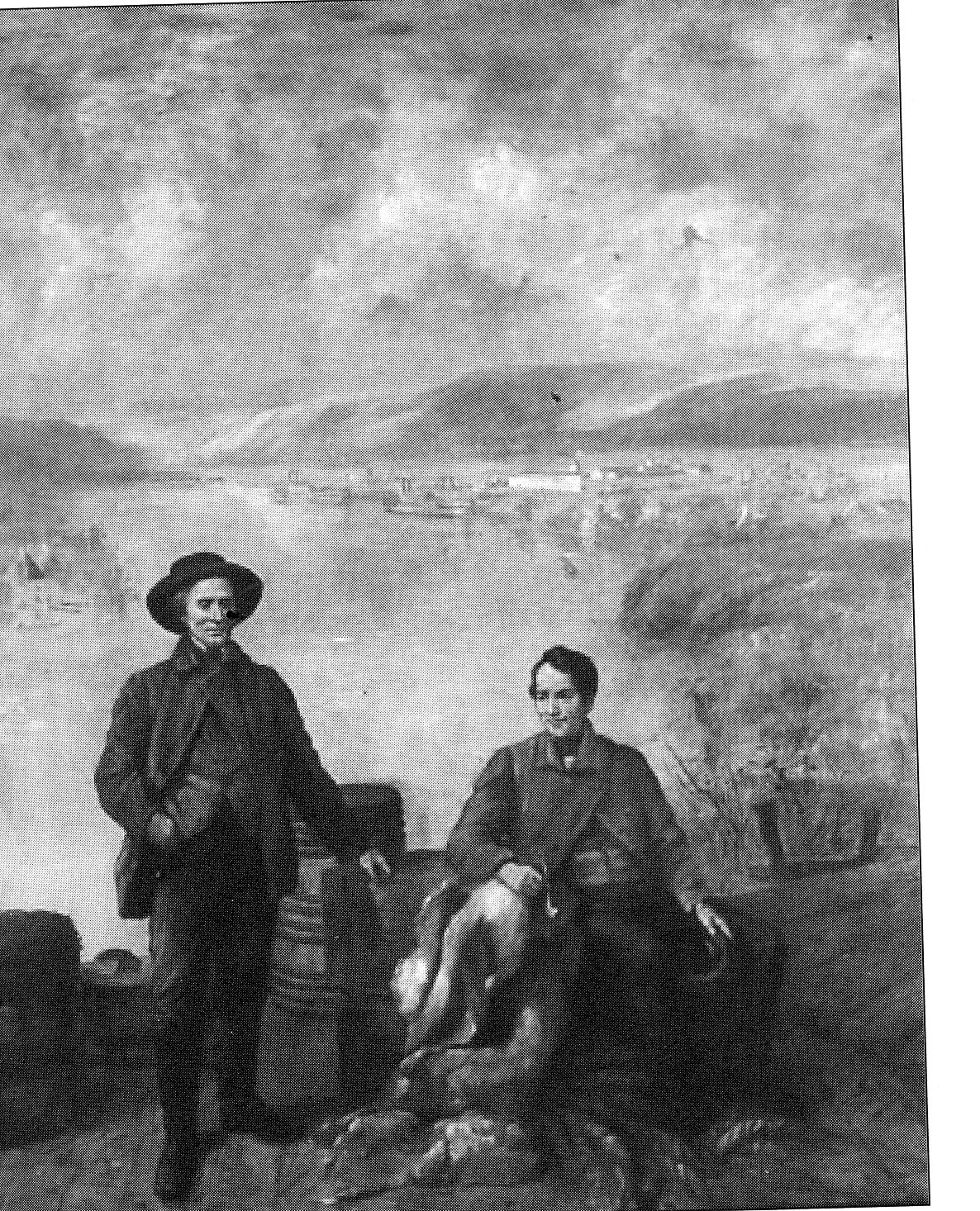
A fantasy vignette of Dawson (R) and Chouteau in front of Ft. Benton.

But there was an earlier episode, worthy of Game of Thrones.  In 1835 Alexander Harvey, another frontier hothead, had been frustrated by Culbertson's insistence on negotiating with the Crow at the siege of Fort McKenzie instead of using violence.  Harvey and Culbertson were barely restrained from violence between them by Pierre Chouteau, Jr. the company owner.  When Culbertson was away from Fort McKenzie, Chardon -- yet another drunk and hothead -- was sent to take over.  In January 1844 twenty Blood warriors came to the fort but were not admitted.  They were angry, killed livestock and then left, but Chardon and Harvey chased them.  The warriors set their trap first: Chardon's slave, Reese, was sent to reconnoiter from a hill.  He was shot in the head and died instantly, then was scalped, much grieving Chardon.  

Chardon and Harvey's trap was to aim their loaded cannon at the front gate, where the tribe customarily would gather while the chiefs came inside to negotiate.  Not only would they kill the chiefs once they were inside, but also they would fire the cannon through the open gate to kill as many as they could.  Then they could take all the furs as well as keeping the trade goods.

Soon enough a Northern Blackfeet party (who had no relationship with the previous attack) arrived and the machinery began to work.  The plan suffered when the chiefs sussed the plot and tried to escape, which made the people scatter but not fast enough.  Women and children were killed along with others, and the traders did acquire a lot of buffalo hides.  But that was the end of trade with the Northern Blackfoot for a long time.  Dawson was big, fire-haired, but much more patient, and certainly fair-minded. In the end he coaxed them to return. 

This is Jerry Potts' family.
The Bundles on the tripod are Sacred Calumets and their accessories.

Dawson's Blackfeet wife was called Kuta, and their children were James and Grace.  He also had a "wood's colt" whom he nevertheless watched out for, and a second marriage after Kuta died, to Pipe Woman, daughter of Running Fisher, produced a third son, Thomas Erskine Dawson in 1859.   Because of friendship with the father of Jerry Potts, he had taken that boy under his wing.  Through his wife he had ties to Little Dog, the same as Clarke had ties to Mountain Chief.  Family had big consequences for everyone.


Jerry Potts became famous as an interpreter and negotiator.

The problem with steam boats was not so much the boats as the notorious Missouri River, which changed channels, floated whole trees, emplaced sand banks and then removed them overnight, was deep and then shallow.  To make the steam, the boat had a heart of fire that sometimes escaped control.  Like the later railroad, the steamship companies saw the advertising advantage of subsidizing artists, scientists and noblemen.  Among them was Audubon, so Dawson got to meet his hero.

Most of these Scotsmen who came to work for the American Fur Company or had intersected with them in some way back in Scotland, formed a friendship network that was sometimes strained by violent temperaments that triggered outbursts from the indigenous people.  Many of the men had indigenous wives, whom Andrew claimed they loved and supported, as well as each other's children.  Indeed, Andrew himself had lost his father when he was eight and had been protected and guided by a friend of the family.  In the tribal world, uncles also took responsibility for children and widows.

There were times when Andrew was facing atrocities as ferocious as any in today's Africa -- mutilation, dismemberment, cannibalism.  He settles the dog-eating question once and for all:  everyone ate them and they were objectively tasty and tender.  Esp. if you didn't know what they were.


Andrew Dawson, back in Scotland for his last years.

This is a very careful work of scholarship on both the main narrative and the edited letters.  But it is also a roaring and amazing tale that only happened a century or so ago.  It is still just under the surface all the time around here.

NOTE:  I am not so careful as the authors and tend to conflate Culbertson and Dawson.  With Lesley Wischmann's help, I've made corrections after the first version.